PRIMITIVE REFLEXES
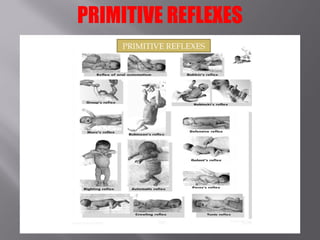
PRIMITIVE REFLEXES
 Dominant form of movement for last 4 months
prenatally and first 4 months postnatally.
 Primitive reflexes critical for human survival.
 Postural reflexes believed to be foundation for
later voluntary movements.
 Appearance and disappearance helpful in
diagnosing neurological disorders.
Introduction of Reflex
 A reflex is an involuntary muscular response to
a sensory stimulus.
 The presence and strength of a reflex is an
important indication of neurological
development and function.
 Many of the infantile reflexes disappear as the
infant matures, though some remain
throughout adulthood.
The Theory Behind Integration
 As the CNS develops, reflexes are either
integrated or transformed. If this does not
occur, these reflexes will interfere with
subsequent development and may be an
indication of neurological damage.
 About 70 primitive reflexes have been
discovered.
 These are many different reflexes that can be
integrated and the reflexes that need to be
integrated will be dependent on the individual
child.
Reflexive movements occur during the last 4
months of prenatal life and the first 4 months
after birth
 Reflexes occur sub cortically (below the
level of the higher brain centers)
 E.g., palmer grasp
Many of the reflexes do not completely
disappear
 First, they are inhibited by the
maturing nervous system
 Second, they are integrated into new
movement behaviors
Classification of Reflexes
 According to their function
 Some reflexes are protective and have a
survival value i.e. reflex saving life.
 Other promote appropriate orientation
for feeding i.e. rooting reflex.
 Other promote postural control and
balance.
According to level of CNS mature
 Spinal level reflexes
 Brain stem level reflexes
 Mid brain level reflexes
 Automatic movement reactions
 Cortical level reflexes
Spinal level reflexes
 1- flexor withdrawal reflex
 2- extensor thrust
 3- crossed extension
 They are mediated by areas of the CNS Deiters
nucleus which is the lower 1/3 of pons.
 They are ‘’phasic’’ or ‘’movement ‘’reflexes
which coordinate muscles of extremities in
patterns of either total flexion or extension.
 Complete domination of these primitive spinal
reflexes results in an apedal (prone-supine
lying) creature.
Brain stem level reflexes
 1- ATNR
 2- STNR
 3- Tonic labyrinthine reaction
 4- positive supporting reaction
 5- negative supporting reaction
 They are mediated by areas from the Deiters
nucleus to the red nucleus which is at the most
caudal level of basal ganglia.
 They are static postural reflexes.
Mid brain level reflexes or Righting
reactions
 1- Neck righting
 2- Body righting
 3- Labyrinthine righting acting on head (different
position)
 4- Optical righting (different position)
 They are integrated at the midbrain level above the red
nucleus, not including cortex.
 They interact with each other and work toward
establishment of normal head and body relationship in
space as well as in relation to each other.
 Their combined actions enable the child to roll over, sit
up, get on hands and knees, and make him a
qudripedal creator.
Automatic movement reactions
 1- Moro reflex
 2- Landau reflex
 3- Parachute reaction ‘’protective extensor
thrust’’
 They are group of reflex observed in infants
and young children which are not strictly
righting reflexes, but reaction produced by
changes in position of head, including
semicircular canal, labyrinths or neck
proprioceptor.
Cortical level reflexes or equilibrium
reactions
 They are highely integrated and complex mechanism
which are automatic response to changes in posture
and movements aimed to- restore balance.
 It can be done in various positions:
 -supine
 -prone
 -quadruped
 -sitting
 -kneeling
 -standing
 -squatting
According to their time of appearance
 Primitive reflexes which are present at
birth and then fade on (disappear).
 Postural reflexes which play an
important role in regulating tone.
PRIMITIVE REFLEXES
 ATNR
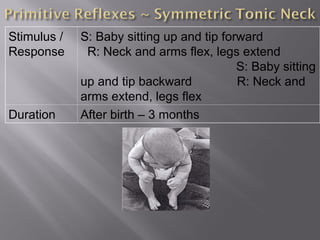
 STNR
 Moro reflex
 Tonic Labyrinthine reaction
 Galant reaction
 Palmar grasp
 Planter grasp
 Sucking reflex
 Rooting reflex
 Swallowing reflex
 Search, startle reflexes
 Babinski reflex
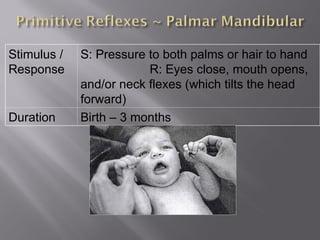
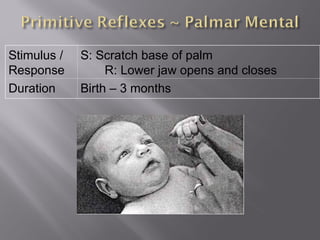
 Palmar Mandibular and palmar Mental
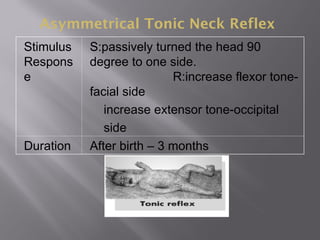
Asymmetrical Tonic Neck Reflex
Stimulus
Respons
e
S:passively turned the head 90
degree to one side.
R:increase flexor tone-
facial side
increase extensor tone-occipital
side
Duration After birth – 3 months
Stimulus /
Response
S: Baby sitting up and tip forward
R: Neck and arms flex, legs extend
S: Baby sitting
up and tip backward R: Neck and
arms extend, legs flex
Duration After birth – 3 months
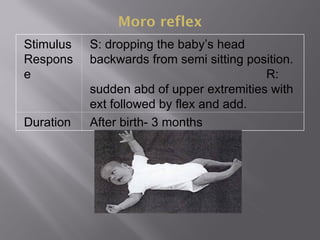
Moro reflex
Stimulus
Respons
e
S: dropping the baby’s head
backwards from semi sitting position.
R:
sudden abd of upper extremities with
ext followed by flex and add.
Duration After birth- 3 months
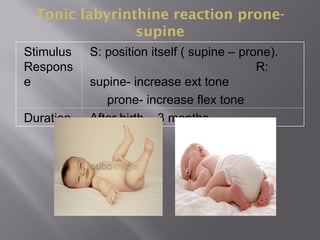
Tonic labyrinthine reaction prone-
supine
Stimulus
Respons
e
S: position itself ( supine – prone).
R:
supine- increase ext tone
prone- increase flex tone
Duration After birth – 3 months.
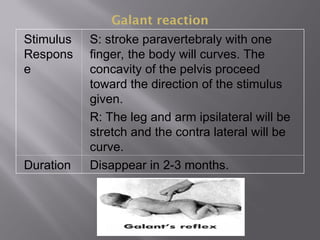
Galant reaction
Stimulus
Respons
e
S: stroke paravertebraly with one
finger, the body will curves. The
concavity of the pelvis proceed
toward the direction of the stimulus
given.
R: The leg and arm ipsilateral will be
stretch and the contra lateral will be
curve.
Duration Disappear in 2-3 months.
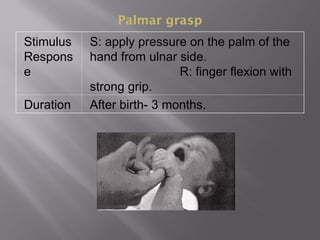
Palmar grasp
Stimulus
Respons
e
S: apply pressure on the palm of the
hand from ulnar side.
R: finger flexion with
strong grip.
Duration After birth- 3 months.
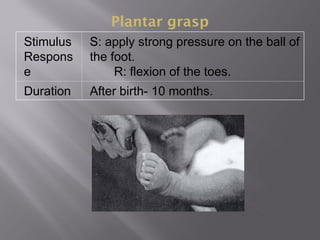
Plantar grasp
Stimulus
Respons
e
S: apply strong pressure on the ball of
the foot.
R: flexion of the toes.
Duration After birth- 10 months.
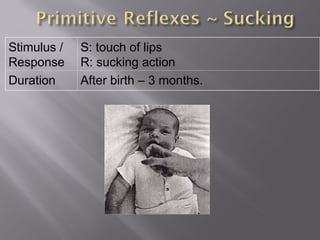
Stimulus /
Response
S: touch of lips
R: sucking action
Duration After birth – 3 months.
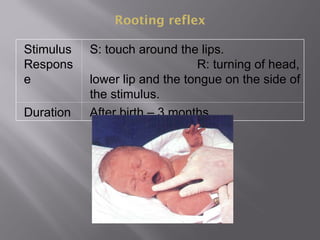
Rooting reflex
Stimulus
Respons
e
S: touch around the lips.
R: turning of head,
lower lip and the tongue on the side of
the stimulus.
Duration After birth – 3 months.
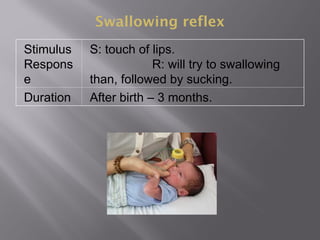
Swallowing reflex
Stimulus
Respons
e
S: touch of lips.
R: will try to swallowing
than, followed by sucking.
Duration After birth – 3 months.
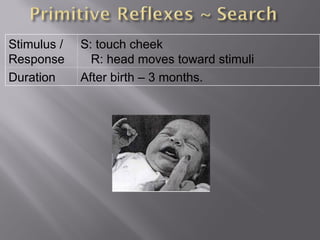
Stimulus /
Response
S: touch cheek
R: head moves toward stimuli
Duration After birth – 3 months.
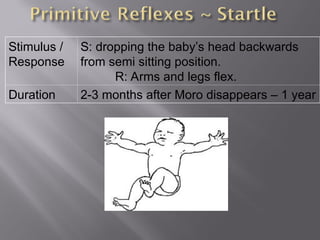
Stimulus /
Response
S: dropping the baby’s head backwards
from semi sitting position.
R: Arms and legs flex.
Duration 2-3 months after Moro disappears – 1 year
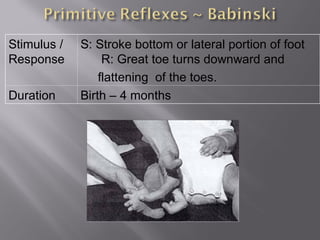
Stimulus /
Response
S: Stroke bottom or lateral portion of foot
R: Great toe turns downward and
flattening of the toes.
Duration Birth – 4 months
Stimulus /
Response
S: Pressure to both palms or hair to hand
R: Eyes close, mouth opens,
and/or neck flexes (which tilts the head
forward)
Duration Birth – 3 months
Stimulus /
Response
S: Scratch base of palm
R: Lower jaw opens and closes
Duration Birth – 3 months
POSTURAL REFLEXES
 Head and Body Righting reactions
 Optical righting reactions( different position)
 Labyrinthine righting acting on head (different position)
 Flexor withdrawal reflex
 Crossed extension
 Extensor thrust
 Positive supporting reaction
 Negative supporting reaction
 Landau reflex
 Parachute reaction
 Equilibrium reactions (different position)
 crawling, swimming reactions
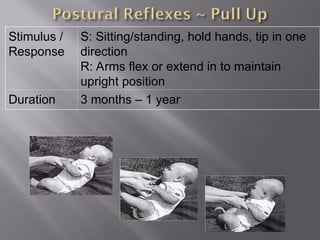
 Pull Up
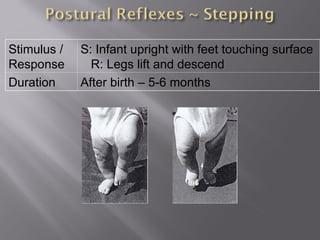
 stepping
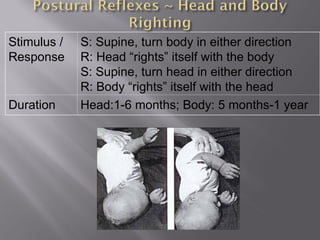
Stimulus /
Response
S: Supine, turn body in either direction
R: Head “rights” itself with the body
S: Supine, turn head in either direction
R: Body “rights” itself with the head
Duration Head:1-6 months; Body: 5 months-1 year
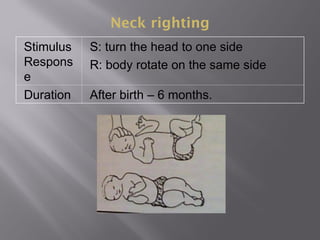
Neck righting
Stimulus
Respons
e
S: turn the head to one side
R: body rotate on the same side
Duration After birth – 6 months.
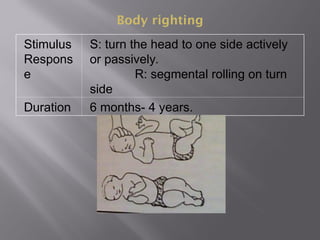
Body righting
Stimulus
Respons
e
S: turn the head to one side actively
or passively.
R: segmental rolling on turn
side
Duration 6 months- 4 years.
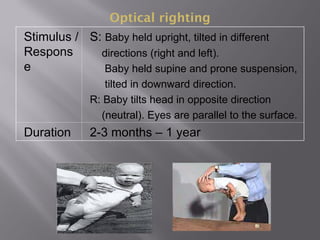
Optical righting
Stimulus /
Respons
e
S: Baby held upright, tilted in different
directions (right and left).
Baby held supine and prone suspension,
tilted in downward direction.
R: Baby tilts head in opposite direction
(neutral). Eyes are parallel to the surface.
Duration 2-3 months – 1 year
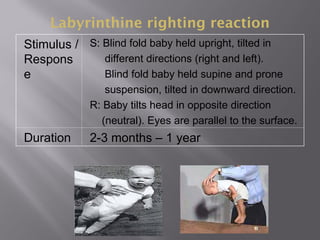
Labyrinthine righting reaction
Stimulus /
Respons
e
S: Blind fold baby held upright, tilted in
different directions (right and left).
Blind fold baby held supine and prone
suspension, tilted in downward direction.
R: Baby tilts head in opposite direction
(neutral). Eyes are parallel to the surface.
Duration 2-3 months – 1 year
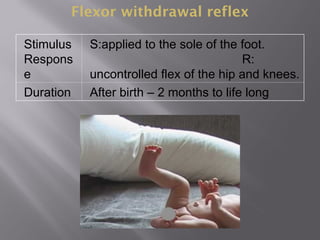
Flexor withdrawal reflex
Stimulus
Respons
e
S:applied to the sole of the foot.
R:
uncontrolled flex of the hip and knees.
Duration After birth – 2 months to life long
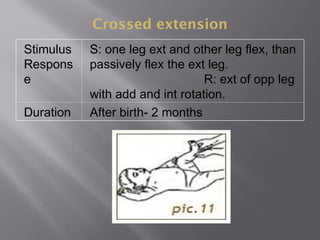
Crossed extension
Stimulus
Respons
e
S: one leg ext and other leg flex, than
passively flex the ext leg.
R: ext of opp leg
with add and int rotation.
Duration After birth- 2 months
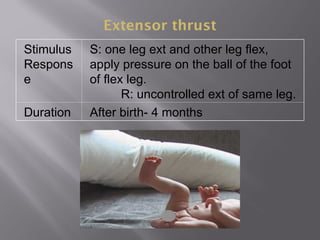
Extensor thrust
Stimulus
Respons
e
S: one leg ext and other leg flex,
apply pressure on the ball of the foot
of flex leg.
R: uncontrolled ext of same leg.
Duration After birth- 4 months
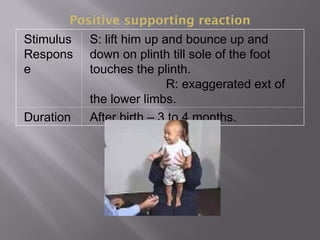
Positive supporting reaction
Stimulus
Respons
e
S: lift him up and bounce up and
down on plinth till sole of the foot
touches the plinth.
R: exaggerated ext of
the lower limbs.
Duration After birth – 3 to 4 months.
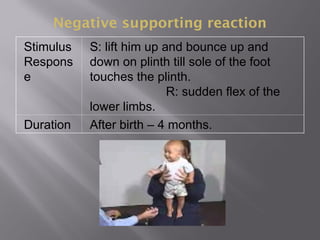
Negative supporting reaction
Stimulus
Respons
e
S: lift him up and bounce up and
down on plinth till sole of the foot
touches the plinth.
R: sudden flex of the
lower limbs.
Duration After birth – 4 months.
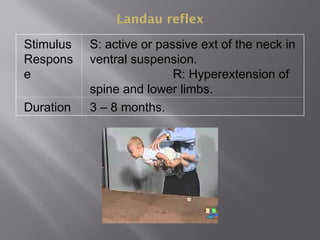
Landau reflex
Stimulus
Respons
e
S: active or passive ext of the neck in
ventral suspension.
R: Hyperextension of
spine and lower limbs.
Duration 3 – 8 months.
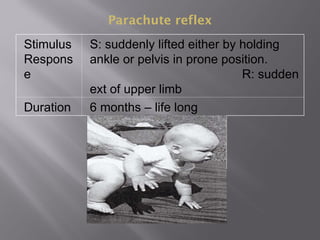
Parachute reflex
Stimulus
Respons
e
S: suddenly lifted either by holding
ankle or pelvis in prone position.
R: sudden
ext of upper limb
Duration 6 months – life long
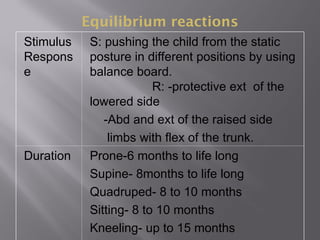
Equilibrium reactions
Stimulus
Respons
e
S: pushing the child from the static
posture in different positions by using
balance board.
R: -protective ext of the
lowered side
-Abd and ext of the raised side
limbs with flex of the trunk.
Duration Prone-6 months to life long
Supine- 8months to life long
Quadruped- 8 to 10 months
Sitting- 8 to 10 months
Kneeling- up to 15 months
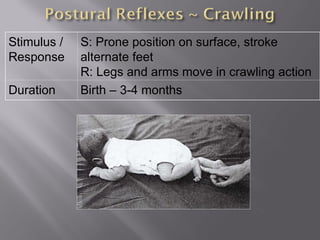
Stimulus /
Response
S: Prone position on surface, stroke
alternate feet
R: Legs and arms move in crawling action
Duration Birth – 3-4 months
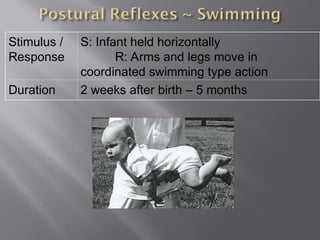
Stimulus /
Response
S: Infant held horizontally
R: Arms and legs move in
coordinated swimming type action
Duration 2 weeks after birth – 5 months
Stimulus /
Response
S: Sitting/standing, hold hands, tip in one
direction
R: Arms flex or extend in to maintain
upright position
Duration 3 months – 1 year
Stimulus /
Response
S: Infant upright with feet touching surface
R: Legs lift and descend
Duration After birth – 5-6 months
References
 1- Sussan B O’sullevan
 2- Anne Shumway cook
 3- Suzzan K Campbell
 4- Glady Samuel Raj
PRI REFLEXES TIPS AND TRICKS DEVELOPMENTAL.ppt

PRI REFLEXES TIPS AND TRICKS DEVELOPMENTAL.ppt

  • 1.
  • 2.
     Dominant formof movement for last 4 months prenatally and first 4 months postnatally.  Primitive reflexes critical for human survival.  Postural reflexes believed to be foundation for later voluntary movements.  Appearance and disappearance helpful in diagnosing neurological disorders.
  • 3.
    Introduction of Reflex A reflex is an involuntary muscular response to a sensory stimulus.  The presence and strength of a reflex is an important indication of neurological development and function.  Many of the infantile reflexes disappear as the infant matures, though some remain throughout adulthood.
  • 4.
    The Theory BehindIntegration  As the CNS develops, reflexes are either integrated or transformed. If this does not occur, these reflexes will interfere with subsequent development and may be an indication of neurological damage.  About 70 primitive reflexes have been discovered.  These are many different reflexes that can be integrated and the reflexes that need to be integrated will be dependent on the individual child.
  • 5.
    Reflexive movements occurduring the last 4 months of prenatal life and the first 4 months after birth  Reflexes occur sub cortically (below the level of the higher brain centers)  E.g., palmer grasp
  • 6.
    Many of thereflexes do not completely disappear  First, they are inhibited by the maturing nervous system  Second, they are integrated into new movement behaviors
  • 7.
    Classification of Reflexes According to their function  Some reflexes are protective and have a survival value i.e. reflex saving life.  Other promote appropriate orientation for feeding i.e. rooting reflex.  Other promote postural control and balance.
  • 8.
    According to levelof CNS mature  Spinal level reflexes  Brain stem level reflexes  Mid brain level reflexes  Automatic movement reactions  Cortical level reflexes
  • 9.
    Spinal level reflexes 1- flexor withdrawal reflex  2- extensor thrust  3- crossed extension  They are mediated by areas of the CNS Deiters nucleus which is the lower 1/3 of pons.  They are ‘’phasic’’ or ‘’movement ‘’reflexes which coordinate muscles of extremities in patterns of either total flexion or extension.  Complete domination of these primitive spinal reflexes results in an apedal (prone-supine lying) creature.
  • 10.
    Brain stem levelreflexes  1- ATNR  2- STNR  3- Tonic labyrinthine reaction  4- positive supporting reaction  5- negative supporting reaction  They are mediated by areas from the Deiters nucleus to the red nucleus which is at the most caudal level of basal ganglia.  They are static postural reflexes.
  • 11.
    Mid brain levelreflexes or Righting reactions  1- Neck righting  2- Body righting  3- Labyrinthine righting acting on head (different position)  4- Optical righting (different position)  They are integrated at the midbrain level above the red nucleus, not including cortex.  They interact with each other and work toward establishment of normal head and body relationship in space as well as in relation to each other.  Their combined actions enable the child to roll over, sit up, get on hands and knees, and make him a qudripedal creator.
  • 12.
    Automatic movement reactions 1- Moro reflex  2- Landau reflex  3- Parachute reaction ‘’protective extensor thrust’’  They are group of reflex observed in infants and young children which are not strictly righting reflexes, but reaction produced by changes in position of head, including semicircular canal, labyrinths or neck proprioceptor.
  • 13.
    Cortical level reflexesor equilibrium reactions  They are highely integrated and complex mechanism which are automatic response to changes in posture and movements aimed to- restore balance.  It can be done in various positions:  -supine  -prone  -quadruped  -sitting  -kneeling  -standing  -squatting
  • 14.
    According to theirtime of appearance  Primitive reflexes which are present at birth and then fade on (disappear).  Postural reflexes which play an important role in regulating tone.
  • 15.
    PRIMITIVE REFLEXES  ATNR STNR  Moro reflex  Tonic Labyrinthine reaction  Galant reaction  Palmar grasp  Planter grasp  Sucking reflex  Rooting reflex  Swallowing reflex  Search, startle reflexes  Babinski reflex  Palmar Mandibular and palmar Mental
  • 16.
    Asymmetrical Tonic NeckReflex Stimulus Respons e S:passively turned the head 90 degree to one side. R:increase flexor tone- facial side increase extensor tone-occipital side Duration After birth – 3 months
  • 17.
    Stimulus / Response S: Babysitting up and tip forward R: Neck and arms flex, legs extend S: Baby sitting up and tip backward R: Neck and arms extend, legs flex Duration After birth – 3 months
  • 18.
    Moro reflex Stimulus Respons e S: droppingthe baby’s head backwards from semi sitting position. R: sudden abd of upper extremities with ext followed by flex and add. Duration After birth- 3 months
  • 19.
    Tonic labyrinthine reactionprone- supine Stimulus Respons e S: position itself ( supine – prone). R: supine- increase ext tone prone- increase flex tone Duration After birth – 3 months.
  • 20.
    Galant reaction Stimulus Respons e S: strokeparavertebraly with one finger, the body will curves. The concavity of the pelvis proceed toward the direction of the stimulus given. R: The leg and arm ipsilateral will be stretch and the contra lateral will be curve. Duration Disappear in 2-3 months.
  • 21.
    Palmar grasp Stimulus Respons e S: applypressure on the palm of the hand from ulnar side. R: finger flexion with strong grip. Duration After birth- 3 months.
  • 22.
    Plantar grasp Stimulus Respons e S: applystrong pressure on the ball of the foot. R: flexion of the toes. Duration After birth- 10 months.
  • 23.
    Stimulus / Response S: touchof lips R: sucking action Duration After birth – 3 months.
  • 24.
    Rooting reflex Stimulus Respons e S: toucharound the lips. R: turning of head, lower lip and the tongue on the side of the stimulus. Duration After birth – 3 months.
  • 25.
    Swallowing reflex Stimulus Respons e S: touchof lips. R: will try to swallowing than, followed by sucking. Duration After birth – 3 months.
  • 26.
    Stimulus / Response S: touchcheek R: head moves toward stimuli Duration After birth – 3 months.
  • 27.
    Stimulus / Response S: droppingthe baby’s head backwards from semi sitting position. R: Arms and legs flex. Duration 2-3 months after Moro disappears – 1 year
  • 28.
    Stimulus / Response S: Strokebottom or lateral portion of foot R: Great toe turns downward and flattening of the toes. Duration Birth – 4 months
  • 29.
    Stimulus / Response S: Pressureto both palms or hair to hand R: Eyes close, mouth opens, and/or neck flexes (which tilts the head forward) Duration Birth – 3 months
  • 30.
    Stimulus / Response S: Scratchbase of palm R: Lower jaw opens and closes Duration Birth – 3 months
  • 31.
    POSTURAL REFLEXES  Headand Body Righting reactions  Optical righting reactions( different position)  Labyrinthine righting acting on head (different position)  Flexor withdrawal reflex  Crossed extension  Extensor thrust  Positive supporting reaction  Negative supporting reaction  Landau reflex  Parachute reaction  Equilibrium reactions (different position)  crawling, swimming reactions  Pull Up  stepping
  • 32.
    Stimulus / Response S: Supine,turn body in either direction R: Head “rights” itself with the body S: Supine, turn head in either direction R: Body “rights” itself with the head Duration Head:1-6 months; Body: 5 months-1 year
  • 33.
    Neck righting Stimulus Respons e S: turnthe head to one side R: body rotate on the same side Duration After birth – 6 months.
  • 34.
    Body righting Stimulus Respons e S: turnthe head to one side actively or passively. R: segmental rolling on turn side Duration 6 months- 4 years.
  • 35.
    Optical righting Stimulus / Respons e S:Baby held upright, tilted in different directions (right and left). Baby held supine and prone suspension, tilted in downward direction. R: Baby tilts head in opposite direction (neutral). Eyes are parallel to the surface. Duration 2-3 months – 1 year
  • 36.
    Labyrinthine righting reaction Stimulus/ Respons e S: Blind fold baby held upright, tilted in different directions (right and left). Blind fold baby held supine and prone suspension, tilted in downward direction. R: Baby tilts head in opposite direction (neutral). Eyes are parallel to the surface. Duration 2-3 months – 1 year
  • 37.
    Flexor withdrawal reflex Stimulus Respons e S:appliedto the sole of the foot. R: uncontrolled flex of the hip and knees. Duration After birth – 2 months to life long
  • 38.
    Crossed extension Stimulus Respons e S: oneleg ext and other leg flex, than passively flex the ext leg. R: ext of opp leg with add and int rotation. Duration After birth- 2 months
  • 39.
    Extensor thrust Stimulus Respons e S: oneleg ext and other leg flex, apply pressure on the ball of the foot of flex leg. R: uncontrolled ext of same leg. Duration After birth- 4 months
  • 40.
    Positive supporting reaction Stimulus Respons e S:lift him up and bounce up and down on plinth till sole of the foot touches the plinth. R: exaggerated ext of the lower limbs. Duration After birth – 3 to 4 months.
  • 41.
    Negative supporting reaction Stimulus Respons e S:lift him up and bounce up and down on plinth till sole of the foot touches the plinth. R: sudden flex of the lower limbs. Duration After birth – 4 months.
  • 42.
    Landau reflex Stimulus Respons e S: activeor passive ext of the neck in ventral suspension. R: Hyperextension of spine and lower limbs. Duration 3 – 8 months.
  • 43.
    Parachute reflex Stimulus Respons e S: suddenlylifted either by holding ankle or pelvis in prone position. R: sudden ext of upper limb Duration 6 months – life long
  • 44.
    Equilibrium reactions Stimulus Respons e S: pushingthe child from the static posture in different positions by using balance board. R: -protective ext of the lowered side -Abd and ext of the raised side limbs with flex of the trunk. Duration Prone-6 months to life long Supine- 8months to life long Quadruped- 8 to 10 months Sitting- 8 to 10 months Kneeling- up to 15 months
  • 45.
    Stimulus / Response S: Proneposition on surface, stroke alternate feet R: Legs and arms move in crawling action Duration Birth – 3-4 months
  • 46.
    Stimulus / Response S: Infantheld horizontally R: Arms and legs move in coordinated swimming type action Duration 2 weeks after birth – 5 months
  • 47.
    Stimulus / Response S: Sitting/standing,hold hands, tip in one direction R: Arms flex or extend in to maintain upright position Duration 3 months – 1 year
  • 48.
    Stimulus / Response S: Infantupright with feet touching surface R: Legs lift and descend Duration After birth – 5-6 months
  • 49.
    References  1- SussanB O’sullevan  2- Anne Shumway cook  3- Suzzan K Campbell  4- Glady Samuel Raj