DEVELOPMENTALMILESTONES
 Development specifies maturation of functions.
 It is related to maturation and myelination of nervous
system and indicates acquisition of a variety of skills for
optimum functioning of the individual.
 Developmentalassessment includes early identification
of problems through screeningand surveillance.
• THE GOAL OF DEVELOPMENTAL ASSESSMENT IS
NOT ONLY TO GENERATE A DIAGNOSIS BUT ALSO
TO ANALYSE THE PATTERN OF STRENGTHS AND
WEAKNESS IN ORDER TO DIRECT TREATMENT.
PRINCIPLES OF DEVELOPMENT
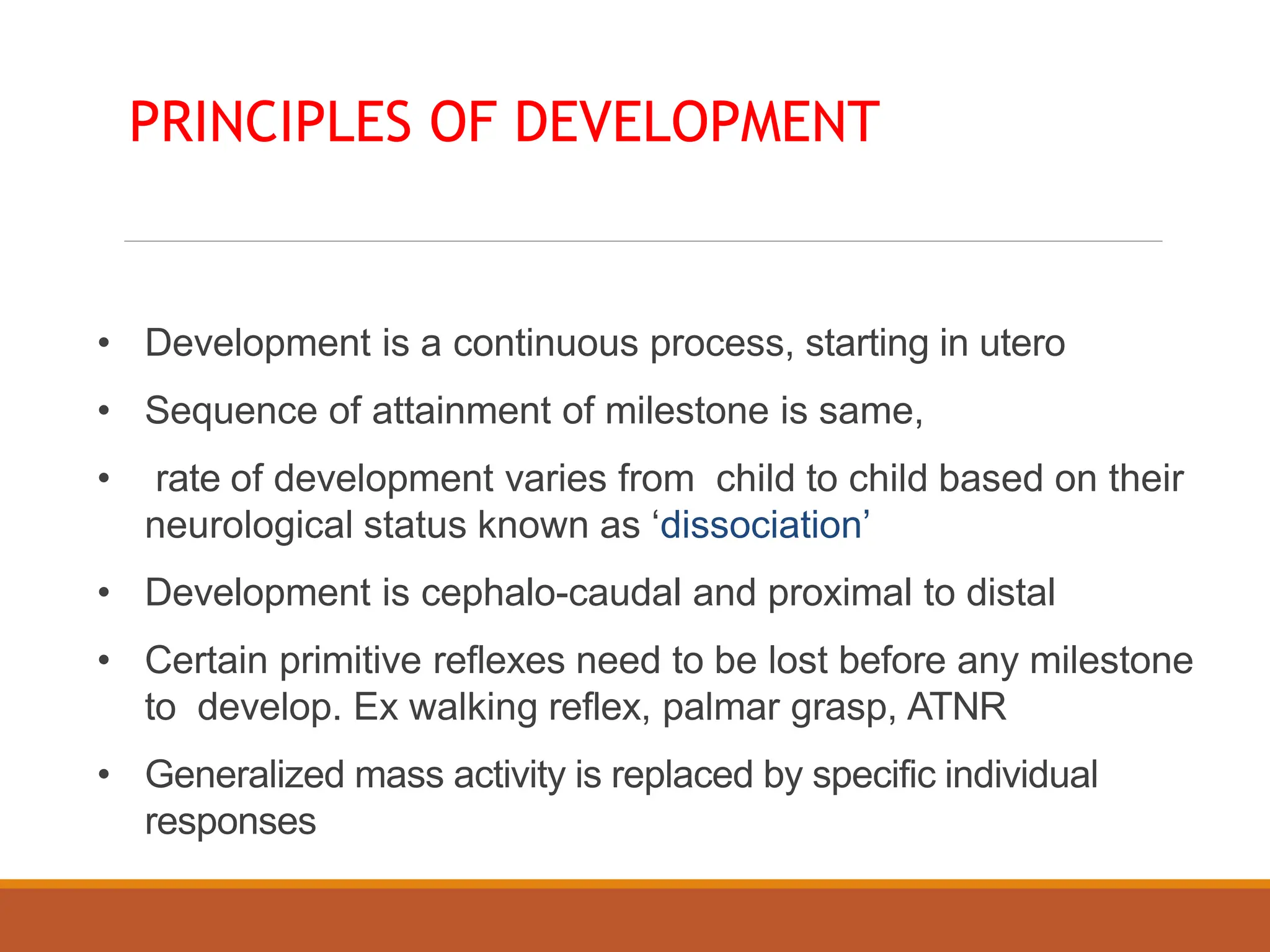
• Development is a continuous process, starting in utero
• Sequence of attainment of milestone is same,
• rate of development varies from child to child based on their
neurological status known as ‘dissociation’
• Development is cephalo-caudal and proximal to distal
• Certain primitive reflexes need to be lost before any milestone
to develop. Ex walking reflex, palmar grasp, ATNR
• Generalized mass activity is replaced by specific individual
responses
• Gross Motor - the development of locomotion
• Vision and fine manipulation – the development of
eye-hand control
• Hearing & speech - the development of language
• Personal & social - integration of acquired abilities to
reflect understanding of environment
4 fields of development
GROSS MOTOR : Involves control of child over his body.
Tested in :
1. Prone
2. Supine
3. Sitting
4. Standing
Gross Motor Milestones
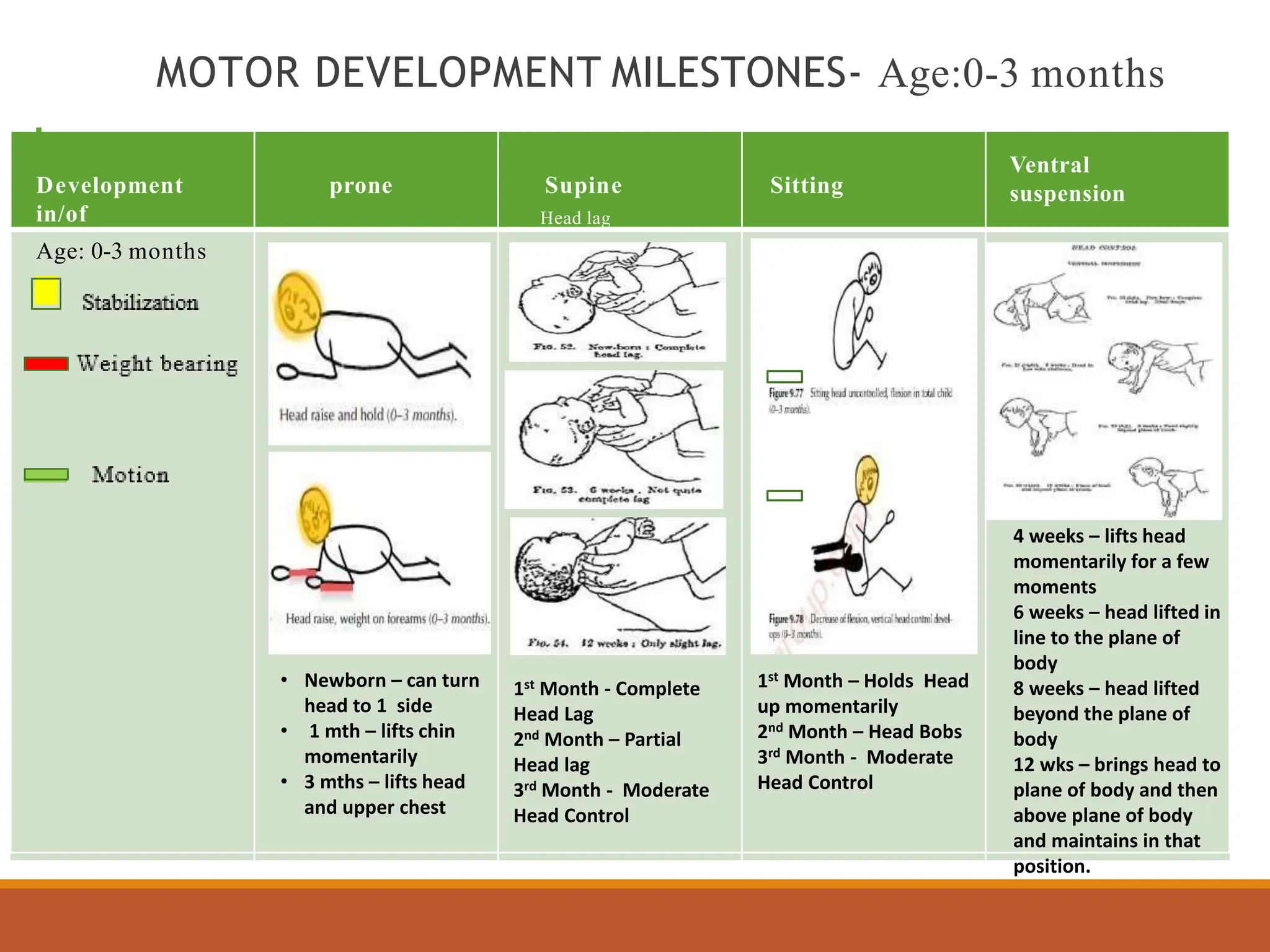
MOTOR DEVELOPMENT MILESTONES- Age:0-3 months
Ventral
suspension
Development prone Supine Sitting
in/of
Age: 0-3 months
4 weeks – lifts head
momentarily for a few
moments
6 weeks – head lifted in
line to the plane of
body
8 weeks – head lifted
beyond the plane of
body
12 wks – brings head to
plane of body and then
above plane of body
and maintains in that
position.
1st Month - Complete
Head Lag
2nd Month – Partial
Head lag
3rd Month - Moderate
Head Control
Head lag
• Newborn – can turn
head to 1 side
• 1 mth – lifts chin
momentarily
• 3 mths – lifts head
and upper chest
1st Month – Holds Head
up momentarily
2nd Month – Head Bobs
3rd Month - Moderate
Head Control
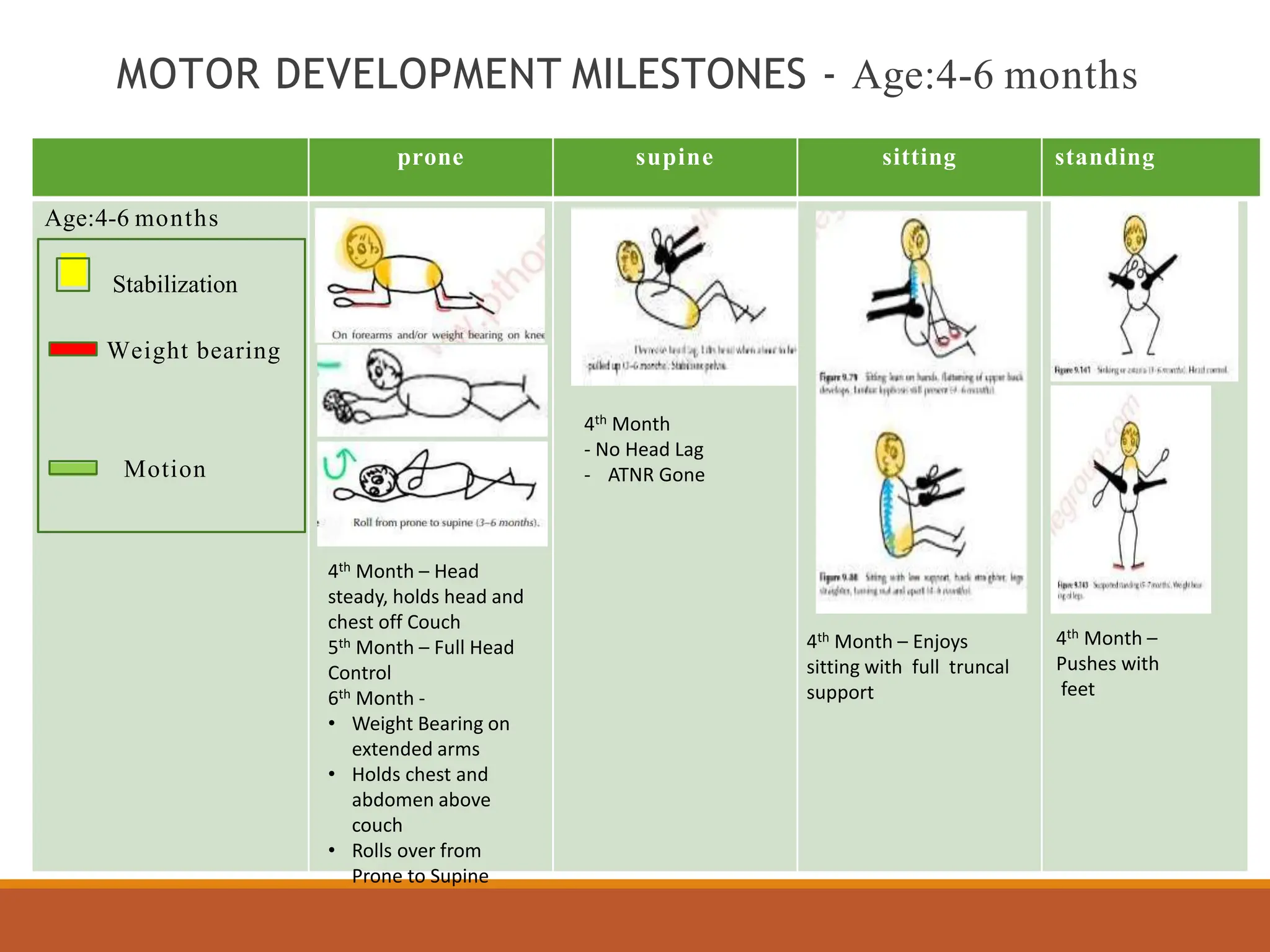
MOTOR DEVELOPMENT MILESTONES - Age:4-6 months
prone supine sitting standing
Age:4-6 months
Stabilization
Weight bearing
Motion
4th Month –
Pushes with
feet
4th Month – Enjoys
sitting with full truncal
support
4th Month
- No Head Lag
- ATNR Gone
4th Month – Head
steady, holds head and
chest off Couch
5th Month – Full Head
Control
6th Month -
• Weight Bearing on
extended arms
• Holds chest and
abdomen above
couch
• Rolls over from
Prone to Supine
Development
in/of
prone supine sitting standing
Age:6-9 months
MOTOR DEVELOPMENT MILESTONES - Age:7-9 months
7th Month – Weight
Bearing Present,
bounces actively
8th Months- Pulls self
to standing position
9th Month - Stands
holding on to furniture
10th month- Cruises
6th to 7th Month –
Grasps his feet and
tries to bring it to his
mouth
7th Month – Sits briefly with
support of pelvis, Weight bearing
on one hand
8th Months- Sits alone with back
straight
9th Month- Can Lean Forward
7th Month Rolls over
from Supine to Prone
Position, Weight
bearing on one hand
8th Month- Weight
bearing on hand and
knees
9th Month- Trying to
crawl
Development in/of prone supine sitting standing
Age:10-12 months
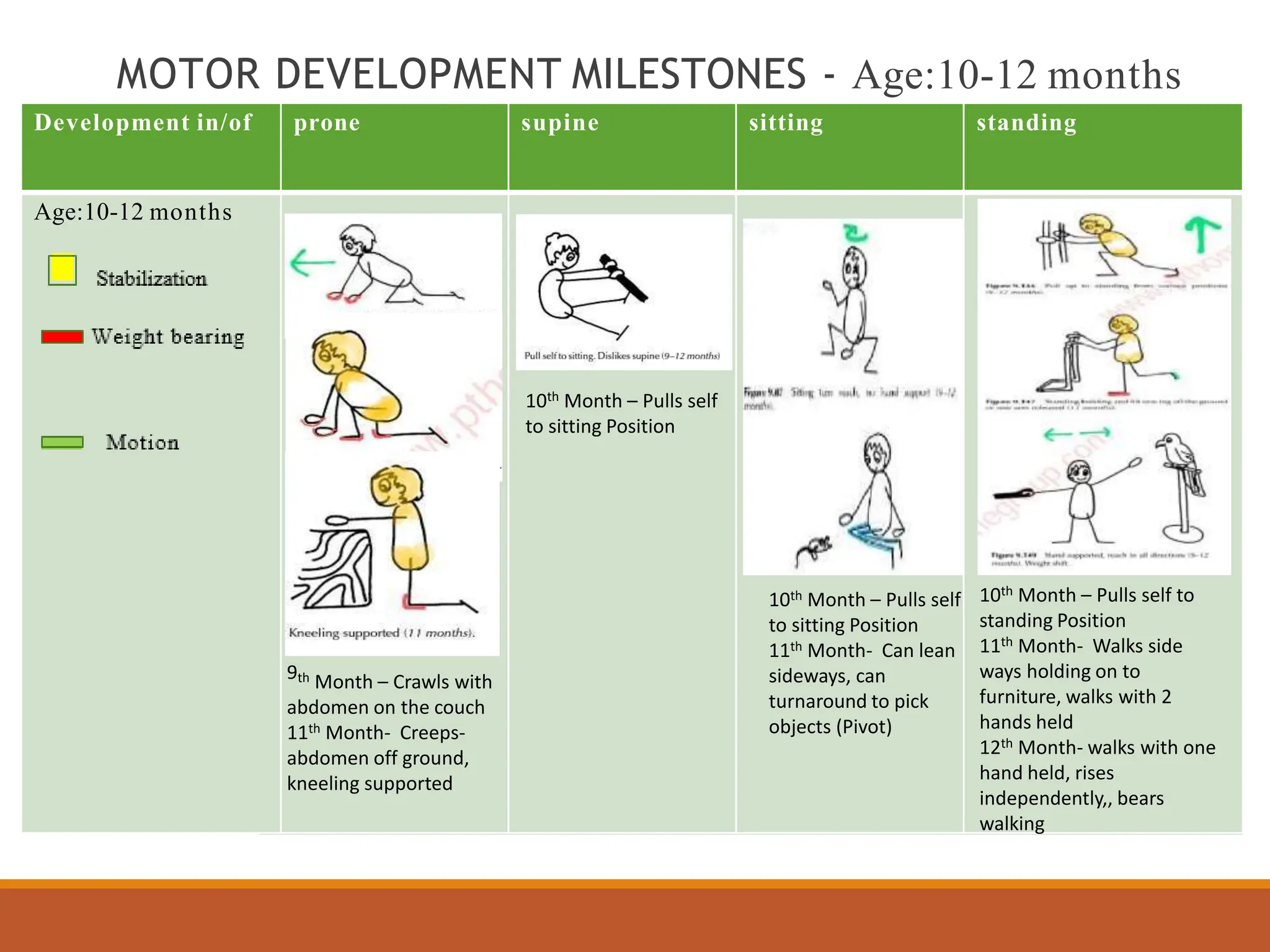
MOTOR DEVELOPMENT MILESTONES - Age:10-12 months
10th Month – Pulls self to
standing Position
11th Month- Walks side
ways holding on to
furniture, walks with 2
hands held
12th Month- walks with one
hand held, rises
independently,, bears
walking
10th Month – Pulls self
to sitting Position
11th Month- Can lean
sideways, can
turnaround to pick
objects (Pivot)
10th Month – Pulls self
to sitting Position
9th Month – Crawls with
abdomen on the couch
11th Month- Creeps-
abdomen off ground,
kneeling supported
Development in/of prone supine sitting standing
Age:12-18 mos
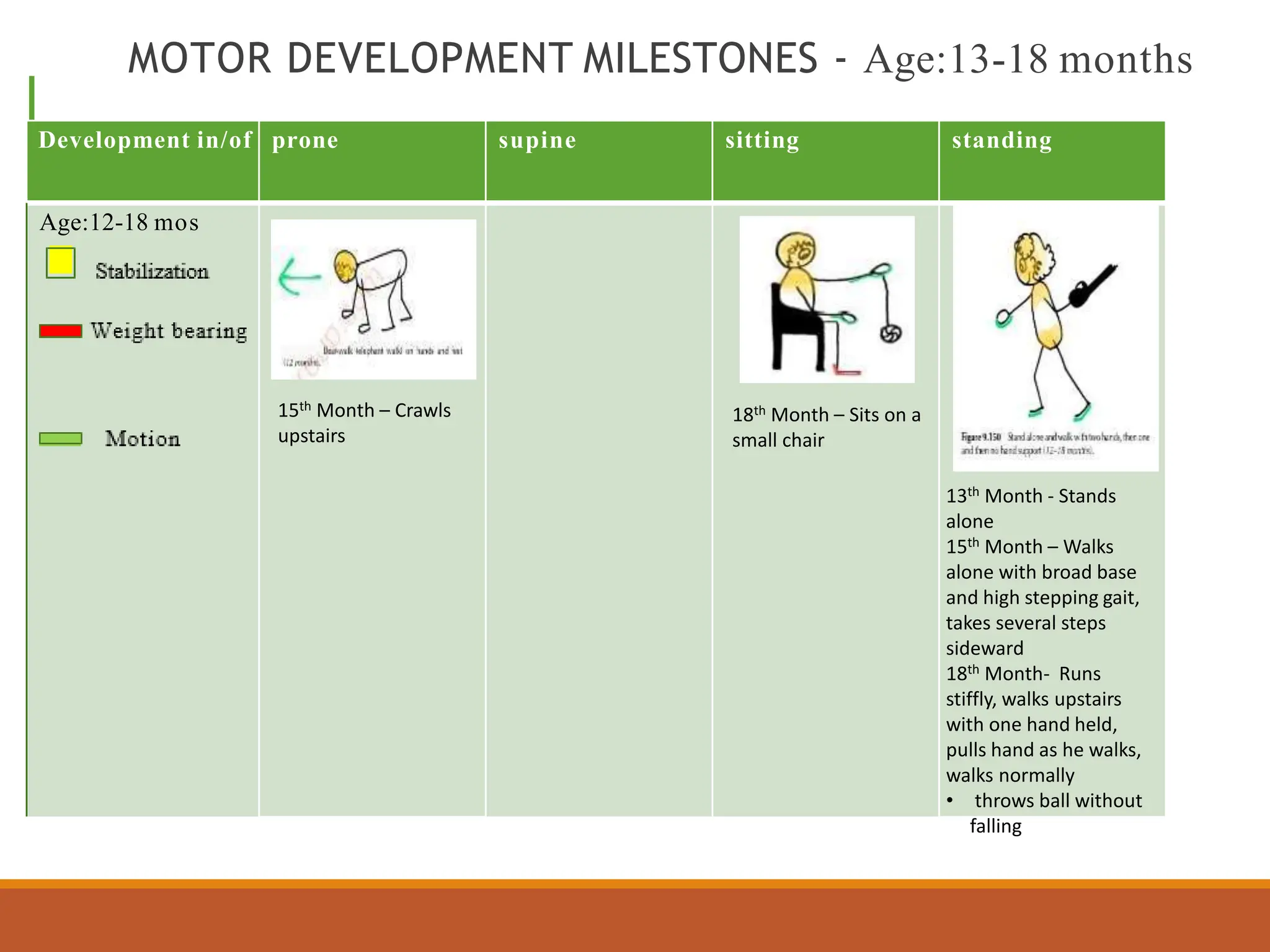
MOTOR DEVELOPMENT MILESTONES - Age:13-18 months
13th Month - Stands
alone
15th Month – Walks
alone with broad base
and high stepping gait,
takes several steps
sideward
18th Month- Runs
stiffly, walks upstairs
with one hand held,
pulls hand as he walks,
walks normally
• throws ball without
falling
15th Month – Crawls
upstairs
18th Month – Sits on a
small chair
18 months
• Walk forward 10 feet with narrow base of
support
• Walk backwards 5 steps
• Walk upstairs and downstairs with hand held
• Kick a ball forward 3 feet
• Throws ball while standing
• Seats self in small chair
• 20 months – squats , carries large object
• 22 months- kicks ball with demonstration
24 months/ 2 Yrs-
• Runs without loss of balance
• climb on furniture
• Walk backward & sideways
• Walks upstairs and down stairs, two feet
per step
• Kicks ball without demonstration
• Throws ball 3 feet away
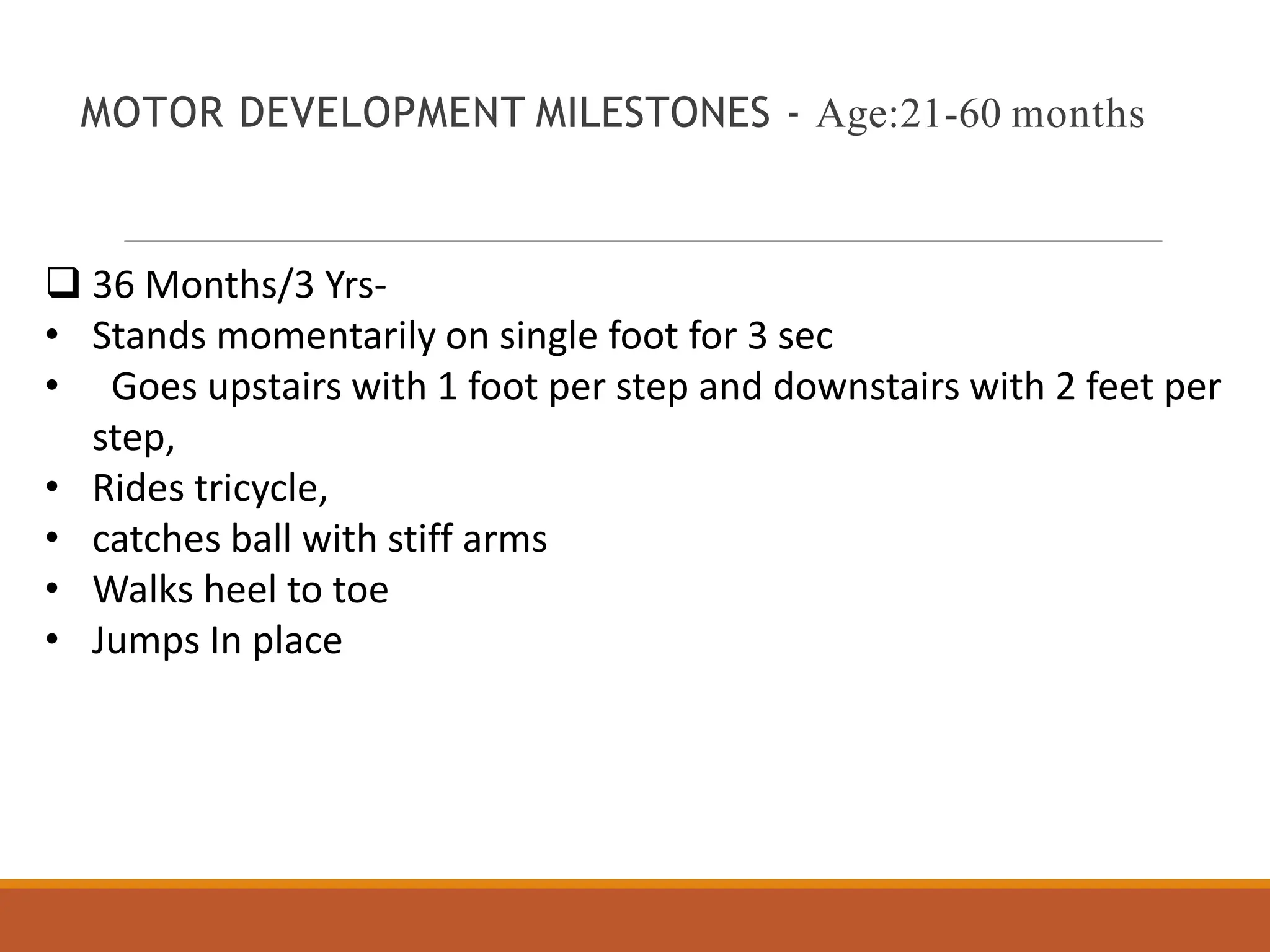
MOTOR DEVELOPMENT MILESTONES - Age:21-60 months
 36 Months/3 Yrs-
• Stands momentarily on single foot for 3 sec
• Goes upstairs with 1 foot per step and downstairs with 2 feet per
step,
• Rides tricycle,
• catches ball with stiff arms
• Walks heel to toe
• Jumps In place
48 Months/4 Yrs-
• Down stairs with 1 foot per step,
• hop on 1 feet,
• throw a ball overhand
• Catches bounced ball
• Standing jump
 5 years –
• skips
• jumps backward
 6 years
• Tandem walking
 7 years
 Bicycle
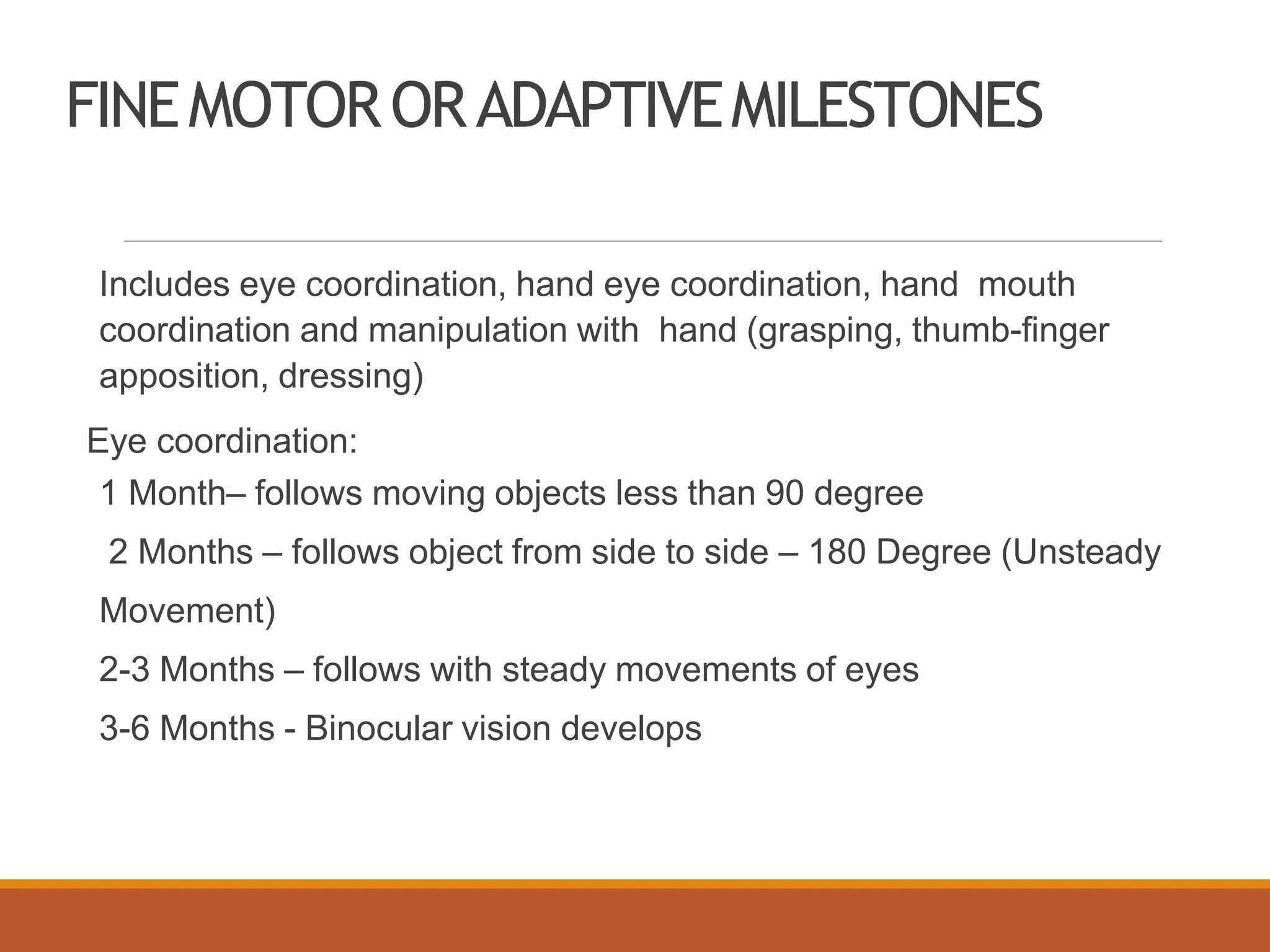
FINEMOTORORADAPTIVEMILESTONES
Includes eye coordination, hand eye coordination, hand mouth
coordination and manipulation with hand (grasping, thumb-finger
apposition, dressing)
Eye coordination:
1 Month– follows moving objects less than 90 degree
2 Months – follows object from side to side – 180 Degree (Unsteady
Movement)
2-3 Months – follows with steady movements of eyes
3-6 Months - Binocular vision develops
2 Months- Hand predominantly closed
3 Months – Hands open, grasps reflex gone, Reaches towards objects and
misses, Hand regard present
4 Months – Approaches objects but overshoots, Hand in midline and plays
with them
5 Months – reaches out & grasps object with ulnar side, no more hand
regard, bidexterous grasp
6 Months - transfers objects from hand to hand, unidextrous reach
8 month- radial grasp
9 Months – immature pincer grasp, attempts to pick fallen toys
10 mths – pincer grasp(between thumb and forefinger) – picks up pellet
12 Months - mature pincer grasp
12 months- casting – throwing deliberately on to floor one after another
FINEMOTORORADAPTIVEMILESTONES-
Hand eye coordination
Hand-mouth coordination:
4 months- mouthing starts
11 months – mouthing stops
12 Months– tries to feed with spoon but may spill
15 Months – feeds with spoon
18 Months – feeds self from cup
Hand skills: Book:
18 Months – turn 2-3 pages at a time
24 Months – turns 1 page at a time
FINEMOTORORADAPTIVEMILESTONES
Scribbling:
12-18 Months- scribbles
18 Months– copies vertical line
24 Months– copies horizontal line, HANDEDNESS is established
3 yrs – circle
4 yrs – cross, rectangle
5 yrs – triangle
6 yrs- hexagon
7yrs- kite
8yrs- doube cross
9 yrs- cylinder
11 yrs - cube
FINEMOTORORADAPTIVEMILESTONES
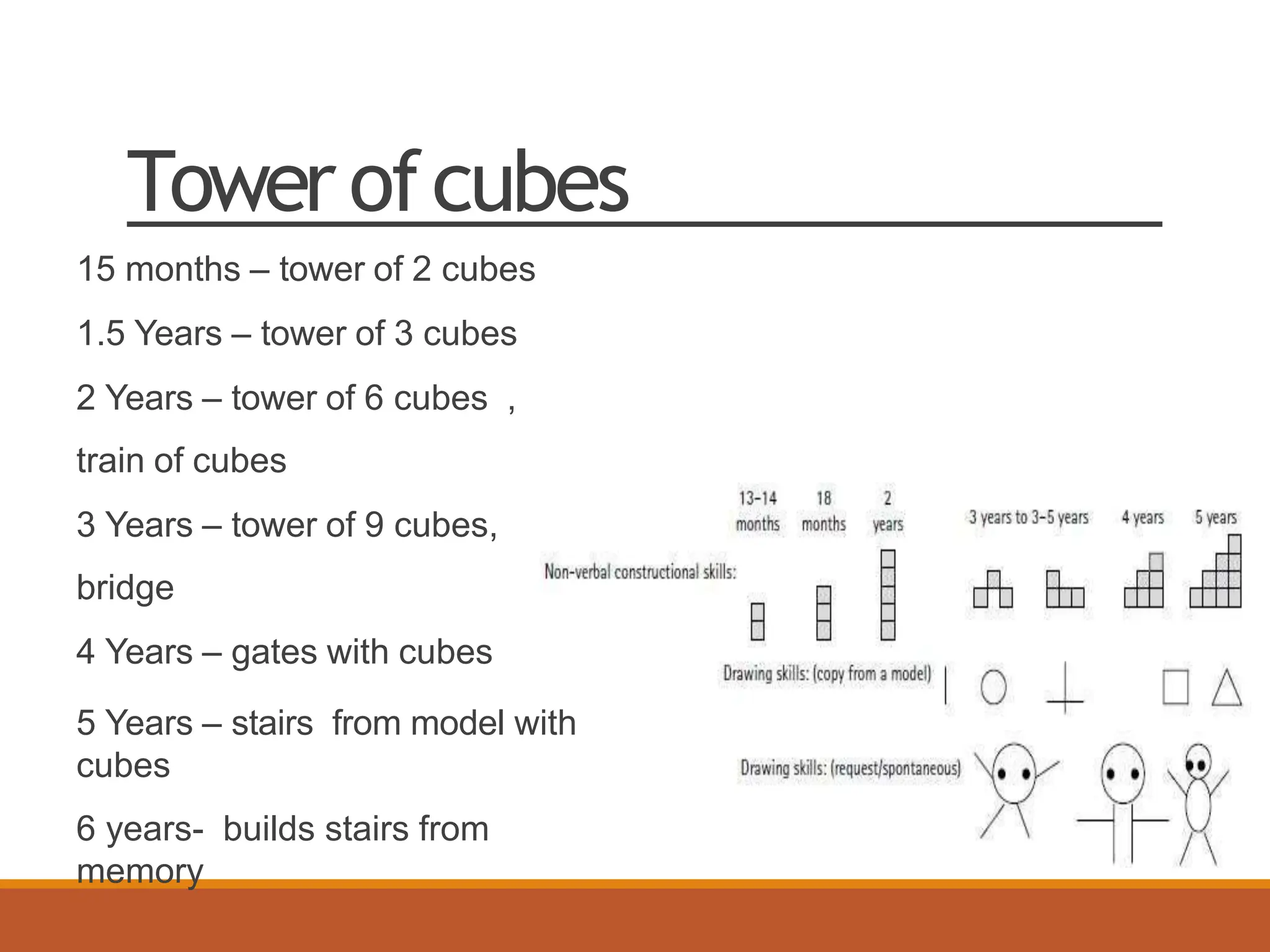
Towerofcubes
15 months – tower of 2 cubes
1.5 Years – tower of 3 cubes
2 Years – tower of 6 cubes ,
train of cubes
3 Years – tower of 9 cubes,
bridge
4 Years – gates with cubes
5 Years – stairs from model with
cubes
6 years- builds stairs from
memory
beads
• 2 yrs- large beads
• 3 yrs- strings small beads well
• 3 yrs- cuts paper with scissors – side to side
awkwardly
• 4 yrs- cuts circle
• 5 yrs- cuts properly
Socio Emotional Development
PERSONAL & SOCIAL DEVELOPMENT
1m Face regard-looks intently at mother
2 mth - social smile
3 mths - recognises mother/caretaker
4 mths – laughs loud
6 mths - enjoys mirror
6-9 months stranger anxiety (disappears by 1 year)
7 months – separation anxiety
8 months – object permanence - the understanding that objects continue to exist
even when they cannot be sensed
9 mths - waves bye-bye, pulls mother to attract her
12m Comes when name is called, understands phrases, plays simple ball
game
18 mths – complaints when wet or soiled
2yrs Asks for food, pulls people to show toys.
3 years – helps in dressing
5 years – dresses and undresses
BOWEL&BLADDERCONTROL
• 1.5-2yrs Start toilet training
• 1.5 yrs Bowel control is achieved
• 1.5-2 yrs Dry by day
• 2 yrs 50 % dry by night
• 3 yrs 75 % dry by night
• 5 yrs 90 % dry by night
language
• 1m Turns head to sound
• 2m Vocalizes
• 3m Cooing and babbling
• 4m Laughs aloud
• 6m Monosyllables
• 9m Bi syllables
• 12m Speaks 1st true word, repetition, knows 2 words with meaning
• 15-18m Jargon speech
• 18m Knows 10 words with meaning
• 2yrs Uses pronouns, points 1 part of body, speaks simple sentence
with 3 words.
• 3yrs Knows name and sex, shares toys, asks questions
• 4yrs Tells a story, plays co-operatively in a group, goes to toilet
alone
• 5yrs Names 5 colors, helps in household tasks
Play Milestones
• 10m Plays peek-a-boo
• 1yr Egocentric pretend play, solitary
• 2yr Parallel play
• 4yr cooperative Plays with others
• 5yr Domestic play
• 7-8 yrs- social play
directions
•PARENTING
•POVERTY
•LACK OF
STIMULAION
•VIOLENCE AND
ABUSE
•MATERNAL
DEPRESSION
•INSTITUTIONALIS
•INFANT AND CHILD
NUTRITION
•IRON DEFICIENCY
•IODINE DEFICIENCY
•INECTIOUS DISEASE
•IUGR
•PREMATURITY
•PERINATALASPHYXIA
• MATERNAL
FACTORS
GENETIC
FACORS
NEONATAL
PSYCHO-
SOCIAL
POST
NEONATAL
PROTECTIVE
BREAST
FEEDING
MATER
NAL EDU
Indication for
developmental assessment
Follow up of high risk neonates for early detection of cerebral palsy or
intellectual disability
Complete evaluation of children with developmental, chromosomal or
neurological disorders
To differentiate children with delay in specific domain of development or
global developmental delay
⦿ DEVELOPMENTAL MILESTONES SERVE AS AN
IMPORTANT BASIS OF MOST STANDARDIZED
ASSESSMENTAND SCREENING TOOLS
⦿ TWO SEP
ARATE DEVEVELOPMENTAL
ASSESSMENT OVER TIME ARE MORE
PRODUCTIVE THAN A SINGLE ONE
⦿WHETHER PARENTS ARE CONCERNED OR NOT
⦿RIGHT QUESTIONS
⦿AGE SPECIFIC QUESTIONS
⦿CHECK DOUBTFUL REPL
Y
⦿CHECK THE ANSWERS ABOUT ONE MILESTONES
BY ANOTHER AND BY EXAMINATION
⦿FAMILY HISTORY-FIRST, SECOND AND THIRD
DEGREE RELATIVE
⦿SOCIAL HISTORY-CAPACITY TO COPE WITH A
CHILD WITH DISABILITY
⦿Observe vocalization and gestures to attract
others attention, to indicate needs . in
response to others vocalization and to share
emotion
⦿Note speech quality ,use of language to
express and responding to conversation
⦿DQ=developmental agechronological age*100
⦿For The infants who were born prematurely
should the chronological age should be
corrected during the gestational age till 2yrs
of life
⦿Interpretation-
⦿>=85-normal
⦿71-84-mild to moderate
⦿<=70-severe delay
Prerequisites
 Should be done in a place free from distractions
 Child should not be hungry, tired, ill or irritated
 Playful mood with mother around
 Adequate time to make child and family
comfortable
 A developmental kit
Equipment required: The following equipment is required
for developmental testing in the fi rst 5 years:
• Ten 1-inch cubes
• Hand bell
• Simple formboard
• Goddard formboard
• Coloured and uncoloured geometric forms
• Picture cards
• Scrap book
• Cards with circle, cross, square, triangle, diamond
drawn on them.
• Patellar hammer
• Paper
• Pellets (8 mm)
Goodenough ‘draw-a man’
test
 The child is asked to draw a man carefully, in
the best way he knows how and to take his
time.
 The test is most suitable for children
between 3 and 10 years of age.
 The child receives one point for each of the
items which is present in his drawing. For
each four points 1 year is added to the basal
age which is 3 years. As a child draws circle
at 3 years, the starting point for drawing a
person, the basic score is considered 3 and
the formula is: 3 + n/4, where n is the
number of parts drawn.
 Interpretation- the score is low in children
who suffered hypoxia in utero and high in
children with certain emotional disorders
Gesell ‘incomplete man’ test
 3 years One or two
parts
 4 years Three
parts
 4½ years Six parts
 5 years Six or
seven parts
 6 years Eight
parts
Goddard formboard. (Best
of three trials)
 3½ years -56 seconds.
 4 years -46 seconds.
 4½ years -40 seconds
 5 years -35 seconds
 6 years -27 seconds
 7 years -23 seconds
 8 years -20 second
Coloured geometric forms
2½ years- Places one
3 years -Places three
4 years- Places all
Uncoloured geometric forms
3 years -Places four
3½ years- Places six
4 years -Places eight
4½ years- Places nine
5 years -Places all
Digits
• 2½ years - Repeats two, one of three trials
• 3 years - Repeats three, one of three trials
• 3½ years - Repeats three, two of three trials
• 4 years - Repeats three, three of three trials
• 4½ years - Repeats four, one of three trials
• 5 years - Repeats four, two of three trials
• 6 years - Repeats five
• 7 years - Repeats three backwards: (‘Say these figures
backwards’)
• 8 years - Repeats six digits, one of three trials
Simple orders.
(Put the ball under the chair, at the side of
the chair, behind the chair, on the chair.)
3 years -Obeys two
3½ years -Obeys three
4 years- Obeys four
Book
15 months- Interested
18 months- Turns pages two or three at a
time Points to picture of cat or dog
2 years- Turns pages singly
Screening tests
Screening Tool for Motor
Milestones
Child Development Centre, Kerala Grading for Motor Milestones
Developmental screening of all babies, particularly graduates of neonatal
intensive care units (including vision and hearing domain), is important in
identification of potentially handicapping conditions that may be prevented
or ameliorated if addressed early.
Motor Milestones Grading: (Assessed at completed 4 months)
Grade 0 - No head holding at all.
Grade I - Head erect and steady momentarily.
Grade II - Dorsal suspension—lifts head along with body.
Grade III - Prone position—elevates on arms, lifting chest.
Grade IV- Holds head steady while mother moves around.
Grade V - Head balanced at all times
. Sitting grading: (Assessed at completed 8
months)
Grade 0 No sitting at all.
Grade I Sits momentarily.
Grade II Sits 30 seconds or more leaning forward.
Grade III Sit with the child’s back straight.
Grade IV While sitting, can turn around and
manipulate a toy.
Grade V Raises self to sitting position
. Standing grading: (Assessed at completed 12 months)
Grade 0 Not standing well.
Grade I Stands holding on to a furniture momentarily.
Grade II Take few steps with both hands supported.
Grade III Can stand alone with legs apart.
Grade IV Come to standing position by throwing weight on arms.
Grade V Without support takes few steps.
(Interpretation of CDC grading: Grade III, IV, V—
normal for that age
Trivandrum Developmental
Screening Chart (TDSC)
 This is a simple developmental screening test for babies below 2 years;
 it is used in large scale community developmental screening programs by
anganwadi workers (community health workers) and other health workers.
 The left end of each horizontal dark line represents the age at which 3% of
children passed the item and the right end represents the age at which 97% of
the children passed the item.
 A vertical line is drawn or a pencil is kept vertically, at the level of the
chronological age of the child being tested. If the child fails to achieve any item
that falls short on the left side of the vertical line, the child is considered to
have a developmental delay.
Bayley developmental
screening chart
• It measures the mental(cognitive) and motor development and test
the behaviour of infants from one to 42 months of age
• It takes 45-60min to complete , administered by examiners who are
experienced clinicians
• The examiners presents a series of test materials to the child and
observes the child’s responses and behaviours
Mental scale – it yields a score called mental development index ,
evaluates severe types of abilities, sensory/perceptual acuities,
discriminations and response , acquisition of object constancy, memory
learning and problem solving, vocalisation , basis of abstract thinking,
habituation, mathematical concept formation
Behavior rating scale-
Motor scale – it assesses the degree of body control ,
large muscle coordination, fine coordination, postural
imitation, stereognosis
It has 30 items which rates child’s relevant behaviors and
measures attention/arousal , orientation, emotional
regulation.
Baroda developmental
screening test
• It is a simplified bayley scales having 22 motor items and 31 mental
items
• It is grouped age wise , one monthly in the first 1 months and 3
monthly thereafter till 30 months
• The 50 percent and 97 percent age placement of each item has been
plotted on a graph and joined to have two smooth curves. The total
number of items passed by a child is plotted against his chronological
age or corrected age if preterm
• When this point falls below 97 percentile curve , this child is
considered to have developmental delay and is subjected to detailed
assessment
Denver developmental
screening test(ddst)
• It is used to assess for examining the developmental
progress of children from birth until the age of six
• The test consists of 125 items divided int 4 domains
• Social- aspects of socialisation inside and outside the
home
• Fine motor – eye/hand coordination, manipulation of
small objects eg. Grasping and drawing
• Language- production of sounds, ability to recognise ,
understand and use of language
• Gross motor – siting, walking, jumping and other
movements
• Performance rated as pass/ caution/delay
• Interpretation-
• Draw a vertical line at the child’s chronological age on the charts , if the infant
was premature , substract the months premature from chronological age
• The more items a child fails to perform passed by 90% of his/her peers, the
more likely the child manifests a significant developmental deviation
Definitive test
Stanford–Binet
Intelligence Scales
• it is an individually administered intelligence test that was revised from
the original Binet–Simon Scale by Lewis Terman, a psychologist at
Stanford University. The Stanford–Binet Intelligence Scale is now in its
fifth edition (SB5) and was released in 2003.
• The test measures five weighted factors and consists of both verbal and
nonverbal subtests.
• The five factors being tested are knowledge, quantitative reasoning,
visual-spatial processing, working memory, and fluid reasoning
• It is for age group 2-23yrs
• Yields intelligent quotient
Fluid reasoning Knowledge
Quantitative
reasoning
Visual-spatial
processing
Working
memory
Early reasoning Vocabulary
Non-verbal
quantitative
reasoning (non-
verbal)
Form board and
form
patterns(non-
verbal)
Delayed
response (non-
verbal)
Verbal
absurdities
Procedural
knowledge (non-
verbal)
Verbal
quantitative
reasoning
Position and
direction
Block span (non-
verbal)
Verbal analogies
Picture
absurdities (non-
verbal)
Memory for
sentences
Object series
matrices (non-
verbal)
Last word
IQ Range ("deviation IQ") IQ Classification
145–160 Very gifted or highly advanced
130–144 Gifted or very advanced
120–129 Superior
110–119 High average
90–109 Average
80–89 Low average
70–79 Borderline impaired or delayed
55–69 Mildly impaired or delayed
40–54 Moderately impaired or delayed
Binet- Kamath intelligence
scale
• It undertook a revision of the Stanford binet scale
• Age limit is of 3 yrs to 22 yrs
• For each item passed the child earns a credit of 2
months, 4 months or 6 months depending on the
corresponding age

DEVELOPMENTAL MILESTONES.pptx

  • 1.
  • 2.
     Development specifiesmaturation of functions.  It is related to maturation and myelination of nervous system and indicates acquisition of a variety of skills for optimum functioning of the individual.  Developmentalassessment includes early identification of problems through screeningand surveillance.
  • 3.
    • THE GOALOF DEVELOPMENTAL ASSESSMENT IS NOT ONLY TO GENERATE A DIAGNOSIS BUT ALSO TO ANALYSE THE PATTERN OF STRENGTHS AND WEAKNESS IN ORDER TO DIRECT TREATMENT.
  • 4.
    PRINCIPLES OF DEVELOPMENT •Development is a continuous process, starting in utero • Sequence of attainment of milestone is same, • rate of development varies from child to child based on their neurological status known as ‘dissociation’ • Development is cephalo-caudal and proximal to distal • Certain primitive reflexes need to be lost before any milestone to develop. Ex walking reflex, palmar grasp, ATNR • Generalized mass activity is replaced by specific individual responses
  • 5.
    • Gross Motor- the development of locomotion • Vision and fine manipulation – the development of eye-hand control • Hearing & speech - the development of language • Personal & social - integration of acquired abilities to reflect understanding of environment 4 fields of development
  • 6.
    GROSS MOTOR :Involves control of child over his body. Tested in : 1. Prone 2. Supine 3. Sitting 4. Standing Gross Motor Milestones
  • 7.
    MOTOR DEVELOPMENT MILESTONES-Age:0-3 months Ventral suspension Development prone Supine Sitting in/of Age: 0-3 months 4 weeks – lifts head momentarily for a few moments 6 weeks – head lifted in line to the plane of body 8 weeks – head lifted beyond the plane of body 12 wks – brings head to plane of body and then above plane of body and maintains in that position. 1st Month - Complete Head Lag 2nd Month – Partial Head lag 3rd Month - Moderate Head Control Head lag • Newborn – can turn head to 1 side • 1 mth – lifts chin momentarily • 3 mths – lifts head and upper chest 1st Month – Holds Head up momentarily 2nd Month – Head Bobs 3rd Month - Moderate Head Control
  • 8.
    MOTOR DEVELOPMENT MILESTONES- Age:4-6 months prone supine sitting standing Age:4-6 months Stabilization Weight bearing Motion 4th Month – Pushes with feet 4th Month – Enjoys sitting with full truncal support 4th Month - No Head Lag - ATNR Gone 4th Month – Head steady, holds head and chest off Couch 5th Month – Full Head Control 6th Month - • Weight Bearing on extended arms • Holds chest and abdomen above couch • Rolls over from Prone to Supine
  • 9.
    Development in/of prone supine sittingstanding Age:6-9 months MOTOR DEVELOPMENT MILESTONES - Age:7-9 months 7th Month – Weight Bearing Present, bounces actively 8th Months- Pulls self to standing position 9th Month - Stands holding on to furniture 10th month- Cruises 6th to 7th Month – Grasps his feet and tries to bring it to his mouth 7th Month – Sits briefly with support of pelvis, Weight bearing on one hand 8th Months- Sits alone with back straight 9th Month- Can Lean Forward 7th Month Rolls over from Supine to Prone Position, Weight bearing on one hand 8th Month- Weight bearing on hand and knees 9th Month- Trying to crawl
  • 10.
    Development in/of pronesupine sitting standing Age:10-12 months MOTOR DEVELOPMENT MILESTONES - Age:10-12 months 10th Month – Pulls self to standing Position 11th Month- Walks side ways holding on to furniture, walks with 2 hands held 12th Month- walks with one hand held, rises independently,, bears walking 10th Month – Pulls self to sitting Position 11th Month- Can lean sideways, can turnaround to pick objects (Pivot) 10th Month – Pulls self to sitting Position 9th Month – Crawls with abdomen on the couch 11th Month- Creeps- abdomen off ground, kneeling supported
  • 11.
    Development in/of pronesupine sitting standing Age:12-18 mos MOTOR DEVELOPMENT MILESTONES - Age:13-18 months 13th Month - Stands alone 15th Month – Walks alone with broad base and high stepping gait, takes several steps sideward 18th Month- Runs stiffly, walks upstairs with one hand held, pulls hand as he walks, walks normally • throws ball without falling 15th Month – Crawls upstairs 18th Month – Sits on a small chair
  • 12.
    18 months • Walkforward 10 feet with narrow base of support • Walk backwards 5 steps • Walk upstairs and downstairs with hand held • Kick a ball forward 3 feet • Throws ball while standing • Seats self in small chair
  • 13.
    • 20 months– squats , carries large object • 22 months- kicks ball with demonstration
  • 14.
    24 months/ 2Yrs- • Runs without loss of balance • climb on furniture • Walk backward & sideways • Walks upstairs and down stairs, two feet per step • Kicks ball without demonstration • Throws ball 3 feet away
  • 15.
    MOTOR DEVELOPMENT MILESTONES- Age:21-60 months  36 Months/3 Yrs- • Stands momentarily on single foot for 3 sec • Goes upstairs with 1 foot per step and downstairs with 2 feet per step, • Rides tricycle, • catches ball with stiff arms • Walks heel to toe • Jumps In place
  • 16.
    48 Months/4 Yrs- •Down stairs with 1 foot per step, • hop on 1 feet, • throw a ball overhand • Catches bounced ball • Standing jump
  • 17.
     5 years– • skips • jumps backward  6 years • Tandem walking  7 years  Bicycle
  • 18.
    FINEMOTORORADAPTIVEMILESTONES Includes eye coordination,hand eye coordination, hand mouth coordination and manipulation with hand (grasping, thumb-finger apposition, dressing) Eye coordination: 1 Month– follows moving objects less than 90 degree 2 Months – follows object from side to side – 180 Degree (Unsteady Movement) 2-3 Months – follows with steady movements of eyes 3-6 Months - Binocular vision develops
  • 19.
    2 Months- Handpredominantly closed 3 Months – Hands open, grasps reflex gone, Reaches towards objects and misses, Hand regard present 4 Months – Approaches objects but overshoots, Hand in midline and plays with them 5 Months – reaches out & grasps object with ulnar side, no more hand regard, bidexterous grasp 6 Months - transfers objects from hand to hand, unidextrous reach 8 month- radial grasp 9 Months – immature pincer grasp, attempts to pick fallen toys 10 mths – pincer grasp(between thumb and forefinger) – picks up pellet 12 Months - mature pincer grasp 12 months- casting – throwing deliberately on to floor one after another FINEMOTORORADAPTIVEMILESTONES- Hand eye coordination
  • 20.
    Hand-mouth coordination: 4 months-mouthing starts 11 months – mouthing stops 12 Months– tries to feed with spoon but may spill 15 Months – feeds with spoon 18 Months – feeds self from cup Hand skills: Book: 18 Months – turn 2-3 pages at a time 24 Months – turns 1 page at a time FINEMOTORORADAPTIVEMILESTONES
  • 21.
    Scribbling: 12-18 Months- scribbles 18Months– copies vertical line 24 Months– copies horizontal line, HANDEDNESS is established 3 yrs – circle 4 yrs – cross, rectangle 5 yrs – triangle 6 yrs- hexagon 7yrs- kite 8yrs- doube cross 9 yrs- cylinder 11 yrs - cube FINEMOTORORADAPTIVEMILESTONES
  • 22.
    Towerofcubes 15 months –tower of 2 cubes 1.5 Years – tower of 3 cubes 2 Years – tower of 6 cubes , train of cubes 3 Years – tower of 9 cubes, bridge 4 Years – gates with cubes 5 Years – stairs from model with cubes 6 years- builds stairs from memory
  • 23.
    beads • 2 yrs-large beads • 3 yrs- strings small beads well • 3 yrs- cuts paper with scissors – side to side awkwardly • 4 yrs- cuts circle • 5 yrs- cuts properly
  • 24.
  • 25.
    PERSONAL & SOCIALDEVELOPMENT 1m Face regard-looks intently at mother 2 mth - social smile 3 mths - recognises mother/caretaker 4 mths – laughs loud 6 mths - enjoys mirror 6-9 months stranger anxiety (disappears by 1 year) 7 months – separation anxiety 8 months – object permanence - the understanding that objects continue to exist even when they cannot be sensed 9 mths - waves bye-bye, pulls mother to attract her 12m Comes when name is called, understands phrases, plays simple ball game 18 mths – complaints when wet or soiled 2yrs Asks for food, pulls people to show toys. 3 years – helps in dressing 5 years – dresses and undresses
  • 26.
    BOWEL&BLADDERCONTROL • 1.5-2yrs Starttoilet training • 1.5 yrs Bowel control is achieved • 1.5-2 yrs Dry by day • 2 yrs 50 % dry by night • 3 yrs 75 % dry by night • 5 yrs 90 % dry by night
  • 27.
    language • 1m Turnshead to sound • 2m Vocalizes • 3m Cooing and babbling • 4m Laughs aloud • 6m Monosyllables • 9m Bi syllables • 12m Speaks 1st true word, repetition, knows 2 words with meaning • 15-18m Jargon speech • 18m Knows 10 words with meaning • 2yrs Uses pronouns, points 1 part of body, speaks simple sentence with 3 words. • 3yrs Knows name and sex, shares toys, asks questions • 4yrs Tells a story, plays co-operatively in a group, goes to toilet alone • 5yrs Names 5 colors, helps in household tasks
  • 28.
    Play Milestones • 10mPlays peek-a-boo • 1yr Egocentric pretend play, solitary • 2yr Parallel play • 4yr cooperative Plays with others • 5yr Domestic play • 7-8 yrs- social play
  • 29.
  • 30.
    •PARENTING •POVERTY •LACK OF STIMULAION •VIOLENCE AND ABUSE •MATERNAL DEPRESSION •INSTITUTIONALIS •INFANTAND CHILD NUTRITION •IRON DEFICIENCY •IODINE DEFICIENCY •INECTIOUS DISEASE •IUGR •PREMATURITY •PERINATALASPHYXIA • MATERNAL FACTORS GENETIC FACORS NEONATAL PSYCHO- SOCIAL POST NEONATAL PROTECTIVE BREAST FEEDING MATER NAL EDU
  • 32.
    Indication for developmental assessment Followup of high risk neonates for early detection of cerebral palsy or intellectual disability Complete evaluation of children with developmental, chromosomal or neurological disorders To differentiate children with delay in specific domain of development or global developmental delay
  • 33.
    ⦿ DEVELOPMENTAL MILESTONESSERVE AS AN IMPORTANT BASIS OF MOST STANDARDIZED ASSESSMENTAND SCREENING TOOLS ⦿ TWO SEP ARATE DEVEVELOPMENTAL ASSESSMENT OVER TIME ARE MORE PRODUCTIVE THAN A SINGLE ONE
  • 34.
    ⦿WHETHER PARENTS ARECONCERNED OR NOT ⦿RIGHT QUESTIONS ⦿AGE SPECIFIC QUESTIONS ⦿CHECK DOUBTFUL REPL Y ⦿CHECK THE ANSWERS ABOUT ONE MILESTONES BY ANOTHER AND BY EXAMINATION
  • 35.
    ⦿FAMILY HISTORY-FIRST, SECONDAND THIRD DEGREE RELATIVE ⦿SOCIAL HISTORY-CAPACITY TO COPE WITH A CHILD WITH DISABILITY
  • 36.
    ⦿Observe vocalization andgestures to attract others attention, to indicate needs . in response to others vocalization and to share emotion ⦿Note speech quality ,use of language to express and responding to conversation
  • 37.
    ⦿DQ=developmental agechronological age*100 ⦿ForThe infants who were born prematurely should the chronological age should be corrected during the gestational age till 2yrs of life ⦿Interpretation- ⦿>=85-normal ⦿71-84-mild to moderate ⦿<=70-severe delay
  • 38.
    Prerequisites  Should bedone in a place free from distractions  Child should not be hungry, tired, ill or irritated  Playful mood with mother around  Adequate time to make child and family comfortable  A developmental kit
  • 39.
    Equipment required: Thefollowing equipment is required for developmental testing in the fi rst 5 years: • Ten 1-inch cubes • Hand bell • Simple formboard • Goddard formboard • Coloured and uncoloured geometric forms • Picture cards • Scrap book • Cards with circle, cross, square, triangle, diamond drawn on them. • Patellar hammer • Paper • Pellets (8 mm)
  • 40.
    Goodenough ‘draw-a man’ test The child is asked to draw a man carefully, in the best way he knows how and to take his time.  The test is most suitable for children between 3 and 10 years of age.  The child receives one point for each of the items which is present in his drawing. For each four points 1 year is added to the basal age which is 3 years. As a child draws circle at 3 years, the starting point for drawing a person, the basic score is considered 3 and the formula is: 3 + n/4, where n is the number of parts drawn.  Interpretation- the score is low in children who suffered hypoxia in utero and high in children with certain emotional disorders
  • 41.
    Gesell ‘incomplete man’test  3 years One or two parts  4 years Three parts  4½ years Six parts  5 years Six or seven parts  6 years Eight parts
  • 42.
    Goddard formboard. (Best ofthree trials)  3½ years -56 seconds.  4 years -46 seconds.  4½ years -40 seconds  5 years -35 seconds  6 years -27 seconds  7 years -23 seconds  8 years -20 second
  • 43.
    Coloured geometric forms 2½years- Places one 3 years -Places three 4 years- Places all Uncoloured geometric forms 3 years -Places four 3½ years- Places six 4 years -Places eight 4½ years- Places nine 5 years -Places all
  • 44.
    Digits • 2½ years- Repeats two, one of three trials • 3 years - Repeats three, one of three trials • 3½ years - Repeats three, two of three trials • 4 years - Repeats three, three of three trials • 4½ years - Repeats four, one of three trials • 5 years - Repeats four, two of three trials • 6 years - Repeats five • 7 years - Repeats three backwards: (‘Say these figures backwards’) • 8 years - Repeats six digits, one of three trials
  • 45.
    Simple orders. (Put theball under the chair, at the side of the chair, behind the chair, on the chair.) 3 years -Obeys two 3½ years -Obeys three 4 years- Obeys four Book 15 months- Interested 18 months- Turns pages two or three at a time Points to picture of cat or dog 2 years- Turns pages singly
  • 46.
  • 47.
    Screening Tool forMotor Milestones Child Development Centre, Kerala Grading for Motor Milestones Developmental screening of all babies, particularly graduates of neonatal intensive care units (including vision and hearing domain), is important in identification of potentially handicapping conditions that may be prevented or ameliorated if addressed early. Motor Milestones Grading: (Assessed at completed 4 months) Grade 0 - No head holding at all. Grade I - Head erect and steady momentarily. Grade II - Dorsal suspension—lifts head along with body. Grade III - Prone position—elevates on arms, lifting chest. Grade IV- Holds head steady while mother moves around. Grade V - Head balanced at all times
  • 48.
    . Sitting grading:(Assessed at completed 8 months) Grade 0 No sitting at all. Grade I Sits momentarily. Grade II Sits 30 seconds or more leaning forward. Grade III Sit with the child’s back straight. Grade IV While sitting, can turn around and manipulate a toy. Grade V Raises self to sitting position
  • 49.
    . Standing grading:(Assessed at completed 12 months) Grade 0 Not standing well. Grade I Stands holding on to a furniture momentarily. Grade II Take few steps with both hands supported. Grade III Can stand alone with legs apart. Grade IV Come to standing position by throwing weight on arms. Grade V Without support takes few steps. (Interpretation of CDC grading: Grade III, IV, V— normal for that age
  • 50.
    Trivandrum Developmental Screening Chart(TDSC)  This is a simple developmental screening test for babies below 2 years;  it is used in large scale community developmental screening programs by anganwadi workers (community health workers) and other health workers.  The left end of each horizontal dark line represents the age at which 3% of children passed the item and the right end represents the age at which 97% of the children passed the item.  A vertical line is drawn or a pencil is kept vertically, at the level of the chronological age of the child being tested. If the child fails to achieve any item that falls short on the left side of the vertical line, the child is considered to have a developmental delay.
  • 52.
    Bayley developmental screening chart •It measures the mental(cognitive) and motor development and test the behaviour of infants from one to 42 months of age • It takes 45-60min to complete , administered by examiners who are experienced clinicians • The examiners presents a series of test materials to the child and observes the child’s responses and behaviours Mental scale – it yields a score called mental development index , evaluates severe types of abilities, sensory/perceptual acuities, discriminations and response , acquisition of object constancy, memory learning and problem solving, vocalisation , basis of abstract thinking, habituation, mathematical concept formation
  • 53.
    Behavior rating scale- Motorscale – it assesses the degree of body control , large muscle coordination, fine coordination, postural imitation, stereognosis It has 30 items which rates child’s relevant behaviors and measures attention/arousal , orientation, emotional regulation.
  • 54.
    Baroda developmental screening test •It is a simplified bayley scales having 22 motor items and 31 mental items • It is grouped age wise , one monthly in the first 1 months and 3 monthly thereafter till 30 months • The 50 percent and 97 percent age placement of each item has been plotted on a graph and joined to have two smooth curves. The total number of items passed by a child is plotted against his chronological age or corrected age if preterm • When this point falls below 97 percentile curve , this child is considered to have developmental delay and is subjected to detailed assessment
  • 55.
    Denver developmental screening test(ddst) •It is used to assess for examining the developmental progress of children from birth until the age of six • The test consists of 125 items divided int 4 domains • Social- aspects of socialisation inside and outside the home • Fine motor – eye/hand coordination, manipulation of small objects eg. Grasping and drawing • Language- production of sounds, ability to recognise , understand and use of language • Gross motor – siting, walking, jumping and other movements
  • 56.
    • Performance ratedas pass/ caution/delay • Interpretation- • Draw a vertical line at the child’s chronological age on the charts , if the infant was premature , substract the months premature from chronological age • The more items a child fails to perform passed by 90% of his/her peers, the more likely the child manifests a significant developmental deviation
  • 57.
  • 58.
    Stanford–Binet Intelligence Scales • itis an individually administered intelligence test that was revised from the original Binet–Simon Scale by Lewis Terman, a psychologist at Stanford University. The Stanford–Binet Intelligence Scale is now in its fifth edition (SB5) and was released in 2003. • The test measures five weighted factors and consists of both verbal and nonverbal subtests. • The five factors being tested are knowledge, quantitative reasoning, visual-spatial processing, working memory, and fluid reasoning • It is for age group 2-23yrs • Yields intelligent quotient
  • 59.
    Fluid reasoning Knowledge Quantitative reasoning Visual-spatial processing Working memory Earlyreasoning Vocabulary Non-verbal quantitative reasoning (non- verbal) Form board and form patterns(non- verbal) Delayed response (non- verbal) Verbal absurdities Procedural knowledge (non- verbal) Verbal quantitative reasoning Position and direction Block span (non- verbal) Verbal analogies Picture absurdities (non- verbal) Memory for sentences Object series matrices (non- verbal) Last word
  • 60.
    IQ Range ("deviationIQ") IQ Classification 145–160 Very gifted or highly advanced 130–144 Gifted or very advanced 120–129 Superior 110–119 High average 90–109 Average 80–89 Low average 70–79 Borderline impaired or delayed 55–69 Mildly impaired or delayed 40–54 Moderately impaired or delayed
  • 61.
    Binet- Kamath intelligence scale •It undertook a revision of the Stanford binet scale • Age limit is of 3 yrs to 22 yrs • For each item passed the child earns a credit of 2 months, 4 months or 6 months depending on the corresponding age