




Self Inflicted Wounds:When We are Our Own Worst EnemyHow we make it harder than it has to be,even though we should know better.GDC OnlineOct 2010Joshua Howard
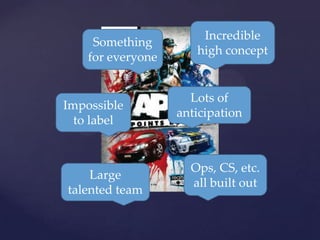
Incredible high conceptSomething for everyoneLots of anticipationImpossible to labelOps, CS, etc. all built outLarge talented team
Common management and organizational failures that leaders talk themselves into accepting, which often end up negatively impacting your success“…mistakes that have been made so often, by so many people, that the consequences of making these mistakes should be predictable and the mistakes themselves should be avoidable.”Define ‘Self Inflicted Wound’
Most common self inflicted woundsFor each, why we let them happen……what  to do should you be in the middle of it
About the BusinessAbout the TeamAbout the GameMost Common Self Inflicted Wounds
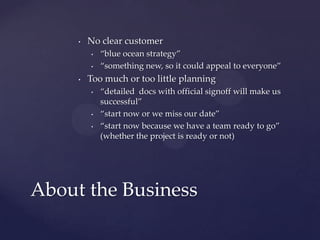
No clear customerBuilding a game for ‘everyone’ means you have no idea who its for‘art’ can be for its own sake, but commercial products need to have customersAbout the Business
Too much or too little planningExpecting very detailed documents and formal sign-offs to  reduce the amount of unplanned change can stifle forward progressStaying busy is not the same as being productiveRushing into action without a clear plan is never goodAbout the Business
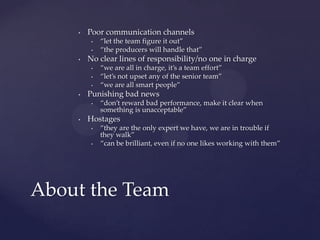
Poor communication channelsHow does one group know what the other groups do?Separation of responsibility can go too farLike building a neighborhood then wondering how to retrofit plumbing between the buildingsAbout the Team
No clear lines of responsibility/no one in chargeWho can make what decision about what areas?Everyone in the team should have the same answerToo many fiefdoms inevitably lead to the larger team not working towards the same thingAbout the Team
Punishing bad newsCommunication is hard enough, but when bad news is punished it results in less communication overallAbout the Team
HostagesLetting anyone, even star talent, hold the team or business hostage may work in the short run, but will bite you in the long runAbout the Team
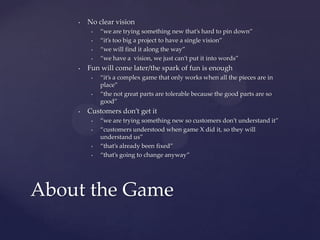
No clear visionCan everyone involved articulate the same vision?No single vision likely means you are not ready to start yet because the team doesn’t know what they are buildingAbout the Game
Fun will come later/the spark of fun is enoughBuild fun in early and improve it, don’t hope it happens when everything comes together near the endTake the spark of fun and grow it intentionallyAbout the Game
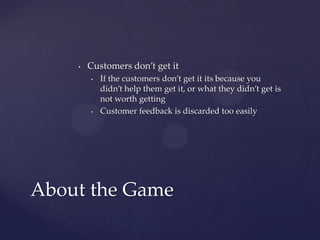
Customers don’t get itIf the customers don’t get it its because you didn’t help them get it, or what they didn’t get is not worth gettingCustomer feedback is discarded too easilyAbout the Game
“The obscure we see eventually. The completely obvious, it seems, takes longer.”Edward R. Murrow
It happens all the time.How do we talk ourselves into being okay about any of these?
No clear customer“blue ocean strategy”“something new, so it could appeal to everyone”Too much or too little planning“detailed  docs with official signoff will make us successful”“start now or we miss our date”“start now because we have a team ready to go” (whether the project is ready or not)About the Business
Poor communication channels“let the team figure it out”“the producers will handle that”No clear lines of responsibility/no one in charge“we are all in charge, it’s a team effort”“let’s not upset any of the senior team”“we are all smart people”Punishing bad news“don’t reward bad performance, make it clear when something is unacceptable”Hostages“they are the only expert we have, we are in trouble if they walk”“can be brilliant, even if no one likes working with them”About the Team
No clear vision“we are trying something new that’s hard to pin down”“it’s too big a project to have a single vision”“we will find it along the way”“we have a  vision, we just can’t put it into words”Fun will come later/the spark of fun is enough“it’s a complex game that only works when all the pieces are in place”“the not great parts are tolerable because the good parts are so good”Customers don’t get it“we are trying something new so customers don’t understand it”“customers understood when game X did it, so they will understand us”“that’s already been fixed”“that’s going to change anyway”About the Game
So What Do I Do About It?Some successful strategies.
No clear customerWork bottom up to decideToo much or too little planningTo start planning is to startInvolve all disciplines in planning, bottom upDon’t confuse ‘sign-off’ with ‘buy-in’About the Business
No clear lines of responsibility/no one in chargeNominate from below and get group buy inTake the high road; be ready to bend the knee or leaveIntroduce RACI*Punishing bad newsReward communication around you, whether good news or notHave the courage to bring truth to power or accept complicity for failureHostagesPeer pressure to enforce acceptable social behaviorBe ready to leaveAbout the Team* See http://en.wikipedia.org/wiki/Responsibility_assignment_matrix for info
No clear visionStart locally and create a shared visionExpand those involved and tweak the vision to keep the larger group on the same pageStop expanding when the vision stops being useful to the day to day work you doFun will come later/the spark of fun is enoughGet clarification if Fun is the goal, and if so speak truth to powerCustomers don’t get itAccept you don’t understand the customer and until you do this won’t changeListen to the feedback, don’t just hear itAbout the Game
Don’t wait for ‘management’ to fix thingsThe project will be just as dead because you waited than because they didn’t actYour job is to help the title ship, and sometimes that means ‘drawing outside the lines’Decide that something not being done right elsewhere won’t keep you from doing it right locallyGet broad multi-discipline support and work bottom upFind what works for your team, then share it with other teams (share, not force)If ‘they’ are not receptive of your effortsLearn how to disagree and commitOr consider joining a new organization that values you moreThemes
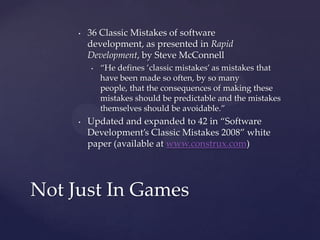
36 Classic Mistakes of software development, as presented in Rapid Development, by Steve McConnell“He defines ’classic mistakes’ as mistakes that have been made so often, by so many people, that the consequences of making these mistakes should be predictable and the mistakes themselves should be avoidable.”Updated and expanded to 42 in “Software Development’s Classic Mistakes 2008” white paper (available at www.construx.com)Not Just In Games
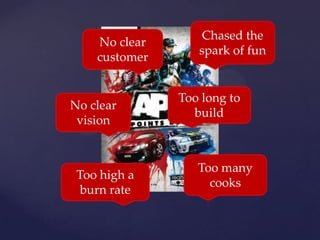
Incredible high conceptChased the spark of funSomething for everyoneNo clear customerLots of anticipationToo long to buildImpossible to labelNo clear visionOps, CS, etc. all built outToo many cooksLarge talented teamToo high a burn rate
“It’s frustrating that the lessons of our failure read like so many other startup failures.”“While I regret not doing more to help fix our problems, and am deeply disappointed by our failure, I don’t regret taking part in the adventure.”			- Luke Halliwell, RTW devClosing
Email me at joshua@bonegames.comCheck out more from me at: http://thereisnothem.wordpress.comAbout Joshua

Self Inflicted Wounds GDC Online 2010

  • 1.
    Self Inflicted Wounds:WhenWe are Our Own Worst EnemyHow we make it harder than it has to be,even though we should know better.GDC OnlineOct 2010Joshua Howard
  • 2.
    Incredible high conceptSomethingfor everyoneLots of anticipationImpossible to labelOps, CS, etc. all built outLarge talented team
  • 3.
    Common management andorganizational failures that leaders talk themselves into accepting, which often end up negatively impacting your success“…mistakes that have been made so often, by so many people, that the consequences of making these mistakes should be predictable and the mistakes themselves should be avoidable.”Define ‘Self Inflicted Wound’
  • 4.
    Most common selfinflicted woundsFor each, why we let them happen……what to do should you be in the middle of it
  • 5.
    About the BusinessAboutthe TeamAbout the GameMost Common Self Inflicted Wounds
  • 6.
    No clear customerBuildinga game for ‘everyone’ means you have no idea who its for‘art’ can be for its own sake, but commercial products need to have customersAbout the Business
  • 7.
    Too much ortoo little planningExpecting very detailed documents and formal sign-offs to reduce the amount of unplanned change can stifle forward progressStaying busy is not the same as being productiveRushing into action without a clear plan is never goodAbout the Business
  • 8.
    Poor communication channelsHowdoes one group know what the other groups do?Separation of responsibility can go too farLike building a neighborhood then wondering how to retrofit plumbing between the buildingsAbout the Team
  • 9.
    No clear linesof responsibility/no one in chargeWho can make what decision about what areas?Everyone in the team should have the same answerToo many fiefdoms inevitably lead to the larger team not working towards the same thingAbout the Team
  • 10.
    Punishing bad newsCommunicationis hard enough, but when bad news is punished it results in less communication overallAbout the Team
  • 11.
    HostagesLetting anyone, evenstar talent, hold the team or business hostage may work in the short run, but will bite you in the long runAbout the Team
  • 12.
    No clear visionCaneveryone involved articulate the same vision?No single vision likely means you are not ready to start yet because the team doesn’t know what they are buildingAbout the Game
  • 13.
    Fun will comelater/the spark of fun is enoughBuild fun in early and improve it, don’t hope it happens when everything comes together near the endTake the spark of fun and grow it intentionallyAbout the Game
  • 14.
    Customers don’t getitIf the customers don’t get it its because you didn’t help them get it, or what they didn’t get is not worth gettingCustomer feedback is discarded too easilyAbout the Game
  • 15.
    “The obscure wesee eventually. The completely obvious, it seems, takes longer.”Edward R. Murrow
  • 16.
    It happens allthe time.How do we talk ourselves into being okay about any of these?
  • 17.
    No clear customer“blueocean strategy”“something new, so it could appeal to everyone”Too much or too little planning“detailed docs with official signoff will make us successful”“start now or we miss our date”“start now because we have a team ready to go” (whether the project is ready or not)About the Business
  • 18.
    Poor communication channels“letthe team figure it out”“the producers will handle that”No clear lines of responsibility/no one in charge“we are all in charge, it’s a team effort”“let’s not upset any of the senior team”“we are all smart people”Punishing bad news“don’t reward bad performance, make it clear when something is unacceptable”Hostages“they are the only expert we have, we are in trouble if they walk”“can be brilliant, even if no one likes working with them”About the Team
  • 19.
    No clear vision“weare trying something new that’s hard to pin down”“it’s too big a project to have a single vision”“we will find it along the way”“we have a vision, we just can’t put it into words”Fun will come later/the spark of fun is enough“it’s a complex game that only works when all the pieces are in place”“the not great parts are tolerable because the good parts are so good”Customers don’t get it“we are trying something new so customers don’t understand it”“customers understood when game X did it, so they will understand us”“that’s already been fixed”“that’s going to change anyway”About the Game
  • 20.
    So What DoI Do About It?Some successful strategies.
  • 21.
    No clear customerWorkbottom up to decideToo much or too little planningTo start planning is to startInvolve all disciplines in planning, bottom upDon’t confuse ‘sign-off’ with ‘buy-in’About the Business
  • 22.
    No clear linesof responsibility/no one in chargeNominate from below and get group buy inTake the high road; be ready to bend the knee or leaveIntroduce RACI*Punishing bad newsReward communication around you, whether good news or notHave the courage to bring truth to power or accept complicity for failureHostagesPeer pressure to enforce acceptable social behaviorBe ready to leaveAbout the Team* See http://en.wikipedia.org/wiki/Responsibility_assignment_matrix for info
  • 23.
    No clear visionStartlocally and create a shared visionExpand those involved and tweak the vision to keep the larger group on the same pageStop expanding when the vision stops being useful to the day to day work you doFun will come later/the spark of fun is enoughGet clarification if Fun is the goal, and if so speak truth to powerCustomers don’t get itAccept you don’t understand the customer and until you do this won’t changeListen to the feedback, don’t just hear itAbout the Game
  • 24.
    Don’t wait for‘management’ to fix thingsThe project will be just as dead because you waited than because they didn’t actYour job is to help the title ship, and sometimes that means ‘drawing outside the lines’Decide that something not being done right elsewhere won’t keep you from doing it right locallyGet broad multi-discipline support and work bottom upFind what works for your team, then share it with other teams (share, not force)If ‘they’ are not receptive of your effortsLearn how to disagree and commitOr consider joining a new organization that values you moreThemes
  • 25.
    36 Classic Mistakesof software development, as presented in Rapid Development, by Steve McConnell“He defines ’classic mistakes’ as mistakes that have been made so often, by so many people, that the consequences of making these mistakes should be predictable and the mistakes themselves should be avoidable.”Updated and expanded to 42 in “Software Development’s Classic Mistakes 2008” white paper (available at www.construx.com)Not Just In Games
  • 26.
    Incredible high conceptChasedthe spark of funSomething for everyoneNo clear customerLots of anticipationToo long to buildImpossible to labelNo clear visionOps, CS, etc. all built outToo many cooksLarge talented teamToo high a burn rate
  • 27.
    “It’s frustrating thatthe lessons of our failure read like so many other startup failures.”“While I regret not doing more to help fix our problems, and am deeply disappointed by our failure, I don’t regret taking part in the adventure.” - Luke Halliwell, RTW devClosing
  • 28.
    Email me atjoshua@bonegames.comCheck out more from me at: http://thereisnothem.wordpress.comAbout Joshua