Police and magistrate
inquest
ABRAR AHMAD
ROLL NO-01
MBBS BATCH 2017-18
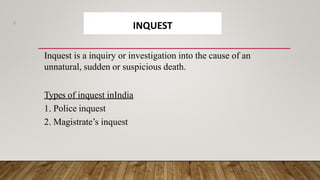
INQUEST2
Inquest is a inquiry or investigation into the cause of an
unnatural, sudden or suspicious death.
Types of inquest inIndia
1. Police inquest
2. Magistrate’s inquest
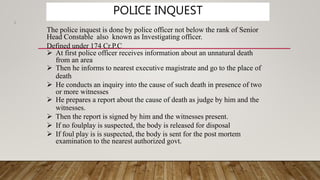
POLICE INQUEST
3
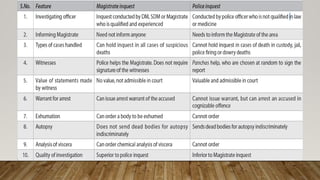
The police inquest is done by police officer not below the rank of Senior
Head Constable also known as Investigating officer.
Defined under 174 Cr.P.C
 At first police officer receives information about an unnatural death
from an area
 Then he informs to nearest executive magistrate and go to the place of
death
 He conducts an inquiry into the cause of such death in presence of two
or more witnesses
 He prepares a report about the cause of death as judge by him and the
witnesses.
 Then the report is signed by him and the witnesses present.
 If no foulplay is suspected, the body is released for disposal
 If foul play is is suspected, the body is sent for the post mortem
examination to the nearest authorized govt.
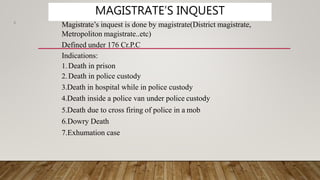
MAGISTRATE’S INQUEST
4
Magistrate’s inquest is done by magistrate(District magistrate,
Metropoliton magistrate..etc)
Defined under 176 Cr.P.C
Indications:
1.Death in prison
2.Death in police custody
3.Death in hospital while in police custody
4.Death inside a police van under police custody
5.Death due to cross firing of police in a mob
6.Dowry Death
7.Exhumation case
REFERENCES
• Gautam Biswas - Review Of Forensic Medicine And toxicology Including Clinical And
Pathological Aspects-Jaypee Brothers Medical Publisher (2015)
• K. S. Narayan Reddy, O. P. Murty - The Essentials Of Forensic Medicine And
Toxicology-Jaypee Brothers (2015)
THANK YOU

Police & magistrate inquest

  • 1.
    Police and magistrate inquest ABRARAHMAD ROLL NO-01 MBBS BATCH 2017-18
  • 2.
    INQUEST2 Inquest is ainquiry or investigation into the cause of an unnatural, sudden or suspicious death. Types of inquest inIndia 1. Police inquest 2. Magistrate’s inquest
  • 3.
    POLICE INQUEST 3 The policeinquest is done by police officer not below the rank of Senior Head Constable also known as Investigating officer. Defined under 174 Cr.P.C  At first police officer receives information about an unnatural death from an area  Then he informs to nearest executive magistrate and go to the place of death  He conducts an inquiry into the cause of such death in presence of two or more witnesses  He prepares a report about the cause of death as judge by him and the witnesses.  Then the report is signed by him and the witnesses present.  If no foulplay is suspected, the body is released for disposal  If foul play is is suspected, the body is sent for the post mortem examination to the nearest authorized govt.
  • 4.
    MAGISTRATE’S INQUEST 4 Magistrate’s inquestis done by magistrate(District magistrate, Metropoliton magistrate..etc) Defined under 176 Cr.P.C Indications: 1.Death in prison 2.Death in police custody 3.Death in hospital while in police custody 4.Death inside a police van under police custody 5.Death due to cross firing of police in a mob 6.Dowry Death 7.Exhumation case
  • 6.
    REFERENCES • Gautam Biswas- Review Of Forensic Medicine And toxicology Including Clinical And Pathological Aspects-Jaypee Brothers Medical Publisher (2015) • K. S. Narayan Reddy, O. P. Murty - The Essentials Of Forensic Medicine And Toxicology-Jaypee Brothers (2015)
  • 7.