VIRGINITY,
PREGNANCY
& DELIVERY
Dr Arun Pinchu Xavier
Assistant Professor
Dept: of Forensic Medicine
Sree Mookambika Institute Of Medical Sciences
VIRGINITY / CHASTITY
 Female who hasn’t experienced sexual intercourse
 Defloration– deprivation of virginity; rupture of hymen by
the act of coitus.
SIGNS OF VIRGINITY
GENITAL & EXTRAGENITAL
GENITAL
 Intact hymen – rigid & inelastic
 Apposing labia majora
 Labia minora not seen outside in normal lithotomy
position
 Fourchette and posterior commissure normal
 Vagina- narrow,tight, sensitive & rugosed
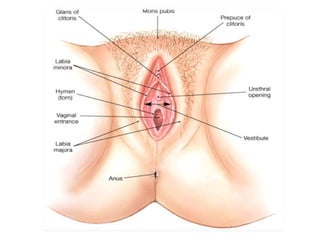
WHATS HYMEN THEN...?
 Thin fold of mucous membrane at the vaginal orifice
partially concealing it.
 It has an opening in it,which gives it different names
 Menstrual blood and vaginal secretions flow through it
 Normally ,it admits –tip of small finger
 Structure and consistency of hymen varies
 Bleeds when stretched via the act of coitus, masturbation,
introduction of fingers, tampons or foregin bodies
TYPES OF HYMEN
CAN THEN A
PROSTITUTE
WHO
POSSES AN
INTACT
HYMEN ,BE
CALLED A
VIRGIN..?
STRUCTURE AND CONSISTENCY OF
HYMEN VARIES
 Thin,fleshy ,thick or elastic
 In elastic hymen ,hymenal orifice can be stretched without
tear
 But, a women harboring an intact hymen which admits only
a tip of little finger can be considered VIRGO INTACTA- A
VIRGIN
 Women having a thick fleshy elastic hymen and who has
experienced sexual act is called FALSE VIRGIN
 A women is a virgin until she has sexual intercourse
 Presence of unruptured hymen is a presumption, but not an
absolute proof of virginity.
 Hymen can be present always in a virgin in someform or the
other or may be congenitally absent, rarely !
 Hymen ruptures at first coitus & is torn ,but may not be
ruptured even after repeted act of coitus if its, loose folded
elastic thick tough & fleshy which permit displacement of
shape and stretching without rupture..!
CHANGES IN GENITALIA DUE TO SEXUAL
ACTIVITY
 First act of coitus ruptures the hymen posteriorly at 6
o’clock Position.
 Frequent coitus ,results in multiple tears, which is then
called as “ CARUNCULAE HYMENALES ”
 After Preg & Delivery hymen will almost be absent except a
marginal attachment – “ CARUNCULAE
MYRTIFORMES”
02.EXTRAGENITAL– BREASTS
 Hemispherical firm & elastic
 Pinkish areola and nipples in fair skinned ,dark brown
in brown skinned.
 It may become large saggy due to frequent handling but
not affected by single act of coitus
SIGNS OF VIRGINITY ARE…
 Intact hymen
 Normal condition of fourchette & post comissure
 Narrow vagina + rugosed walls
These signs taken together may be regarded as …
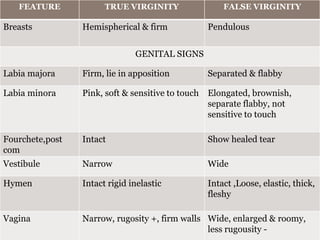
FEATURE TRUE VIRGINITY FALSE VIRGINITY
Breasts Hemispherical & firm Pendulous
GENITAL SIGNS
Labia majora Firm, lie in apposition Separated & flabby
Labia minora Pink, soft & sensitive to touch Elongated, brownish,
separate flabby, not
sensitive to touch
Fourchete,post
com
Intact Show healed tear
Vestibule Narrow Wide
Hymen Intact rigid inelastic Intact ,Loose, elastic, thick,
fleshy
Vagina Narrow, rugosity +, firm walls Wide, enlarged & roomy,
less rugousity -
MLI of Virginity
 Nullity of marriage– virginity proof of non
consummation
 Divorce
 Defamation of character—illegal damage to reputation
against a person who has alleged that she is not a virgin
 Criminal cases– charge of Rape
PREGNANCY
PREGNANCY
 Development of an embryo in a female ,when ovum is
fertilized by a spermatozoa.
 Fertilized ovum moves to uterine cavity, gets implanted in
the endometrium and grows into a fetus
 Divided into 3 trimesters
 Written Expressed Witnessed consent has to be obtained ..!
 Signs of pregnancy - Presumptive, Probable & Positive.
MLI of Pregnancy
 Women may plead pregnancy to avoid attendance in
the court of law as a witness
 Execution of death sentence
 Fegin preg in maintenance cases
 In an allegation of seduction / blackmailing
 In cases of divorce ,the women may claim to be
pregnant to get more alimony
 Preg due to illicit sexual intimacy - Suicide / Murder
 Maternity leave
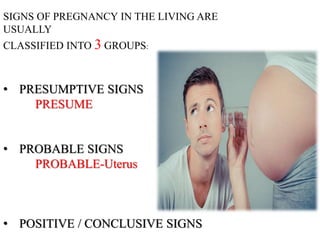
SIGNS OF PREGNANCY IN THE LIVING ARE
USUALLY
CLASSIFIED INTO 3 GROUPS:
• PRESUMPTIVE SIGNS
PRESUME
• PROBABLE SIGNS
PROBABLE-Uterus
• POSITIVE / CONCLUSIVE SIGNS
PRESUMPTIVE SIGNS OF PREGNANCY- PRESUME
PERIODS ABSENT–AMENORRHEA, PIGMENTAION
REALLY TIRED -MORNING SICKNESS
ENLARGED & SORE BREAST
URINARY DISTURBANCES
MOVEMENT OF FOETUS - QUICKENING
EMESIS,NAUSEA - MORNING SICKNESS
PRESUMPTIVE SIGNS OF PREGNANCY
PRESUME
PERIODS ABSENT - AMENORRHEA
 Earliest & most important symptom
 Menstrual flow stops after conception and doesn’t
commence again ,until 3 months or more after delivery –
Lactational Amenorrhea
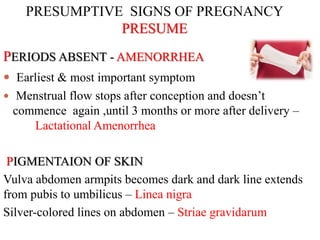
PIGMENTAION OF SKIN
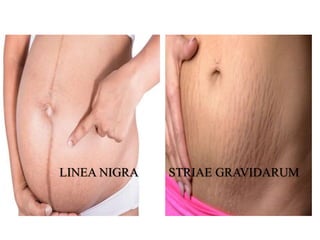
Vulva abdomen armpits becomes dark and dark line extends
from pubis to umbilicus – Linea nigra
Silver-colored lines on abdomen – Striae gravidarum
PRESUMPTIVE SIGNS OF PREGNANCY…
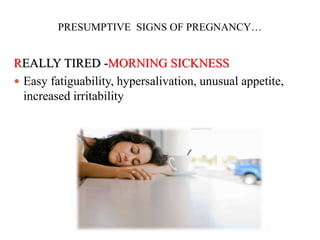
REALLY TIRED -MORNING SICKNESS
 Easy fatiguability, hypersalivation, unusual appetite,
increased irritability
PRESUMPTIVE SIGNS OF PREGNANCY…
ENLARGED & SORE BREAST
 Progressive enlargement & tenderness
Easily visible superficial veins
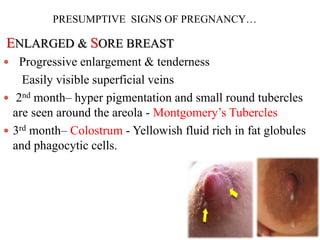
 2nd month– hyper pigmentation and small round tubercles
are seen around the areola - Montgomery’s Tubercles
 3rd month– Colostrum - Yellowish fluid rich in fat globules
and phagocytic cells.
PRESUMPTIVE SIGNS OF PREGNANCY…
URINARY DISTURBANCES
 Enlarging uterus exerts pressure on bladder
 Disturbances in micturition: increased frequency
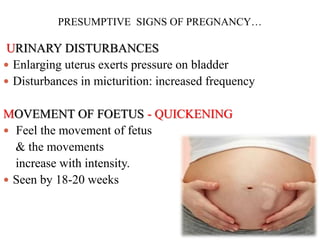
MOVEMENT OF FOETUS - QUICKENING
 Feel the movement of fetus
& the movements
increase with intensity.
 Seen by 18-20 weeks
PRESUMPTIVE SIGNS OF PREGNANCY…
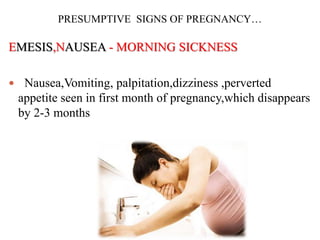
EMESIS,NAUSEA - MORNING SICKNESS
 Nausea,Vomiting, palpitation,dizziness ,perverted
appetite seen in first month of pregnancy,which disappears
by 2-3 months
LINEA NIGRA STRIAE GRAVIDARUM
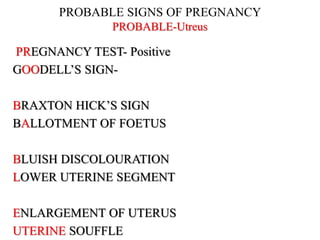
PROBABLE SIGNS OF PREGNANCY
PROBABLE-Utreus
PREGNANCY TEST- Positive
GOODELL’S SIGN-
BRAXTON HICK’S SIGN
BALLOTMENT OF FOETUS
BLUISH DISCOLOURATION
LOWER UTERINE SEGMENT
ENLARGEMENT OF UTERUS
UTERINE SOUFFLE
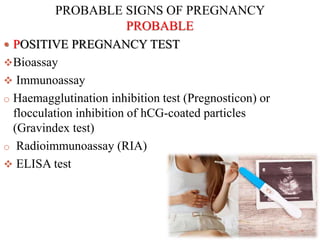
PROBABLE SIGNS OF PREGNANCY
PROBABLE
 POSITIVE PREGNANCY TEST
Bioassay
 Immunoassay
o Haemagglutination inhibition test (Pregnosticon) or
flocculation inhibition of hCG-coated particles
(Gravindex test)
o Radioimmunoassay (RIA)
 ELISA test
PROBABLE SIGNS OF PREGNANCY
 GOODELL’S SIGN- Softening of cervix due to
increased vascularity seen at 6-8 weeks, cervix
become patulous as pregnancy advances
 BRAXTON HICK’S Sign: appreciation of
intermittent painless contractions of uterus felt per
abdomen from 16 weeks, 5-20 min interval, lasts for
1-5 mins.
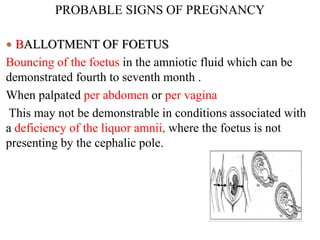
PROBABLE SIGNS OF PREGNANCY
 BALLOTMENT OF FOETUS
Bouncing of the foetus in the amniotic fluid which can be
demonstrated fourth to seventh month .
When palpated per abdomen or per vagina
This may not be demonstrable in conditions associated with
a deficiency of the liquor amnii, where the foetus is not
presenting by the cephalic pole.
PROBABLE SIGNS OF PREGNANCY
 Bluish Discolouration of the Vagina - detected
between the fourth and 8th weeks of pregnancy.
The discolouration increases in intensity up to
the 16th weeks
 Lower Uterine Segment - Softening & easy
compressibility seen at 6-8 weeks - Hegar’s sign
PROBABLE SIGNS OF PREGNANCY
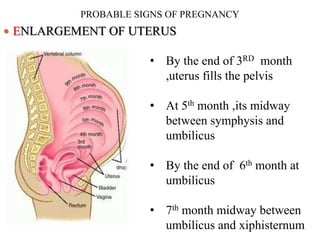
 ENLARGEMENT OF UTERUS
• By the end of 3RD month
,uterus fills the pelvis
• At 5th month ,its midway
between symphysis and
umbilicus
• By the end of 6th month at
umbilicus
• 7th month midway between
umbilicus and xiphisternum
PROBABLE SIGNS OF PREGNANCY
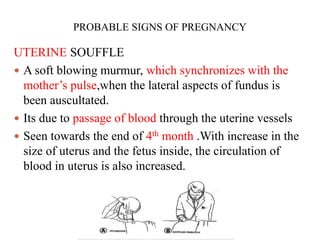
UTERINE SOUFFLE
 A soft blowing murmur, which synchronizes with the
mother’s pulse,when the lateral aspects of fundus is
been auscultated.
 Its due to passage of blood through the uterine vessels
 Seen towards the end of 4th month .With increase in the
size of uterus and the fetus inside, the circulation of
blood in uterus is also increased.
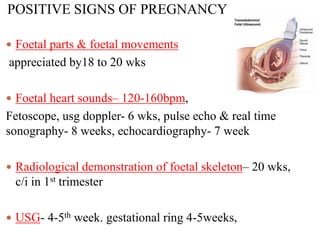
POSITIVE SIGNS OF PREGNANCY
 Foetal parts & foetal movements
appreciated by18 to 20 wks
 Foetal heart sounds– 120-160bpm,
Fetoscope, usg doppler- 6 wks, pulse echo & real time
sonography- 8 weeks, echocardiography- 7 week
 Radiological demonstration of foetal skeleton– 20 wks,
c/i in 1st trimester
 USG- 4-5th week. gestational ring 4-5weeks,
DIFFERENTIAL DIAGNOSIS
OF PREGNANCY
PSEUDOCYESIS / SPURIOUS/PHANTOM-PREGNANCY
 Women nearing menopause or in younger women anxious
to have kids
 Most frequently, it is observed in a woman who is
approaching the menopause, when her menstrual flow has
become scanty or has ceased for a time.
 A deposit of fat takes place in the anterior abdominal wall
and omentum or the intestines become distended with flatus
 Changes in breast may be present, women imagine fetal
movements
 Secretions from the breast & intestinal movements.
Presumed to be fetal movements ..!
 Preg test / X-ray examination / USG will solve ..!
SUPERFOETATION
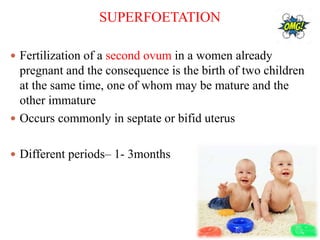
 Fertilization of a second ovum in a women already
pregnant and the consequence is the birth of two children
at the same time, one of whom may be mature and the
other immature
 Occurs commonly in septate or bifid uterus
 Different periods– 1- 3months
SUPERFECUNDATION
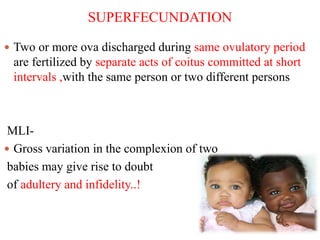
 Two or more ova discharged during same ovulatory period
are fertilized by separate acts of coitus committed at short
intervals ,with the same person or two different persons
MLI-
 Gross variation in the complexion of two
babies may give rise to doubt
of adultery and infidelity..!
PEROID OF GESTATION & VIABILITY
Period of gestation is usually 280 days
VIABILITY
Ability of a new born child to have an independent life
apart from the mother.
Children born at or after 180
days may be viable,but usually
210 days is accepted ,for all
legal purposes.
DELIVERY
DELIVERY
 Process by which fetus is expelled from the uterus
 Normal duration 40 weeks / 280 days from the LMP
 Normally ,delivers near full term.
 She undergoes a process of LABOR, where rhythmic
contractions expel the baby through the vagina.
Labor is divided into 3 stages:
 Dilatation of cervix
 Delivery of baby
 Expulsion of placenta
SIGNS OF RECENT DELIVERY IN LIVING
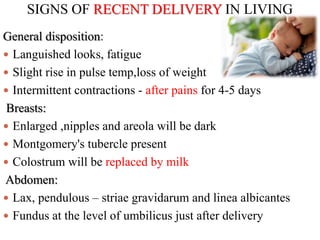
General disposition:
 Languished looks, fatigue
 Slight rise in pulse temp,loss of weight
 Intermittent contractions - after pains for 4-5 days
Breasts:
 Enlarged ,nipples and areola will be dark
 Montgomery's tubercle present
 Colostrum will be replaced by milk
Abdomen:
 Lax, pendulous – striae gravidarum and linea albicantes
 Fundus at the level of umbilicus just after delivery
SIGNS OF RECENT DELIVERY IN LIVING…
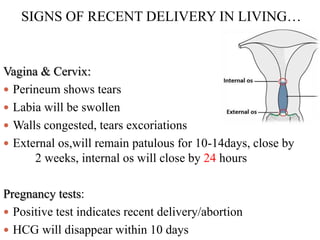
Vagina & Cervix:
 Perineum shows tears
 Labia will be swollen
 Walls congested, tears excoriations
 External os,will remain patulous for 10-14days, close by
2 weeks, internal os will close by 24 hours
Pregnancy tests:
 Positive test indicates recent delivery/abortion
 HCG will disappear within 10 days
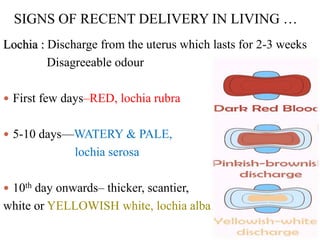
Lochia : Discharge from the uterus which lasts for 2-3 weeks
Disagreeable odour
 First few days–RED, lochia rubra
 5-10 days—WATERY & PALE,
lochia serosa
 10th day onwards– thicker, scantier,
white or YELLOWISH white, lochia alba
SIGNS OF RECENT DELIVERY IN LIVING …
SIGNS OF RECENT DELIVERY IN DEAD
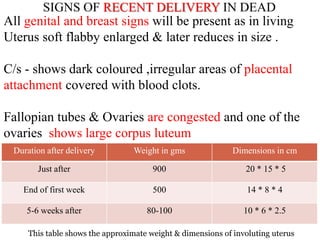
Duration after delivery Weight in gms Dimensions in cm
Just after 900 20 * 15 * 5
End of first week 500 14 * 8 * 4
5-6 weeks after 80-100 10 * 6 * 2.5
All genital and breast signs will be present as in living
Uterus soft flabby enlarged & later reduces in size .
C/s - shows dark coloured ,irregular areas of placental
attachment covered with blood clots.
Fallopian tubes & Ovaries are congested and one of the
ovaries shows large corpus luteum
This table shows the approximate weight & dimensions of involuting uterus
SIGNS OF REMOTE DELIVERY IN LIVING
 Breasts- flabby, pigmented enlarged prominent nipples
 Abdomen -lax with linea nigra & albicantes
 Vagina- lax capacious ,absent rugosity
labia do not close the vaginal orifice completely
Fourchette and perineum reveal old scars
 Hymen – lost and represented carunculae mytriformis
SIGNS OF REMOTE DELIVERY IN DEAD
 Uterus usually does not involute as in a nulliparous womb
 Fundus tends to be higher than the line of fallopian tubes
 Cervix and body are about the same length in virgin, while
in parous women cervix, is twice the length
 In virgin there is several mucosal folds in cervical canal –
ARBOR VITAE. It will be lost during delivery
 Histology of the placental site
shows blood pigments
upto 6 months after
delivery.
MLI OF DELIVERY
 In cases where there is a dispute over legitimacy/mathernity
 Feigns delivery for some duration and then produce a child,
alleging that it is hers - Fictitious / Suppositous child- with a
motive to extract more money
 Abortion & infanticide – alleged to have aborted/delivered /
killed the child
 Cases of suspected concealment of birth – a child born to a
unmarried / Widow / out of lawful wedlock- she conceals !
LEGITIMACY
 Legal state of a person born in lawful marriage
 A child born during continuance of legal marriage,between
his mother and any man or within 280 days after the
dissolution,the mother being unmarried.
ILLEGITIMATE / BASTARD CHILD ,is ..
 One who is born out of lawful wedlock
 Within a wedlock or within competent period after
cessation of relationship of man and wife
 Born within wedlock when procreation by husband is not
possible bcz of congenital or acquired malformations.
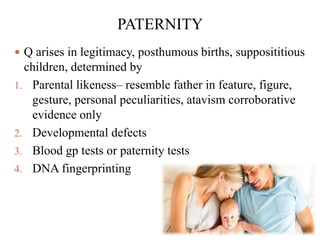
PATERNITY
 Q arises in legitimacy, posthumous births, supposititious
children, determined by
1. Parental likeness– resemble father in feature, figure,
gesture, personal peculiarities, atavism corroborative
evidence only
2. Developmental defects
3. Blood gp tests or paternity tests
4. DNA fingerprinting
DISPUTED PATERNITY
DISPUTED PATERNITY
Arises, when a mother of a child, names a person to be father
of child, whereas man denies the accusation
Question of disputed paternity :
CIVIL CASES:
Divorce/ nullity of marriage: husband file divorce suit
Maintenance of claim:
Share of property: pretend to be preg and delivers a child so as
to obtain a greater share of husbands property
CRIMINAL CASES:
Adultery: husband may deny a child born in lawful marriage
Blackmail :for personal gains
ATAVISM
ATAVISM
 When a child doesn’t resembles its parents but
resembles its grand parents ,such child is atavistic
child and the process is called atavism
 It is due to chance recombination of genes, which
failed to express in the father but not in the child
 Any mental / physical / tendency / a disease peculiar
to remote ancestor may be inherited.
RESTORING YOUR INNOCENCE ..!
A surgical procedure that involves restoring to normal,
a torn hymen for cultural, religious or social reasons
MAY THE GRACIOUS GOD
BLESS US ALL ALWAYS
WISHING YOU ALL SUCCESS
FOR YOUR UPCOMING
EXAMS
Your valuable suggestions are
entertained -
drpinchu89@gmail.com

Virginity, pregnancy and delivery

  • 1.
    VIRGINITY, PREGNANCY & DELIVERY Dr ArunPinchu Xavier Assistant Professor Dept: of Forensic Medicine Sree Mookambika Institute Of Medical Sciences
  • 2.
    VIRGINITY / CHASTITY Female who hasn’t experienced sexual intercourse  Defloration– deprivation of virginity; rupture of hymen by the act of coitus.
  • 4.
    SIGNS OF VIRGINITY GENITAL& EXTRAGENITAL GENITAL  Intact hymen – rigid & inelastic  Apposing labia majora  Labia minora not seen outside in normal lithotomy position  Fourchette and posterior commissure normal  Vagina- narrow,tight, sensitive & rugosed
  • 5.
    WHATS HYMEN THEN...? Thin fold of mucous membrane at the vaginal orifice partially concealing it.  It has an opening in it,which gives it different names  Menstrual blood and vaginal secretions flow through it  Normally ,it admits –tip of small finger  Structure and consistency of hymen varies  Bleeds when stretched via the act of coitus, masturbation, introduction of fingers, tampons or foregin bodies
  • 6.
  • 7.
    CAN THEN A PROSTITUTE WHO POSSESAN INTACT HYMEN ,BE CALLED A VIRGIN..?
  • 8.
    STRUCTURE AND CONSISTENCYOF HYMEN VARIES  Thin,fleshy ,thick or elastic  In elastic hymen ,hymenal orifice can be stretched without tear  But, a women harboring an intact hymen which admits only a tip of little finger can be considered VIRGO INTACTA- A VIRGIN  Women having a thick fleshy elastic hymen and who has experienced sexual act is called FALSE VIRGIN
  • 9.
     A womenis a virgin until she has sexual intercourse  Presence of unruptured hymen is a presumption, but not an absolute proof of virginity.  Hymen can be present always in a virgin in someform or the other or may be congenitally absent, rarely !  Hymen ruptures at first coitus & is torn ,but may not be ruptured even after repeted act of coitus if its, loose folded elastic thick tough & fleshy which permit displacement of shape and stretching without rupture..!
  • 10.
    CHANGES IN GENITALIADUE TO SEXUAL ACTIVITY  First act of coitus ruptures the hymen posteriorly at 6 o’clock Position.  Frequent coitus ,results in multiple tears, which is then called as “ CARUNCULAE HYMENALES ”  After Preg & Delivery hymen will almost be absent except a marginal attachment – “ CARUNCULAE MYRTIFORMES”
  • 11.
    02.EXTRAGENITAL– BREASTS  Hemisphericalfirm & elastic  Pinkish areola and nipples in fair skinned ,dark brown in brown skinned.  It may become large saggy due to frequent handling but not affected by single act of coitus
  • 12.
    SIGNS OF VIRGINITYARE…  Intact hymen  Normal condition of fourchette & post comissure  Narrow vagina + rugosed walls These signs taken together may be regarded as …
  • 13.
    FEATURE TRUE VIRGINITYFALSE VIRGINITY Breasts Hemispherical & firm Pendulous GENITAL SIGNS Labia majora Firm, lie in apposition Separated & flabby Labia minora Pink, soft & sensitive to touch Elongated, brownish, separate flabby, not sensitive to touch Fourchete,post com Intact Show healed tear Vestibule Narrow Wide Hymen Intact rigid inelastic Intact ,Loose, elastic, thick, fleshy Vagina Narrow, rugosity +, firm walls Wide, enlarged & roomy, less rugousity -
  • 14.
    MLI of Virginity Nullity of marriage– virginity proof of non consummation  Divorce  Defamation of character—illegal damage to reputation against a person who has alleged that she is not a virgin  Criminal cases– charge of Rape
  • 15.
  • 16.
    PREGNANCY  Development ofan embryo in a female ,when ovum is fertilized by a spermatozoa.  Fertilized ovum moves to uterine cavity, gets implanted in the endometrium and grows into a fetus  Divided into 3 trimesters  Written Expressed Witnessed consent has to be obtained ..!  Signs of pregnancy - Presumptive, Probable & Positive.
  • 17.
    MLI of Pregnancy Women may plead pregnancy to avoid attendance in the court of law as a witness  Execution of death sentence  Fegin preg in maintenance cases  In an allegation of seduction / blackmailing  In cases of divorce ,the women may claim to be pregnant to get more alimony  Preg due to illicit sexual intimacy - Suicide / Murder  Maternity leave
  • 18.
    SIGNS OF PREGNANCYIN THE LIVING ARE USUALLY CLASSIFIED INTO 3 GROUPS: • PRESUMPTIVE SIGNS PRESUME • PROBABLE SIGNS PROBABLE-Uterus • POSITIVE / CONCLUSIVE SIGNS
  • 19.
    PRESUMPTIVE SIGNS OFPREGNANCY- PRESUME PERIODS ABSENT–AMENORRHEA, PIGMENTAION REALLY TIRED -MORNING SICKNESS ENLARGED & SORE BREAST URINARY DISTURBANCES MOVEMENT OF FOETUS - QUICKENING EMESIS,NAUSEA - MORNING SICKNESS
  • 20.
    PRESUMPTIVE SIGNS OFPREGNANCY PRESUME PERIODS ABSENT - AMENORRHEA  Earliest & most important symptom  Menstrual flow stops after conception and doesn’t commence again ,until 3 months or more after delivery – Lactational Amenorrhea PIGMENTAION OF SKIN Vulva abdomen armpits becomes dark and dark line extends from pubis to umbilicus – Linea nigra Silver-colored lines on abdomen – Striae gravidarum
  • 21.
    PRESUMPTIVE SIGNS OFPREGNANCY… REALLY TIRED -MORNING SICKNESS  Easy fatiguability, hypersalivation, unusual appetite, increased irritability
  • 22.
    PRESUMPTIVE SIGNS OFPREGNANCY… ENLARGED & SORE BREAST  Progressive enlargement & tenderness Easily visible superficial veins  2nd month– hyper pigmentation and small round tubercles are seen around the areola - Montgomery’s Tubercles  3rd month– Colostrum - Yellowish fluid rich in fat globules and phagocytic cells.
  • 23.
    PRESUMPTIVE SIGNS OFPREGNANCY… URINARY DISTURBANCES  Enlarging uterus exerts pressure on bladder  Disturbances in micturition: increased frequency MOVEMENT OF FOETUS - QUICKENING  Feel the movement of fetus & the movements increase with intensity.  Seen by 18-20 weeks
  • 24.
    PRESUMPTIVE SIGNS OFPREGNANCY… EMESIS,NAUSEA - MORNING SICKNESS  Nausea,Vomiting, palpitation,dizziness ,perverted appetite seen in first month of pregnancy,which disappears by 2-3 months
  • 25.
  • 26.
    PROBABLE SIGNS OFPREGNANCY PROBABLE-Utreus PREGNANCY TEST- Positive GOODELL’S SIGN- BRAXTON HICK’S SIGN BALLOTMENT OF FOETUS BLUISH DISCOLOURATION LOWER UTERINE SEGMENT ENLARGEMENT OF UTERUS UTERINE SOUFFLE
  • 27.
    PROBABLE SIGNS OFPREGNANCY PROBABLE  POSITIVE PREGNANCY TEST Bioassay  Immunoassay o Haemagglutination inhibition test (Pregnosticon) or flocculation inhibition of hCG-coated particles (Gravindex test) o Radioimmunoassay (RIA)  ELISA test
  • 28.
    PROBABLE SIGNS OFPREGNANCY  GOODELL’S SIGN- Softening of cervix due to increased vascularity seen at 6-8 weeks, cervix become patulous as pregnancy advances  BRAXTON HICK’S Sign: appreciation of intermittent painless contractions of uterus felt per abdomen from 16 weeks, 5-20 min interval, lasts for 1-5 mins.
  • 29.
    PROBABLE SIGNS OFPREGNANCY  BALLOTMENT OF FOETUS Bouncing of the foetus in the amniotic fluid which can be demonstrated fourth to seventh month . When palpated per abdomen or per vagina This may not be demonstrable in conditions associated with a deficiency of the liquor amnii, where the foetus is not presenting by the cephalic pole.
  • 30.
    PROBABLE SIGNS OFPREGNANCY  Bluish Discolouration of the Vagina - detected between the fourth and 8th weeks of pregnancy. The discolouration increases in intensity up to the 16th weeks  Lower Uterine Segment - Softening & easy compressibility seen at 6-8 weeks - Hegar’s sign
  • 31.
    PROBABLE SIGNS OFPREGNANCY  ENLARGEMENT OF UTERUS • By the end of 3RD month ,uterus fills the pelvis • At 5th month ,its midway between symphysis and umbilicus • By the end of 6th month at umbilicus • 7th month midway between umbilicus and xiphisternum
  • 32.
    PROBABLE SIGNS OFPREGNANCY UTERINE SOUFFLE  A soft blowing murmur, which synchronizes with the mother’s pulse,when the lateral aspects of fundus is been auscultated.  Its due to passage of blood through the uterine vessels  Seen towards the end of 4th month .With increase in the size of uterus and the fetus inside, the circulation of blood in uterus is also increased.
  • 33.
    POSITIVE SIGNS OFPREGNANCY  Foetal parts & foetal movements appreciated by18 to 20 wks  Foetal heart sounds– 120-160bpm, Fetoscope, usg doppler- 6 wks, pulse echo & real time sonography- 8 weeks, echocardiography- 7 week  Radiological demonstration of foetal skeleton– 20 wks, c/i in 1st trimester  USG- 4-5th week. gestational ring 4-5weeks,
  • 34.
  • 35.
    PSEUDOCYESIS / SPURIOUS/PHANTOM-PREGNANCY Women nearing menopause or in younger women anxious to have kids  Most frequently, it is observed in a woman who is approaching the menopause, when her menstrual flow has become scanty or has ceased for a time.  A deposit of fat takes place in the anterior abdominal wall and omentum or the intestines become distended with flatus  Changes in breast may be present, women imagine fetal movements  Secretions from the breast & intestinal movements. Presumed to be fetal movements ..!  Preg test / X-ray examination / USG will solve ..!
  • 36.
    SUPERFOETATION  Fertilization ofa second ovum in a women already pregnant and the consequence is the birth of two children at the same time, one of whom may be mature and the other immature  Occurs commonly in septate or bifid uterus  Different periods– 1- 3months
  • 37.
    SUPERFECUNDATION  Two ormore ova discharged during same ovulatory period are fertilized by separate acts of coitus committed at short intervals ,with the same person or two different persons MLI-  Gross variation in the complexion of two babies may give rise to doubt of adultery and infidelity..!
  • 38.
    PEROID OF GESTATION& VIABILITY Period of gestation is usually 280 days VIABILITY Ability of a new born child to have an independent life apart from the mother. Children born at or after 180 days may be viable,but usually 210 days is accepted ,for all legal purposes.
  • 39.
  • 40.
    DELIVERY  Process bywhich fetus is expelled from the uterus  Normal duration 40 weeks / 280 days from the LMP  Normally ,delivers near full term.  She undergoes a process of LABOR, where rhythmic contractions expel the baby through the vagina. Labor is divided into 3 stages:  Dilatation of cervix  Delivery of baby  Expulsion of placenta
  • 41.
    SIGNS OF RECENTDELIVERY IN LIVING General disposition:  Languished looks, fatigue  Slight rise in pulse temp,loss of weight  Intermittent contractions - after pains for 4-5 days Breasts:  Enlarged ,nipples and areola will be dark  Montgomery's tubercle present  Colostrum will be replaced by milk Abdomen:  Lax, pendulous – striae gravidarum and linea albicantes  Fundus at the level of umbilicus just after delivery
  • 42.
    SIGNS OF RECENTDELIVERY IN LIVING… Vagina & Cervix:  Perineum shows tears  Labia will be swollen  Walls congested, tears excoriations  External os,will remain patulous for 10-14days, close by 2 weeks, internal os will close by 24 hours Pregnancy tests:  Positive test indicates recent delivery/abortion  HCG will disappear within 10 days
  • 43.
    Lochia : Dischargefrom the uterus which lasts for 2-3 weeks Disagreeable odour  First few days–RED, lochia rubra  5-10 days—WATERY & PALE, lochia serosa  10th day onwards– thicker, scantier, white or YELLOWISH white, lochia alba SIGNS OF RECENT DELIVERY IN LIVING …
  • 44.
    SIGNS OF RECENTDELIVERY IN DEAD Duration after delivery Weight in gms Dimensions in cm Just after 900 20 * 15 * 5 End of first week 500 14 * 8 * 4 5-6 weeks after 80-100 10 * 6 * 2.5 All genital and breast signs will be present as in living Uterus soft flabby enlarged & later reduces in size . C/s - shows dark coloured ,irregular areas of placental attachment covered with blood clots. Fallopian tubes & Ovaries are congested and one of the ovaries shows large corpus luteum This table shows the approximate weight & dimensions of involuting uterus
  • 45.
    SIGNS OF REMOTEDELIVERY IN LIVING  Breasts- flabby, pigmented enlarged prominent nipples  Abdomen -lax with linea nigra & albicantes  Vagina- lax capacious ,absent rugosity labia do not close the vaginal orifice completely Fourchette and perineum reveal old scars  Hymen – lost and represented carunculae mytriformis
  • 46.
    SIGNS OF REMOTEDELIVERY IN DEAD  Uterus usually does not involute as in a nulliparous womb  Fundus tends to be higher than the line of fallopian tubes  Cervix and body are about the same length in virgin, while in parous women cervix, is twice the length  In virgin there is several mucosal folds in cervical canal – ARBOR VITAE. It will be lost during delivery  Histology of the placental site shows blood pigments upto 6 months after delivery.
  • 47.
    MLI OF DELIVERY In cases where there is a dispute over legitimacy/mathernity  Feigns delivery for some duration and then produce a child, alleging that it is hers - Fictitious / Suppositous child- with a motive to extract more money  Abortion & infanticide – alleged to have aborted/delivered / killed the child  Cases of suspected concealment of birth – a child born to a unmarried / Widow / out of lawful wedlock- she conceals !
  • 48.
    LEGITIMACY  Legal stateof a person born in lawful marriage  A child born during continuance of legal marriage,between his mother and any man or within 280 days after the dissolution,the mother being unmarried. ILLEGITIMATE / BASTARD CHILD ,is ..  One who is born out of lawful wedlock  Within a wedlock or within competent period after cessation of relationship of man and wife  Born within wedlock when procreation by husband is not possible bcz of congenital or acquired malformations.
  • 49.
    PATERNITY  Q arisesin legitimacy, posthumous births, supposititious children, determined by 1. Parental likeness– resemble father in feature, figure, gesture, personal peculiarities, atavism corroborative evidence only 2. Developmental defects 3. Blood gp tests or paternity tests 4. DNA fingerprinting
  • 50.
  • 51.
    DISPUTED PATERNITY Arises, whena mother of a child, names a person to be father of child, whereas man denies the accusation Question of disputed paternity : CIVIL CASES: Divorce/ nullity of marriage: husband file divorce suit Maintenance of claim: Share of property: pretend to be preg and delivers a child so as to obtain a greater share of husbands property CRIMINAL CASES: Adultery: husband may deny a child born in lawful marriage Blackmail :for personal gains
  • 52.
  • 53.
    ATAVISM  When achild doesn’t resembles its parents but resembles its grand parents ,such child is atavistic child and the process is called atavism  It is due to chance recombination of genes, which failed to express in the father but not in the child  Any mental / physical / tendency / a disease peculiar to remote ancestor may be inherited.
  • 54.
    RESTORING YOUR INNOCENCE..! A surgical procedure that involves restoring to normal, a torn hymen for cultural, religious or social reasons
  • 55.
    MAY THE GRACIOUSGOD BLESS US ALL ALWAYS WISHING YOU ALL SUCCESS FOR YOUR UPCOMING EXAMS Your valuable suggestions are entertained - drpinchu89@gmail.com