PAOSTMORTEM EXAMINATION
DR C HIMWAZE
• Also called autopsy examination or necropsy
• Autopsy examination is the methodical
dissection of a dead body.
Classification
• Three types
1. Clinical or pathological autopsy;
- detemines the disease causing death. It is
performed when relatives give consent
2. Medicolegal autopsy;
- Performed to solve mysterious unnatural death.
- Done with authorization by the state
3. Anatomical autopsy;
-done in order to study the normal structure of
the human body. This is done mostly on the
unclaimed bodies handed over to anatomy.
Consent for autopsy
• Clinical autopsy, obtain consent from relatives
• Medical legal autopsy, no consent from
relatives bbut legal permission is a must
• Anatomical autopsy, no consent is needed.
Medicolegal autopsy
• Is a special type of autopsy ordered by the
state in all unnatural deaths eg homicides,
suicide, accident
Objectives:
- Identity of the deceased
- Time since death
- Cause of death
Flow chart for cause of death
Legal formalities
• Authorization order
• Identification of the deceased
• Facts about the case
• Place of performing autopsy
• Qualifications
Other formalities
- Do a pm as soon as possible
- Don’t allow unauthosized people in the mortuary
- Prepare the report immediately
Procedure of medicolegal autopsy
• External examination
- Most important part of the medicaolegal
autopsy as most information is gathered
during the examination
- These include; clothes, stains, identity, body
orifices, fingers, injuries, rigor mortis,
decomposition
Internal examination
• Includes dissection and examination of the
three major cavities
- Dissection of the skull/cranial cavity
- Dissection of the thoracic cavity
- Dissection of abdominal cavity
All body organs should be examination
meticulously and in detail.
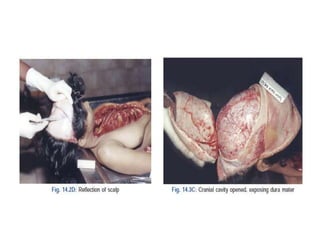
Dissecting cranial cavity
• Includes;
- sculp incision
- removing the skull cap
- opening the duramater
- removing the brain
- dissection of brain matter
Examine; any inuries, fractures, hemorrhages,
congenital anomalies
Dissection of thoracic and abdominal
cavities.
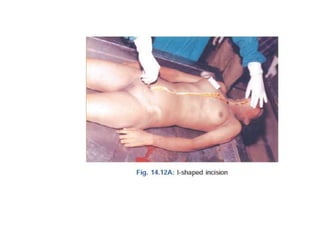
- Incision:
- I shaped, y or modified y.
- Removal of abdominal and thoracic viscera
- Open the cavities to expose internal organs.
- Examine the cavites for fat , pus, blood or any
hemorrhage
- Examine organs one by one
- Closing the body
- Handing over of the body
Dissection of Heart
• Holding it at its apex and cutting the aorta and
pulmonary vessels as far away as possible from
base, separate the heart.
• dissected in the direction of blood flow
• Pass a forceps through the openings of superior
and inferior vena cava and by cutting between
the arms of forceps, open the right atrium.
Open the auricular appendage and look for the
thrombi, if any.
Cont’d
• Examine right ventricle through tricuspid
valve and assess its size (normally three
fingers can be introduced easily).
• Introduce a long pointed knife through it and
pierce the apex and cut along the right lateral
margin in one stroke the thickness
• Examine the valve cusps.
Cont’d
From the apex cut open the pulmonary artery,
along its long axis and examine the valve, cusps
and look for the presence of any embolus.
• pass the scissors into pulmonary veins, jointly
cut them and enter into left atrium Cut the left
auricular appendage and look for the thrombus, if
any.
• Introduce fingers into mitral valve and examine it
• examine the wall, valves, papillary muscles,
chordae tendinae, septum, etc.
Cont’d
• open the aorta from left ventricle and
examine the aortic valve and coronary ostia.
• Coronaries are dissected longitudinally or by
serial sectioning along their course for their
patency.
• Heart is preferably weighed after its
dissection.
Special Procedures for Specific Cases
• These vary according to types of cases, and are enumerated
below and discussed separately:
• Poisoning
• Mechanical asphyxia such as hanging, strangulation,
drowning, etc.
• Burns
• Criminal abortion
• Road traffic accident
• Newborn/infant/foetus—infanticide case
• Firearm injurieExhumation
• Examination of skeletal remains.
Poisoning Case
Take care to note following observations as
found during the autopsy examination:
• Smell
• Color of PM stain
• Froth around mouth and nostrils
• Corrosions
• Any injuries, fang marks, etc.
• Gastrointestinal tract findings.
Hanging/Strangulation Cases
• Take care note of the following:
• Ligature material and mark
• Salivary dribbling marks
• Face findings (eyes, pupils, and tongue)
• Injuries to spinal vertebrae.
• Bloodless dissection of neck
• Here the cranial and thoracoabdominal cavities
are dissected first, and neck and neck structures
dissected last
Firearms Injuries
• Note the following during the autopsy
examination:
• Clothes
• Cadaveric spasm
• Radiological examination
• Details of wound (terminal ballistics)
• Projectile if any must be collected, preserved
properly with
• proper marking
Drowning
Note the following during the autopsy examination:
• Changes in hand, feet, skin, etc.
• Froth around mouth and nostrils
• Cadaveric spasm
• Injuries (reconstruction of case)
• Air passages and lungs
• Diatom test
• Viscera for chemical examination
Burns
Note
• Smell
• Nature of burns (note antemortem/
postmortem, by looking for vital changes)
• Age of burns or time since burns injury
• Color of postmortem stains
• Presence of soot particles in air passages
suggestive of antemortem burns.
Criminal Abortion
Note:
• Evidence of pregnancy and gestation period
• Criminal abortion—evidence
• Toxic substance—evidence
• Sepsis, emboli, complications, etc.
Road Traffic Accidents
• All injuries must be described
• Any foreign particles—preserved
• Alcohol—stomach, blood, urine
• Eyes—vision impairment evidence
NEGATIVE AND OBSCURE AUTOPSY
• It is a fact that a medicolegal autopsy result
may not be favorable in deciding every case.
• It could be negative or obscure
Negative Autopsy
• An autopsy, which fails to reveal the cause of
death with gross,microscopic, toxicologic and
other laboratory investigations.
Causes
• Inadequate history especially in cases of death due to
vagal inhibition, hypersensitivity, etc.
• Lapses in external examination as in case of death due
to snake bite, other insect stinging, etc.
• Inadequate or improper internal examination, e.g. air
embolism or pneumothorax missed.
• Insufficient laboratory examination.
• Lack of toxicological analysis
• Lack of proper training to perform an autopsy properly.
Obscure Autopsy
• An autopsy done meticulously, properly and
perfectly, but
• present with no clear-cut findings as to give a
definite cause of death
Causes
1. Natural causes such as:
• Obscure morbid anatomy
• Obscure histopathology
• Emotional causes
• Paroxysmal fibrillation, etc.
2. Biochemical disturbances like uremia, diabetes, etc.
3. Concealed trauma, such as concealed punctured wound.
4. Endocrine disturbances such as conceded fimctired wound.
5. Poisoning due to: Anaesthetic over-dosage
6. Miscellaneous—such as putrefied body
Medicolegal Importance of Negative
or Obscure Autopsy
1. In autopsies, which are obscure, medical
examiner must not hesitate to state that no
opinion can be given regarding the cause of
death.
2. No doctor should entertain a guesswork in
establishing cause of death for the reason that
medicolegal autopsy is to exclude foul play
and derive justice
FETAL AUTOPSY
foetal autopsy is alsoan essential work done by a
medicolegal expert.
The various aspects of fetal autopsy can be studied under
following heads.
• Objectives
ascertain the following:
• What is the intrauterine age of the fetus?
• Is it viable or not?
• If viable, is it liveborn or not?
• If liveborn, how long did it survive after birth?
• If yes, ascertain the intrauterine age of the fetus.
Legal Formalities
• Investigating police officer has to give a
requisition for the fetal autopsy with brief
history of the case.
• The special objectives in a case of infanticide
require certain special examinations and tests
to be done besides the routine dissection to
find out the cause of death.
• A detailed examination is done
External Examination
• A thorough external examination is done noting following
facts;
• Clothes and wrappings
• Postmortem changes
• Signs of maceration; the skin of the macerated fetus is
coppery red in colour.
- The body parts are flaccid and flat when placed on a table.
- The bones appear to be separated.
- Umbilical cord tied or torn, or with signs of inflammation.
• Placenta—note whether attached or not, measure the
weight, and look for any infarcts, disease, etc
• Signs of maturity (intrauterine age and viability)
- Crown heel/rump length with a flexible tape
- Weight
- Midpoint of body in relation to sternum and umbilicus.
- Skin—wrinkled or smooth with presence of fat, covered
- Nails—appeared or not. If present–extent of growth.
- Scalp hairs—appeared or not.
- Eyelashes and eyebrows—appeared or not.
- Eyelids—adherent or open.
- Testicles—ascertain the position by incising the scrotum
and inguinal canal if necessary
Cont’d
• Ossification centres:
• Special emphasis may be given to
• note for ossification status of
• certain bones only in certain parts of the body
by special procedures of dissection of
Knee joints
Ankle bones
• Sternum:
• Sacral segments
• Cyanosis—look for this in the face, and
fingernails.
• Caput succedaneum—over the head (scalp) or
buttocks.
Internal Examination
• Examination of Skull and Brain
• Reflect scalp as usual and cut through the
membranous connections of the skull bones.
Look for bruising of the scalp,
• fracture of skull bones, site and extent of caput,
moulding, tears in membranes, hemorrhage in
meninges, puncture in anterior fontanel, etc.
• Remove and examine the brain
Examination of Thorax and Abdomen
• Make a midline incision from chin to pubis avoiding umbilicus
• Open the abdomen first and ascertain level of diaphragm. Then
reflect the chest muscles, remove the sternal plate exposing the
viscera.
• Note position of heart and lungs in situ
• The floor of the mouth, larynx and deeper tissues of the neck are
now examined—for foreign bodies, mucus, meconium and marks of
violence.
• Ligate the trachea halfway to its bifurcation to prevent foreign
• Remove the thoracic organs enmasse by gentle traction.
• Put the whole piece consisting of the heart, thymus and both the
lungs in a tall jar containing water and note whether it sinks or
floats.
Cont’d
• Look for the presence of Tardieu’s spots under the
serous membranes.
• Open the trachea and bronchi and note down the
contents.
• Remove the lungs and heart.
• Examine the heart through the ventricles and note any
difference in colour of blood on two sides.
• Examine the lungs for its weight, colour, consistency,
edges, presence of distended air cells under pleura,
crepitation and for conditions like collapse or
consolidation.
• Perform hydrostatic test at this stage.
HYDROSTATIC TEST/
FLOATATION TEST
• Hydrostatic test is a test done to confirm whether the lungs tested are
from a respired newborn or not.
Principle
• If the newborn has respired after birth, the air that has entered the lungs
shall remain within the lungs as residual air, which cannot be removed
even after death, renders the lung lighter and makes it float in water
giving positive result.
Procedure
• Put each lung separately into a jar of water, see whether it sinks or floats.
• Cut each into 10 to 12 pieces observe the blood exuding.
Test each of them for buoyancy.
• Pick up the floating pieces, and press firmly under water.
• Observe the nature of bubbles streaming up. Note whether they continue
to float or not.
Interpretation
• If the entire lung floats, it means that the child had not
only respired but respiration had been completely
established.
• In the absence of putrefaction this test itself is conclusive.
• If some pieces float but others sink, the child has of course
respired but for a very short period and ineffectively. Yet it
is a live born child.
• If all pieces sink, the child never respired and is stillborn.
disadvantages
• Putrefaction:
• An unrespired lung may float due to gases of
decomposition.
STOMACH BOWEL TEST
(BRESLAU’S SECOND LIFE TEST)
• Test is done to determine whether the child was born alive
or not.
Principle
• Some air is swallowed during respiration in a live born child
and detecting the presence of this air in these viscera
constitutes the basis for this test.
Procedure
• Remove stomach and duodenum separately by cutting in
• ligatures.
• Place them both in water. See whether they float or sink.
• f they float, make a small cut while under water to see air-
• bubbles coming up.
Cont’d
• A floating viscera giving out air-bubbles when
opened under
• water is positive test and suggestive of live birth.
• A positive test proves live birth even in the
absence of a positive hydrostatic lung test.
• A negative test does not mean stillbirth since air
does not necessarily enter stomach in adequate
amounts during the breathing act.
• Putrefaction invalidates the result.
Other Findings Suggestive of Live Birth
• Open the stomach along the greater curvature
and look for mucus and milk.
• Examine the large bowel for meconium and
urinary bladder for urine, presence of which
indicates that the child had lived for some
time.
• The umbilical vessels are removed and
examined histologically, which is of help in
determining exactly how long the child, lived.
AGE OF THE FETUS
• Determination of age of the fetus (is very
essentiaL and crucial in cases such as:
• Infanticide: A child which has completed 7
months of IU development is deemed viable,
i.e. capable of being born alive and reared.
• Criminal abortion: is abortion induced after
14-18 weeks hence need for punishment
WHETHER THE CHILD WAS BORN
ALIVE OR NOT
• A charge of infanticide can be sustained only
when it is proved that the child was born alive,
and it was killed by criminal means
• Live born child is one, which is partly or wholly
born external to the mother and showed
some signs of life.
Cont’d
Dead Born Child
• It is diagnosed by the presence of maceration, i.e. a
peculiar change that a dead fetus undergoes when it
remains in the uterus without being expelled.
Stillborn Child
• After being born the child never showed any sign of life. It
might have died during deliver y. It shows neither the signs
of maceration nor positive signs of live birth. A complete
autopsy may give the cause of stillbirth.
• Check for;
1. Signs of maceration
2. Signs of immaturity
Cont’d
3. Signs of respiration
4. Confirmatory signs of live birth:
MURDER, SUICIDE OR ACCIDENT
• Doctor’s responsibility in connection with a death
is only to determine, and often certify, the
medical “cause of death.
• For example, a stabbed person may be certified
as “stab injury of the chest.
• Medical cause of death requires further
clarification for legal purposes, into manner of
death, i.e. homicide, suicide, accident or natural
cause.
• Enter the manner of death on death certificate,
along with medical cause.
FIREARMS INJURIES
• distinction between murder,suicide or accident.
• Range of firing beyond arms length cannot be suicidal,
unless otherwise certain special mechanical devices are
used.
• Absence of weapon at the scene of death excludes
suicide.
• Homiciders usually choose sites like inaccessible parts
of the body (for a victim)–such as back of the neck or
trunk.
• Regarding wounds inflicted on eyes, back of the head,
abdomen, etc. accident or murder is highly likely.
• A doctor has to take note all factors in firearm injury
KNIFE WOUNDS
• Suicidal knife wounds have a characteristic pattern, though
a murderer can even simulate these very occasionally.
Suicide shows;
• Presence of tentative cuts or hesitation cuts
• Site—usually seen on the wrist, throat, etc.
• In right-handed victims, the cuts in the throat are often
deepest on the left side while it tails off to the right,
passing obliquely downwards across the larynx, which may
be badly damaged.
Homicidal cut throat is usually more severe and lacks tentative
cuts.
• Homicidal cut wounds are usually deep even into the
vertebral column.
Cont’d
• In self-destruction, the stabs are most often into chest,
though some may be made into the head through skull.
• Abdominal wounds are uncommon, as are gunshots, as
death may be uncertain or lingering and painful.
• Suicidal chest wounds are usually over left side
• Stabs are usually single, but multiple stab wounds
indicate homicide
• Many of the suicides who stab themselves in the chest,
pull aside the clothing first, a feature which may be
useful in interpreting the motive, as homicidal
stabbings invariably penetrate the clothing
Cont’d
• Homicidal stab wounds have no particular
characteristics and can only be identified if
they are into inaccessible parts of the body
such as the back or if the weapon is present at
the scene of death.
• Fatal accidental stab wounds with knives is
unusual, but may occur in butchers,
slaughtermen, etc.
HANGING, STRANGULATION AND
SUFFOCATION
• Asphyxial deaths give rise to considerable difficulties for doctor and
investigators in distinguishing between accident, suicide and
homicide.
• Hanging is almost always suicidal
• Hanging is very rare and unless the victim is drugged or drunk,
hanging cannot be accomplished in resisting conscious person,
unless restrained by tying up, etc.
• Self-strangulation is virtually impossible with the hands.
• In ligature strangulation, whether murder or suicide, the mark on
the neck takes generally a horizontal course, even though this might
be high up under the chin and angles of the jaw.
• In hanging, there is usually a rising ligature mark to the place where
the knot is situated, leaving a gap
• Strangulation In young
adolescent/adults/even middle-aged, sexual
asphyxia must be thought.
• These activities usually amount to accidental
hanging, here death not being intended by the
man who is indulging in sexual fantasies
• The police often who are unaware of this may
label the death as suicide or even murder
Cont’d
• Suffocation, by external soft fabrics, pillows,
cushions and plastic sheets almost never leaves
any signs
• cannot differentiated from other natural deaths
if the obstructing object is removed before the
doctor or other witness attends the scene.
• Sufficient pressure exerted may cause abrasion;
contusion, etc. which may create suspicions.
DROWNING
• In drowning again it is circumstances, which will be
more helpful in distinguishing the manner of death.
• E.g removal of clothing, spectacles, etc. and kept on
the river banks are suggestive of suicide than accident
or homicide.
• A full examination of dead body is essential to exclude
natural diseases, which may have caused a fall into
water, and injuries sustained before entering
• Tying of hands and legs/tying some heavy objects like
stone, by a determined suicider need to be convinced
that the tying is by the victim himself or herself
SELECTED SPECIAL PROCEDURE OF
AUTOPSY
• Certain selected autopsy procedures and techniques that are
• helpful in the routine performance of medicolegal postmortem
• examinations are discussed include:
• Demonstration of air embolism
• Demonstration of pneumothorax
• Demonstration of thrombi in the calves
• Reconstruction of the skull for personal identification and
determination of type of violence
• Removal of the jaw for dental identification
• Removal of spinal cord by anterior approach
• Fixation of the brain
• Autopsy photography.

postmortem examination.pptx

  • 2.
  • 3.
    • Also calledautopsy examination or necropsy • Autopsy examination is the methodical dissection of a dead body.
  • 4.
    Classification • Three types 1.Clinical or pathological autopsy; - detemines the disease causing death. It is performed when relatives give consent 2. Medicolegal autopsy; - Performed to solve mysterious unnatural death. - Done with authorization by the state 3. Anatomical autopsy;
  • 5.
    3. Anatomical autopsy; -donein order to study the normal structure of the human body. This is done mostly on the unclaimed bodies handed over to anatomy.
  • 6.
    Consent for autopsy •Clinical autopsy, obtain consent from relatives • Medical legal autopsy, no consent from relatives bbut legal permission is a must • Anatomical autopsy, no consent is needed.
  • 7.
    Medicolegal autopsy • Isa special type of autopsy ordered by the state in all unnatural deaths eg homicides, suicide, accident Objectives: - Identity of the deceased - Time since death - Cause of death
  • 8.
    Flow chart forcause of death
  • 9.
    Legal formalities • Authorizationorder • Identification of the deceased • Facts about the case • Place of performing autopsy • Qualifications Other formalities - Do a pm as soon as possible - Don’t allow unauthosized people in the mortuary - Prepare the report immediately
  • 10.
    Procedure of medicolegalautopsy • External examination - Most important part of the medicaolegal autopsy as most information is gathered during the examination - These include; clothes, stains, identity, body orifices, fingers, injuries, rigor mortis, decomposition
  • 11.
    Internal examination • Includesdissection and examination of the three major cavities - Dissection of the skull/cranial cavity - Dissection of the thoracic cavity - Dissection of abdominal cavity All body organs should be examination meticulously and in detail.
  • 14.
    Dissecting cranial cavity •Includes; - sculp incision - removing the skull cap - opening the duramater - removing the brain - dissection of brain matter Examine; any inuries, fractures, hemorrhages, congenital anomalies
  • 17.
    Dissection of thoracicand abdominal cavities. - Incision: - I shaped, y or modified y. - Removal of abdominal and thoracic viscera - Open the cavities to expose internal organs. - Examine the cavites for fat , pus, blood or any hemorrhage - Examine organs one by one - Closing the body - Handing over of the body
  • 21.
    Dissection of Heart •Holding it at its apex and cutting the aorta and pulmonary vessels as far away as possible from base, separate the heart. • dissected in the direction of blood flow • Pass a forceps through the openings of superior and inferior vena cava and by cutting between the arms of forceps, open the right atrium. Open the auricular appendage and look for the thrombi, if any.
  • 22.
    Cont’d • Examine rightventricle through tricuspid valve and assess its size (normally three fingers can be introduced easily). • Introduce a long pointed knife through it and pierce the apex and cut along the right lateral margin in one stroke the thickness • Examine the valve cusps.
  • 23.
    Cont’d From the apexcut open the pulmonary artery, along its long axis and examine the valve, cusps and look for the presence of any embolus. • pass the scissors into pulmonary veins, jointly cut them and enter into left atrium Cut the left auricular appendage and look for the thrombus, if any. • Introduce fingers into mitral valve and examine it • examine the wall, valves, papillary muscles, chordae tendinae, septum, etc.
  • 24.
    Cont’d • open theaorta from left ventricle and examine the aortic valve and coronary ostia. • Coronaries are dissected longitudinally or by serial sectioning along their course for their patency. • Heart is preferably weighed after its dissection.
  • 25.
    Special Procedures forSpecific Cases • These vary according to types of cases, and are enumerated below and discussed separately: • Poisoning • Mechanical asphyxia such as hanging, strangulation, drowning, etc. • Burns • Criminal abortion • Road traffic accident • Newborn/infant/foetus—infanticide case • Firearm injurieExhumation • Examination of skeletal remains.
  • 26.
    Poisoning Case Take careto note following observations as found during the autopsy examination: • Smell • Color of PM stain • Froth around mouth and nostrils • Corrosions • Any injuries, fang marks, etc. • Gastrointestinal tract findings.
  • 27.
    Hanging/Strangulation Cases • Takecare note of the following: • Ligature material and mark • Salivary dribbling marks • Face findings (eyes, pupils, and tongue) • Injuries to spinal vertebrae. • Bloodless dissection of neck • Here the cranial and thoracoabdominal cavities are dissected first, and neck and neck structures dissected last
  • 28.
    Firearms Injuries • Notethe following during the autopsy examination: • Clothes • Cadaveric spasm • Radiological examination • Details of wound (terminal ballistics) • Projectile if any must be collected, preserved properly with • proper marking
  • 29.
    Drowning Note the followingduring the autopsy examination: • Changes in hand, feet, skin, etc. • Froth around mouth and nostrils • Cadaveric spasm • Injuries (reconstruction of case) • Air passages and lungs • Diatom test • Viscera for chemical examination
  • 30.
    Burns Note • Smell • Natureof burns (note antemortem/ postmortem, by looking for vital changes) • Age of burns or time since burns injury • Color of postmortem stains • Presence of soot particles in air passages suggestive of antemortem burns.
  • 31.
    Criminal Abortion Note: • Evidenceof pregnancy and gestation period • Criminal abortion—evidence • Toxic substance—evidence • Sepsis, emboli, complications, etc.
  • 32.
    Road Traffic Accidents •All injuries must be described • Any foreign particles—preserved • Alcohol—stomach, blood, urine • Eyes—vision impairment evidence
  • 33.
    NEGATIVE AND OBSCUREAUTOPSY • It is a fact that a medicolegal autopsy result may not be favorable in deciding every case. • It could be negative or obscure Negative Autopsy • An autopsy, which fails to reveal the cause of death with gross,microscopic, toxicologic and other laboratory investigations.
  • 34.
    Causes • Inadequate historyespecially in cases of death due to vagal inhibition, hypersensitivity, etc. • Lapses in external examination as in case of death due to snake bite, other insect stinging, etc. • Inadequate or improper internal examination, e.g. air embolism or pneumothorax missed. • Insufficient laboratory examination. • Lack of toxicological analysis • Lack of proper training to perform an autopsy properly.
  • 35.
    Obscure Autopsy • Anautopsy done meticulously, properly and perfectly, but • present with no clear-cut findings as to give a definite cause of death
  • 36.
    Causes 1. Natural causessuch as: • Obscure morbid anatomy • Obscure histopathology • Emotional causes • Paroxysmal fibrillation, etc. 2. Biochemical disturbances like uremia, diabetes, etc. 3. Concealed trauma, such as concealed punctured wound. 4. Endocrine disturbances such as conceded fimctired wound. 5. Poisoning due to: Anaesthetic over-dosage 6. Miscellaneous—such as putrefied body
  • 37.
    Medicolegal Importance ofNegative or Obscure Autopsy 1. In autopsies, which are obscure, medical examiner must not hesitate to state that no opinion can be given regarding the cause of death. 2. No doctor should entertain a guesswork in establishing cause of death for the reason that medicolegal autopsy is to exclude foul play and derive justice
  • 38.
    FETAL AUTOPSY foetal autopsyis alsoan essential work done by a medicolegal expert. The various aspects of fetal autopsy can be studied under following heads. • Objectives ascertain the following: • What is the intrauterine age of the fetus? • Is it viable or not? • If viable, is it liveborn or not? • If liveborn, how long did it survive after birth? • If yes, ascertain the intrauterine age of the fetus.
  • 39.
    Legal Formalities • Investigatingpolice officer has to give a requisition for the fetal autopsy with brief history of the case. • The special objectives in a case of infanticide require certain special examinations and tests to be done besides the routine dissection to find out the cause of death. • A detailed examination is done
  • 40.
    External Examination • Athorough external examination is done noting following facts; • Clothes and wrappings • Postmortem changes • Signs of maceration; the skin of the macerated fetus is coppery red in colour. - The body parts are flaccid and flat when placed on a table. - The bones appear to be separated. - Umbilical cord tied or torn, or with signs of inflammation. • Placenta—note whether attached or not, measure the weight, and look for any infarcts, disease, etc
  • 41.
    • Signs ofmaturity (intrauterine age and viability) - Crown heel/rump length with a flexible tape - Weight - Midpoint of body in relation to sternum and umbilicus. - Skin—wrinkled or smooth with presence of fat, covered - Nails—appeared or not. If present–extent of growth. - Scalp hairs—appeared or not. - Eyelashes and eyebrows—appeared or not. - Eyelids—adherent or open. - Testicles—ascertain the position by incising the scrotum and inguinal canal if necessary
  • 42.
    Cont’d • Ossification centres: •Special emphasis may be given to • note for ossification status of • certain bones only in certain parts of the body by special procedures of dissection of Knee joints Ankle bones
  • 43.
    • Sternum: • Sacralsegments • Cyanosis—look for this in the face, and fingernails. • Caput succedaneum—over the head (scalp) or buttocks.
  • 44.
    Internal Examination • Examinationof Skull and Brain • Reflect scalp as usual and cut through the membranous connections of the skull bones. Look for bruising of the scalp, • fracture of skull bones, site and extent of caput, moulding, tears in membranes, hemorrhage in meninges, puncture in anterior fontanel, etc. • Remove and examine the brain
  • 45.
    Examination of Thoraxand Abdomen • Make a midline incision from chin to pubis avoiding umbilicus • Open the abdomen first and ascertain level of diaphragm. Then reflect the chest muscles, remove the sternal plate exposing the viscera. • Note position of heart and lungs in situ • The floor of the mouth, larynx and deeper tissues of the neck are now examined—for foreign bodies, mucus, meconium and marks of violence. • Ligate the trachea halfway to its bifurcation to prevent foreign • Remove the thoracic organs enmasse by gentle traction. • Put the whole piece consisting of the heart, thymus and both the lungs in a tall jar containing water and note whether it sinks or floats.
  • 46.
    Cont’d • Look forthe presence of Tardieu’s spots under the serous membranes. • Open the trachea and bronchi and note down the contents. • Remove the lungs and heart. • Examine the heart through the ventricles and note any difference in colour of blood on two sides. • Examine the lungs for its weight, colour, consistency, edges, presence of distended air cells under pleura, crepitation and for conditions like collapse or consolidation. • Perform hydrostatic test at this stage.
  • 47.
    HYDROSTATIC TEST/ FLOATATION TEST •Hydrostatic test is a test done to confirm whether the lungs tested are from a respired newborn or not. Principle • If the newborn has respired after birth, the air that has entered the lungs shall remain within the lungs as residual air, which cannot be removed even after death, renders the lung lighter and makes it float in water giving positive result. Procedure • Put each lung separately into a jar of water, see whether it sinks or floats. • Cut each into 10 to 12 pieces observe the blood exuding. Test each of them for buoyancy. • Pick up the floating pieces, and press firmly under water. • Observe the nature of bubbles streaming up. Note whether they continue to float or not.
  • 48.
    Interpretation • If theentire lung floats, it means that the child had not only respired but respiration had been completely established. • In the absence of putrefaction this test itself is conclusive. • If some pieces float but others sink, the child has of course respired but for a very short period and ineffectively. Yet it is a live born child. • If all pieces sink, the child never respired and is stillborn. disadvantages • Putrefaction: • An unrespired lung may float due to gases of decomposition.
  • 49.
    STOMACH BOWEL TEST (BRESLAU’SSECOND LIFE TEST) • Test is done to determine whether the child was born alive or not. Principle • Some air is swallowed during respiration in a live born child and detecting the presence of this air in these viscera constitutes the basis for this test. Procedure • Remove stomach and duodenum separately by cutting in • ligatures. • Place them both in water. See whether they float or sink. • f they float, make a small cut while under water to see air- • bubbles coming up.
  • 50.
    Cont’d • A floatingviscera giving out air-bubbles when opened under • water is positive test and suggestive of live birth. • A positive test proves live birth even in the absence of a positive hydrostatic lung test. • A negative test does not mean stillbirth since air does not necessarily enter stomach in adequate amounts during the breathing act. • Putrefaction invalidates the result.
  • 51.
    Other Findings Suggestiveof Live Birth • Open the stomach along the greater curvature and look for mucus and milk. • Examine the large bowel for meconium and urinary bladder for urine, presence of which indicates that the child had lived for some time. • The umbilical vessels are removed and examined histologically, which is of help in determining exactly how long the child, lived.
  • 52.
    AGE OF THEFETUS • Determination of age of the fetus (is very essentiaL and crucial in cases such as: • Infanticide: A child which has completed 7 months of IU development is deemed viable, i.e. capable of being born alive and reared. • Criminal abortion: is abortion induced after 14-18 weeks hence need for punishment
  • 53.
    WHETHER THE CHILDWAS BORN ALIVE OR NOT • A charge of infanticide can be sustained only when it is proved that the child was born alive, and it was killed by criminal means • Live born child is one, which is partly or wholly born external to the mother and showed some signs of life.
  • 54.
    Cont’d Dead Born Child •It is diagnosed by the presence of maceration, i.e. a peculiar change that a dead fetus undergoes when it remains in the uterus without being expelled. Stillborn Child • After being born the child never showed any sign of life. It might have died during deliver y. It shows neither the signs of maceration nor positive signs of live birth. A complete autopsy may give the cause of stillbirth. • Check for; 1. Signs of maceration 2. Signs of immaturity
  • 55.
    Cont’d 3. Signs ofrespiration 4. Confirmatory signs of live birth:
  • 56.
    MURDER, SUICIDE ORACCIDENT • Doctor’s responsibility in connection with a death is only to determine, and often certify, the medical “cause of death. • For example, a stabbed person may be certified as “stab injury of the chest. • Medical cause of death requires further clarification for legal purposes, into manner of death, i.e. homicide, suicide, accident or natural cause. • Enter the manner of death on death certificate, along with medical cause.
  • 57.
    FIREARMS INJURIES • distinctionbetween murder,suicide or accident. • Range of firing beyond arms length cannot be suicidal, unless otherwise certain special mechanical devices are used. • Absence of weapon at the scene of death excludes suicide. • Homiciders usually choose sites like inaccessible parts of the body (for a victim)–such as back of the neck or trunk. • Regarding wounds inflicted on eyes, back of the head, abdomen, etc. accident or murder is highly likely. • A doctor has to take note all factors in firearm injury
  • 58.
    KNIFE WOUNDS • Suicidalknife wounds have a characteristic pattern, though a murderer can even simulate these very occasionally. Suicide shows; • Presence of tentative cuts or hesitation cuts • Site—usually seen on the wrist, throat, etc. • In right-handed victims, the cuts in the throat are often deepest on the left side while it tails off to the right, passing obliquely downwards across the larynx, which may be badly damaged. Homicidal cut throat is usually more severe and lacks tentative cuts. • Homicidal cut wounds are usually deep even into the vertebral column.
  • 59.
    Cont’d • In self-destruction,the stabs are most often into chest, though some may be made into the head through skull. • Abdominal wounds are uncommon, as are gunshots, as death may be uncertain or lingering and painful. • Suicidal chest wounds are usually over left side • Stabs are usually single, but multiple stab wounds indicate homicide • Many of the suicides who stab themselves in the chest, pull aside the clothing first, a feature which may be useful in interpreting the motive, as homicidal stabbings invariably penetrate the clothing
  • 60.
    Cont’d • Homicidal stabwounds have no particular characteristics and can only be identified if they are into inaccessible parts of the body such as the back or if the weapon is present at the scene of death. • Fatal accidental stab wounds with knives is unusual, but may occur in butchers, slaughtermen, etc.
  • 61.
    HANGING, STRANGULATION AND SUFFOCATION •Asphyxial deaths give rise to considerable difficulties for doctor and investigators in distinguishing between accident, suicide and homicide. • Hanging is almost always suicidal • Hanging is very rare and unless the victim is drugged or drunk, hanging cannot be accomplished in resisting conscious person, unless restrained by tying up, etc. • Self-strangulation is virtually impossible with the hands. • In ligature strangulation, whether murder or suicide, the mark on the neck takes generally a horizontal course, even though this might be high up under the chin and angles of the jaw. • In hanging, there is usually a rising ligature mark to the place where the knot is situated, leaving a gap
  • 62.
    • Strangulation Inyoung adolescent/adults/even middle-aged, sexual asphyxia must be thought. • These activities usually amount to accidental hanging, here death not being intended by the man who is indulging in sexual fantasies • The police often who are unaware of this may label the death as suicide or even murder
  • 63.
    Cont’d • Suffocation, byexternal soft fabrics, pillows, cushions and plastic sheets almost never leaves any signs • cannot differentiated from other natural deaths if the obstructing object is removed before the doctor or other witness attends the scene. • Sufficient pressure exerted may cause abrasion; contusion, etc. which may create suspicions.
  • 64.
    DROWNING • In drowningagain it is circumstances, which will be more helpful in distinguishing the manner of death. • E.g removal of clothing, spectacles, etc. and kept on the river banks are suggestive of suicide than accident or homicide. • A full examination of dead body is essential to exclude natural diseases, which may have caused a fall into water, and injuries sustained before entering • Tying of hands and legs/tying some heavy objects like stone, by a determined suicider need to be convinced that the tying is by the victim himself or herself
  • 65.
    SELECTED SPECIAL PROCEDUREOF AUTOPSY • Certain selected autopsy procedures and techniques that are • helpful in the routine performance of medicolegal postmortem • examinations are discussed include: • Demonstration of air embolism • Demonstration of pneumothorax • Demonstration of thrombi in the calves • Reconstruction of the skull for personal identification and determination of type of violence • Removal of the jaw for dental identification • Removal of spinal cord by anterior approach • Fixation of the brain • Autopsy photography.