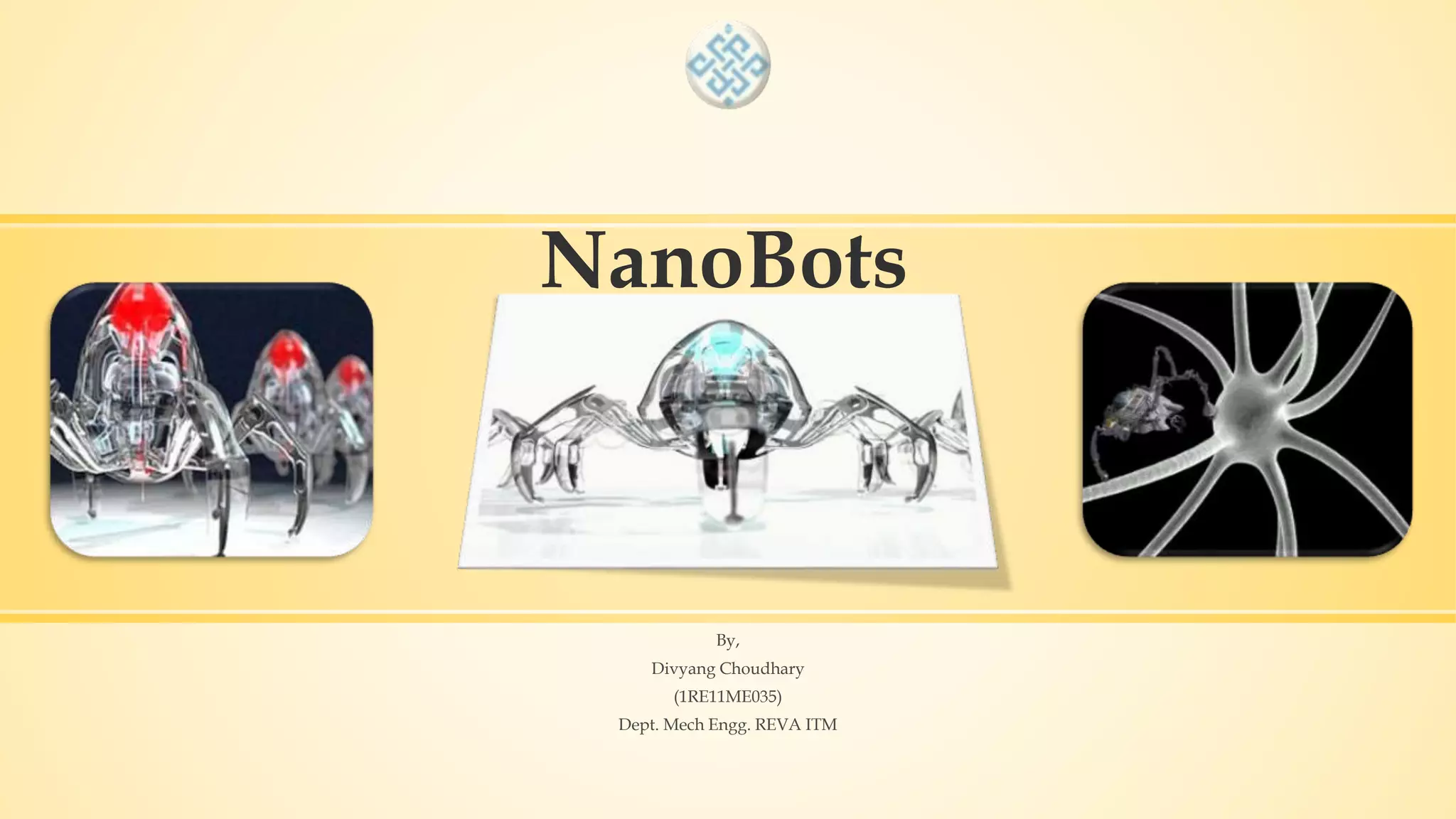
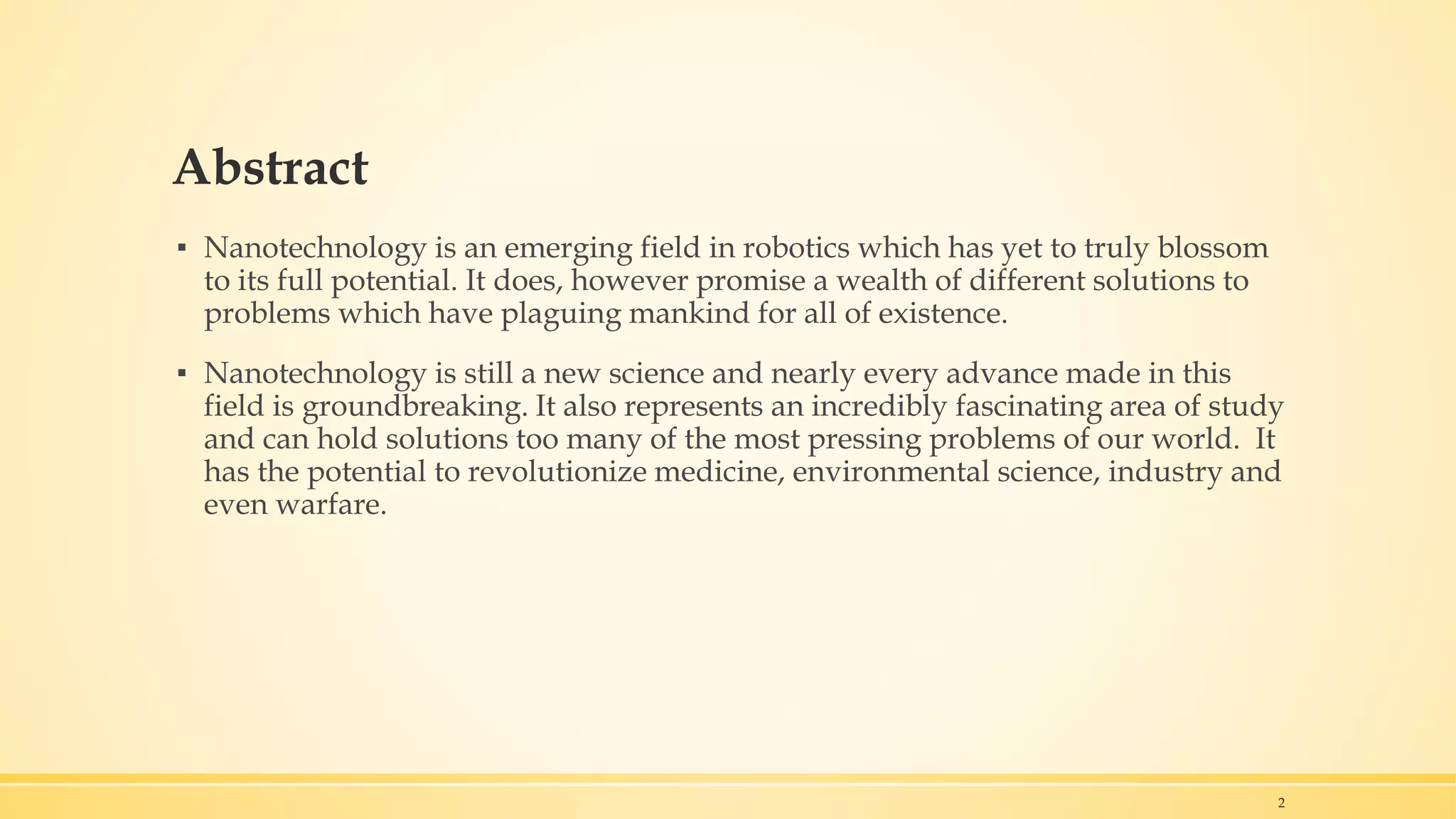
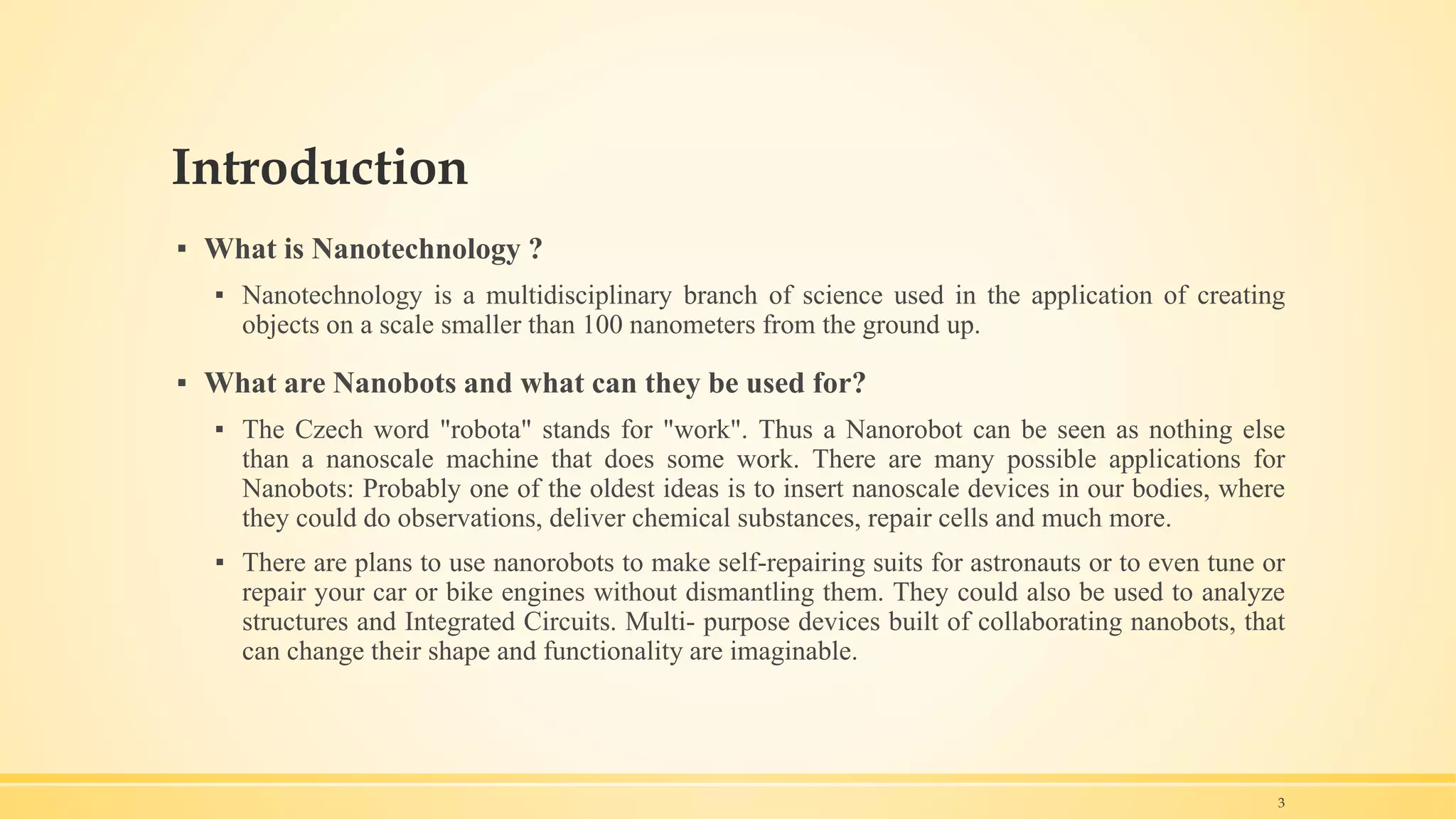
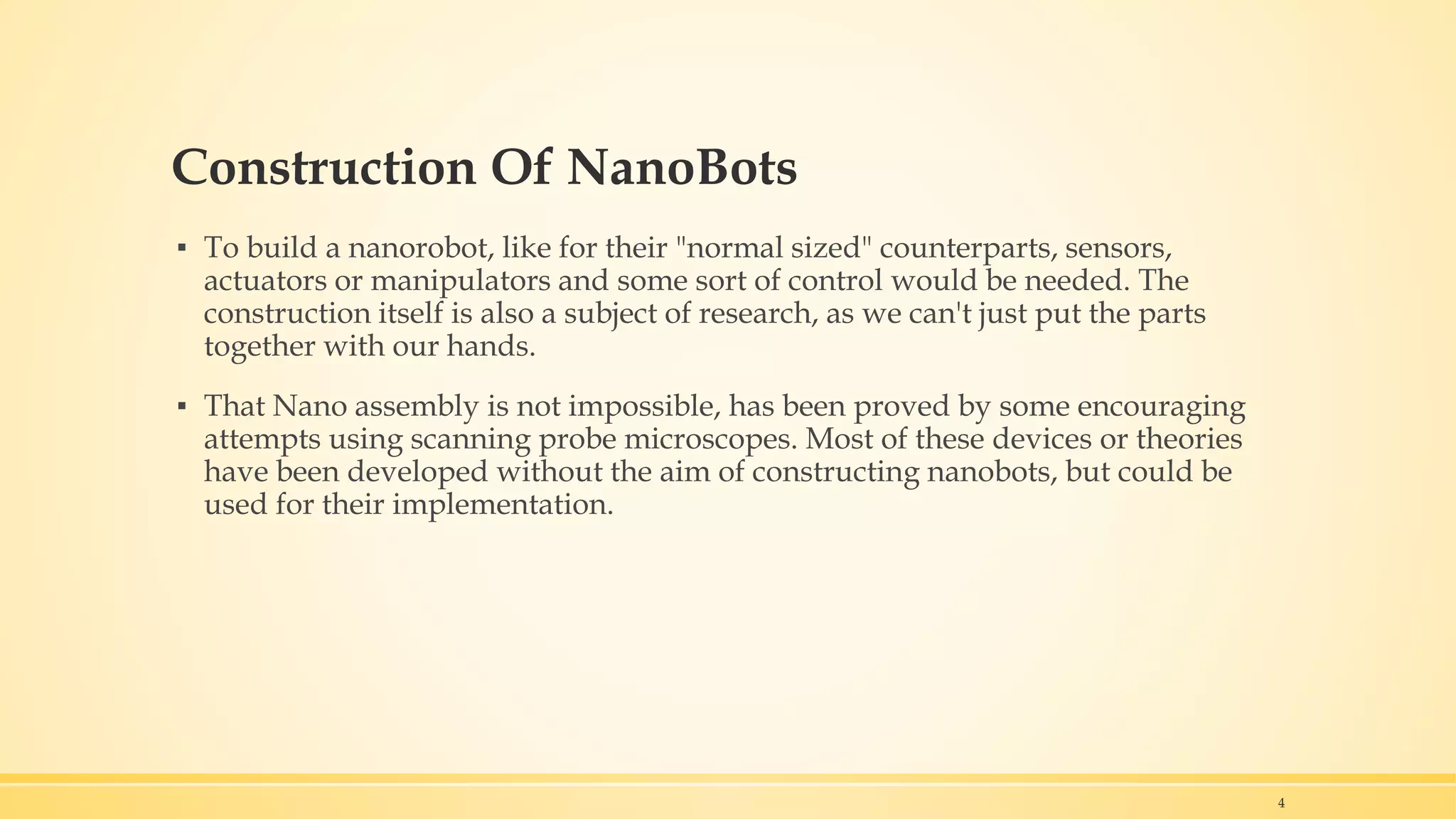



NanoBots
By,
Divyang Choudhary
(1RE11ME035)
Dept. Mech Engg. REVA ITM
Abstract
▪ Nanotechnology is an emerging field in robotics which has yet to truly blossom
to its full potential. It does, however promise a wealth of different solutions to
problems which have plaguing mankind for all of existence.
▪ Nanotechnology is still a new science and nearly every advance made in this
field is groundbreaking. It also represents an incredibly fascinating area of study
and can hold solutions too many of the most pressing problems of our world. It
has the potential to revolutionize medicine, environmental science, industry and
even warfare.
2
Introduction
▪ What is Nanotechnology ?
▪ Nanotechnology is a multidisciplinary branch of science used in the application of creating
objects on a scale smaller than 100 nanometers from the ground up.
▪ What are Nanobots and what can they be used for?
▪ The Czech word "robota" stands for "work". Thus a Nanorobot can be seen as nothing else
than a nanoscale machine that does some work. There are many possible applications for
Nanobots: Probably one of the oldest ideas is to insert nanoscale devices in our bodies, where
they could do observations, deliver chemical substances, repair cells and much more.
▪ There are plans to use nanorobots to make self-repairing suits for astronauts or to even tune or
repair your car or bike engines without dismantling them. They could also be used to analyze
structures and Integrated Circuits. Multi- purpose devices built of collaborating nanobots, that
can change their shape and functionality are imaginable.
3
Construction Of NanoBots
▪ To build a nanorobot, like for their "normal sized" counterparts, sensors,
actuators or manipulators and some sort of control would be needed. The
construction itself is also a subject of research, as we can't just put the parts
together with our hands.
▪ That Nano assembly is not impossible, has been proved by some encouraging
attempts using scanning probe microscopes. Most of these devices or theories
have been developed without the aim of constructing nanobots, but could be
used for their implementation.
4
How will they move?
▪ For most applications it is sufficient for nanobots to be able to float in a fluid,
what probably is easier to achieve than walking on a surface with big (micro-
scale) obstacles. But also floating in fluids can be tricky.
▪ A. A. G. Requicha stated in one of his papers that already structures in the
micro-scale range will have a Reynolds number in the range of 10-5 (Calculated
with typical speed 10 micrometer/s and typical length of 1 micrometer), and
thus will be in the low-Reynolds regime, which makes friction the dominant
force.
▪ He also mentions that it appears that below 600nm no self-propelled organism
can be found. Thus for small nanobots, diffusion should also be considered as a
way of transportation.
5
Controls in NanoBots
▪ Types Of Controls:
▪ Central Control:
▪ The advantage of this central control is that there are basically no limits to the computation and the
program complexity. In a task where you have a homogeneous group of Nanobots, performing the
same task simultaneously like in the Marsuit-Nanobots assemblers, this might be a good solution, as
you could just send one order to the whole group. But what if the tasks are not performed
simultaneously or you need feedback from the Nanobots?
▪ If so you will have to give every Nanobot a unique identification number, what will be a problem,
first, as the Nanobot will need on board computation to distinguish whether or not a message is sent
for them, and second, as soon as you have a larger group of Nanorobots, you might need thousands
of these identifiers.
▪ Simple control circuits:
▪ In many applications complex computing might not be needed. For drug delivery, it could be
sufficient for the Nanobot to diffuse in the blood circuit until a certain environmental condition
(some molecules, ph-value..) is present and then release the drug.
6
Controls in NanoBots (continued…)
▪ Swarming:
▪ There is an other, bio-inspired concept, called swarming. The main point about swarming is, that you
have relatively simple agents with limited capacities that, in collaboration with other agents, achieve a
performance that is much more than the sum of the individual performances.
▪ A termite swarm, for example, can do amazing things, while the single termites are quite simple. And
that is exactly what is needed for Nanorobot swarms. That the concept also works outside nature has
first been showed by Craig Reynolds in 1986, who made a bird-swarm animation based on it.
7
Computing in Nanoscale
▪ No matter if central control, swarming or an other concept is used to control
Nanobots, a certain on-board computation (and if it is only a switch) will always be
needed. In the following sites, different computing approaches are presented.
▪ Computing Approaches:
1. The universal Turing machine
2. Electro-Mechanical Approach
3. Field effect transistors
4. Quantum Electronics
5. Quantum Dot
6. Molecular Electronics
7. DNA Computing
8
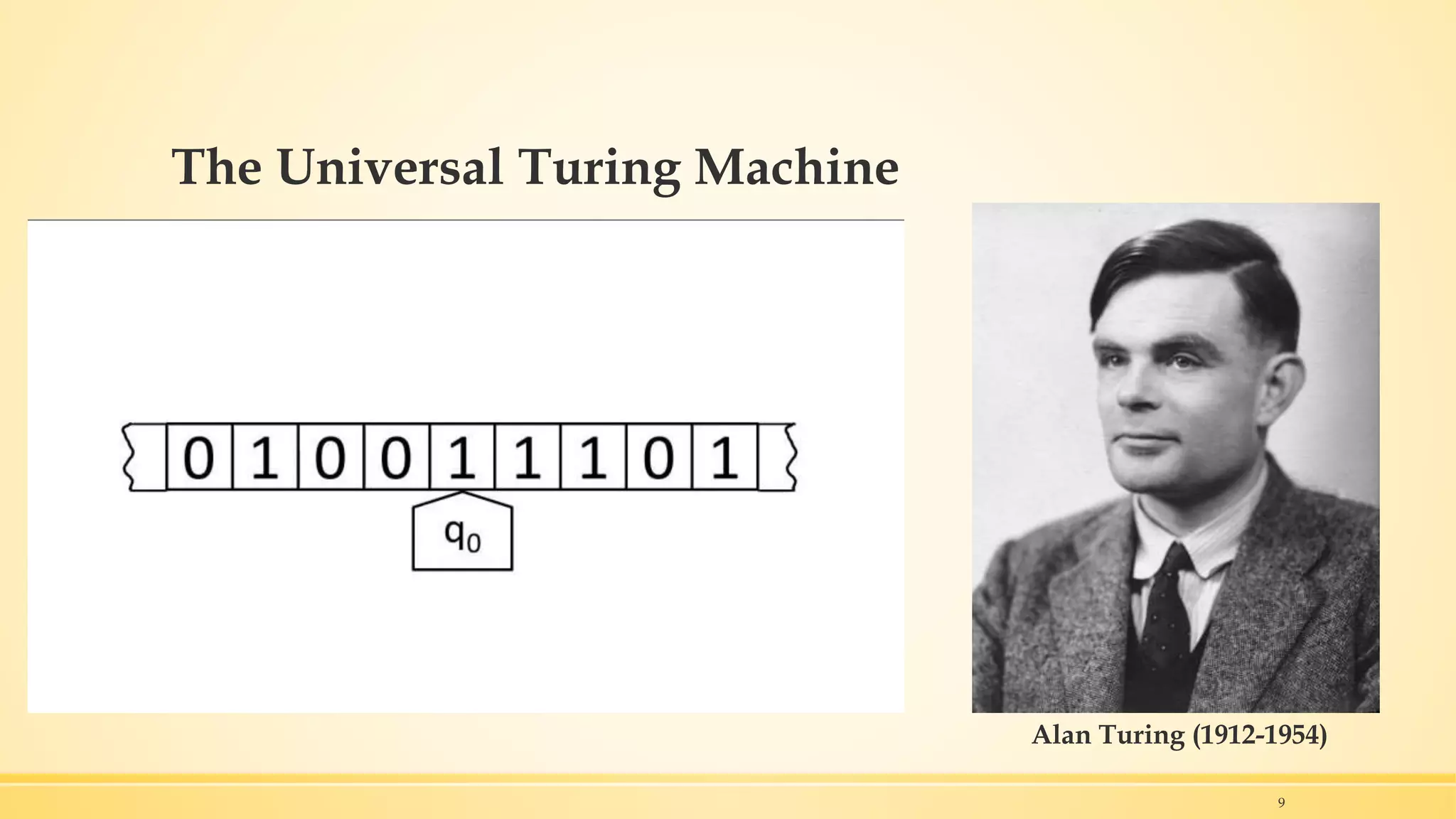
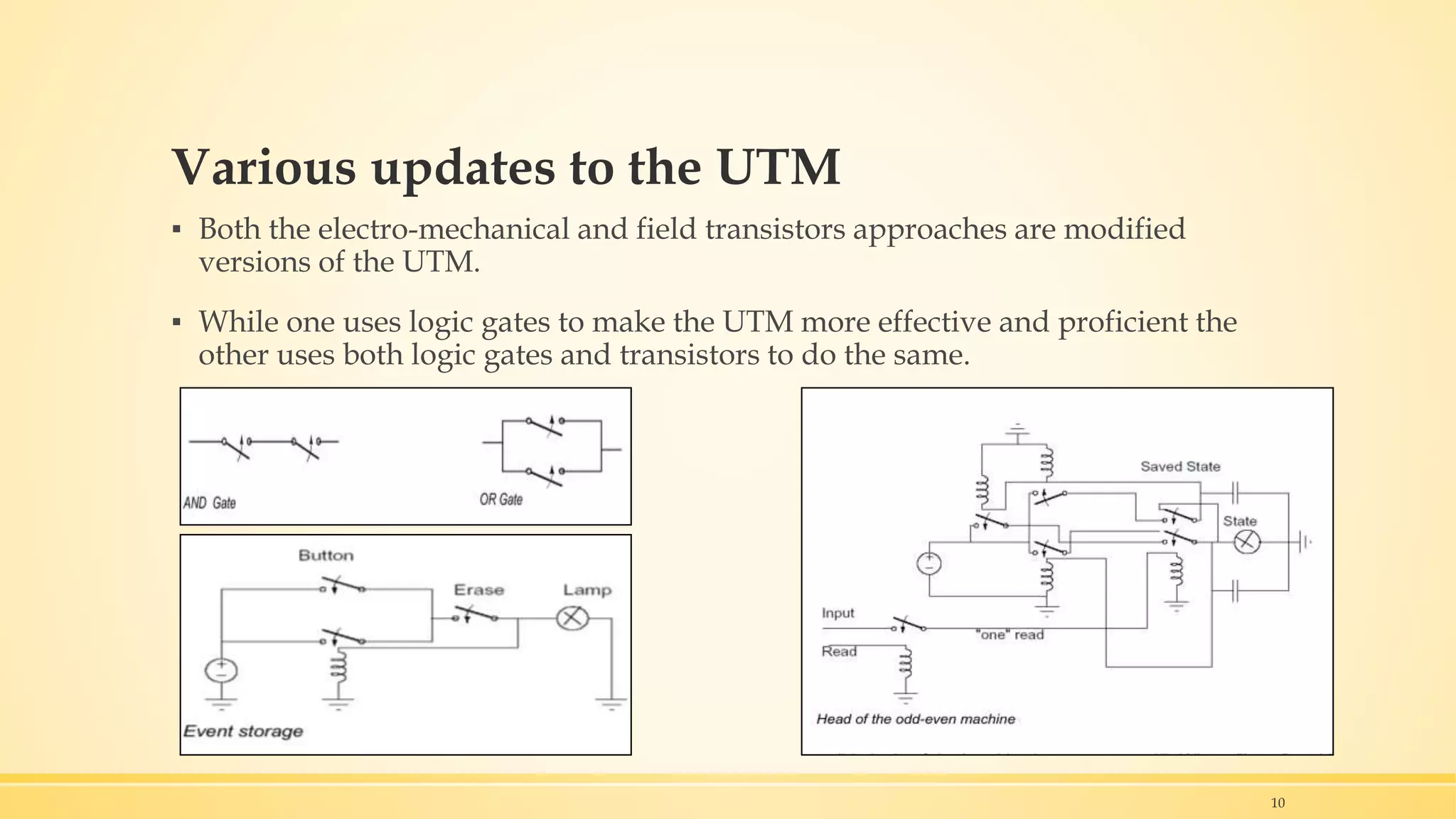
The Universal Turing Machine
Alan Turing (1912-1954)
9
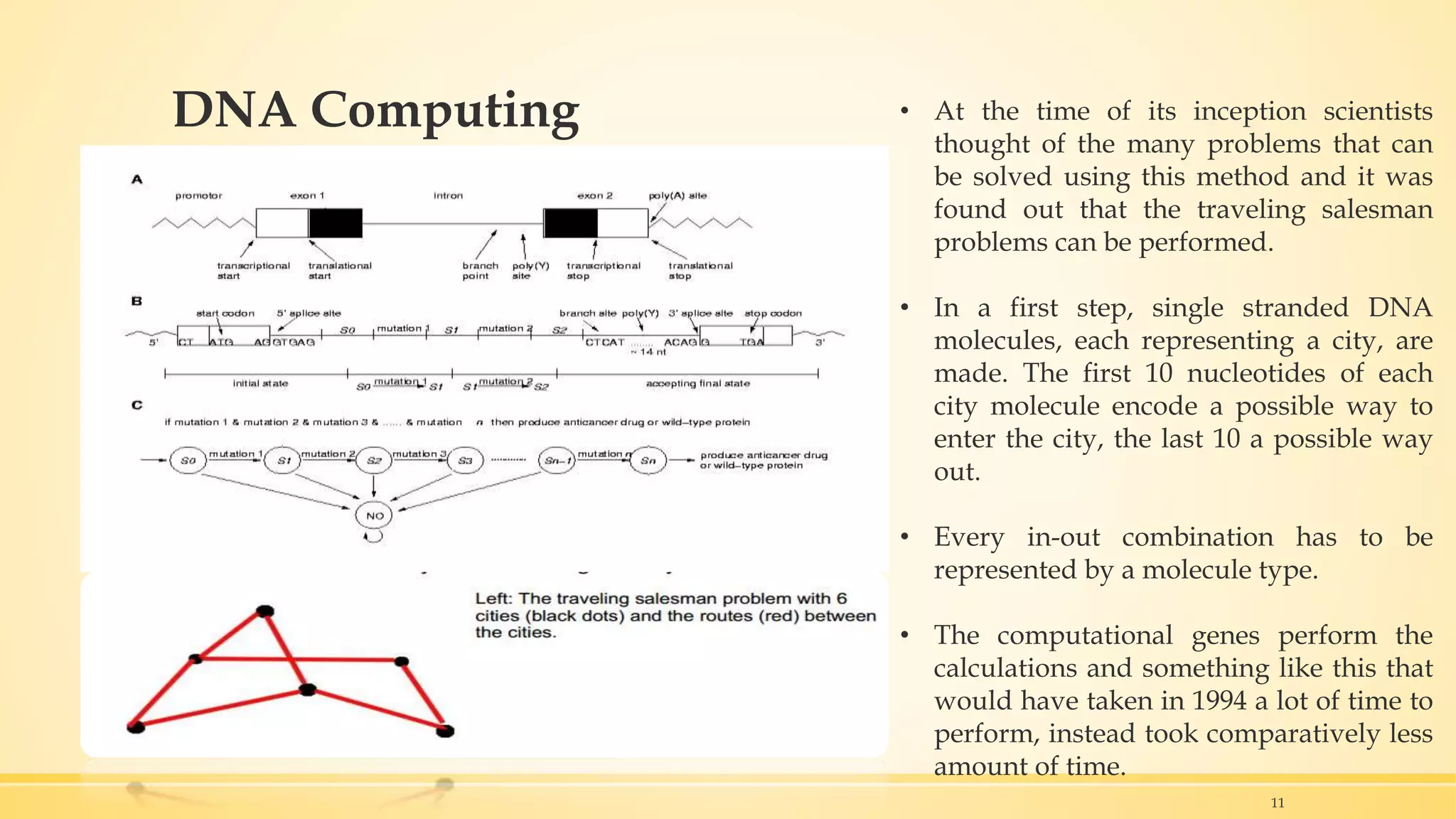
Various updates to the UTM
▪ Both the electro-mechanical and field transistors approaches are modified
versions of the UTM.
▪ While one uses logic gates to make the UTM more effective and proficient the
other uses both logic gates and transistors to do the same.
10
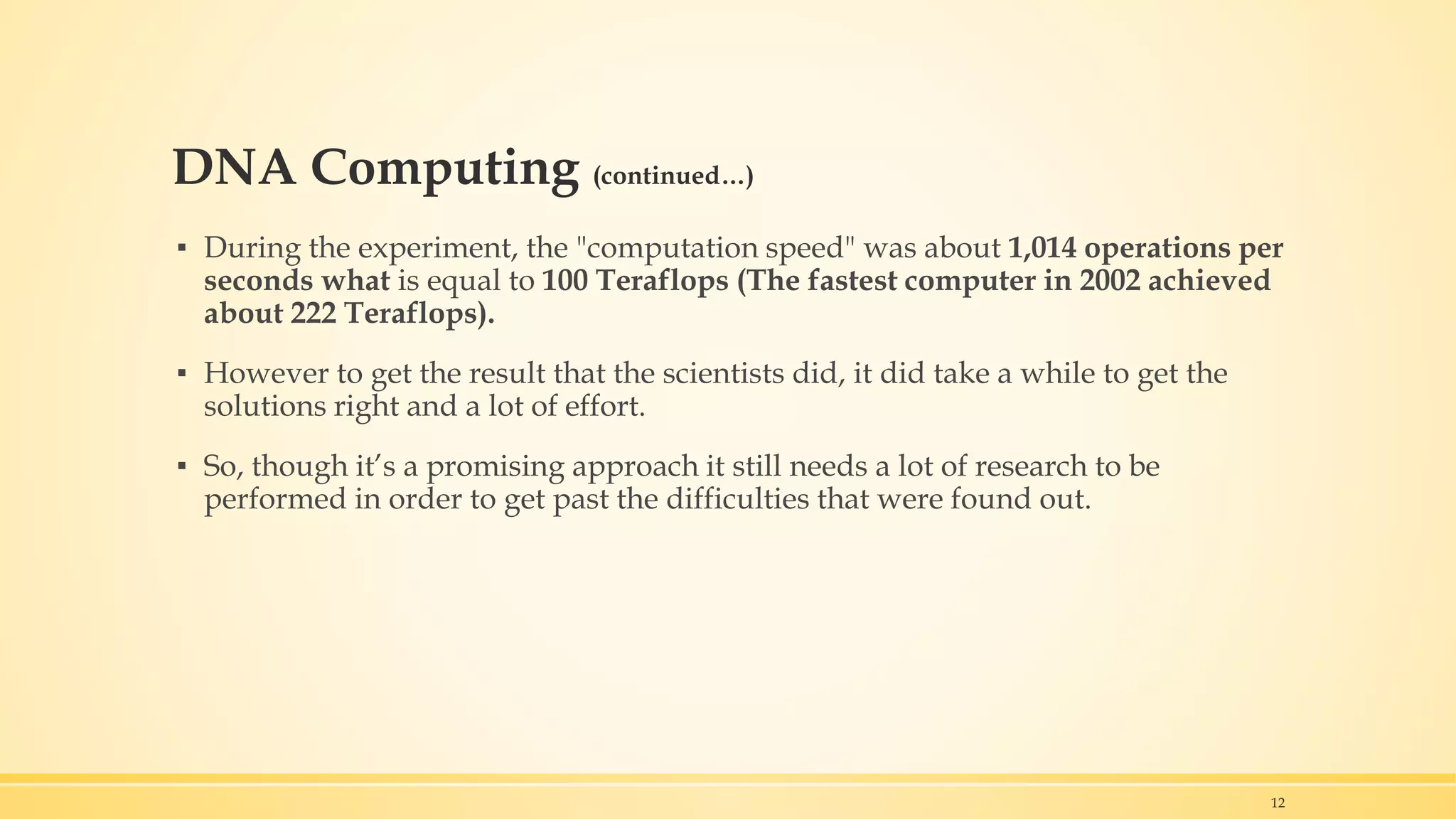
DNA Computing • At the time of its inception scientists
thought of the many problems that can
be solved using this method and it was
found out that the traveling salesman
problems can be performed.
• In a first step, single stranded DNA
molecules, each representing a city, are
made. The first 10 nucleotides of each
city molecule encode a possible way to
enter the city, the last 10 a possible way
out.
• Every in-out combination has to be
represented by a molecule type.
• The computational genes perform the
calculations and something like this that
would have taken in 1994 a lot of time to
perform, instead took comparatively less
amount of time.
11
DNA Computing (continued…)
▪ During the experiment, the "computation speed" was about 1,014 operations per
seconds what is equal to 100 Teraflops (The fastest computer in 2002 achieved
about 222 Teraflops).
▪ However to get the result that the scientists did, it did take a while to get the
solutions right and a lot of effort.
▪ So, though it’s a promising approach it still needs a lot of research to be
performed in order to get past the difficulties that were found out.
12
Advantages
1. More than million people in this world are affected by dreaded diseases.
Currently there are no permanent vaccines or medicines available to cure
certain myriad of diseases. The currently available drugs can increase the
patient’s life to a few years only, so the invention of this nanorobots will make
the patients to get rid of the disease.
2. As the nanorobot do not generate any harmful activities there is no side effect.
It operates at specific site only.
3. The initial cost of development is only high but the manufacturing by batch
processing reduces the cost.
13
Disadvantages
1. The nanorobot should be very accurate, otherwise harmful effects may occur.
2. The initial design cost is very high.
3. The design of this nanorobot is a very complicated one
14
Conclusion
▪ The idea of Nanorobots seems futuristic, but the future is much nearer than one thinks. Nanobots are not scaled
down mechanical machines, instead as we have seen, in the nanoscale range, the dominant effects are different
from the ones in the macroscopic world. Brownian Motion, friction and tunneling play minor roles in the world
known to us, but are significant factors in the Nano world.
▪ The scaling down of devices will at some point reach it's definite limits as the size of atoms sets final barriers.
Rather than those small scale mechanical devices with gears, simple organic structures should be expected. In fact,
the modified viruses used in genetic engineering to introduce DNA sequences to genomes could already be seen as
biology-based nanobots.
▪ Control of nanobots, even limited by their size, should be possible, as also with limited computation resources,
quite complex behavior can be achieved.
▪ In terms of the logical devices some problems of "classical" field effect transistors, like non-homogeneous doping
and heat dissipation can be solved by tunneling devices (RTD, RTT, QD, SET), as they consume less power.
▪ To produce one quantum dot is one thing, but to build a complete logic device is completely different. Molecular
electronics can help at this point, as chemistry already offers a broad range of tools to manipulate molecules.
▪ Chemical computation is probably the one that is most likely to be used in Nanorobots. Drug delivery for example
just needs a shell that opens when an environmental condition, like the presence of an other chemical, is met.
16
References
▪ Nanomedicine.org
▪ Foresight.com
▪ Lmr.use.edu
▪ Nanorobots.info
▪ Dbdresearchinstitue.com
▪ Stefan Bracher’s “Nanoscale Computing and actuators for potential use in Nanobots”, of
Northwestern University ME 385 Nanotechnology
17
18
Any Questions?
19
20

NanoBots-Nanotechnology

  • 1.
  • 2.
    Abstract ▪ Nanotechnology isan emerging field in robotics which has yet to truly blossom to its full potential. It does, however promise a wealth of different solutions to problems which have plaguing mankind for all of existence. ▪ Nanotechnology is still a new science and nearly every advance made in this field is groundbreaking. It also represents an incredibly fascinating area of study and can hold solutions too many of the most pressing problems of our world. It has the potential to revolutionize medicine, environmental science, industry and even warfare. 2
  • 3.
    Introduction ▪ What isNanotechnology ? ▪ Nanotechnology is a multidisciplinary branch of science used in the application of creating objects on a scale smaller than 100 nanometers from the ground up. ▪ What are Nanobots and what can they be used for? ▪ The Czech word "robota" stands for "work". Thus a Nanorobot can be seen as nothing else than a nanoscale machine that does some work. There are many possible applications for Nanobots: Probably one of the oldest ideas is to insert nanoscale devices in our bodies, where they could do observations, deliver chemical substances, repair cells and much more. ▪ There are plans to use nanorobots to make self-repairing suits for astronauts or to even tune or repair your car or bike engines without dismantling them. They could also be used to analyze structures and Integrated Circuits. Multi- purpose devices built of collaborating nanobots, that can change their shape and functionality are imaginable. 3
  • 4.
    Construction Of NanoBots ▪To build a nanorobot, like for their "normal sized" counterparts, sensors, actuators or manipulators and some sort of control would be needed. The construction itself is also a subject of research, as we can't just put the parts together with our hands. ▪ That Nano assembly is not impossible, has been proved by some encouraging attempts using scanning probe microscopes. Most of these devices or theories have been developed without the aim of constructing nanobots, but could be used for their implementation. 4
  • 5.
    How will theymove? ▪ For most applications it is sufficient for nanobots to be able to float in a fluid, what probably is easier to achieve than walking on a surface with big (micro- scale) obstacles. But also floating in fluids can be tricky. ▪ A. A. G. Requicha stated in one of his papers that already structures in the micro-scale range will have a Reynolds number in the range of 10-5 (Calculated with typical speed 10 micrometer/s and typical length of 1 micrometer), and thus will be in the low-Reynolds regime, which makes friction the dominant force. ▪ He also mentions that it appears that below 600nm no self-propelled organism can be found. Thus for small nanobots, diffusion should also be considered as a way of transportation. 5
  • 6.
    Controls in NanoBots ▪Types Of Controls: ▪ Central Control: ▪ The advantage of this central control is that there are basically no limits to the computation and the program complexity. In a task where you have a homogeneous group of Nanobots, performing the same task simultaneously like in the Marsuit-Nanobots assemblers, this might be a good solution, as you could just send one order to the whole group. But what if the tasks are not performed simultaneously or you need feedback from the Nanobots? ▪ If so you will have to give every Nanobot a unique identification number, what will be a problem, first, as the Nanobot will need on board computation to distinguish whether or not a message is sent for them, and second, as soon as you have a larger group of Nanorobots, you might need thousands of these identifiers. ▪ Simple control circuits: ▪ In many applications complex computing might not be needed. For drug delivery, it could be sufficient for the Nanobot to diffuse in the blood circuit until a certain environmental condition (some molecules, ph-value..) is present and then release the drug. 6
  • 7.
    Controls in NanoBots(continued…) ▪ Swarming: ▪ There is an other, bio-inspired concept, called swarming. The main point about swarming is, that you have relatively simple agents with limited capacities that, in collaboration with other agents, achieve a performance that is much more than the sum of the individual performances. ▪ A termite swarm, for example, can do amazing things, while the single termites are quite simple. And that is exactly what is needed for Nanorobot swarms. That the concept also works outside nature has first been showed by Craig Reynolds in 1986, who made a bird-swarm animation based on it. 7
  • 8.
    Computing in Nanoscale ▪No matter if central control, swarming or an other concept is used to control Nanobots, a certain on-board computation (and if it is only a switch) will always be needed. In the following sites, different computing approaches are presented. ▪ Computing Approaches: 1. The universal Turing machine 2. Electro-Mechanical Approach 3. Field effect transistors 4. Quantum Electronics 5. Quantum Dot 6. Molecular Electronics 7. DNA Computing 8
  • 9.
    The Universal TuringMachine Alan Turing (1912-1954) 9
  • 10.
    Various updates tothe UTM ▪ Both the electro-mechanical and field transistors approaches are modified versions of the UTM. ▪ While one uses logic gates to make the UTM more effective and proficient the other uses both logic gates and transistors to do the same. 10
  • 11.
    DNA Computing •At the time of its inception scientists thought of the many problems that can be solved using this method and it was found out that the traveling salesman problems can be performed. • In a first step, single stranded DNA molecules, each representing a city, are made. The first 10 nucleotides of each city molecule encode a possible way to enter the city, the last 10 a possible way out. • Every in-out combination has to be represented by a molecule type. • The computational genes perform the calculations and something like this that would have taken in 1994 a lot of time to perform, instead took comparatively less amount of time. 11
  • 12.
    DNA Computing (continued…) ▪During the experiment, the "computation speed" was about 1,014 operations per seconds what is equal to 100 Teraflops (The fastest computer in 2002 achieved about 222 Teraflops). ▪ However to get the result that the scientists did, it did take a while to get the solutions right and a lot of effort. ▪ So, though it’s a promising approach it still needs a lot of research to be performed in order to get past the difficulties that were found out. 12
  • 13.
    Advantages 1. More thanmillion people in this world are affected by dreaded diseases. Currently there are no permanent vaccines or medicines available to cure certain myriad of diseases. The currently available drugs can increase the patient’s life to a few years only, so the invention of this nanorobots will make the patients to get rid of the disease. 2. As the nanorobot do not generate any harmful activities there is no side effect. It operates at specific site only. 3. The initial cost of development is only high but the manufacturing by batch processing reduces the cost. 13
  • 14.
    Disadvantages 1. The nanorobotshould be very accurate, otherwise harmful effects may occur. 2. The initial design cost is very high. 3. The design of this nanorobot is a very complicated one 14
  • 15.
    Conclusion ▪ The ideaof Nanorobots seems futuristic, but the future is much nearer than one thinks. Nanobots are not scaled down mechanical machines, instead as we have seen, in the nanoscale range, the dominant effects are different from the ones in the macroscopic world. Brownian Motion, friction and tunneling play minor roles in the world known to us, but are significant factors in the Nano world. ▪ The scaling down of devices will at some point reach it's definite limits as the size of atoms sets final barriers. Rather than those small scale mechanical devices with gears, simple organic structures should be expected. In fact, the modified viruses used in genetic engineering to introduce DNA sequences to genomes could already be seen as biology-based nanobots. ▪ Control of nanobots, even limited by their size, should be possible, as also with limited computation resources, quite complex behavior can be achieved. ▪ In terms of the logical devices some problems of "classical" field effect transistors, like non-homogeneous doping and heat dissipation can be solved by tunneling devices (RTD, RTT, QD, SET), as they consume less power. ▪ To produce one quantum dot is one thing, but to build a complete logic device is completely different. Molecular electronics can help at this point, as chemistry already offers a broad range of tools to manipulate molecules. ▪ Chemical computation is probably the one that is most likely to be used in Nanorobots. Drug delivery for example just needs a shell that opens when an environmental condition, like the presence of an other chemical, is met. 16
  • 16.
    References ▪ Nanomedicine.org ▪ Foresight.com ▪Lmr.use.edu ▪ Nanorobots.info ▪ Dbdresearchinstitue.com ▪ Stefan Bracher’s “Nanoscale Computing and actuators for potential use in Nanobots”, of Northwestern University ME 385 Nanotechnology 17
  • 17.
  • 18.
  • 19.

Editor's Notes

  • #6 The Reynolds number is defined as the ratio of inertia forces to viscous forces.
  • #9 A resonant-tunneling diode (RTD) is a diode with a resonant-tunneling structure in which electrons can tunnel through some resonant states at certain energy levels. A quantum dot is a semiconductor nanostructure that confines the motion of conduction band electrons, valence band holes, or excitons (bound pairs of conduction band electrons and valence band holes) in all three spatial directions.
  • #12 Logic gates are the means by which computers “compute,” as sets of them are combined in different ways to enable computers to ultimately perform tasks like addition or subtraction. In DNA computing, these gates are created by combining different strands of DNA, rather than a series of transistors.  They utilised a DNA-based logic gate known as an “AND” gate that was engineered to respond to the presence of two specific microRNAs – known as miRNA-21 and miRNA-122. Just as computer operations utilise different inputs to create a particular output, the researchers’ DNA-based Boolean logic gate was activated only when both miRNA-21 and miRNA-122 “inputs” were present in cells. If they were present, the gate generated an “output” by releasing a fluorescent molecule