Prepared by: Dr. rer. nat. Ashraf Aboshosha EAEA, NCRRT, Engineering Dept.  www.icgst.com, www.icgst-amc.com [email_address] Tel.: 0020-12-1804952 Fax.: 0020-2-24115475 Mechatronics:  Education, Research & Development
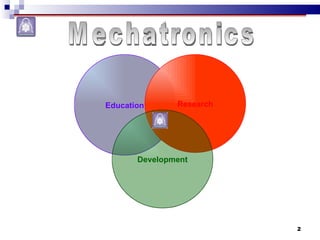
Mechatronics Education Research Development
Education Bsc., Msc. and PhD regulations (Catalog) Preparation of curricula guidelines (Printed and Online materials) Academic advertising for mechatronics  Preparing list of lab equipments Educational/public training courses (courses and partners) Comparative survey on local/international mechatronics institutes Contact with mechatronics pioneers to share ideas and strategies Inviting our strategic partners to explore the future
Research Preparing our short/long term research plan (topics, fund, priorities) Contacting mechatronics leading firms to join our strategic partnership Academic promotion for our research products Scheduling our academic activities (conferences, training, visiting Prof. etc.) Preparing our academic exchange program Preparing our academic press (small scale) Contacting our strategic partners to plan the future work
Development A survey on the local and international job market of mechatronics A survey on the increasing demand in automation and exploring the available chances of this field Preparing a study on mechatronics standards in industry and automation Linking education, research and development
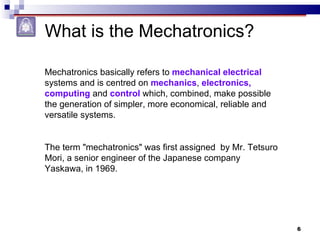
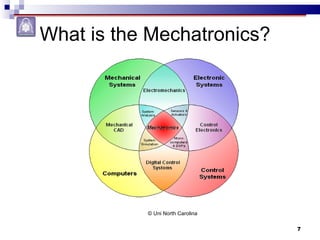
What is the Mechatronics? Mechatronics basically refers to  mechanical electrical  systems and is centred on  mechanics ,  electronics, computing  and  control  which, combined, make possible the generation of simpler, more economical, reliable and versatile systems.  The term "mechatronics" was first assigned  by Mr. Tetsuro Mori, a senior engineer of the Japanese company Yaskawa, in 1969.
What is the Mechatronics? © Uni North Carolina
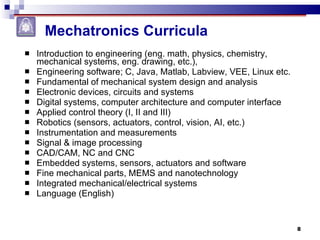
Mechatronics Curricula   Introduction to engineering (eng. math, physics, chemistry, mechanical systems, eng. drawing, etc.),  Engineering software; C, Java, Matlab, Labview, VEE, Linux etc. Fundamental of mechanical system design and analysis Electronic devices, circuits and systems Digital systems, computer architecture and computer interface Applied control theory (I, II and III) Robotics (sensors, actuators, control, vision, AI, etc.) Instrumentation and measurements Signal & image processing CAD/CAM, NC and CNC Embedded systems, sensors, actuators and software Fine mechanical parts, MEMS and nanotechnology Integrated mechanical/electrical systems Language (English)
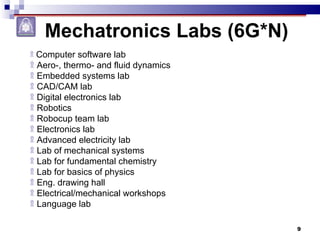
Mechatronics Labs (6G*N)   Computer software lab Aero-, thermo- and fluid dynamics Embedded systems lab CAD/CAM lab Digital electronics lab Robotics Robocup team lab Electronics lab Advanced electricity lab Lab of mechanical systems Lab for fundamental chemistry Lab for basics of physics Eng. drawing hall Electrical/mechanical workshops Language lab
Embedded Systems A combination of hardware and software which together form a component of a Mechatronics systems.  An embedded system is designed to run on its own without human intervention, and may be required to respond to events in real time.
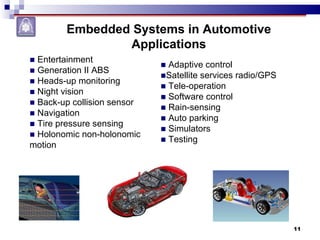
Adaptive control Satellite services radio/GPS Tele-operation Software control Rain-sensing  Auto parking Simulators Testing Entertainment Generation II ABS Heads-up monitoring Night vision Back-up collision sensor Navigation Tire pressure sensing Holonomic non-holonomic motion Embedded Systems in Automotive Applications
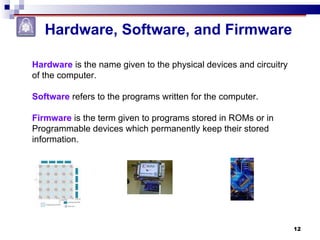
Hardware, Software, and Firmware   Hardware  is the name given to the physical devices and circuitry of the computer.  Software  refers to the programs written for the computer.  Firmware  is the term given to programs stored in ROMs or in Programmable devices which permanently keep their stored information.
Robotics Curricula Introduction to Robotics:  History,  Asimov’s laws, Different types of robot platforms (humanoid, Car-like, holonomic & non-holonomic, miniature, manipulators, animators, indoor, outdoor, space robots, medical robots, under water robots, locomotion, areal robots, educational robots, legged robots, mobile robots, robot simulators etc.) Path Planning:  objectives and methods (Voronoi, Bug, potential field, visibility, reactive, road map).  Environment modeling:    the general meaning and the applied techniques (occupancy grid, topological graphs, integrated, 3D modelling).  Distributed sensors:   IR, laser, sonar, E-nose, vision, artificial skin, artificial ear etc.  Robot kinematics and inverse kinematics Sensors Integration:  advantages, weaknesses and methods (Bayes network, Kalman filter, fuzzy logic, particle filter).  Robot actuators:   Hydraulic, pneumatic and electric drives (DC, Ac, servo, and stepper motors) Self localization:   Introduction and techniques (SLAM, Markov, Bayes network, expectation maximizing, maximum likelihood).
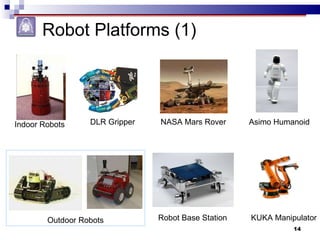
Robot Platforms (1) Indoor Robots DLR Gripper NASA Mars Rover Asimo Humanoid Outdoor Robots Robot Base Station KUKA Manipulator
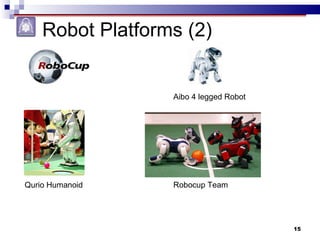
Robot Platforms (2) Aibo 4 legged Robot Robocup Team Qurio Humanoid
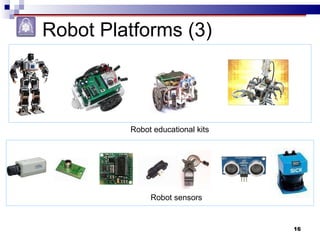
Robot Platforms (3) Robot educational kits Robot sensors
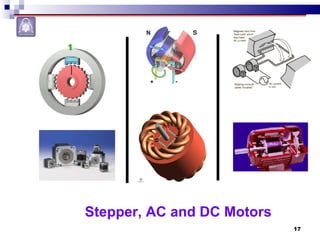
Stepper, AC and DC Motors
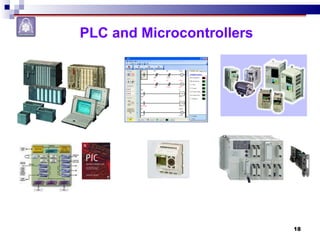
PLC and Microcontrollers
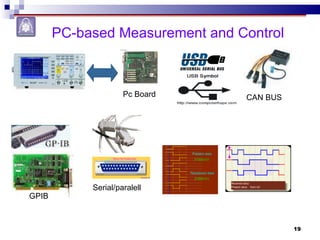
PC-based Measurement and Control Pc Board GPIB Serial/paralell CAN BUS
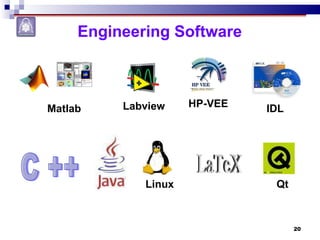
Engineering Software C ++ LaTeX IDL Matlab Labview HP-VEE Linux Qt
End   Thank you

Mechatronics

  • 1.
    Prepared by: Dr.rer. nat. Ashraf Aboshosha EAEA, NCRRT, Engineering Dept. www.icgst.com, www.icgst-amc.com [email_address] Tel.: 0020-12-1804952 Fax.: 0020-2-24115475 Mechatronics: Education, Research & Development
  • 2.
  • 3.
    Education Bsc., Msc.and PhD regulations (Catalog) Preparation of curricula guidelines (Printed and Online materials) Academic advertising for mechatronics Preparing list of lab equipments Educational/public training courses (courses and partners) Comparative survey on local/international mechatronics institutes Contact with mechatronics pioneers to share ideas and strategies Inviting our strategic partners to explore the future
  • 4.
    Research Preparing ourshort/long term research plan (topics, fund, priorities) Contacting mechatronics leading firms to join our strategic partnership Academic promotion for our research products Scheduling our academic activities (conferences, training, visiting Prof. etc.) Preparing our academic exchange program Preparing our academic press (small scale) Contacting our strategic partners to plan the future work
  • 5.
    Development A surveyon the local and international job market of mechatronics A survey on the increasing demand in automation and exploring the available chances of this field Preparing a study on mechatronics standards in industry and automation Linking education, research and development
  • 6.
    What is theMechatronics? Mechatronics basically refers to mechanical electrical systems and is centred on mechanics , electronics, computing and control which, combined, make possible the generation of simpler, more economical, reliable and versatile systems. The term "mechatronics" was first assigned by Mr. Tetsuro Mori, a senior engineer of the Japanese company Yaskawa, in 1969.
  • 7.
    What is theMechatronics? © Uni North Carolina
  • 8.
    Mechatronics Curricula Introduction to engineering (eng. math, physics, chemistry, mechanical systems, eng. drawing, etc.), Engineering software; C, Java, Matlab, Labview, VEE, Linux etc. Fundamental of mechanical system design and analysis Electronic devices, circuits and systems Digital systems, computer architecture and computer interface Applied control theory (I, II and III) Robotics (sensors, actuators, control, vision, AI, etc.) Instrumentation and measurements Signal & image processing CAD/CAM, NC and CNC Embedded systems, sensors, actuators and software Fine mechanical parts, MEMS and nanotechnology Integrated mechanical/electrical systems Language (English)
  • 9.
    Mechatronics Labs (6G*N) Computer software lab Aero-, thermo- and fluid dynamics Embedded systems lab CAD/CAM lab Digital electronics lab Robotics Robocup team lab Electronics lab Advanced electricity lab Lab of mechanical systems Lab for fundamental chemistry Lab for basics of physics Eng. drawing hall Electrical/mechanical workshops Language lab
  • 10.
    Embedded Systems Acombination of hardware and software which together form a component of a Mechatronics systems. An embedded system is designed to run on its own without human intervention, and may be required to respond to events in real time.
  • 11.
    Adaptive control Satelliteservices radio/GPS Tele-operation Software control Rain-sensing Auto parking Simulators Testing Entertainment Generation II ABS Heads-up monitoring Night vision Back-up collision sensor Navigation Tire pressure sensing Holonomic non-holonomic motion Embedded Systems in Automotive Applications
  • 12.
    Hardware, Software, andFirmware Hardware is the name given to the physical devices and circuitry of the computer. Software refers to the programs written for the computer. Firmware is the term given to programs stored in ROMs or in Programmable devices which permanently keep their stored information.
  • 13.
    Robotics Curricula Introductionto Robotics: History, Asimov’s laws, Different types of robot platforms (humanoid, Car-like, holonomic & non-holonomic, miniature, manipulators, animators, indoor, outdoor, space robots, medical robots, under water robots, locomotion, areal robots, educational robots, legged robots, mobile robots, robot simulators etc.) Path Planning: objectives and methods (Voronoi, Bug, potential field, visibility, reactive, road map). Environment modeling:   the general meaning and the applied techniques (occupancy grid, topological graphs, integrated, 3D modelling). Distributed sensors: IR, laser, sonar, E-nose, vision, artificial skin, artificial ear etc. Robot kinematics and inverse kinematics Sensors Integration: advantages, weaknesses and methods (Bayes network, Kalman filter, fuzzy logic, particle filter). Robot actuators: Hydraulic, pneumatic and electric drives (DC, Ac, servo, and stepper motors) Self localization: Introduction and techniques (SLAM, Markov, Bayes network, expectation maximizing, maximum likelihood).
  • 14.
    Robot Platforms (1)Indoor Robots DLR Gripper NASA Mars Rover Asimo Humanoid Outdoor Robots Robot Base Station KUKA Manipulator
  • 15.
    Robot Platforms (2)Aibo 4 legged Robot Robocup Team Qurio Humanoid
  • 16.
    Robot Platforms (3)Robot educational kits Robot sensors
  • 17.
    Stepper, AC andDC Motors
  • 18.
  • 19.
    PC-based Measurement andControl Pc Board GPIB Serial/paralell CAN BUS
  • 20.
    Engineering Software C++ LaTeX IDL Matlab Labview HP-VEE Linux Qt
  • 21.
    End Thank you