THE NEW
TECHNOLOGY
THATS
HEALING THE
WORLD

By

R.SHIRISHA

The easy injection and you are set for life


Imagine going to the doctor to get treatment for a persistent fever.
Instead of giving you a pill or a shot, the doctor refers you to a special
medical team which implants a tiny robot into your bloodstream. The
robot detects the cause of your fever, travels to the appropriate system
and provides a dose of medication directly to the infected area.



Surprisingly, we're not that far off from seeing devices like this actually
used in medical procedures. They're called nanorobots and engineering
teams around the world are working to design robots that will eventually
be used to treat everything from hemophilia to cancer.



The possibility of nanorobots was first proposed by
Richard Feyman in his talk
“There’s Plenty of Room at the Bottom” in 1959.


A nanobot is a nanotechnological robot machine, also called a
nanite, which is a mechanical or eletromechanical device whose
dimensions are measured in nanometres.



Since nanorobots would be microscopic in size, it may be
necessary for very large numbers of them to work together to
perform macroscopic tasks.



These nanobots don’t have microprocessors in them that think
and act according to a program.



They don’t swim intelligently to a desired target in a straight line
path. Instead they float around, exhibiting simple behaviors such
as releasing a chemical agent, attaching to something, or
destroying something based on their geometries and chemical
constituents.



When used in proper quantity and with well defined
objectives, these “boring”, “dumb” nanobots have the
potential to attack cancer in new ways, target
malfunctioning proteins, repair damaged tissues, and
much more…


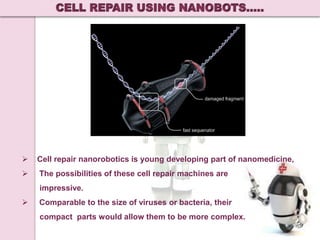
Cell repair nanorobotics is young developing part of nanomedicine,



The possibilities of these cell repair machines are
impressive.



Comparable to the size of viruses or bacteria, their
compact parts would allow them to be more complex.
HOW DOES IT WORK?????


Powerful nanocomputers and fast
sequenators will be needed to guide
these machines..



These computers will direct machines to
examine, take apart, and rebuild damaged
molecular structures.



Repair machines will be able to repair whole cells by working structure by
structure. Then by working cell by cell and tissue by tissue, whole organs can
be repaired. Finally, by working organ by organ, health is restored to the body.



Special express DNA-sequenator analyze all DNA and

cut off damaged nucleotides, or unwanted genes.


This model is based on diamondoid nanorobot conception.


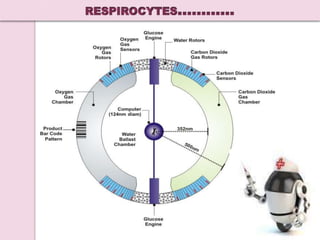
Respirocytes are nanomachines, tiny mechanical devices designed to
operate on the molecular level.



Respirocytes function as artificial red blood cells, carrying oxygen
and carbon dioxide molecules through the body.
ARE THEY SAFE?


Respirocytes are extremely reliable. If a malfunction occurs while it is in
your bloodstream, its temperature won't rise at all.



That's because the 7.3 picowatts of continuous thermal energy, the
device is generating is easily absorbed by the huge aqueous heat sink,
which has a bountiful heat capacity.



If the device explodes inside human tissue, then water temperature
raises only by 0.04°C.so single device exploisions are unlikely to cause
significant damage



Collisions with respirocytes do not injure other cells like

wbc’s nor blood vessel walls.


Preliminary tests show that diamondoid surfaces are
very biocompatible, unlikely to draw a major response
from leukocytes, the immune system, or other natural
body defenses.


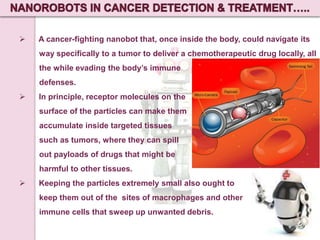
A cancer-fighting nanobot that, once inside the body, could navigate its
way specifically to a tumor to deliver a chemotherapeutic drug locally, all
the while evading the body’s immune

defenses.


In principle, receptor molecules on the
surface of the particles can make them
accumulate inside targeted tissues

such as tumors, where they can spill
out payloads of drugs that might be
harmful to other tissues.


Keeping the particles extremely small also ought to
keep them out of the sites of macrophages and other
immune cells that sweep up unwanted debris.


Langer, Farokhzad and their associates reported exceptional success in
a phase I, clinical-safety study of the experimental antitumor therapeutic
called BIND-014.



At the core of the BIND-014 nanoparticleis a
polymer that can slowly release the chemotherapy
drug docetaxel.



But the more important molecules on the surface
are ones that will bind with a particular protein
(called prostate-specific membrane antigen) found
on prostate tumors and on the newly forming blood
vessels that feed the growth of other types of solid
tumors.


The protein molecules in many drugs often fare poorly in the
bloodstream because the body collects or degrades them before they
have much opportunity to do patients good.



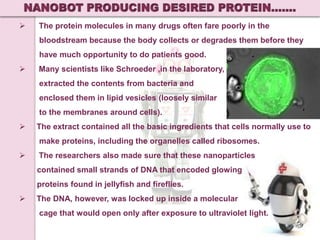
Many scientists like Schroeder ,in the laboratory,

extracted the contents from bacteria and
enclosed them in lipid vesicles (loosely similar
to the membranes around cells).


The extract contained all the basic ingredients that cells normally use to

make proteins, including the organelles called ribosomes.


The researchers also made sure that these nanoparticles
contained small strands of DNA that encoded glowing
proteins found in jellyfish and fireflies.



The DNA, however, was locked up inside a molecular
cage that would open only after exposure to ultraviolet light.


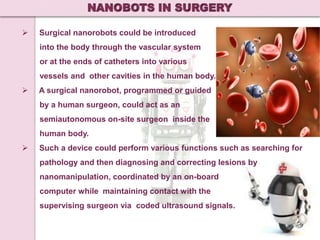
Surgical nanorobots could be introduced
into the body through the vascular system
or at the ends of catheters into various
vessels and other cavities in the human body.



A surgical nanorobot, programmed or guided
by a human surgeon, could act as an
semiautonomous on-site surgeon inside the
human body.



Such a device could perform various functions such as searching for
pathology and then diagnosing and correcting lesions by
nanomanipulation, coordinated by an on-board

computer while maintaining contact with the
supervising surgeon via coded ultrasound signals.


CURE BLINDNESS



REPAIRING OF DAMAGED TISSUES BY NANOBOTS



NANOROBOTICS IN DENTISTRY



NANOROBOTS IN THE DIAGNOSIS AND TREATMENT OF DIABETES



CRYOSTASIS



NANOROBOTS IN GENE THERAPY.



ARTIFICIAL NEURON REPLACEMENT



DIAGNOSTICS AND TESTING


All of the current developments in technology directs human a step
closer to nanorobots production.



Nanorobots can theoretically destroy all common diseases of the 20th

century, thereby ending much of the pain and suffering.


Although research into nanorobots is in its preliminary stages, the
promise of such technology is endless.



Cost free , pollution free.



We can use technology for more accuracy in any field



These are used to cure many diseases which are not
possible from ancient methods.



Nanobots are going to revolutionize the medical
industry in future.



Technology may rule us !
Nanobots, the new technology thats healing the world

Nanobots, the new technology thats healing the world

  • 1.
    THE NEW TECHNOLOGY THATS HEALING THE WORLD By R.SHIRISHA Theeasy injection and you are set for life
  • 2.
     Imagine going tothe doctor to get treatment for a persistent fever. Instead of giving you a pill or a shot, the doctor refers you to a special medical team which implants a tiny robot into your bloodstream. The robot detects the cause of your fever, travels to the appropriate system and provides a dose of medication directly to the infected area.  Surprisingly, we're not that far off from seeing devices like this actually used in medical procedures. They're called nanorobots and engineering teams around the world are working to design robots that will eventually be used to treat everything from hemophilia to cancer.  The possibility of nanorobots was first proposed by Richard Feyman in his talk “There’s Plenty of Room at the Bottom” in 1959.
  • 3.
     A nanobot isa nanotechnological robot machine, also called a nanite, which is a mechanical or eletromechanical device whose dimensions are measured in nanometres.  Since nanorobots would be microscopic in size, it may be necessary for very large numbers of them to work together to perform macroscopic tasks.  These nanobots don’t have microprocessors in them that think and act according to a program.  They don’t swim intelligently to a desired target in a straight line path. Instead they float around, exhibiting simple behaviors such as releasing a chemical agent, attaching to something, or destroying something based on their geometries and chemical constituents.  When used in proper quantity and with well defined objectives, these “boring”, “dumb” nanobots have the potential to attack cancer in new ways, target malfunctioning proteins, repair damaged tissues, and much more…
  • 4.
     Cell repair nanoroboticsis young developing part of nanomedicine,  The possibilities of these cell repair machines are impressive.  Comparable to the size of viruses or bacteria, their compact parts would allow them to be more complex.
  • 5.
    HOW DOES ITWORK?????  Powerful nanocomputers and fast sequenators will be needed to guide these machines..  These computers will direct machines to examine, take apart, and rebuild damaged molecular structures.  Repair machines will be able to repair whole cells by working structure by structure. Then by working cell by cell and tissue by tissue, whole organs can be repaired. Finally, by working organ by organ, health is restored to the body.  Special express DNA-sequenator analyze all DNA and cut off damaged nucleotides, or unwanted genes.  This model is based on diamondoid nanorobot conception.
  • 6.
     Respirocytes are nanomachines,tiny mechanical devices designed to operate on the molecular level.  Respirocytes function as artificial red blood cells, carrying oxygen and carbon dioxide molecules through the body.
  • 8.
    ARE THEY SAFE?  Respirocytesare extremely reliable. If a malfunction occurs while it is in your bloodstream, its temperature won't rise at all.  That's because the 7.3 picowatts of continuous thermal energy, the device is generating is easily absorbed by the huge aqueous heat sink, which has a bountiful heat capacity.  If the device explodes inside human tissue, then water temperature raises only by 0.04°C.so single device exploisions are unlikely to cause significant damage  Collisions with respirocytes do not injure other cells like wbc’s nor blood vessel walls.  Preliminary tests show that diamondoid surfaces are very biocompatible, unlikely to draw a major response from leukocytes, the immune system, or other natural body defenses.
  • 9.
     A cancer-fighting nanobotthat, once inside the body, could navigate its way specifically to a tumor to deliver a chemotherapeutic drug locally, all the while evading the body’s immune defenses.  In principle, receptor molecules on the surface of the particles can make them accumulate inside targeted tissues such as tumors, where they can spill out payloads of drugs that might be harmful to other tissues.  Keeping the particles extremely small also ought to keep them out of the sites of macrophages and other immune cells that sweep up unwanted debris.
  • 10.
     Langer, Farokhzad andtheir associates reported exceptional success in a phase I, clinical-safety study of the experimental antitumor therapeutic called BIND-014.  At the core of the BIND-014 nanoparticleis a polymer that can slowly release the chemotherapy drug docetaxel.  But the more important molecules on the surface are ones that will bind with a particular protein (called prostate-specific membrane antigen) found on prostate tumors and on the newly forming blood vessels that feed the growth of other types of solid tumors.
  • 11.
     The protein moleculesin many drugs often fare poorly in the bloodstream because the body collects or degrades them before they have much opportunity to do patients good.  Many scientists like Schroeder ,in the laboratory, extracted the contents from bacteria and enclosed them in lipid vesicles (loosely similar to the membranes around cells).  The extract contained all the basic ingredients that cells normally use to make proteins, including the organelles called ribosomes.  The researchers also made sure that these nanoparticles contained small strands of DNA that encoded glowing proteins found in jellyfish and fireflies.  The DNA, however, was locked up inside a molecular cage that would open only after exposure to ultraviolet light.
  • 12.
     Surgical nanorobots couldbe introduced into the body through the vascular system or at the ends of catheters into various vessels and other cavities in the human body.  A surgical nanorobot, programmed or guided by a human surgeon, could act as an semiautonomous on-site surgeon inside the human body.  Such a device could perform various functions such as searching for pathology and then diagnosing and correcting lesions by nanomanipulation, coordinated by an on-board computer while maintaining contact with the supervising surgeon via coded ultrasound signals.
  • 13.
     CURE BLINDNESS  REPAIRING OFDAMAGED TISSUES BY NANOBOTS  NANOROBOTICS IN DENTISTRY  NANOROBOTS IN THE DIAGNOSIS AND TREATMENT OF DIABETES  CRYOSTASIS  NANOROBOTS IN GENE THERAPY.  ARTIFICIAL NEURON REPLACEMENT  DIAGNOSTICS AND TESTING
  • 14.
     All of thecurrent developments in technology directs human a step closer to nanorobots production.  Nanorobots can theoretically destroy all common diseases of the 20th century, thereby ending much of the pain and suffering.  Although research into nanorobots is in its preliminary stages, the promise of such technology is endless.  Cost free , pollution free.  We can use technology for more accuracy in any field  These are used to cure many diseases which are not possible from ancient methods.  Nanobots are going to revolutionize the medical industry in future.  Technology may rule us !