1.1- What is Nanotechnology?
• The design, characterization, and application of
structures, devices, and systems by controlled
manipulation of size and shape of materials at
the nanometer scale (atomic, molecular, and
macromolecular scale) ,
• To produce materials with at least one
novel/superior characteristic or property.
CLASSIFICATION
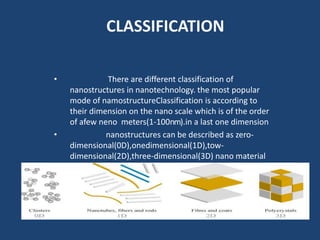
• There are different classification of
nanostructures in nanotechnology. the most popular
mode of namostructureClassification is according to
their dimension on the nano scale which is of the order
of afew neno meters(1-100nm).in a last one dimension
• nanostructures can be described as zero-
dimensional(0D),onedimensional(1D),tow-
dimensional(2D),three-dimensional(3D) nano material
•
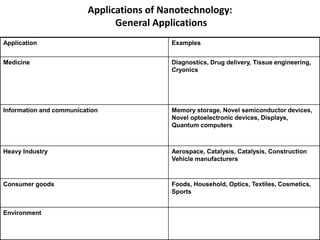
Applications of Nanotechnology:
General Applications
ExamplesApplication
Diagnostics, Drug delivery, Tissue engineering,
Cryonics
Medicine
Memory storage, Novel semiconductor devices,
Novel optoelectronic devices, Displays,
Quantum computers
Information and communication
Aerospace, Catalysis, Catalysis, Construction
Vehicle manufacturers
Heavy Industry
Foods, Household, Optics, Textiles, Cosmetics,
Sports
Consumer goods
Environment
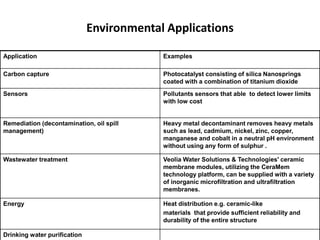
Environmental Applications
ExamplesApplication
Photocatalyst consisting of silica Nanosprings
coated with a combination of titanium dioxide
Carbon capture
Pollutants sensors that able to detect lower limits
with low cost
Sensors
Heavy metal decontaminant removes heavy metals
such as lead, cadmium, nickel, zinc, copper,
manganese and cobalt in a neutral pH environment
without using any form of sulphur .
Remediation (decontamination, oil spill
management)
Veolia Water Solutions & Technologies' ceramic
membrane modules, utilizing the CeraMem
technology platform, can be supplied with a variety
of inorganic microfiltration and ultrafiltration
membranes.
Wastewater treatment
Heat distribution e.g. ceramic-like
materials that provide sufficient reliability and
durability of the entire structure
Energy
Drinking water purification
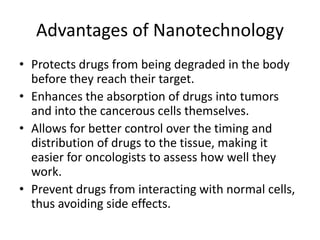
Advantages of Nanotechnology
• Protects drugs from being degraded in the body
before they reach their target.
• Enhances the absorption of drugs into tumors
and into the cancerous cells themselves.
• Allows for better control over the timing and
distribution of drugs to the tissue, making it
easier for oncologists to assess how well they
work.
• Prevent drugs from interacting with normal cells,
thus avoiding side effects.
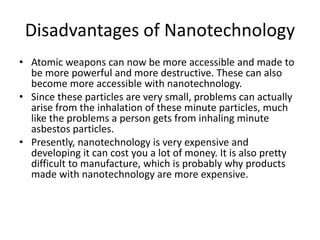
Disadvantages of Nanotechnology
• Atomic weapons can now be more accessible and made to
be more powerful and more destructive. These can also
become more accessible with nanotechnology.
• Since these particles are very small, problems can actually
arise from the inhalation of these minute particles, much
like the problems a person gets from inhaling minute
asbestos particles.
• Presently, nanotechnology is very expensive and
developing it can cost you a lot of money. It is also pretty
difficult to manufacture, which is probably why products
made with nanotechnology are more expensive.
THANK YOU

Nano materials & technology

  • 2.
    1.1- What isNanotechnology? • The design, characterization, and application of structures, devices, and systems by controlled manipulation of size and shape of materials at the nanometer scale (atomic, molecular, and macromolecular scale) , • To produce materials with at least one novel/superior characteristic or property.
  • 3.
    CLASSIFICATION • There aredifferent classification of nanostructures in nanotechnology. the most popular mode of namostructureClassification is according to their dimension on the nano scale which is of the order of afew neno meters(1-100nm).in a last one dimension • nanostructures can be described as zero- dimensional(0D),onedimensional(1D),tow- dimensional(2D),three-dimensional(3D) nano material •
  • 4.
    Applications of Nanotechnology: GeneralApplications ExamplesApplication Diagnostics, Drug delivery, Tissue engineering, Cryonics Medicine Memory storage, Novel semiconductor devices, Novel optoelectronic devices, Displays, Quantum computers Information and communication Aerospace, Catalysis, Catalysis, Construction Vehicle manufacturers Heavy Industry Foods, Household, Optics, Textiles, Cosmetics, Sports Consumer goods Environment
  • 5.
    Environmental Applications ExamplesApplication Photocatalyst consistingof silica Nanosprings coated with a combination of titanium dioxide Carbon capture Pollutants sensors that able to detect lower limits with low cost Sensors Heavy metal decontaminant removes heavy metals such as lead, cadmium, nickel, zinc, copper, manganese and cobalt in a neutral pH environment without using any form of sulphur . Remediation (decontamination, oil spill management) Veolia Water Solutions & Technologies' ceramic membrane modules, utilizing the CeraMem technology platform, can be supplied with a variety of inorganic microfiltration and ultrafiltration membranes. Wastewater treatment Heat distribution e.g. ceramic-like materials that provide sufficient reliability and durability of the entire structure Energy Drinking water purification
  • 6.
    Advantages of Nanotechnology •Protects drugs from being degraded in the body before they reach their target. • Enhances the absorption of drugs into tumors and into the cancerous cells themselves. • Allows for better control over the timing and distribution of drugs to the tissue, making it easier for oncologists to assess how well they work. • Prevent drugs from interacting with normal cells, thus avoiding side effects.
  • 7.
    Disadvantages of Nanotechnology •Atomic weapons can now be more accessible and made to be more powerful and more destructive. These can also become more accessible with nanotechnology. • Since these particles are very small, problems can actually arise from the inhalation of these minute particles, much like the problems a person gets from inhaling minute asbestos particles. • Presently, nanotechnology is very expensive and developing it can cost you a lot of money. It is also pretty difficult to manufacture, which is probably why products made with nanotechnology are more expensive.
  • 8.