Soil, Air and Water pollution :
Risks of Nanotechnology
PRESENTED BY AJAL.A.J
FACULTY- Dept of ECE
FEDERAL INSTITUTE OF SCIENCE & TECHNOLOGY
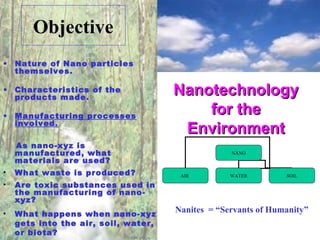
NANO
AIR WATER SOIL
Objective
• Nature of Nano particles
themselves.
• Characteristics of the
products made.
• Manufacturing processes
involved.
As nano-xyz is
manufactured, what
materials are used?
• What waste is produced?
• Are toxic substances used in
the manufacturing of nano-
xyz?
• What happens when nano-xyz
gets into the air, soil, water,
or biota?
NanotechnologyNanotechnology
for thefor the
EnvironmentEnvironment
Nanites = “Servants of Humanity”
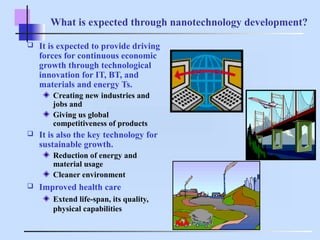
What is expected through nanotechnology development?
 It is expected to provide driving
forces for continuous economic
growth through technological
innovation for IT, BT, and
materials and energy Ts.
Creating new industries and
jobs and
Giving us global
competitiveness of products
 It is also the key technology for
sustainable growth.
Reduction of energy and
material usage
Cleaner environment
 Improved health care
Extend life-span, its quality,
physical capabilities
“A time when no one lacks for any need,
and everyone is enabled to reach
their full potential.”
WARNING!
Technology can be misused
Advanced technology = Advanced dangers
The Promise of Modern Technology
In late march 2006, six people
went to hospital with serious
respiratory problems after using
a new German bathroom
cleaning product called Magic
Nano. The product was removed
from sale after just three days.
Some manufacturerers are using
high strength materials for tennis
rackets and golf clubs and stain
resistant fabrics. These products
contain nanoparticles of zinc
oxide. But they all have one thing
in common-their Nano
components have not gone
through safety tests.
The benefits in this product is supported by the
nanotechnology so it helps the skin and gives vitamin D
The Bottom Line
Ms. McCann tried this,
and found the skin
around her eyes felt soft
and looked shiny at first
but no lasting effects.
She did not find it
comfortable.
What are nanotechnology socks
Nanotechnology socks
contain nanoparticles
of silver. These
particles help kill the
bacteria that makes our
feet smell. Many people
with smelly feet will
benefit from this
technology.
Nanotechnology offers ... possibilities for health,
wealth, and capabilities beyond most past
imaginings.
K. Eric Drexler
Improving the Economy:
Refrigerants Automobiles
…working with U.S. Industry
Electric Power
Information & Semiconductor
Technology Cell Phones
Improving the Quality of Life:
Medical Tests
Mammography
Cancer Treatment
Smoke Detectors
Body Armor
Dentistry
ADVANTAGES : NANOTECHNOLOGY
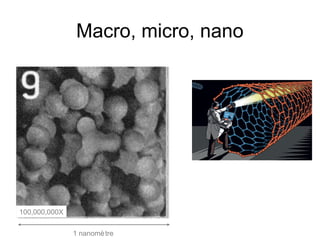
Macro, micro, nano
10 centimètres
1X
1 centimètre
10X100X
1 millimètre100 microns
1000X
10 microns
10,000X
1 micron
100,000X1,000,000X
100 nanomètres
10,000,000X
10 nanomètres
100,000,000X
1 nanomètre
The “Dark Side” of Nanotechnology?
• There has not been enough research done to know
what the biological implications of Nano Industry will
be.
• There is evidence to suggest possible problems.
• As a scientific community, we should be pro-active
in addressing the possible risks.
Nanotoxicology:
• An Emerging Discipline Evolving from
Studies of Ultra fine Particles.
Groups opposing the installation of nanotechnology
laboratories in Grenoble, France, have spray painted
their opposition on a former fortress above the city
Nanotechnology.
Risks of nanotechnology

Can cause serious damage.

3 reasons:

More reactive

Can accumulate

Lack of knowledge

Company policy.

Lack of leadership and organisation.
What are environmental groups and
NGO’s saying about nanotechnology?
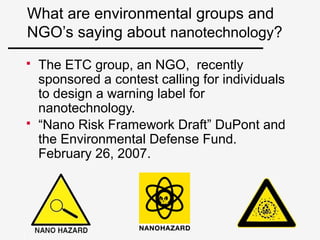
 The ETC group, an NGO, recently
sponsored a contest calling for individuals
to design a warning label for
nanotechnology.
 “Nano Risk Framework Draft” DuPont and
the Environmental Defense Fund.
February 26, 2007.
PM10 (10,000 nm) air pollution isPM10 (10,000 nm) air pollution is
linked to increased lung cancer,linked to increased lung cancer,
heart, and lung disease and deathheart, and lung disease and death
Donaldson K, Tran L, Jimenez L, Duffin R, Newby DE, Mills N,Donaldson K, Tran L, Jimenez L, Duffin R, Newby DE, Mills N, et alet al.:.:
Combustion-derived nanoparticles: A review of their toxicology followingCombustion-derived nanoparticles: A review of their toxicology following
inhalation exposure 1.inhalation exposure 1. Part Fibre ToxicolPart Fibre Toxicol 2005, 2:102005, 2:10
Nanomaterials may cause oxidativeNanomaterials may cause oxidative
stress, inflammation, and cancerstress, inflammation, and cancer
Xia et al, Nano Lett. 2006 Aug;6(8):1794-Xia et al, Nano Lett. 2006 Aug;6(8):1794-
807. Reviewed in Stone and Donaldson,807. Reviewed in Stone and Donaldson,
Nature Nanotechnology 1, (2006)Nature Nanotechnology 1, (2006)
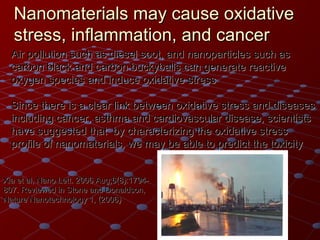
Air pollution such as diesel soot, and nanoparticles such asAir pollution such as diesel soot, and nanoparticles such as
carbon black and carbon buckyballs can generate reactivecarbon black and carbon buckyballs can generate reactive
oxygen species and induce oxidative stressoxygen species and induce oxidative stress
Since there is a clear link between oxidative stress and diseasesSince there is a clear link between oxidative stress and diseases
including cancer, asthma and cardiovascular disease, scientistsincluding cancer, asthma and cardiovascular disease, scientists
have suggested that by characterizing the oxidative stresshave suggested that by characterizing the oxidative stress
profile of nanomaterials, we may be able to predict the toxicityprofile of nanomaterials, we may be able to predict the toxicity
Basic elements of a precautionaryBasic elements of a precautionary
policy for nanomaterials:policy for nanomaterials:
1.1. Prohibit the untested or unsafe use of nanomaterialsProhibit the untested or unsafe use of nanomaterials
2.2. Conduct full life-cycle EHS impact assessments as aConduct full life-cycle EHS impact assessments as a
prerequisite to commercialization; assessprerequisite to commercialization; assess
nanomaterials as new substances, since uniquenanomaterials as new substances, since unique
physical properties impart unique hazard profilesphysical properties impart unique hazard profiles
3.3. Facilitate full and meaningful participation by publicFacilitate full and meaningful participation by public
and workers in nanotechnologies development andand workers in nanotechnologies development and
control; assess the social and ethical impacts ofcontrol; assess the social and ethical impacts of
nanotechnologiesnanotechnologies
4.4. Act on early warnings to protect communities andAct on early warnings to protect communities and
workers.workers.
Problem: no regulatory oversightProblem: no regulatory oversight
Must trigger a mass/vol threshold to triggerMust trigger a mass/vol threshold to trigger
regulation .regulation .
Burden on govt to prove harm; No dataBurden on govt to prove harm; No data
means no risk.means no risk.
Reg’s target chemical, not final use/productReg’s target chemical, not final use/product
No detection equipment means noNo detection equipment means no
enforcement abilityenforcement ability
Why worry?
Inhaled nanomaterials have the potential to
pass directly to the brain, and from the lungs
into the blood stream.
Ingested nano
materials
pass from the
gut into the
blood stream.
Nemmar et al, 2001, 2002. (Reviewed in Borm PJ, Kreyling W: J
Nanosci Nanotechnol 2004, 4:521-531)
25
I.I. Develop TechnologyDevelop Technology
I.I. Understand ImplicationsUnderstand Implications
I.I. Prepare SolutionsPrepare Solutions
I.I. Implement GloballyImplement Globally
Challenges of Nanotech
Satisfactory
outcome requires
all four
to be effectively
addressed.
Satisfactory
outcome requires
all four
to be effectively
addressed.
26
Potential Risks of Nanotechnology
• Health issues
– Nanoparticles could be inhaled, swallowed, absorbed
through skin, or deliberately injected
– Could they trigger inflammation and weaken the
immune system? Could they interfere with regulatory
mechanisms of enzymes and proteins?
• Environmental issues
– Nanoparticles could accumulate in soil, water, plants;
traditional filters are too big to catch them
• New risk assessment methods are needed
– National and international agencies are beginning to
study the risk; results will lead to new regulations
Science and Engineering approaches are
needed that offer new capabilities to prevent or
treat highly toxic or persistent pollutants, and
that result in the more effective monitoring of
pollutants or their impact in ways not currently
possible.
Conclusions
Nanoscience, engineering, and technology
holds great potential for the continued
improvement of technologies for environmental
protection. The recent breakthroughs in creating
nanocircuitry, give further evidence and support
the predictions that nanoscale science and
engineering “will most likely produce the
breakthroughs of tomorrow.”
PARADIGM SHIFT
(nano in the environment) ( nano for the environment )
28
Thank you!
ajal4u@facebook.com
BACK UP SLIDES
Transmission Electron
Microscope (TEM)
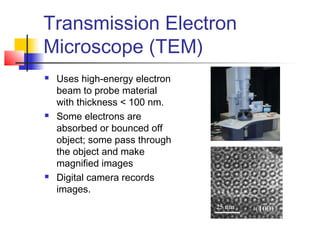
 Uses high-energy electron
beam to probe material
with thickness < 100 nm.
 Some electrons are
absorbed or bounced off
object; some pass through
the object and make
magnified images
 Digital camera records
images.
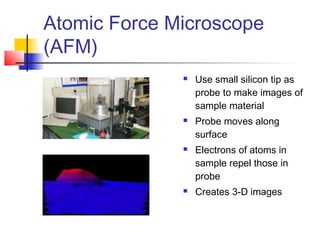
Atomic Force Microscope
(AFM)
 Use small silicon tip as
probe to make images of
sample material
 Probe moves along
surface
 Electrons of atoms in
sample repel those in
probe
 Creates 3-D images
Scanning Tunneling
Microscope (STM)
 Uses nanosized probe to
scan objects and
materials
 Uses tunneling to detect
surface and creates a
map of surface
 Rate of electrons that
tunnel from probe to
surface related to distance
between probe and
surface
Nanotechnology for the Environment

Nanotechnology for the Environment

  • 1.
    Soil, Air andWater pollution : Risks of Nanotechnology PRESENTED BY AJAL.A.J FACULTY- Dept of ECE FEDERAL INSTITUTE OF SCIENCE & TECHNOLOGY
  • 2.
    NANO AIR WATER SOIL Objective •Nature of Nano particles themselves. • Characteristics of the products made. • Manufacturing processes involved. As nano-xyz is manufactured, what materials are used? • What waste is produced? • Are toxic substances used in the manufacturing of nano- xyz? • What happens when nano-xyz gets into the air, soil, water, or biota? NanotechnologyNanotechnology for thefor the EnvironmentEnvironment Nanites = “Servants of Humanity”
  • 3.
    What is expectedthrough nanotechnology development?  It is expected to provide driving forces for continuous economic growth through technological innovation for IT, BT, and materials and energy Ts. Creating new industries and jobs and Giving us global competitiveness of products  It is also the key technology for sustainable growth. Reduction of energy and material usage Cleaner environment  Improved health care Extend life-span, its quality, physical capabilities
  • 4.
    “A time whenno one lacks for any need, and everyone is enabled to reach their full potential.” WARNING! Technology can be misused Advanced technology = Advanced dangers The Promise of Modern Technology
  • 5.
    In late march2006, six people went to hospital with serious respiratory problems after using a new German bathroom cleaning product called Magic Nano. The product was removed from sale after just three days. Some manufacturerers are using high strength materials for tennis rackets and golf clubs and stain resistant fabrics. These products contain nanoparticles of zinc oxide. But they all have one thing in common-their Nano components have not gone through safety tests.
  • 6.
    The benefits inthis product is supported by the nanotechnology so it helps the skin and gives vitamin D The Bottom Line Ms. McCann tried this, and found the skin around her eyes felt soft and looked shiny at first but no lasting effects. She did not find it comfortable.
  • 7.
    What are nanotechnologysocks Nanotechnology socks contain nanoparticles of silver. These particles help kill the bacteria that makes our feet smell. Many people with smelly feet will benefit from this technology.
  • 8.
    Nanotechnology offers ...possibilities for health, wealth, and capabilities beyond most past imaginings. K. Eric Drexler
  • 9.
    Improving the Economy: RefrigerantsAutomobiles …working with U.S. Industry Electric Power Information & Semiconductor Technology Cell Phones Improving the Quality of Life: Medical Tests Mammography Cancer Treatment Smoke Detectors Body Armor Dentistry ADVANTAGES : NANOTECHNOLOGY
  • 11.
    Macro, micro, nano 10centimètres 1X 1 centimètre 10X100X 1 millimètre100 microns 1000X 10 microns 10,000X 1 micron 100,000X1,000,000X 100 nanomètres 10,000,000X 10 nanomètres 100,000,000X 1 nanomètre
  • 12.
    The “Dark Side”of Nanotechnology? • There has not been enough research done to know what the biological implications of Nano Industry will be. • There is evidence to suggest possible problems. • As a scientific community, we should be pro-active in addressing the possible risks.
  • 13.
    Nanotoxicology: • An EmergingDiscipline Evolving from Studies of Ultra fine Particles.
  • 14.
    Groups opposing theinstallation of nanotechnology laboratories in Grenoble, France, have spray painted their opposition on a former fortress above the city
  • 15.
    Nanotechnology. Risks of nanotechnology  Cancause serious damage.  3 reasons:  More reactive  Can accumulate  Lack of knowledge  Company policy.  Lack of leadership and organisation.
  • 16.
    What are environmentalgroups and NGO’s saying about nanotechnology?  The ETC group, an NGO, recently sponsored a contest calling for individuals to design a warning label for nanotechnology.  “Nano Risk Framework Draft” DuPont and the Environmental Defense Fund. February 26, 2007.
  • 20.
    PM10 (10,000 nm)air pollution isPM10 (10,000 nm) air pollution is linked to increased lung cancer,linked to increased lung cancer, heart, and lung disease and deathheart, and lung disease and death Donaldson K, Tran L, Jimenez L, Duffin R, Newby DE, Mills N,Donaldson K, Tran L, Jimenez L, Duffin R, Newby DE, Mills N, et alet al.:.: Combustion-derived nanoparticles: A review of their toxicology followingCombustion-derived nanoparticles: A review of their toxicology following inhalation exposure 1.inhalation exposure 1. Part Fibre ToxicolPart Fibre Toxicol 2005, 2:102005, 2:10
  • 21.
    Nanomaterials may causeoxidativeNanomaterials may cause oxidative stress, inflammation, and cancerstress, inflammation, and cancer Xia et al, Nano Lett. 2006 Aug;6(8):1794-Xia et al, Nano Lett. 2006 Aug;6(8):1794- 807. Reviewed in Stone and Donaldson,807. Reviewed in Stone and Donaldson, Nature Nanotechnology 1, (2006)Nature Nanotechnology 1, (2006) Air pollution such as diesel soot, and nanoparticles such asAir pollution such as diesel soot, and nanoparticles such as carbon black and carbon buckyballs can generate reactivecarbon black and carbon buckyballs can generate reactive oxygen species and induce oxidative stressoxygen species and induce oxidative stress Since there is a clear link between oxidative stress and diseasesSince there is a clear link between oxidative stress and diseases including cancer, asthma and cardiovascular disease, scientistsincluding cancer, asthma and cardiovascular disease, scientists have suggested that by characterizing the oxidative stresshave suggested that by characterizing the oxidative stress profile of nanomaterials, we may be able to predict the toxicityprofile of nanomaterials, we may be able to predict the toxicity
  • 22.
    Basic elements ofa precautionaryBasic elements of a precautionary policy for nanomaterials:policy for nanomaterials: 1.1. Prohibit the untested or unsafe use of nanomaterialsProhibit the untested or unsafe use of nanomaterials 2.2. Conduct full life-cycle EHS impact assessments as aConduct full life-cycle EHS impact assessments as a prerequisite to commercialization; assessprerequisite to commercialization; assess nanomaterials as new substances, since uniquenanomaterials as new substances, since unique physical properties impart unique hazard profilesphysical properties impart unique hazard profiles 3.3. Facilitate full and meaningful participation by publicFacilitate full and meaningful participation by public and workers in nanotechnologies development andand workers in nanotechnologies development and control; assess the social and ethical impacts ofcontrol; assess the social and ethical impacts of nanotechnologiesnanotechnologies 4.4. Act on early warnings to protect communities andAct on early warnings to protect communities and workers.workers.
  • 23.
    Problem: no regulatoryoversightProblem: no regulatory oversight Must trigger a mass/vol threshold to triggerMust trigger a mass/vol threshold to trigger regulation .regulation . Burden on govt to prove harm; No dataBurden on govt to prove harm; No data means no risk.means no risk. Reg’s target chemical, not final use/productReg’s target chemical, not final use/product No detection equipment means noNo detection equipment means no enforcement abilityenforcement ability
  • 24.
    Why worry? Inhaled nanomaterialshave the potential to pass directly to the brain, and from the lungs into the blood stream. Ingested nano materials pass from the gut into the blood stream. Nemmar et al, 2001, 2002. (Reviewed in Borm PJ, Kreyling W: J Nanosci Nanotechnol 2004, 4:521-531)
  • 25.
    25 I.I. Develop TechnologyDevelopTechnology I.I. Understand ImplicationsUnderstand Implications I.I. Prepare SolutionsPrepare Solutions I.I. Implement GloballyImplement Globally Challenges of Nanotech Satisfactory outcome requires all four to be effectively addressed. Satisfactory outcome requires all four to be effectively addressed.
  • 26.
    26 Potential Risks ofNanotechnology • Health issues – Nanoparticles could be inhaled, swallowed, absorbed through skin, or deliberately injected – Could they trigger inflammation and weaken the immune system? Could they interfere with regulatory mechanisms of enzymes and proteins? • Environmental issues – Nanoparticles could accumulate in soil, water, plants; traditional filters are too big to catch them • New risk assessment methods are needed – National and international agencies are beginning to study the risk; results will lead to new regulations
  • 27.
    Science and Engineeringapproaches are needed that offer new capabilities to prevent or treat highly toxic or persistent pollutants, and that result in the more effective monitoring of pollutants or their impact in ways not currently possible. Conclusions Nanoscience, engineering, and technology holds great potential for the continued improvement of technologies for environmental protection. The recent breakthroughs in creating nanocircuitry, give further evidence and support the predictions that nanoscale science and engineering “will most likely produce the breakthroughs of tomorrow.” PARADIGM SHIFT (nano in the environment) ( nano for the environment )
  • 28.
  • 29.
  • 30.
    Transmission Electron Microscope (TEM) Uses high-energy electron beam to probe material with thickness < 100 nm.  Some electrons are absorbed or bounced off object; some pass through the object and make magnified images  Digital camera records images.
  • 31.
    Atomic Force Microscope (AFM) Use small silicon tip as probe to make images of sample material  Probe moves along surface  Electrons of atoms in sample repel those in probe  Creates 3-D images
  • 32.
    Scanning Tunneling Microscope (STM) Uses nanosized probe to scan objects and materials  Uses tunneling to detect surface and creates a map of surface  Rate of electrons that tunnel from probe to surface related to distance between probe and surface

Editor's Notes

  • #16 The main problem with nanotechnology is that there are no firm rules for how it can be safely used. Although we breathe 10million nanoparticles everyday, from which not much are really harmfull, there&amp;apos;re still some that can cause serious problems. One reason for this is that the most reactive part of a material is the surface. With a nanoparticle this is 50% of the particle. Another reason is that nanoparticles are so small that they can evade some of the body&amp;apos;s natural defense and can accumulate in the brain, cells, blood and nerves. Because of the lack of knowledge about nanoparticles ever new particle needs to be treated as a new substance. Which means that it needs to be extensively tested for it&amp;apos;s proporties and especially it&amp;apos;s toxicity. But the lack of research and the variation of results means there are no rules yet on when a particle is save. Therefor companies can themselves determine what the safety policies are on nanotechnology. Because their aims are gaining profits, they&amp;apos;re more inclinned to fund research for applications than for safety. Although &amp;quot;more research is needed&amp;quot; is the main cry of scientists, there are still other problems like the lack of leadership and organisation and most will agre that this is what nanotechnology needs in order to have a promising future.
  • #31 The transmission electron microscope is one that utilizes a high-energy electron beam that probes sample materials with a thickness less than 100 nanometers (nm). While some electrons are either absorbed or bounced of the material, others pass through it creating a magnified image as the one shown in the example. Current TEMs use digital cameras placed behind the material to capture and record images, magnifying images up to 30 million times. The TEM is the most popular microscope used the make images published in scientific journals on nanocrystals found in semiconductors.
  • #32 The atomic force microscope (AFM) uses a small silicon tip as a probe to make images of sample material. While the probe move along the surface of the sample, the electrons of the atoms in the material begin to repel the electrons of the probe. The AFM then adjusts the height of the probe to keep the force of the sample constant. A mechanism records the movement of the probe and sends this information to a computer that will generate a three-dimensional image as shown in the slide. The image will show the exact topography of the surface.
  • #33 A scanning tunneling microscope (STM) uses a wavelike property of electrons known as tunneling, which allows electrons emitted from a probe to penetrate, or tunnel into, the surface of the examined object. The electrons generate a tiny electric current that the STM measures. Similar to the atomic force microscope, the height of the probe in the STM is adjusted constantly to keep the current constant. In doing, so a detailed map of the material’ surface is produced as the example in this slide shows.