APPLICATIONS OF
NANOTECHNOLOGY
BY,
SHRIHITH.A
2nd MSc microbiology
Bangalore university
JBC,campus
Bangalore-560 056
NANOTECHNOLOGY
Nanotechnology is an important field of modern
research dealing with synthesis, strategy and
manipulation of particle’s structure ranging from
approximately 1 to 100nm in size.
HISTORY
The ideas and concepts behind nanoscience and
nanotechnology started by physicist Richard
Feynman.
Feynman described a process in which scientists
would be able to manipulate and control individual
atoms and molecules.
APPLICATIONS
Nanoscience and nanotechnology are the
study and application of extremely small things
and can be used across all the other science
fields, such as chemistry, biology, physics,
materials science, and engineering.
Nanotechnology may be able to create many
new materials and devices with a vast range of
applications, such as in medicine, electronics,
biomaterials and energy production.
NANOSCIENCE APPLICATIONS
 MEDICINE
 COMPUTERS
 ELECTRONICS
 MOBILE
 FABRICS
 ENERGY
 TEXTILE
 MILITARY
 Provide new options for drug delivery and drug
therapies.
 Enable drugs to be delivered to precisely the right
location in the body and release drug doses on a
predetermined schedule for optimal treatment.
 Attach the drug to a nanosized carrier.
 They become localized at the disease site, i.e
cancer tumour.
 Then they release medicine that kills the tumour.
 Current treatment is through radiotherapy or
chemotherapy.
 Nanobots can clear the blockage in arteries.
 Gold nanoparticles can be used to detect
early-stage Alzheimer’s disease.
 We can prevent blindness by treating
glaucoma using nano particale eye drops.
 Nanotechnology vacancies for diseases
such as hepatitis one injection cost may be
low.
 To facilitate bone regeneration in the
treatment of osteoporosis .
 Nanotechnology has been used in the early
diagnosis of atherosclerosis, or the
buildup of plaque in arteries. Researchers
have developed an imaging technology to
measure the amount of an antibody-
nanoparticle complex that accumulates
specifically in plaque. Clinical scientists are
able to monitor the development of plaque
as well as its disappearance following
treatment (see image).
 Before (left) and after (right) picture of
atherosclerotic placque in a mouse artery.
Placque accumulation is shown in this image by
the increasing intensity of color, from blue to
yellow and red. (Image courtesy of M.
Nahrendorf, MGH Center for Systems
Biology, Harvard Medical School)
NANOTECHNOLOGY IN COMPUTERS
 The silicon transistors in your computer may be
replaced by transistors based on carbon nanotubes.
 A carbon nanotube is a molecule in form of a hollow
cylinder with a diameter of around a nanometer
which consists of pure carbon.
 Nanorods is a upcoming technology in the displays
techniques due to less consumption of electricity
and less heat emission.
 Size of the microprocessors are reduced to greater
extend.
 Researchers at North Carolina State University
says that growing arrays of magnetic nanoparticles,
called nanodots.
 . Nanotechnology in Memory and Storage .This is a
2 gigabyte hard drive. It weighs about 70 pounds.
It was first used in the 1980s. Its cost at that
time ranged from $80,000 to $140,000.
 2 GB in 1980s $80,000 2 GB in 1990s $200 2 GB in
2010 $5
 Current research shows that by using
nanotechnology, 1 000 GB of memory can fit on the
head of this pin. 1000 GB is 1 Terabyte.
NANOTECHNOLOGY IN ELECTRONICS
 Electrodes made from nanowires enable flat panel
displays to be flexible as well as thinner than
current flat panel displays.
 Nanolithography is used for fabrication of chips.
 The transistors are made of nanowires, that are
assembled on glass or thin films of flexible plastic.
 E-paper, displays on sunglasses and map on car
windshields.
 Nanoscale transistors that are faster, more
powerful, and increasingly energy-efficient; soon
your computer’s entire memory may be stored on a
single tiny chip.
 Magnetic random access memory (MRAM) enabled
by nanometer‐scale magnetic tunnel junctions that
can quickly and effectively save even encrypted
data during a system shutdown or crash, enable
resume‐play features, and gather vehicle accident
data.
 Displays for many new TVs, laptop computers, cell
phones, digital cameras, and other devices
incorporate nanostructured polymer films known as
organic light-emitting diodes, or OLEDs. OLED
screens offer brighter images in a flat format, as
well as wider viewing angles, lighter weight, better
picture density, lower power consumption, and
longer lifetimes.
 Other computing and electronic products include
Flash memory chips for iPod nanos; ultraresponsive
hearing aids; antimicrobial/antibacterial coatings on
mouse/keyboard/cell phone casings; conductive inks
for printed electronics for RFID/smart
cards/smart packaging; more life-like video games;
and flexible displays for e-book readers.
 Nanotechnologies for Flexible Electronics.
Nanomaterials are playing a vital role in
the development of flexible electronics.
Only by manipulating the nanoscale
structure of materials can we create
components with the necessary electronic
properties which can also be made
flexible.
NANOTECHNOLOGY IN MOBILE
 a nanotechnology concept device developed by
Nokia Research Center (NRC) and the University of
Cambridge (UK).
 The Morph will be super hydrophobic making it
extremely dirt repellent.
 It will be able to charge itself from available light
sources using photovoltaic nanowire grass covering
its surface.
 Nanoscale electronics also allow stretching. Nokia
envisage that a nanoscale mesh of fibers will allow
our mobile devices to be bent, stretched and folded
into any number of conceivable shapes.
NANOTECHNOLOGY IN FABRICS
 The properties of familiar materials are being
changed by manufacturers who are adding
nano-sized components to conventional
materials to improve performance.
 For example, some clothing manufacturers are
making water and stain repellent clothing
using nano- sized whiskers in the fabric that
cause water to bead up on the surface.
 In manufacturing bullet proof jackets.
 Making spill & dirt resistant, antimicrobial,
antibacterial fabrics.
NANOTECHNOLOGY IN ENERGY
 Energy applications of nanotechnology .An
important subfield of nanotechnology
related to energy is
nanofabrication.Nanofabrication is the
process of designing and creating devices
on the nanoscale. Creating devices smaller
than 100 nanometres opens many doors for
the development of new ways to capture,
store, and transfer energy.
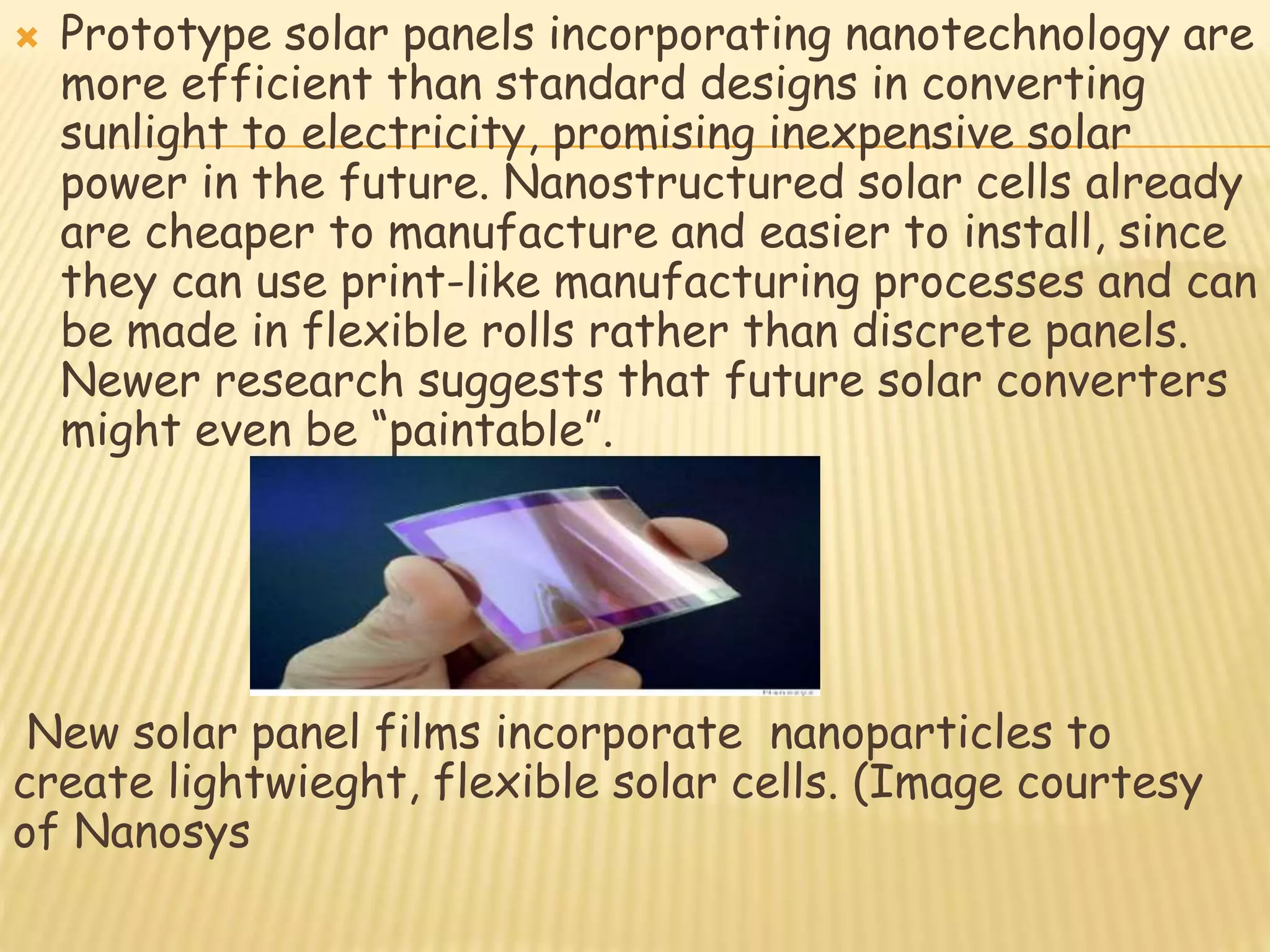
 Prototype solar panels incorporating nanotechnology are
more efficient than standard designs in converting
sunlight to electricity, promising inexpensive solar
power in the future. Nanostructured solar cells already
are cheaper to manufacture and easier to install, since
they can use print-like manufacturing processes and can
be made in flexible rolls rather than discrete panels.
Newer research suggests that future solar converters
might even be “paintable”.
New solar panel films incorporate nanoparticles to
create lightwieght, flexible solar cells. (Image courtesy
of Nanosys
NANOTECHNOLOGY SURFACES AND
COATINGS
The most prominent application of
nanotechnology in the household is self-
cleaning or "easy-to-clean" surfaces on
ceramics or glasses. Nano ceramic particles
have improved the smoothness and heat
resistance of common household equipment
such as the flat iron.
NANO TECHNOLOGY IN TEXTILES
 Textiles:- The use of engineered
nanofibers already makes clothes water-
and stain-repellent or wrinkle-free.
Textiles with a nanotechnological finish
can be washed less frequently and at lower
temperatures. Nanotechnology has been
used to integrate tiny carbon particles
membrane and guarantee full- surface
protection from electrostatic charges for
the wearer.
NANO TECHNOLOGY IN MILITARY
 Military By using nanotechnology, the
military would be able to create sensor
systems that could detect biological
agents. Nanoparticles can be injected into
the material on soldiers’ uniforms to not
only make the material more durable, but
also to protect soldiers from many
different dangers such as high
temperatures, impacts and chemicals.
CONCLUSION
 As a conclusion to this topic I would like to say
that Nanotechnology is a brand new technology
that has just began, it is a revolutionary science
that will change all what we knew before. This
new technology will first of all, keep us healthy
because of Nano robots that will repair every
damage that we have in our body
Nanotechnology covers a lot of domains today
and will cover a lot more in the near future, it is
infinitely big and will make a lot of inventions
come true .
 Currently, a variety of research is being
performed on nanomedical devices.
 Few industrial products exist right now.
 The possibilities are endless, but will take
time to develop.
REFERENCE
www.wikipedia.com/nanotechnoloy
www.nano.gov/nanotech-101
www.nanotechgroup.org
www.nano.gov/you/nanotechnology-benefits
www.nanostart.de/index.php/en/nanotechnolog
y/nan otechnology-information/610-schneller-
sparsamer-robuster- nanotechnologie-in-
computer-handy-a-co
APPLICATION OF NANOTECHNOLOGY

APPLICATION OF NANOTECHNOLOGY

  • 1.
    APPLICATIONS OF NANOTECHNOLOGY BY, SHRIHITH.A 2nd MScmicrobiology Bangalore university JBC,campus Bangalore-560 056
  • 2.
    NANOTECHNOLOGY Nanotechnology is animportant field of modern research dealing with synthesis, strategy and manipulation of particle’s structure ranging from approximately 1 to 100nm in size.
  • 3.
    HISTORY The ideas andconcepts behind nanoscience and nanotechnology started by physicist Richard Feynman. Feynman described a process in which scientists would be able to manipulate and control individual atoms and molecules.
  • 4.
    APPLICATIONS Nanoscience and nanotechnologyare the study and application of extremely small things and can be used across all the other science fields, such as chemistry, biology, physics, materials science, and engineering. Nanotechnology may be able to create many new materials and devices with a vast range of applications, such as in medicine, electronics, biomaterials and energy production.
  • 5.
    NANOSCIENCE APPLICATIONS  MEDICINE COMPUTERS  ELECTRONICS  MOBILE  FABRICS  ENERGY  TEXTILE  MILITARY
  • 6.
     Provide newoptions for drug delivery and drug therapies.  Enable drugs to be delivered to precisely the right location in the body and release drug doses on a predetermined schedule for optimal treatment.  Attach the drug to a nanosized carrier.  They become localized at the disease site, i.e cancer tumour.  Then they release medicine that kills the tumour.  Current treatment is through radiotherapy or chemotherapy.  Nanobots can clear the blockage in arteries.
  • 7.
     Gold nanoparticlescan be used to detect early-stage Alzheimer’s disease.  We can prevent blindness by treating glaucoma using nano particale eye drops.  Nanotechnology vacancies for diseases such as hepatitis one injection cost may be low.  To facilitate bone regeneration in the treatment of osteoporosis .
  • 8.
     Nanotechnology hasbeen used in the early diagnosis of atherosclerosis, or the buildup of plaque in arteries. Researchers have developed an imaging technology to measure the amount of an antibody- nanoparticle complex that accumulates specifically in plaque. Clinical scientists are able to monitor the development of plaque as well as its disappearance following treatment (see image).
  • 9.
     Before (left)and after (right) picture of atherosclerotic placque in a mouse artery. Placque accumulation is shown in this image by the increasing intensity of color, from blue to yellow and red. (Image courtesy of M. Nahrendorf, MGH Center for Systems Biology, Harvard Medical School)
  • 10.
    NANOTECHNOLOGY IN COMPUTERS The silicon transistors in your computer may be replaced by transistors based on carbon nanotubes.  A carbon nanotube is a molecule in form of a hollow cylinder with a diameter of around a nanometer which consists of pure carbon.  Nanorods is a upcoming technology in the displays techniques due to less consumption of electricity and less heat emission.  Size of the microprocessors are reduced to greater extend.  Researchers at North Carolina State University says that growing arrays of magnetic nanoparticles, called nanodots.
  • 11.
     . Nanotechnologyin Memory and Storage .This is a 2 gigabyte hard drive. It weighs about 70 pounds. It was first used in the 1980s. Its cost at that time ranged from $80,000 to $140,000.  2 GB in 1980s $80,000 2 GB in 1990s $200 2 GB in 2010 $5  Current research shows that by using nanotechnology, 1 000 GB of memory can fit on the head of this pin. 1000 GB is 1 Terabyte.
  • 12.
    NANOTECHNOLOGY IN ELECTRONICS Electrodes made from nanowires enable flat panel displays to be flexible as well as thinner than current flat panel displays.  Nanolithography is used for fabrication of chips.  The transistors are made of nanowires, that are assembled on glass or thin films of flexible plastic.  E-paper, displays on sunglasses and map on car windshields.  Nanoscale transistors that are faster, more powerful, and increasingly energy-efficient; soon your computer’s entire memory may be stored on a single tiny chip.
  • 13.
     Magnetic randomaccess memory (MRAM) enabled by nanometer‐scale magnetic tunnel junctions that can quickly and effectively save even encrypted data during a system shutdown or crash, enable resume‐play features, and gather vehicle accident data.
  • 14.
     Displays formany new TVs, laptop computers, cell phones, digital cameras, and other devices incorporate nanostructured polymer films known as organic light-emitting diodes, or OLEDs. OLED screens offer brighter images in a flat format, as well as wider viewing angles, lighter weight, better picture density, lower power consumption, and longer lifetimes.  Other computing and electronic products include Flash memory chips for iPod nanos; ultraresponsive hearing aids; antimicrobial/antibacterial coatings on mouse/keyboard/cell phone casings; conductive inks for printed electronics for RFID/smart cards/smart packaging; more life-like video games; and flexible displays for e-book readers.
  • 15.
     Nanotechnologies forFlexible Electronics. Nanomaterials are playing a vital role in the development of flexible electronics. Only by manipulating the nanoscale structure of materials can we create components with the necessary electronic properties which can also be made flexible.
  • 16.
    NANOTECHNOLOGY IN MOBILE a nanotechnology concept device developed by Nokia Research Center (NRC) and the University of Cambridge (UK).  The Morph will be super hydrophobic making it extremely dirt repellent.  It will be able to charge itself from available light sources using photovoltaic nanowire grass covering its surface.  Nanoscale electronics also allow stretching. Nokia envisage that a nanoscale mesh of fibers will allow our mobile devices to be bent, stretched and folded into any number of conceivable shapes.
  • 18.
    NANOTECHNOLOGY IN FABRICS The properties of familiar materials are being changed by manufacturers who are adding nano-sized components to conventional materials to improve performance.  For example, some clothing manufacturers are making water and stain repellent clothing using nano- sized whiskers in the fabric that cause water to bead up on the surface.  In manufacturing bullet proof jackets.  Making spill & dirt resistant, antimicrobial, antibacterial fabrics.
  • 19.
    NANOTECHNOLOGY IN ENERGY Energy applications of nanotechnology .An important subfield of nanotechnology related to energy is nanofabrication.Nanofabrication is the process of designing and creating devices on the nanoscale. Creating devices smaller than 100 nanometres opens many doors for the development of new ways to capture, store, and transfer energy.
  • 20.
     Prototype solarpanels incorporating nanotechnology are more efficient than standard designs in converting sunlight to electricity, promising inexpensive solar power in the future. Nanostructured solar cells already are cheaper to manufacture and easier to install, since they can use print-like manufacturing processes and can be made in flexible rolls rather than discrete panels. Newer research suggests that future solar converters might even be “paintable”. New solar panel films incorporate nanoparticles to create lightwieght, flexible solar cells. (Image courtesy of Nanosys
  • 21.
    NANOTECHNOLOGY SURFACES AND COATINGS Themost prominent application of nanotechnology in the household is self- cleaning or "easy-to-clean" surfaces on ceramics or glasses. Nano ceramic particles have improved the smoothness and heat resistance of common household equipment such as the flat iron.
  • 22.
    NANO TECHNOLOGY INTEXTILES  Textiles:- The use of engineered nanofibers already makes clothes water- and stain-repellent or wrinkle-free. Textiles with a nanotechnological finish can be washed less frequently and at lower temperatures. Nanotechnology has been used to integrate tiny carbon particles membrane and guarantee full- surface protection from electrostatic charges for the wearer.
  • 23.
    NANO TECHNOLOGY INMILITARY  Military By using nanotechnology, the military would be able to create sensor systems that could detect biological agents. Nanoparticles can be injected into the material on soldiers’ uniforms to not only make the material more durable, but also to protect soldiers from many different dangers such as high temperatures, impacts and chemicals.
  • 24.
    CONCLUSION  As aconclusion to this topic I would like to say that Nanotechnology is a brand new technology that has just began, it is a revolutionary science that will change all what we knew before. This new technology will first of all, keep us healthy because of Nano robots that will repair every damage that we have in our body Nanotechnology covers a lot of domains today and will cover a lot more in the near future, it is infinitely big and will make a lot of inventions come true .
  • 25.
     Currently, avariety of research is being performed on nanomedical devices.  Few industrial products exist right now.  The possibilities are endless, but will take time to develop.
  • 26.