NANOSCIENCE NANOTECHNOLOGY Walkiria Eyre [email_address]
TOPICS  Nanoscience and nanotechnology concepts The begining of the nanoscience research Abstract on some nanostructures and it´s aplications Magnetic nanostructures Part 1 Part 2
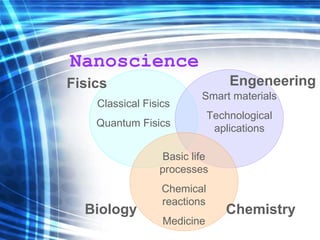
Nanoscience Fisics Engeneering Biology Chemistry Basic life processes Chemical reactions Medicine Classical Fisics Quantum Fisics Smart materials Technological aplications
Nanotechnology Using nanoscience to create: Smart materials Engines (in nanometric scale) Devices (with an enormous amount of aplications)
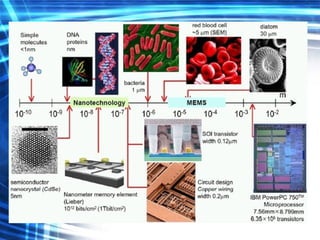
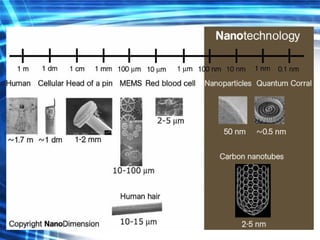
Nanostructures Between 1 a 100 nm What is smaller than 1 nanometer ? Alone atoms Small and simple molecules
 
 
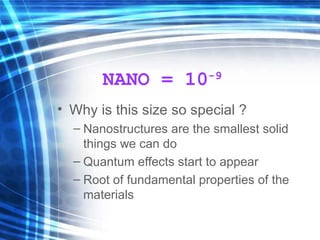
NANO = 10 -9 Why is this size so special ? Nanostructures are the smallest solid things we can do Quantum effects start to appear Root of fundamental properties of the materials
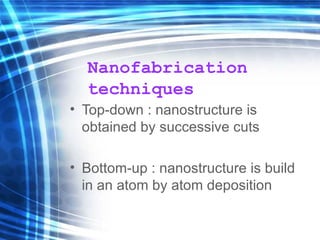
Nanofabrication techniques Top-down : nanostructure is obtained by  successive cuts  Bottom-up : nanostructure is build in an atom by atom deposition
Beginning of Nanoscience 1959 – Richard Feynman “ there´s plenty of room at the bottom” New instruments: Tunneling microscopes Atomic force microscopes Near-field microscopes
1981 – Gerd Binning e Heinrich Roher (laboratório IBM em Zurique) STM SCANNING TUNNELING MICROSCOPE
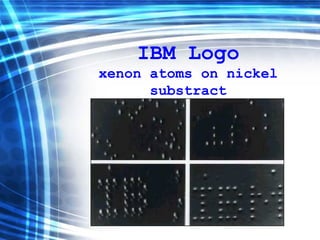
IBM Logo xenon atoms on nickel substract
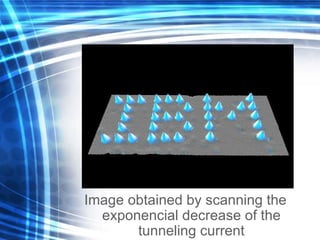
Image obtained by scanning the exponencial decrease of the tunneling current
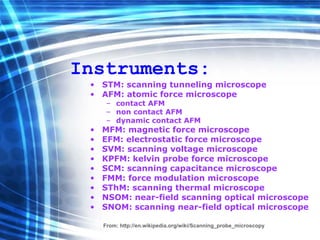
Instruments: STM: scanning tunneling microscope  AFM: atomic force microscope  contact AFM  non contact AFM  dynamic contact AFM  MFM: magnetic force microscope  EFM: electrostatic force microscope  SVM: scanning voltage microscope  KPFM: kelvin probe force microscope  SCM: scanning capacitance microscope  FMM: force modulation microscope  SThM: scanning thermal microscope  NSOM: near-field scanning optical microscope  SNOM: scanning near-field optical microscope   From:  http://en.wikipedia.org/wiki/Scanning_probe_microscopy
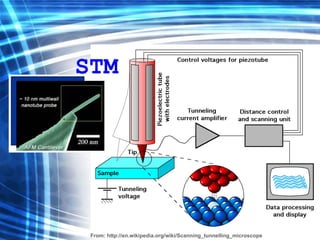
STM From:  http://en.wikipedia.org/wiki/Scanning_tunnelling_microscope
Piezoelectric effect The  piezoel ec tric   effect was discovered by  Pierre e Jacques Curie  in  1880  and  consist s on  varia tion   of   fisical  dimens ions   of  cert ain  materia l s subjected to an externally applied voltage. O pposite also occurs ,  e.g.,   when a mechanical stress is applied, a voltage is generated  in response.  The  quartz  and the   t ourmaline,  natural crystals ,  are  piezoel ec tric.
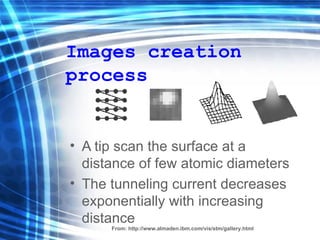
Images creation process A tip scan the surface at a distance of few atomic diameters The tunneling current  decreases exponentially with increasing distance From:  http://www.almaden.ibm.com/vis/stm/gallery.html
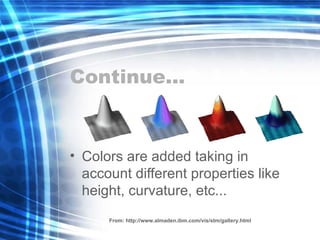
Continue... Colors are added taking in account different properties like height, curvature, etc... From:  http://www.almaden.ibm.com/vis/stm/gallery.html
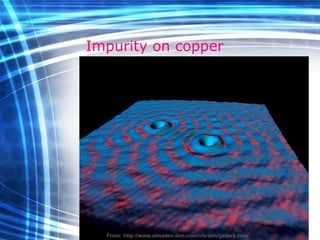
Impurity on copper From:  http://www.almaden.ibm.com/vis/stm/gallery.html
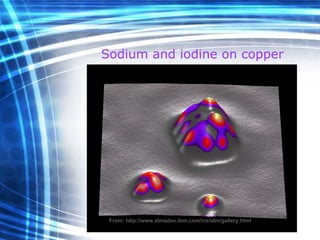
Sodium and iodine on copper   From:  http://www.almaden.ibm.com/vis/stm/gallery.html
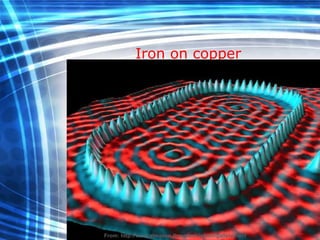
Iron on copper From:  http://www.almaden.ibm.com/vis/stm/gallery.html
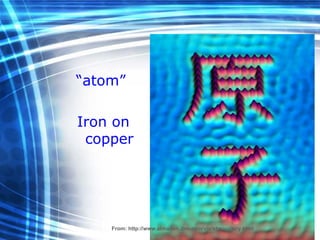
“ atom”  Iron on copper From:  http://www.almaden.ibm.com/vis/stm/gallery.html
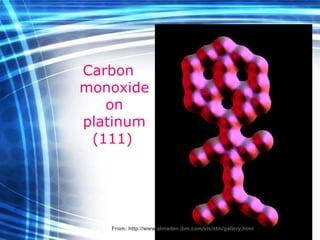
Carbon monoxide on platinum (111)   From:  http://www.almaden.ibm.com/vis/stm/gallery.html
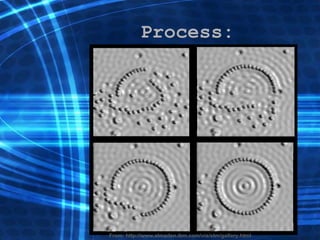
Process: From:  http://www.almaden.ibm.com/vis/stm/gallery.html
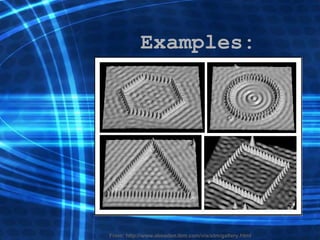
Examples: From:  http://www.almaden.ibm.com/vis/stm/gallery.html
Nanostructures: The nanostructures can be divided in some classes, like: Nanoparticles Nanofilms Nanowires Nanotubes
Nanostructures and potencial aplications: At atomic scale: Quantum wells   Extreme - thin layers   of semiconductor  material ( the well ) grown between barriers (gr ids ). The gr ids  imprison electrons in the extreme- thin  layers . CD devices, telecomunication, optics From:  http://www.mct.gov.br/index.php/content/view/index.php
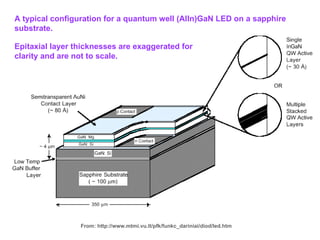
A typical configuration for a quantum well (AlIn)GaN LED on a sapphire substrate.  Epitaxial layer thicknesses are exaggerated for clarity and are not   to scale. From:  http://www.mtmi.vu.lt/pfk/funkc_dariniai/diod/led.htm
Quantum dots   F luorescent  nanoparticles . Depending on its composition, these particles can show  many different  colors . Telecommunications, optics . Polymers Some organic materials emit light under electric c urrent  action . informatics From:  http://www.mct.gov.br/index.php/content/view/index.php
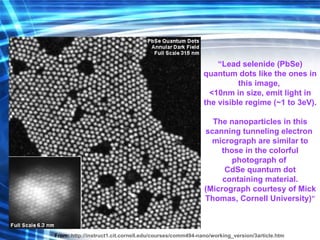
“ Lead selenide (PbSe) quantum dots like the ones in this image,  <10nm in size, emit light in the visible regime (~1 to 3eV).  The nanoparticles in this scanning tunneling electron  micrograph are similar to those in the  colorful photograph  of  CdSe quantum dot containing material. (Micrograph courtesy of Mick Thomas, Cornell University) ” From:   http://instruct1.cit.cornell.edu/courses/comm494-nano/working_version/3article.htm
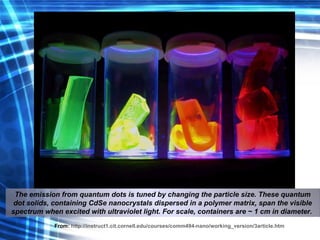
The emission from quantum dots is tuned by changing the particle size. These quantum dot solids, containing CdSe nanocrystals dispersed in a polymer matrix, span the visible spectrum when excited with ultraviolet light. For scale, containers are ~ 1 cm in diameter.   From:   http://instruct1.cit.cornell.edu/courses/comm494-nano/working_version/3article.htm
Part icles smaller than  100 nm : Nanoc a psul e s   Buckminsterfullerenes  are the most known . D i sco vered in  1985,  these  part i c le s  have  1 nm width.  Dry  Lubri cant .  C atal y tic  n anopart icles   In  a  1-10  nm range , these particles, when manipulated,  shows  a great superf i cial area, improving its reactivity  M aterials, fuels and foods  production From:  http://www.mct.gov.br/index.php/content/view/index.php
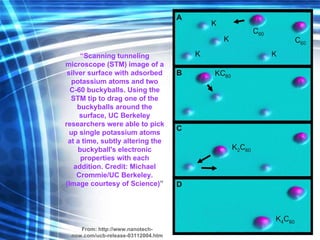
“ Scanning tunneling microscope (STM) image of a silver surface with adsorbed potassium atoms and two C-60 buckyballs. Using the STM tip to drag one of the buckyballs around the surface, UC Berkeley researchers were able to pick up single potassium atoms at a time, subtly altering the buckyball's electronic properties with each addition. Credit: Michael Crommie/UC Berkeley. (Image courtesy of Science) ” From:  http://www.nanotech-now.com/ucb-release-03112004.htm
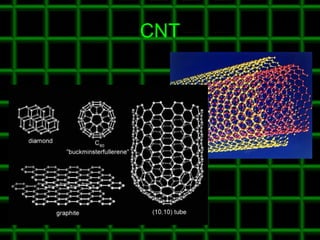
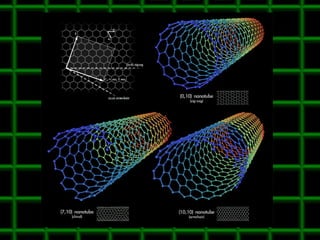
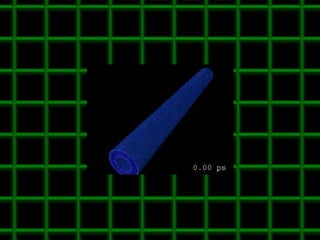
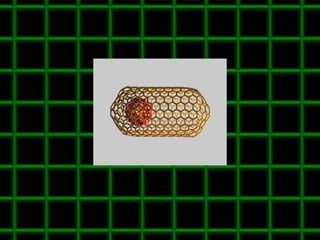
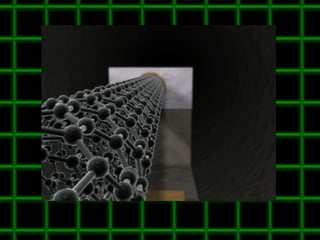
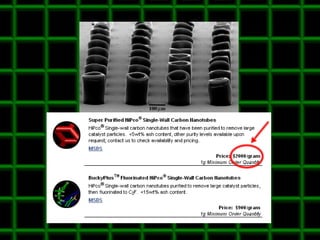
Wires   with   less than  100 nm di a met e r   Carbon Nanotubes Two types exist:  single wall  nanotub e s,   call ed  “ buckytubes ” , and  multi-wall  nanotub e s.   Described as the most important material in nanotec h nolog y , t hey  can  have  big  mechanical  resistance ,  50-100  times  that steel in one sixth of its weight. S pace and electronic   industries, aviation and innumerable other areas . From:  http://www.mct.gov.br/index.php/content/view/index.php
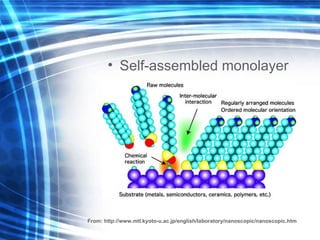
Films  with less than  100 nm  thickness Self-assembled  Mono layers Organic or inorg a nic substances that, spontane ously , form a layer of the thickness of a molecule A  large amount  of applications based on the chemical and physical properties .  From:  http://www.mct.gov.br/index.php/content/view/index.php
Self-assembled monolayer From:  http://www.mtl.kyoto-u.ac.jp/english/laboratory/nanoscopic/nanoscopic.htm
N anopartic les coverings Stainless steel layers applied by nanocr y stalin  powder  confer greater hardness in comparison with conventional applications. Sensors. Fabrica tion of   liquid  cr y stal. M olecular  wires . Lubrication, protection and anticorrosive  layers . Stronger and hard er cut  tools.  From:  http://www.mct.gov.br/index.php/content/view/index.php
CNT


MAGNETIC NANOSTRUCTURES
Topics Magnetism concepts Magnetic materials Magnetic nanostructured systems  Thin films Giant Magnetoresistence
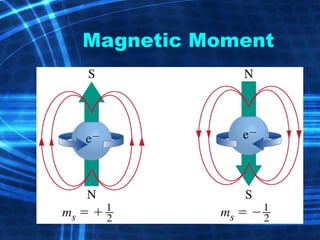
Spin Classic point of view: Rotation m ovement  of  the electron around a n  axle,  it means , an  angular moment
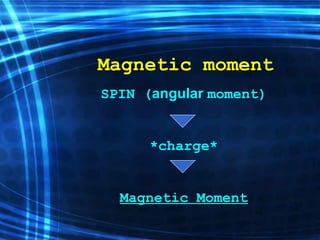
Magnetic moment SPIN ( angular   moment) *charge* Magnetic Moment
Magnetic Moment
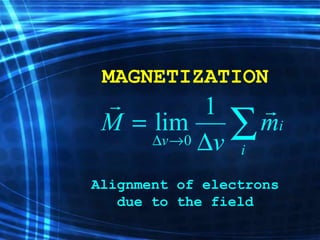
Magnetization It is the total magnetic moment of a certain amount of the substance for unit of volume   Due  to this ,  electrons   tend to line up when submitted to a n  external magnetic field
MAGNETIZATION Alignment of electrons due to the field
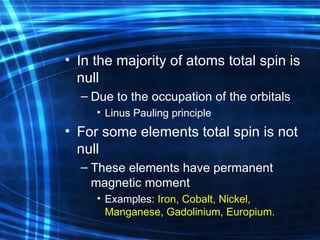
In the majority of atoms  total  spin is null  Due to  the  occupation of the orbital s Linus Pauling principle For some elements total spin is not null These elements have permanent magnetic moment Examples:  Iron, Cobalt, Nickel, Manganese, Gadolinium, Europium.
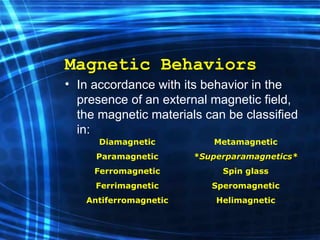
Magnetic Behaviors In accordance with its behavior  in the presence  of a n  external magnetic field, the magnetic materials can be classified in: Metamagnetic *Superparamagnetics* Spin glass Speromagnetic Helimagnetic Diamagnetic Paramagnetic Ferromagnetic Ferrimagnetic Antiferromagnetic
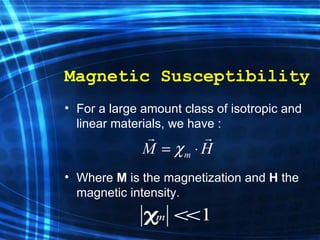
Magnetic Susceptibility For a  large amount class  of isotropic and linear materials, we have  : Where  M  is the magnetization and  H  the magnetic intensity.
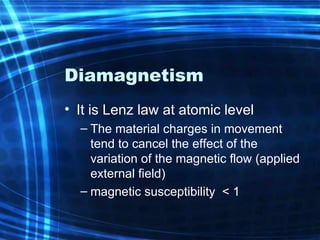
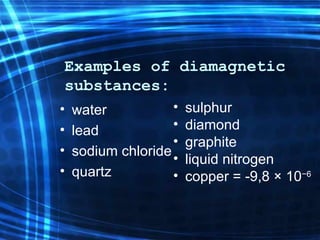
Diamagnetism It is Lenz law at atomic level The  material charges  in movement tend to cancel the effect of the variation of the magnetic flow (applied external field)  magnetic susceptibility   < 1
Examples of diamagnetic substances: water lead so di um chloride   quartz sulphur diam o n d gra phi te li quid  nitrogen copper = -9,8 × 10 −6
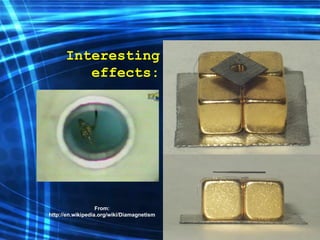
Interesting effects: From:  http://en.wikipedia.org/wiki/Diamagnetism
Paramagnetism The presence of a n  external magnetic field produces a torque that tends to line up the magnetic moments in the same direction of the field.
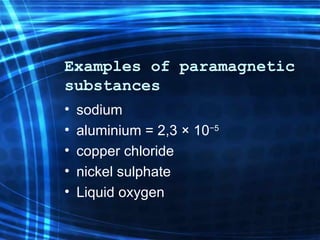
Examples of paramagnetic substances sodium  aluminium = 2,3 × 10 −5 copper chloride  nickel sulphate Liquid oxygen
Ferromagnetism Ferromagn e tic materials  have  a permanent magnetization  atoms with electrons not pair uped whose spins  are  guided in the same direction It generates regions called DOMAINS
Ferromagnetic materials examples Iron  = 5.500 Magnetite (Fe 3 O 4 ) Cobalt Nickel  Gadolinium
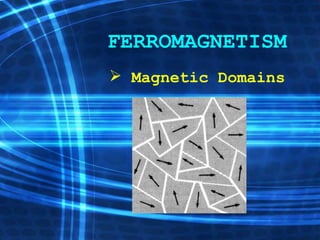
FERROMAGNETISM Magnetic Domains
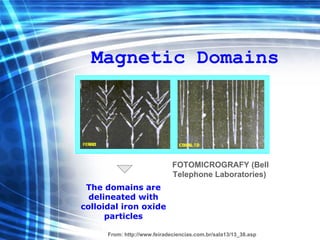
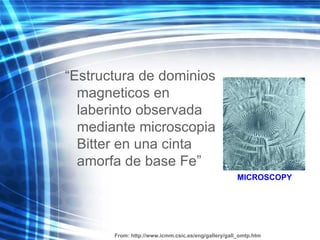
Magnetic Domains The domains are delineated with colloidal iron oxide particles FOTOMICROGRAFY   (Bell Telephone Laboratories)  From:  http://www.feiradeciencias.com.br/sala13/13_38.asp
“ Estructura de   dominios magneticos en laberinto observada mediante microscopia Bitter en una cinta amorfa de base Fe ” MICROSCOPY From:  http://www.icmm.csic.es/eng/gallery/gall_omtp.htm
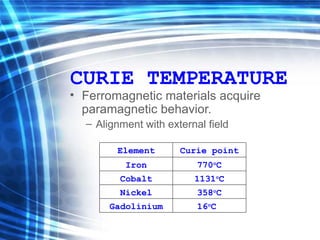
CURIE TEMPERATURE  Ferromagn e tic materials acquire paramagnetic behavior.  Alignment with external field  16 o C  Gadolinium 358 o C Nickel 1131 o C Cobalt 770 o C Iron Curie point Element
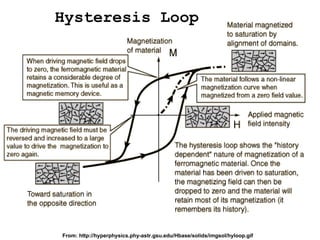
Hysteresis loop It determines the characteristics of a magnetic material.  It is the graph of magnetization M of the material in function of the external magnetic field applied H.
Hysteresis Loop It shows how much a material magnetizes under the influence of a magnetic field and how much of magnetization remains in it  after the  field is off.
Hysteresis Loop From:  http://hyperphysics.phy-astr.gsu.edu/Hbase/solids/imgsol/hyloop.gif
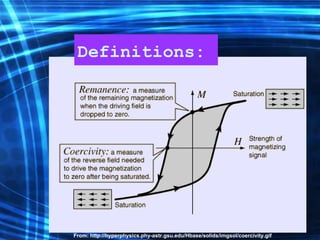
Definitions: From:  http://hyperphysics.phy-astr.gsu.edu/Hbase/solids/imgsol/coercivity.gif
Granulars: magnetic nanoparticles dispersed in a solid or liquid medium: Solid: granular solids Liquid: magnetic fluids Magnetic nanostructured systems:
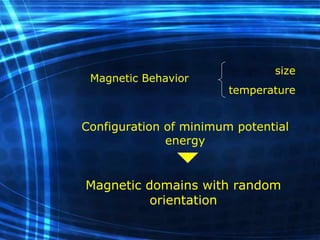
Magnetic Behavior Configuration of minimum potential energy Magnetic domains with random orientation size temperature
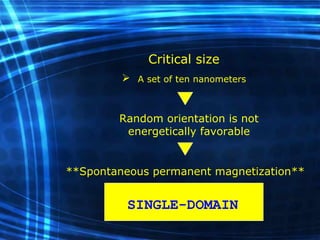
Critical size A set of ten nanometers Random orientation is not energetically favorable **Spontaneous permanent magnetization** SINGLE-DOMAIN
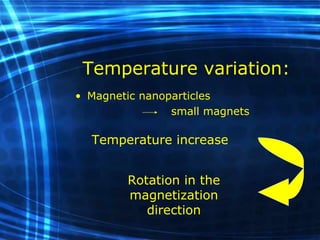
Temperature variation: Magnetic nanoparticles small magnets Temperature increase Rotation in the magnetization direction
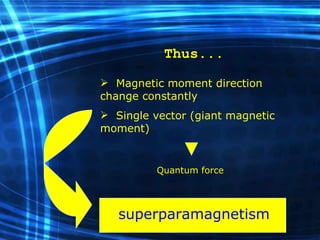
Thus... Magnetic moment direction change constantly Single vector (giant magnetic moment) Quantum force superparamagnetism
Thin films Materials of small thickness that can be made with one or more layers
Some aplications: Electronic semiconductors devices Optic devices    In the ceramic  thin  films  : Coverings against corrosion     In the ferromagnetic films: Computer memories
Fabrication Techniques Sputtering   Chemical vapor deposition   Molecular beam epitaxy   Sol-Gel   process Spin coating   Pulsed laser deposition
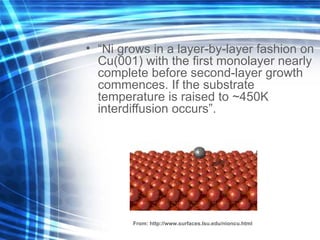
“ Ni grows in a layer-by-layer fashion on Cu(001) with the first monolayer nearly complete before second-layer growth commences. If the substrate temperature is raised to ~450K interdiffusion occurs”. From:  http://www.surfaces.lsu.edu/nioncu.html
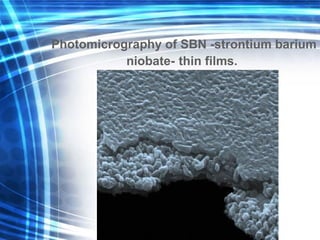
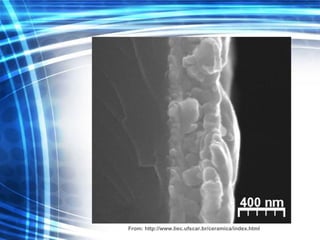
Ph otomicrogra phy   of SBN -s trontium  b arium  n iobate -   thin films .
From:  http://www.liec.ufscar.br/ceramica/index.html
Thin films and giant magnetoresistance Thin films: Gradual deposition of atoms in a substract Simple and multilayers [ iron – cobalt – nickel ] [ chromium – copper – ruthenium ] Giant magnetoresistance
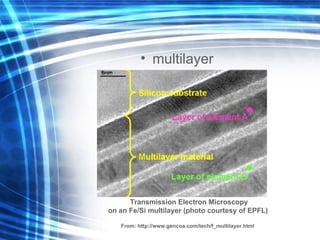
multilayer Transmission Electron Microscopy on an Fe/Si multilayer (photo courtesy of EPFL)  From:  http://www.gencoa.com/tech/f_multilayer.html
Giant Magnetoresistance: Discovered in 1988. Thin films multilayer structures intercalating iron and chromium.
Experiment: Mesure of electrical resistance of the system for different applied magnetic fields.
Results: When the ferromagnetics layers are  with contrary alignment  Device shows high electric resistance When the ferromagnetics layers are  with  paralel  alignment The resistance falls, around 40% to 50%
Applications of the giant magnetoresistance effect: Magnetic writing   Spintronics
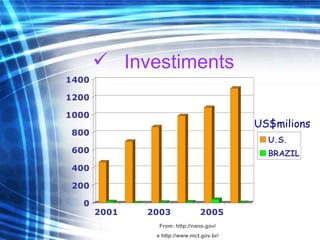
Investiments From:  http://nano.gov/ e  http://www.mct.gov.br/ US$milions
T H E E N D !

Nano-Science

  • 1.
  • 2.
    TOPICS Nanoscienceand nanotechnology concepts The begining of the nanoscience research Abstract on some nanostructures and it´s aplications Magnetic nanostructures Part 1 Part 2
  • 3.
    Nanoscience Fisics EngeneeringBiology Chemistry Basic life processes Chemical reactions Medicine Classical Fisics Quantum Fisics Smart materials Technological aplications
  • 4.
    Nanotechnology Using nanoscienceto create: Smart materials Engines (in nanometric scale) Devices (with an enormous amount of aplications)
  • 5.
    Nanostructures Between 1a 100 nm What is smaller than 1 nanometer ? Alone atoms Small and simple molecules
  • 6.
  • 7.
  • 8.
    NANO = 10-9 Why is this size so special ? Nanostructures are the smallest solid things we can do Quantum effects start to appear Root of fundamental properties of the materials
  • 9.
    Nanofabrication techniques Top-down: nanostructure is obtained by successive cuts Bottom-up : nanostructure is build in an atom by atom deposition
  • 10.
    Beginning of Nanoscience1959 – Richard Feynman “ there´s plenty of room at the bottom” New instruments: Tunneling microscopes Atomic force microscopes Near-field microscopes
  • 11.
    1981 – GerdBinning e Heinrich Roher (laboratório IBM em Zurique) STM SCANNING TUNNELING MICROSCOPE
  • 12.
    IBM Logo xenonatoms on nickel substract
  • 13.
    Image obtained byscanning the exponencial decrease of the tunneling current
  • 14.
    Instruments: STM: scanningtunneling microscope AFM: atomic force microscope contact AFM non contact AFM dynamic contact AFM MFM: magnetic force microscope EFM: electrostatic force microscope SVM: scanning voltage microscope KPFM: kelvin probe force microscope SCM: scanning capacitance microscope FMM: force modulation microscope SThM: scanning thermal microscope NSOM: near-field scanning optical microscope SNOM: scanning near-field optical microscope From: http://en.wikipedia.org/wiki/Scanning_probe_microscopy
  • 15.
    STM From: http://en.wikipedia.org/wiki/Scanning_tunnelling_microscope
  • 16.
    Piezoelectric effect The piezoel ec tric effect was discovered by Pierre e Jacques Curie in 1880 and consist s on varia tion of fisical dimens ions of cert ain materia l s subjected to an externally applied voltage. O pposite also occurs , e.g., when a mechanical stress is applied, a voltage is generated in response. The quartz and the t ourmaline, natural crystals , are piezoel ec tric.
  • 17.
    Images creation processA tip scan the surface at a distance of few atomic diameters The tunneling current decreases exponentially with increasing distance From: http://www.almaden.ibm.com/vis/stm/gallery.html
  • 18.
    Continue... Colors areadded taking in account different properties like height, curvature, etc... From: http://www.almaden.ibm.com/vis/stm/gallery.html
  • 19.
    Impurity on copperFrom: http://www.almaden.ibm.com/vis/stm/gallery.html
  • 20.
    Sodium and iodineon copper From: http://www.almaden.ibm.com/vis/stm/gallery.html
  • 21.
    Iron on copperFrom: http://www.almaden.ibm.com/vis/stm/gallery.html
  • 22.
    “ atom” Iron on copper From: http://www.almaden.ibm.com/vis/stm/gallery.html
  • 23.
    Carbon monoxide onplatinum (111) From: http://www.almaden.ibm.com/vis/stm/gallery.html
  • 24.
    Process: From: http://www.almaden.ibm.com/vis/stm/gallery.html
  • 25.
    Examples: From: http://www.almaden.ibm.com/vis/stm/gallery.html
  • 26.
    Nanostructures: The nanostructurescan be divided in some classes, like: Nanoparticles Nanofilms Nanowires Nanotubes
  • 27.
    Nanostructures and potencialaplications: At atomic scale: Quantum wells Extreme - thin layers of semiconductor material ( the well ) grown between barriers (gr ids ). The gr ids imprison electrons in the extreme- thin layers . CD devices, telecomunication, optics From: http://www.mct.gov.br/index.php/content/view/index.php
  • 28.
    A typical configurationfor a quantum well (AlIn)GaN LED on a sapphire substrate. Epitaxial layer thicknesses are exaggerated for clarity and are not to scale. From: http://www.mtmi.vu.lt/pfk/funkc_dariniai/diod/led.htm
  • 29.
    Quantum dots F luorescent nanoparticles . Depending on its composition, these particles can show many different colors . Telecommunications, optics . Polymers Some organic materials emit light under electric c urrent action . informatics From: http://www.mct.gov.br/index.php/content/view/index.php
  • 30.
    “ Lead selenide(PbSe) quantum dots like the ones in this image, <10nm in size, emit light in the visible regime (~1 to 3eV). The nanoparticles in this scanning tunneling electron micrograph are similar to those in the colorful photograph of CdSe quantum dot containing material. (Micrograph courtesy of Mick Thomas, Cornell University) ” From: http://instruct1.cit.cornell.edu/courses/comm494-nano/working_version/3article.htm
  • 31.
    The emission fromquantum dots is tuned by changing the particle size. These quantum dot solids, containing CdSe nanocrystals dispersed in a polymer matrix, span the visible spectrum when excited with ultraviolet light. For scale, containers are ~ 1 cm in diameter. From: http://instruct1.cit.cornell.edu/courses/comm494-nano/working_version/3article.htm
  • 32.
    Part icles smallerthan 100 nm : Nanoc a psul e s Buckminsterfullerenes are the most known . D i sco vered in 1985, these part i c le s have 1 nm width. Dry Lubri cant . C atal y tic n anopart icles In a 1-10 nm range , these particles, when manipulated, shows a great superf i cial area, improving its reactivity M aterials, fuels and foods production From: http://www.mct.gov.br/index.php/content/view/index.php
  • 33.
    “ Scanning tunnelingmicroscope (STM) image of a silver surface with adsorbed potassium atoms and two C-60 buckyballs. Using the STM tip to drag one of the buckyballs around the surface, UC Berkeley researchers were able to pick up single potassium atoms at a time, subtly altering the buckyball's electronic properties with each addition. Credit: Michael Crommie/UC Berkeley. (Image courtesy of Science) ” From: http://www.nanotech-now.com/ucb-release-03112004.htm
  • 34.
    Wires with less than 100 nm di a met e r Carbon Nanotubes Two types exist: single wall nanotub e s, call ed “ buckytubes ” , and multi-wall nanotub e s. Described as the most important material in nanotec h nolog y , t hey can have big mechanical resistance , 50-100 times that steel in one sixth of its weight. S pace and electronic industries, aviation and innumerable other areas . From: http://www.mct.gov.br/index.php/content/view/index.php
  • 35.
    Films withless than 100 nm thickness Self-assembled Mono layers Organic or inorg a nic substances that, spontane ously , form a layer of the thickness of a molecule A large amount of applications based on the chemical and physical properties . From: http://www.mct.gov.br/index.php/content/view/index.php
  • 36.
    Self-assembled monolayer From: http://www.mtl.kyoto-u.ac.jp/english/laboratory/nanoscopic/nanoscopic.htm
  • 37.
    N anopartic lescoverings Stainless steel layers applied by nanocr y stalin powder confer greater hardness in comparison with conventional applications. Sensors. Fabrica tion of liquid cr y stal. M olecular wires . Lubrication, protection and anticorrosive layers . Stronger and hard er cut tools. From: http://www.mct.gov.br/index.php/content/view/index.php
  • 38.
  • 39.
  • 40.
  • 41.
  • 42.
  • 43.
  • 44.
  • 45.
    Topics Magnetism conceptsMagnetic materials Magnetic nanostructured systems Thin films Giant Magnetoresistence
  • 46.
    Spin Classic pointof view: Rotation m ovement of the electron around a n axle, it means , an angular moment
  • 47.
    Magnetic moment SPIN( angular moment) *charge* Magnetic Moment
  • 48.
  • 49.
    Magnetization It isthe total magnetic moment of a certain amount of the substance for unit of volume Due to this , electrons tend to line up when submitted to a n external magnetic field
  • 50.
    MAGNETIZATION Alignment ofelectrons due to the field
  • 51.
    In the majorityof atoms total spin is null Due to the occupation of the orbital s Linus Pauling principle For some elements total spin is not null These elements have permanent magnetic moment Examples: Iron, Cobalt, Nickel, Manganese, Gadolinium, Europium.
  • 52.
    Magnetic Behaviors Inaccordance with its behavior in the presence of a n external magnetic field, the magnetic materials can be classified in: Metamagnetic *Superparamagnetics* Spin glass Speromagnetic Helimagnetic Diamagnetic Paramagnetic Ferromagnetic Ferrimagnetic Antiferromagnetic
  • 53.
    Magnetic Susceptibility Fora large amount class of isotropic and linear materials, we have : Where M is the magnetization and H the magnetic intensity.
  • 54.
    Diamagnetism It isLenz law at atomic level The material charges in movement tend to cancel the effect of the variation of the magnetic flow (applied external field) magnetic susceptibility < 1
  • 55.
    Examples of diamagneticsubstances: water lead so di um chloride quartz sulphur diam o n d gra phi te li quid nitrogen copper = -9,8 × 10 −6
  • 56.
    Interesting effects: From: http://en.wikipedia.org/wiki/Diamagnetism
  • 57.
    Paramagnetism The presenceof a n external magnetic field produces a torque that tends to line up the magnetic moments in the same direction of the field.
  • 58.
    Examples of paramagneticsubstances sodium aluminium = 2,3 × 10 −5 copper chloride nickel sulphate Liquid oxygen
  • 59.
    Ferromagnetism Ferromagn etic materials have a permanent magnetization atoms with electrons not pair uped whose spins are guided in the same direction It generates regions called DOMAINS
  • 60.
    Ferromagnetic materials examplesIron = 5.500 Magnetite (Fe 3 O 4 ) Cobalt Nickel Gadolinium
  • 61.
  • 62.
    Magnetic Domains Thedomains are delineated with colloidal iron oxide particles FOTOMICROGRAFY (Bell Telephone Laboratories) From: http://www.feiradeciencias.com.br/sala13/13_38.asp
  • 63.
    “ Estructura de dominios magneticos en laberinto observada mediante microscopia Bitter en una cinta amorfa de base Fe ” MICROSCOPY From: http://www.icmm.csic.es/eng/gallery/gall_omtp.htm
  • 64.
    CURIE TEMPERATURE Ferromagn e tic materials acquire paramagnetic behavior. Alignment with external field 16 o C Gadolinium 358 o C Nickel 1131 o C Cobalt 770 o C Iron Curie point Element
  • 65.
    Hysteresis loop Itdetermines the characteristics of a magnetic material. It is the graph of magnetization M of the material in function of the external magnetic field applied H.
  • 66.
    Hysteresis Loop Itshows how much a material magnetizes under the influence of a magnetic field and how much of magnetization remains in it after the field is off.
  • 67.
    Hysteresis Loop From: http://hyperphysics.phy-astr.gsu.edu/Hbase/solids/imgsol/hyloop.gif
  • 68.
    Definitions: From: http://hyperphysics.phy-astr.gsu.edu/Hbase/solids/imgsol/coercivity.gif
  • 69.
    Granulars: magnetic nanoparticlesdispersed in a solid or liquid medium: Solid: granular solids Liquid: magnetic fluids Magnetic nanostructured systems:
  • 70.
    Magnetic Behavior Configurationof minimum potential energy Magnetic domains with random orientation size temperature
  • 71.
    Critical size Aset of ten nanometers Random orientation is not energetically favorable **Spontaneous permanent magnetization** SINGLE-DOMAIN
  • 72.
    Temperature variation: Magneticnanoparticles small magnets Temperature increase Rotation in the magnetization direction
  • 73.
    Thus... Magnetic momentdirection change constantly Single vector (giant magnetic moment) Quantum force superparamagnetism
  • 74.
    Thin films Materialsof small thickness that can be made with one or more layers
  • 75.
    Some aplications: Electronicsemiconductors devices Optic devices In the ceramic thin films : Coverings against corrosion In the ferromagnetic films: Computer memories
  • 76.
    Fabrication Techniques Sputtering Chemical vapor deposition Molecular beam epitaxy Sol-Gel process Spin coating Pulsed laser deposition
  • 77.
    “ Ni growsin a layer-by-layer fashion on Cu(001) with the first monolayer nearly complete before second-layer growth commences. If the substrate temperature is raised to ~450K interdiffusion occurs”. From: http://www.surfaces.lsu.edu/nioncu.html
  • 78.
    Ph otomicrogra phy of SBN -s trontium b arium n iobate - thin films .
  • 79.
  • 80.
    Thin films andgiant magnetoresistance Thin films: Gradual deposition of atoms in a substract Simple and multilayers [ iron – cobalt – nickel ] [ chromium – copper – ruthenium ] Giant magnetoresistance
  • 81.
    multilayer Transmission ElectronMicroscopy on an Fe/Si multilayer (photo courtesy of EPFL) From: http://www.gencoa.com/tech/f_multilayer.html
  • 82.
    Giant Magnetoresistance: Discoveredin 1988. Thin films multilayer structures intercalating iron and chromium.
  • 83.
    Experiment: Mesure ofelectrical resistance of the system for different applied magnetic fields.
  • 84.
    Results: When theferromagnetics layers are with contrary alignment Device shows high electric resistance When the ferromagnetics layers are with paralel alignment The resistance falls, around 40% to 50%
  • 85.
    Applications of thegiant magnetoresistance effect: Magnetic writing Spintronics
  • 86.
    Investiments From: http://nano.gov/ e http://www.mct.gov.br/ US$milions
  • 87.
    T H EE N D !