Topic:
Prepared By:
DR. SHABANA NAZ SHAH
PhD. In Pharmaceutical Chemistry
1
What is Nanotechnology?
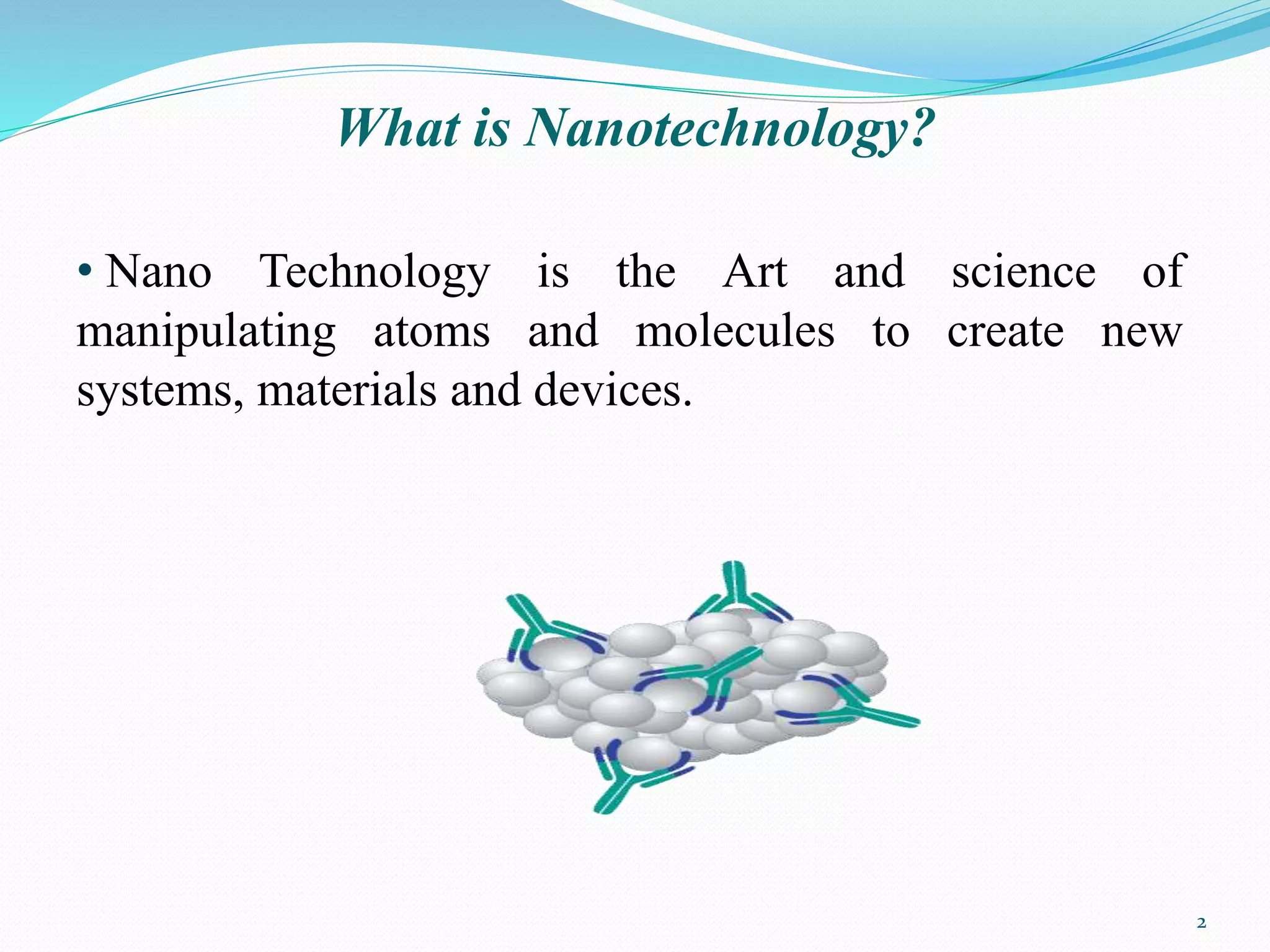
• Nano Technology is the Art and science of
manipulating atoms and molecules to create new
systems, materials and devices.
2
3
Nanotechnology is enabling much faster and more precise
diagnosis, as many tests can be built into a single, often palm-sized
device that only requires tiny quantities of sample.
This device is sometimes called a 'lab-on-a-chip', and samples
can be processed and analysed so rapidly that the results can be
read out almost instantaneously.
Nanotechnology
The concepts that seeded nanotechnology were first
discussed in 1959 by renowned physicist Richard
Feynman in his talk .
There's Plenty of Room at the Bottom, in which he
described the possibility of synthesis via direct
manipulation of atoms.
The term "nano-technology" was first used by Norio
Taniguchi in 1974, though it was not widely known.
Origins: History of Nanotechnology
4
2000 Years Ago – Sulfide nanocrystals used by Greeks and Romans to
dye hair.
1000 Years Ago (Middle Ages)- Gold nanoparticles of different sizes
used to produce different colors in stained glass windows.
1974- “Nano-technology" Taniguchi used the term nanotechnology
for the first time.
1981- IBM develops scanning tunneling microscope. This microscope
evolved to allow the manipulation of individual atoms and molecules in the
field of Nano technology.
1985 – “Buckyball”- Scientists at Rice University and University of Sussex
discover C60.
1991- Carbon nanotube discovered by S. Iijima.
History of Nanotechnology
5
Generation of Nanotechnology
6
At the nanoscale, the physical, chemical, and
biological properties of materials differ in fundamental
and valuable ways from the properties of individual
atoms and molecules or bulk matter.
Nanotechnology R&D is directed toward
understanding and creating improved materials,
devices, and systems that exploit these new properties.
Why Nanotechnology?
7
Allows the placement of small structures placed with
precision, simplicity and low cost.
Leads to economic growth.
Enhance national security.
Improve the quality of life.
Leads to job creation.
Need For Nanotechnology
8
Growth of Nanotechnology
9
Size Matters
10
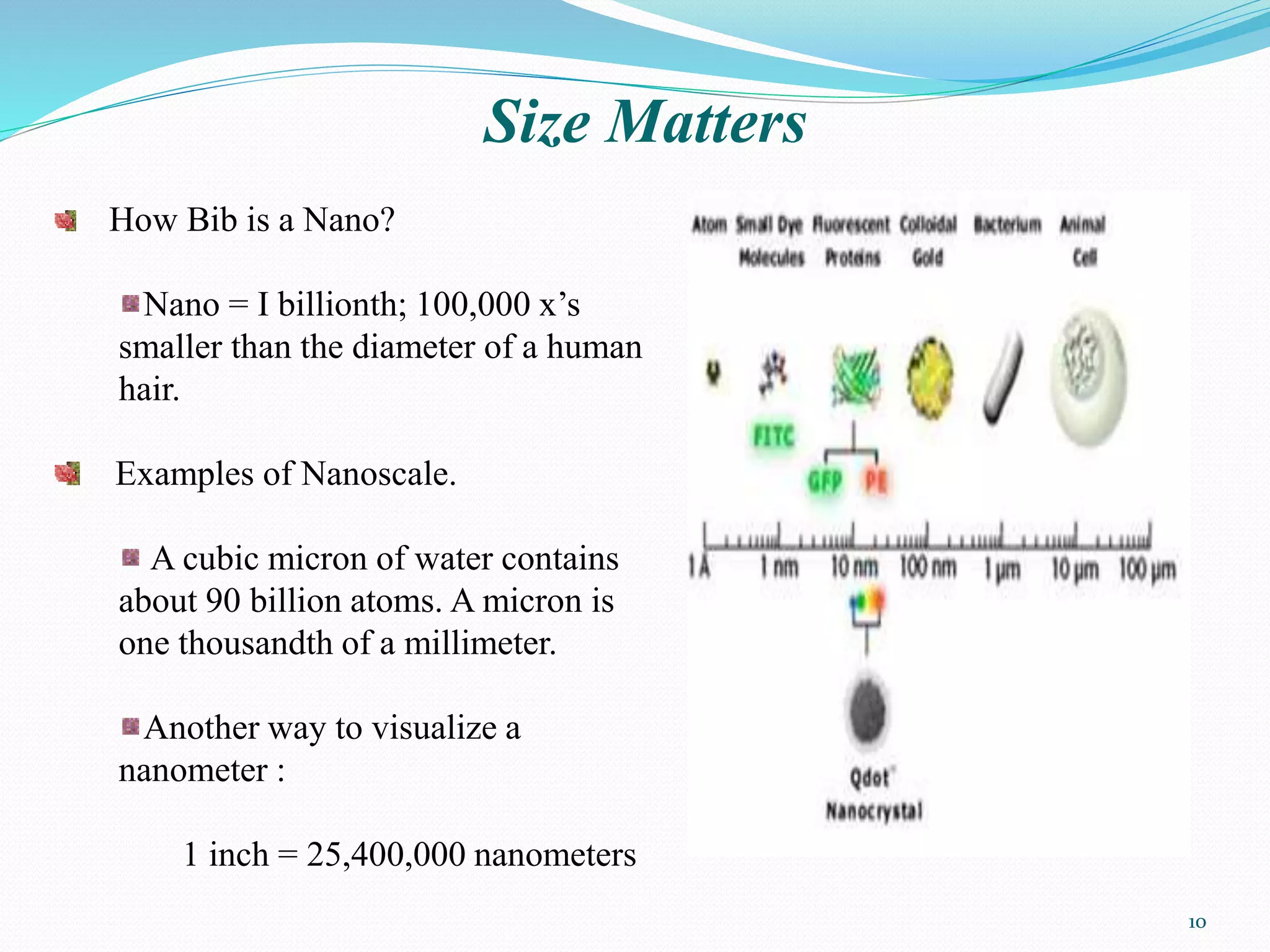
How Bib is a Nano?
Nano = I billionth; 100,000 x’s
smaller than the diameter of a human
hair.
Examples of Nanoscale.
A cubic micron of water contains
about 90 billion atoms. A micron is
one thousandth of a millimeter.
Another way to visualize a
nanometer :
1 inch = 25,400,000 nanometers
11
“The power of nanotechnology is rooted in its potential to
transform and revolutionize multiple technology and industry
sectors, including:
Aerospace.
Agriculture.
Biotechnology.
Homeland security and national defense.
Energy.
Environmental improvement.
Information technology.
Medicine and
Transportation.
Discovery in some of these areas has advanced to the point
where it is now possible to identify applications that will impact the
world we live in.”
Benefits of Nanotechnology
12
Benefits of Nanotechnology
13
Economic Impact of Nanotechnology
Market Size Predictions (within a decade)*
$340B/yr Materials
$300B/yr Electronics
$180B/yr Pharmaceuticals
$100B/yr Chemical manufacture
$ 70B/yr Aerospace
$ 20B/yr Tools
$ 30B/yr Improved healthcare
$ 45B/yr Sustainability
$1 Trillion per year by 2015
*2007 Estimates by industry groups, source: NSF
14
Economic Impact of Nanotechnology
According to “The Nanotechnology Opportunity Report (NOR),” 3rd Edition
Cientifica Ltd., published in June 2008
“The market for products enabled by nano-technologies will reach US$ 263
billion by 2012.”
“The highest growth rates will be in the convergence between bio- and
nanotechnologies in the healthcare and pharmaceutical sectors.”
15
16
Advantages of Nanotechnology
17
Disadvantages of Nanotechnology
Very expensive.
Atomic weapons will become more
destructive.
Very hard to make.
18
Application of Nanotechnology
19
Nanosystem:
It is small system can be seen as an extension of biotechnology.
For example, to create a molecular motor about the size of the virus.
Scientists have combined genetically engineered proteins with other
chemically structured components.
Application of Nanotechnology
20
Nanomaterials:
It is possible to create new
kinds of materials by working at
the nanolevel.
One of the first
nanomaterials was “carbon
nanotube”, which conducts
electricity better than copper yet
is stronger and lighter than steel.
Application of Nanotechnology
21
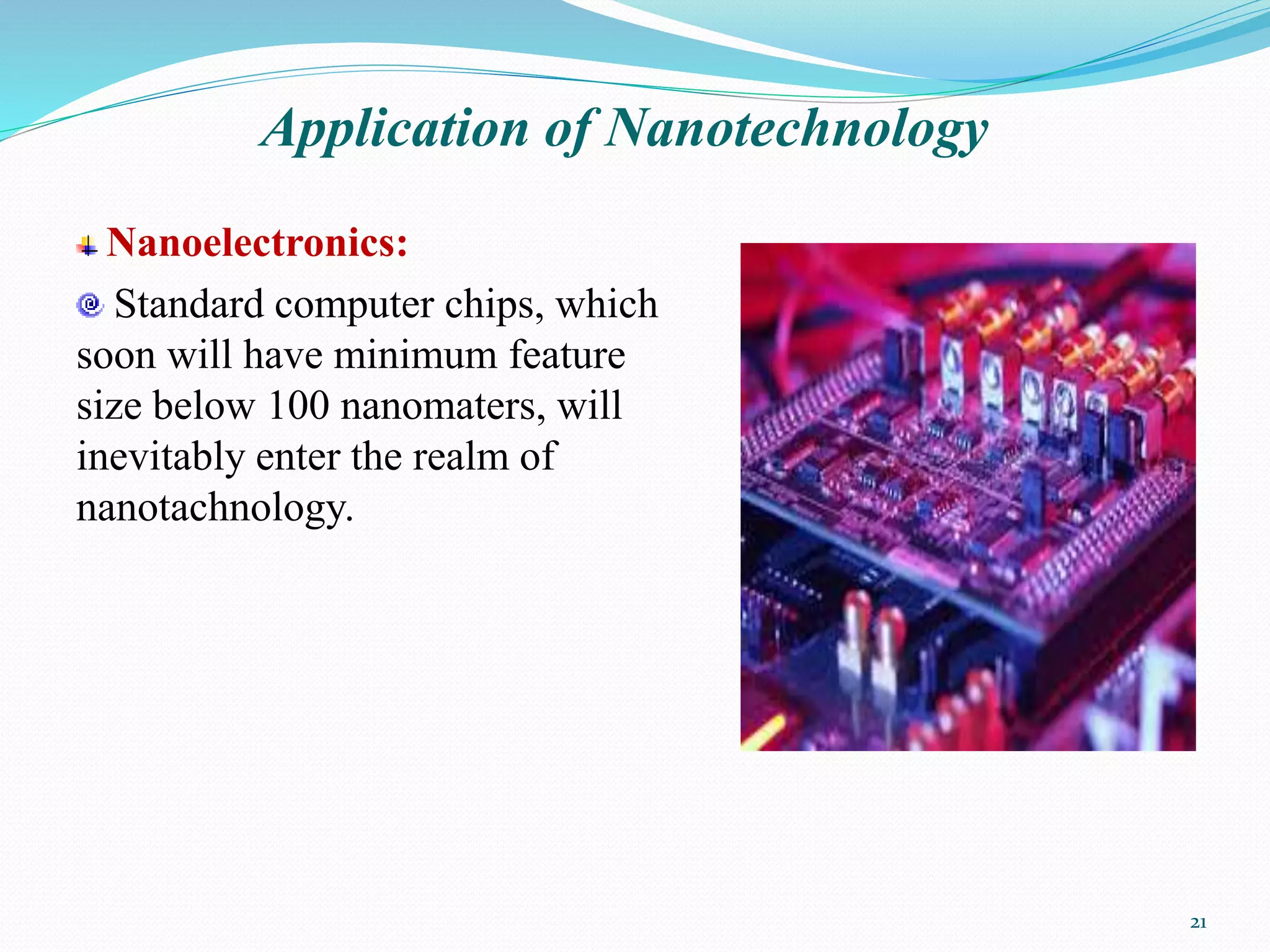
Nanoelectronics:
Standard computer chips, which
soon will have minimum feature
size below 100 nanomaters, will
inevitably enter the realm of
nanotachnology.
Application of Nanotechnology
22
Nano Robots:
Nanorobotics is the technology
of creating machine or robots at
or close to the microscopic scale
of a nanometres (10-9 meters).
Application of Nanotechnology
23
Carbon Nanotubes:
Stiffest and strongest fibers known,
which remarkable electronic properties
and unique characteristics.
They are the result of synthesis of
buckminsterfullerene, C60 and other
fullerences.
Application of Nanotechnology
24
Cancer Treatment:
 Cancer cells can be killed
without the pain full side effects of
chemotherapy.
 QuantumDot.
 Scientists may now be able to
destroy tumors without killing healthy
cells at the same time.
Nanoshells as Cancer Therapy
25
Application of Nanotechnology
26
Nanodentistry:
Nanodentistry will make possible the
maintenance of comprehensive oral health by
employing nanomaterials, biotechnology,
including tissue engineering, and ultimately,
dental nanorobotics. New potential treatment
opportunities in dentistry may include, local
anesthesia, dentition renaturalization,
permanent hypersensitivity cure, complete
orthodontic realignments during a single
office visit, covalently bonded diamondised
enamel, and continuous oral health
maintenance using mechanical dentifrobots.
Application of Nanotechnology
27
Many Nano medicines are already in routine clinical use.
Application of Nanotechnology
28
Nanofood:
Preservation of food without refrigeration.
Protection of food from bacteria and diseases..
Lighter foods.
Application of Nanotechnology
29
Hi-Tech Lens:
Contact lens that let you check your blood sugar
level by looking in a mirror.
Coming in about five years.
Application of Nanotechnology
30
Intelligent Nano Coatings:
Intelligents nano coatings for
windows that reflect solar heat in the
summer and transmit it in winter.
Implications of Nanotechnology
31
Health and safety issues.
 Nanoparticles can cause serious illness or
damage human body.
 Untraceable destructive weapons of mass
destruction.
Social & Political issues.
 Creates social strife through increasing wealth
gap.
 Advisability of increasing scope of the
technology creates political dilemma.
Implications of Nanotechnology
32
Environmental issues.
 Nanopollution is created by toxic wastes from
nanomaterial manufacturing.
 Enhances Global warming in the long run.
Grey-goo.
 It is a hypothetical situation where self
replicating nanobots go out of control, and
consume all matter on earth.
The Promise of Nanotechnology
33
34

Nanotechnology

  • 1.
    Topic: Prepared By: DR. SHABANANAZ SHAH PhD. In Pharmaceutical Chemistry 1
  • 2.
    What is Nanotechnology? •Nano Technology is the Art and science of manipulating atoms and molecules to create new systems, materials and devices. 2
  • 3.
    3 Nanotechnology is enablingmuch faster and more precise diagnosis, as many tests can be built into a single, often palm-sized device that only requires tiny quantities of sample. This device is sometimes called a 'lab-on-a-chip', and samples can be processed and analysed so rapidly that the results can be read out almost instantaneously. Nanotechnology
  • 4.
    The concepts thatseeded nanotechnology were first discussed in 1959 by renowned physicist Richard Feynman in his talk . There's Plenty of Room at the Bottom, in which he described the possibility of synthesis via direct manipulation of atoms. The term "nano-technology" was first used by Norio Taniguchi in 1974, though it was not widely known. Origins: History of Nanotechnology 4
  • 5.
    2000 Years Ago– Sulfide nanocrystals used by Greeks and Romans to dye hair. 1000 Years Ago (Middle Ages)- Gold nanoparticles of different sizes used to produce different colors in stained glass windows. 1974- “Nano-technology" Taniguchi used the term nanotechnology for the first time. 1981- IBM develops scanning tunneling microscope. This microscope evolved to allow the manipulation of individual atoms and molecules in the field of Nano technology. 1985 – “Buckyball”- Scientists at Rice University and University of Sussex discover C60. 1991- Carbon nanotube discovered by S. Iijima. History of Nanotechnology 5
  • 6.
  • 7.
    At the nanoscale,the physical, chemical, and biological properties of materials differ in fundamental and valuable ways from the properties of individual atoms and molecules or bulk matter. Nanotechnology R&D is directed toward understanding and creating improved materials, devices, and systems that exploit these new properties. Why Nanotechnology? 7
  • 8.
    Allows the placementof small structures placed with precision, simplicity and low cost. Leads to economic growth. Enhance national security. Improve the quality of life. Leads to job creation. Need For Nanotechnology 8
  • 9.
  • 10.
    Size Matters 10 How Bibis a Nano? Nano = I billionth; 100,000 x’s smaller than the diameter of a human hair. Examples of Nanoscale. A cubic micron of water contains about 90 billion atoms. A micron is one thousandth of a millimeter. Another way to visualize a nanometer : 1 inch = 25,400,000 nanometers
  • 11.
    11 “The power ofnanotechnology is rooted in its potential to transform and revolutionize multiple technology and industry sectors, including: Aerospace. Agriculture. Biotechnology. Homeland security and national defense. Energy. Environmental improvement. Information technology. Medicine and Transportation. Discovery in some of these areas has advanced to the point where it is now possible to identify applications that will impact the world we live in.” Benefits of Nanotechnology
  • 12.
  • 13.
    13 Economic Impact ofNanotechnology Market Size Predictions (within a decade)* $340B/yr Materials $300B/yr Electronics $180B/yr Pharmaceuticals $100B/yr Chemical manufacture $ 70B/yr Aerospace $ 20B/yr Tools $ 30B/yr Improved healthcare $ 45B/yr Sustainability $1 Trillion per year by 2015 *2007 Estimates by industry groups, source: NSF
  • 14.
    14 Economic Impact ofNanotechnology According to “The Nanotechnology Opportunity Report (NOR),” 3rd Edition Cientifica Ltd., published in June 2008 “The market for products enabled by nano-technologies will reach US$ 263 billion by 2012.” “The highest growth rates will be in the convergence between bio- and nanotechnologies in the healthcare and pharmaceutical sectors.”
  • 15.
  • 16.
  • 17.
    17 Disadvantages of Nanotechnology Veryexpensive. Atomic weapons will become more destructive. Very hard to make.
  • 18.
  • 19.
    Application of Nanotechnology 19 Nanosystem: Itis small system can be seen as an extension of biotechnology. For example, to create a molecular motor about the size of the virus. Scientists have combined genetically engineered proteins with other chemically structured components.
  • 20.
    Application of Nanotechnology 20 Nanomaterials: Itis possible to create new kinds of materials by working at the nanolevel. One of the first nanomaterials was “carbon nanotube”, which conducts electricity better than copper yet is stronger and lighter than steel.
  • 21.
    Application of Nanotechnology 21 Nanoelectronics: Standardcomputer chips, which soon will have minimum feature size below 100 nanomaters, will inevitably enter the realm of nanotachnology.
  • 22.
    Application of Nanotechnology 22 NanoRobots: Nanorobotics is the technology of creating machine or robots at or close to the microscopic scale of a nanometres (10-9 meters).
  • 23.
    Application of Nanotechnology 23 CarbonNanotubes: Stiffest and strongest fibers known, which remarkable electronic properties and unique characteristics. They are the result of synthesis of buckminsterfullerene, C60 and other fullerences.
  • 24.
    Application of Nanotechnology 24 CancerTreatment:  Cancer cells can be killed without the pain full side effects of chemotherapy.  QuantumDot.  Scientists may now be able to destroy tumors without killing healthy cells at the same time.
  • 25.
  • 26.
    Application of Nanotechnology 26 Nanodentistry: Nanodentistrywill make possible the maintenance of comprehensive oral health by employing nanomaterials, biotechnology, including tissue engineering, and ultimately, dental nanorobotics. New potential treatment opportunities in dentistry may include, local anesthesia, dentition renaturalization, permanent hypersensitivity cure, complete orthodontic realignments during a single office visit, covalently bonded diamondised enamel, and continuous oral health maintenance using mechanical dentifrobots.
  • 27.
    Application of Nanotechnology 27 ManyNano medicines are already in routine clinical use.
  • 28.
    Application of Nanotechnology 28 Nanofood: Preservationof food without refrigeration. Protection of food from bacteria and diseases.. Lighter foods.
  • 29.
    Application of Nanotechnology 29 Hi-TechLens: Contact lens that let you check your blood sugar level by looking in a mirror. Coming in about five years.
  • 30.
    Application of Nanotechnology 30 IntelligentNano Coatings: Intelligents nano coatings for windows that reflect solar heat in the summer and transmit it in winter.
  • 31.
    Implications of Nanotechnology 31 Healthand safety issues.  Nanoparticles can cause serious illness or damage human body.  Untraceable destructive weapons of mass destruction. Social & Political issues.  Creates social strife through increasing wealth gap.  Advisability of increasing scope of the technology creates political dilemma.
  • 32.
    Implications of Nanotechnology 32 Environmentalissues.  Nanopollution is created by toxic wastes from nanomaterial manufacturing.  Enhances Global warming in the long run. Grey-goo.  It is a hypothetical situation where self replicating nanobots go out of control, and consume all matter on earth.
  • 33.
    The Promise ofNanotechnology 33
  • 34.