Batteries and Fuel Cells
Portable Electric Energy
The Battery
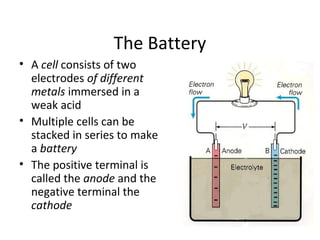
• A cell consists of two
electrodes of different
metals immersed in a
weak acid
• Multiple cells can be
stacked in series to make
a battery
• The positive terminal is
called the anode and the
negative terminal the
cathode
Connecting Batteries in Series
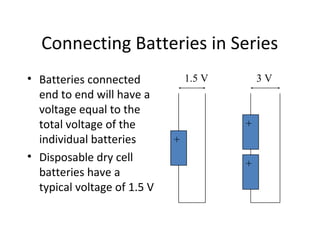
• Batteries connected
end to end will have a
voltage equal to the
total voltage of the
individual batteries
• Disposable dry cell
batteries have a
typical voltage of 1.5 V
+
+
+
1.5 V 3 V
Amp-hours
• The total energy contained within a battery can be described
using Amp-hours
• Example: A battery that can provide 4 A-hrs can generate 4
A for 1 hour, 2 A for 2 hrs., etc.
• Example: A 12 volt car battery can provide 60 A-hrs. of
energy. How many joules is this?
• Solution: If it drew 60 A of current at 12 V, that would be (60
A) x (12 V) = 720 W. And 1 hr = 3600 s, so (720 W) x (3600 s)
= 2.59 x 10⁶
J
• In other words: Energy (J) = (Amp-hours) x (Volts) x (3600)
SHANKARSINGH VAGHELA BAPU INSTITUTE
OF TECHNOLOGY
SUBJECT: EEE
FACULTY: GAJENDRA SIR
NAME: KARAN SHAH
CLASS: COMPTER ENGINEERING
SEM: 1ST
ENROLMENT NO 140750107009
ROLL NO: 62
TOPIC: BATTERY
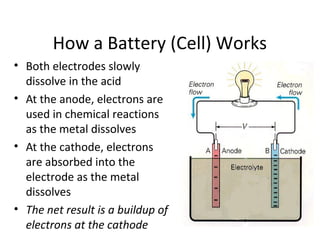
How a Battery (Cell) Works
• Both electrodes slowly
dissolve in the acid
• At the anode, electrons are
used in chemical reactions
as the metal dissolves
• At the cathode, electrons
are absorbed into the
electrode as the metal
dissolves
• The net result is a buildup of
electrons at the cathode
Disposable and Rechargeable Batteries
• A rechargeable battery can be connected to
an electric current so that dissolved metals
reform on the electrodes
• Examples: lead acid, nickel cadmium, lithium,
etc.
• The chemical reactions that power a
disposable battery cannot be reversed
• Examples: alkaline dry cells, etc.
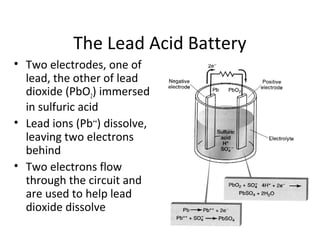
The Lead Acid Battery
• Two electrodes, one of
lead, the other of lead
dioxide (PbO2) immersed
in sulfuric acid
• Lead ions (Pb++
) dissolve,
leaving two electrons
behind
• Two electrons flow
through the circuit and
are used to help lead
dioxide dissolve
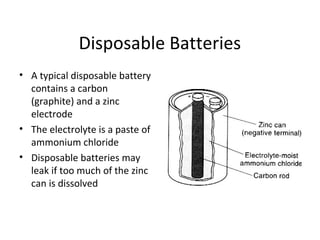
Disposable Batteries
• A typical disposable battery
contains a carbon
(graphite) and a zinc
electrode
• The electrolyte is a paste of
ammonium chloride
• Disposable batteries may
leak if too much of the zinc
can is dissolved
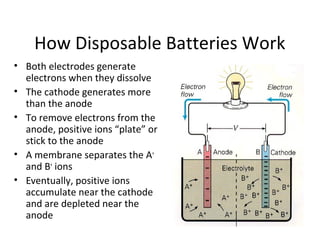
How Disposable Batteries Work
• Both electrodes generate
electrons when they dissolve
• The cathode generates more
than the anode
• To remove electrons from the
anode, positive ions “plate” or
stick to the anode
• A membrane separates the A+
and B+
ions
• Eventually, positive ions
accumulate near the cathode
and are depleted near the
anode
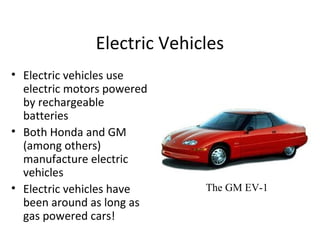
Electric Vehicles
• Electric vehicles use
electric motors powered
by rechargeable
batteries
• Both Honda and GM
(among others)
manufacture electric
vehicles
• Electric vehicles have
been around as long as
gas powered cars!
The GM EV-1
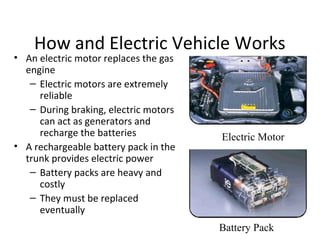
How and Electric Vehicle Works
• An electric motor replaces the gas
engine
– Electric motors are extremely
reliable
– During braking, electric motors
can act as generators and
recharge the batteries
• A rechargeable battery pack in the
trunk provides electric power
– Battery packs are heavy and
costly
– They must be replaced
eventually
Electric Motor
Battery Pack
Why Nobody Buys Electric Cars
“The battery challenge is vast. Even with our most
advanced experimental power pack, operating costs in 1998
would be unacceptable to the vast majority of drivers.
Essentially, it’s like asking the customer to buy a car with a
$15,000 gas tank--a $15,000 gas tank that holds the range
equivalent to 3 gallons of gasoline; a 3 gallon tank that takes 8
hours to refill, compared to a few minutes at a self-service gas
station.”
D. Wilkie, 1994
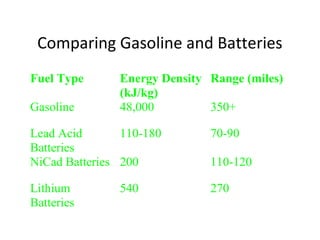
Comparing Gasoline and Batteries
Fuel Type Energy Density
(kJ/kg)
Range (miles)
Gasoline 48,000 350+
Lead Acid
Batteries
110-180 70-90
NiCad Batteries 200 110-120
Lithium
Batteries
540 270
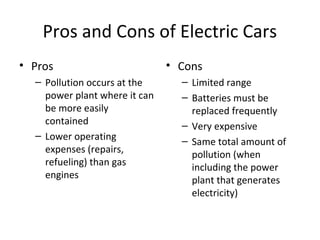
Pros and Cons of Electric Cars
• Pros
– Pollution occurs at the
power plant where it can
be more easily
contained
– Lower operating
expenses (repairs,
refueling) than gas
engines
• Cons
– Limited range
– Batteries must be
replaced frequently
– Very expensive
– Same total amount of
pollution (when
including the power
plant that generates
electricity)
Fuel Cells
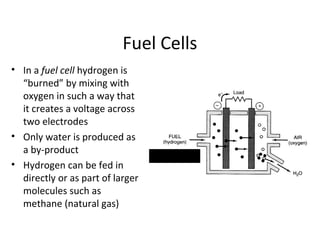
• In a fuel cell hydrogen is
“burned” by mixing with
oxygen in such a way that
it creates a voltage across
two electrodes
• Only water is produced as
a by-product
• Hydrogen can be fed in
directly or as part of larger
molecules such as
methane (natural gas)
How They Work
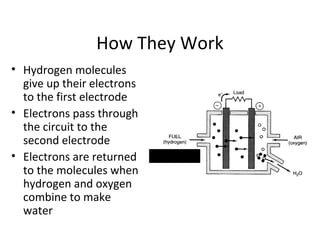
• Hydrogen molecules
give up their electrons
to the first electrode
• Electrons pass through
the circuit to the
second electrode
• Electrons are returned
to the molecules when
hydrogen and oxygen
combine to make
water
Comments on Fuel Cells
• Fuel cells have been around for 100 years
• Fuel cells can be made to burn other
molecules, such as methane, propane, etc.
• Hydrogen can be extracted from gasoline
before being fed into a fuel cell
• Fuel cells cannot store energy, so they must be
used in conjunction with a storage battery
Fuel Cells in Electric Cars
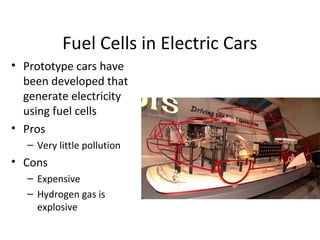
• Prototype cars have
been developed that
generate electricity
using fuel cells
• Pros
– Very little pollution
• Cons
– Expensive
– Hydrogen gas is
explosive
Fuel Cells to Replace Batteries
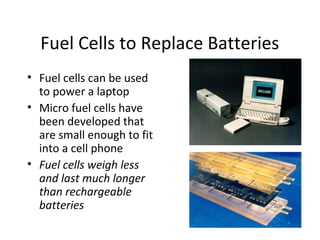
• Fuel cells can be used
to power a laptop
• Micro fuel cells have
been developed that
are small enough to fit
into a cell phone
• Fuel cells weigh less
and last much longer
than rechargeable
batteries
Why are Fuel Cells so Uncommon?
• Methods are being developed to store
hydrogen in a porous material rather than as
compressed gas
• Fuel cells require expensive catalysts
• How do you pump compressed hydrogen at a
self-service gas station?
• What happens to the hydrogen tank in an
accident?
Flywheels?
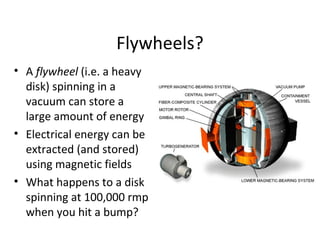
• A flywheel (i.e. a heavy
disk) spinning in a
vacuum can store a
large amount of energy
• Electrical energy can be
extracted (and stored)
using magnetic fields
• What happens to a disk
spinning at 100,000 rmp
when you hit a bump?

Batteries and fuel cells

  • 1.
    Batteries and FuelCells Portable Electric Energy
  • 2.
    The Battery • Acell consists of two electrodes of different metals immersed in a weak acid • Multiple cells can be stacked in series to make a battery • The positive terminal is called the anode and the negative terminal the cathode
  • 3.
    Connecting Batteries inSeries • Batteries connected end to end will have a voltage equal to the total voltage of the individual batteries • Disposable dry cell batteries have a typical voltage of 1.5 V + + + 1.5 V 3 V
  • 4.
    Amp-hours • The totalenergy contained within a battery can be described using Amp-hours • Example: A battery that can provide 4 A-hrs can generate 4 A for 1 hour, 2 A for 2 hrs., etc. • Example: A 12 volt car battery can provide 60 A-hrs. of energy. How many joules is this? • Solution: If it drew 60 A of current at 12 V, that would be (60 A) x (12 V) = 720 W. And 1 hr = 3600 s, so (720 W) x (3600 s) = 2.59 x 10⁶ J • In other words: Energy (J) = (Amp-hours) x (Volts) x (3600)
  • 5.
    SHANKARSINGH VAGHELA BAPUINSTITUTE OF TECHNOLOGY SUBJECT: EEE FACULTY: GAJENDRA SIR NAME: KARAN SHAH CLASS: COMPTER ENGINEERING SEM: 1ST ENROLMENT NO 140750107009 ROLL NO: 62 TOPIC: BATTERY
  • 6.
    How a Battery(Cell) Works • Both electrodes slowly dissolve in the acid • At the anode, electrons are used in chemical reactions as the metal dissolves • At the cathode, electrons are absorbed into the electrode as the metal dissolves • The net result is a buildup of electrons at the cathode
  • 7.
    Disposable and RechargeableBatteries • A rechargeable battery can be connected to an electric current so that dissolved metals reform on the electrodes • Examples: lead acid, nickel cadmium, lithium, etc. • The chemical reactions that power a disposable battery cannot be reversed • Examples: alkaline dry cells, etc.
  • 8.
    The Lead AcidBattery • Two electrodes, one of lead, the other of lead dioxide (PbO2) immersed in sulfuric acid • Lead ions (Pb++ ) dissolve, leaving two electrons behind • Two electrons flow through the circuit and are used to help lead dioxide dissolve
  • 9.
    Disposable Batteries • Atypical disposable battery contains a carbon (graphite) and a zinc electrode • The electrolyte is a paste of ammonium chloride • Disposable batteries may leak if too much of the zinc can is dissolved
  • 10.
    How Disposable BatteriesWork • Both electrodes generate electrons when they dissolve • The cathode generates more than the anode • To remove electrons from the anode, positive ions “plate” or stick to the anode • A membrane separates the A+ and B+ ions • Eventually, positive ions accumulate near the cathode and are depleted near the anode
  • 11.
    Electric Vehicles • Electricvehicles use electric motors powered by rechargeable batteries • Both Honda and GM (among others) manufacture electric vehicles • Electric vehicles have been around as long as gas powered cars! The GM EV-1
  • 12.
    How and ElectricVehicle Works • An electric motor replaces the gas engine – Electric motors are extremely reliable – During braking, electric motors can act as generators and recharge the batteries • A rechargeable battery pack in the trunk provides electric power – Battery packs are heavy and costly – They must be replaced eventually Electric Motor Battery Pack
  • 13.
    Why Nobody BuysElectric Cars “The battery challenge is vast. Even with our most advanced experimental power pack, operating costs in 1998 would be unacceptable to the vast majority of drivers. Essentially, it’s like asking the customer to buy a car with a $15,000 gas tank--a $15,000 gas tank that holds the range equivalent to 3 gallons of gasoline; a 3 gallon tank that takes 8 hours to refill, compared to a few minutes at a self-service gas station.” D. Wilkie, 1994
  • 14.
    Comparing Gasoline andBatteries Fuel Type Energy Density (kJ/kg) Range (miles) Gasoline 48,000 350+ Lead Acid Batteries 110-180 70-90 NiCad Batteries 200 110-120 Lithium Batteries 540 270
  • 15.
    Pros and Consof Electric Cars • Pros – Pollution occurs at the power plant where it can be more easily contained – Lower operating expenses (repairs, refueling) than gas engines • Cons – Limited range – Batteries must be replaced frequently – Very expensive – Same total amount of pollution (when including the power plant that generates electricity)
  • 16.
    Fuel Cells • Ina fuel cell hydrogen is “burned” by mixing with oxygen in such a way that it creates a voltage across two electrodes • Only water is produced as a by-product • Hydrogen can be fed in directly or as part of larger molecules such as methane (natural gas)
  • 17.
    How They Work •Hydrogen molecules give up their electrons to the first electrode • Electrons pass through the circuit to the second electrode • Electrons are returned to the molecules when hydrogen and oxygen combine to make water
  • 18.
    Comments on FuelCells • Fuel cells have been around for 100 years • Fuel cells can be made to burn other molecules, such as methane, propane, etc. • Hydrogen can be extracted from gasoline before being fed into a fuel cell • Fuel cells cannot store energy, so they must be used in conjunction with a storage battery
  • 19.
    Fuel Cells inElectric Cars • Prototype cars have been developed that generate electricity using fuel cells • Pros – Very little pollution • Cons – Expensive – Hydrogen gas is explosive
  • 20.
    Fuel Cells toReplace Batteries • Fuel cells can be used to power a laptop • Micro fuel cells have been developed that are small enough to fit into a cell phone • Fuel cells weigh less and last much longer than rechargeable batteries
  • 21.
    Why are FuelCells so Uncommon? • Methods are being developed to store hydrogen in a porous material rather than as compressed gas • Fuel cells require expensive catalysts • How do you pump compressed hydrogen at a self-service gas station? • What happens to the hydrogen tank in an accident?
  • 22.
    Flywheels? • A flywheel(i.e. a heavy disk) spinning in a vacuum can store a large amount of energy • Electrical energy can be extracted (and stored) using magnetic fields • What happens to a disk spinning at 100,000 rmp when you hit a bump?