Index
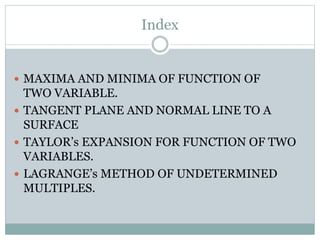
 MAXIMA AND MINIMA OF FUNCTION OF
TWO VARIABLE.
 TANGENT PLANE AND NORMAL LINE TO A
SURFACE
 TAYLOR’s EXPANSION FOR FUNCTION OF TWO
VARIABLES.
 LAGRANGE’s METHOD OF UNDETERMINED
MULTIPLES.
MAXIMA AND MINIMA OF FUNCTION OF
TWO VARIABLE
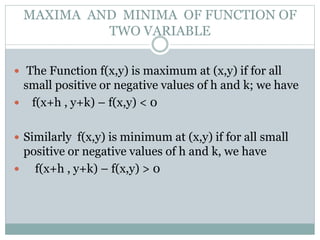
 The Function f(x,y) is maximum at (x,y) if for all
small positive or negative values of h and k; we have
 f(x+h , y+k) – f(x,y) < 0
 Similarly f(x,y) is minimum at (x,y) if for all small
positive or negative values of h and k, we have
 f(x+h , y+k) – f(x,y) > 0
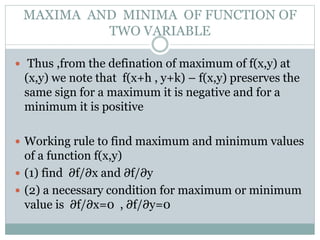
 Thus ,from the defination of maximum of f(x,y) at
(x,y) we note that f(x+h , y+k) – f(x,y) preserves the
same sign for a maximum it is negative and for a
minimum it is positive
 Working rule to find maximum and minimum values
of a function f(x,y)
 (1) find ∂f/∂x and ∂f/∂y
 (2) a necessary condition for maximum or minimum
value is ∂f/∂x=0 , ∂f/∂y=0
MAXIMA AND MINIMA OF FUNCTION OF
TWO VARIABLE
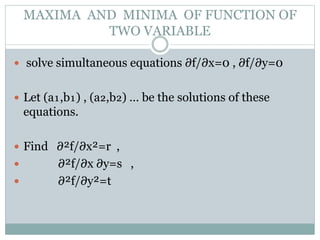
 solve simultaneous equations ∂f/∂x=0 , ∂f/∂y=0
 Let (a₁,b₁) , (a₂,b₂) … be the solutions of these
equations.
 Find ∂²f/∂x²=r ,
 ∂²f/∂x ∂y=s ,
 ∂²f/∂y²=t
MAXIMA AND MINIMA OF FUNCTION OF
TWO VARIABLE
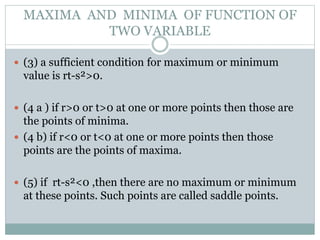
 (3) a sufficient condition for maximum or minimum
value is rt-s²>0.
 (4 a ) if r>0 or t>0 at one or more points then those are
the points of minima.
 (4 b) if r<0 or t<0 at one or more points then those
points are the points of maxima.
 (5) if rt-s²<0 ,then there are no maximum or minimum
at these points. Such points are called saddle points.
MAXIMA AND MINIMA OF FUNCTION OF
TWO VARIABLE
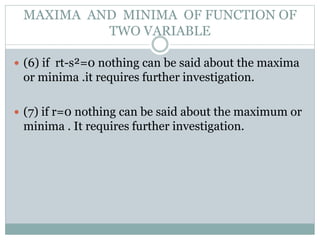
 (6) if rt-s²=0 nothing can be said about the maxima
or minima .it requires further investigation.
 (7) if r=0 nothing can be said about the maximum or
minima . It requires further investigation.
MAXIMA AND MINIMA OF FUNCTION OF
TWO VARIABLE
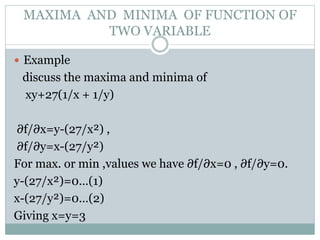
 Example
discuss the maxima and minima of
xy+27(1/x + 1/y)
∂f/∂x=y-(27/x²) ,
∂f/∂y=x-(27/y²)
For max. or min ,values we have ∂f/∂x=0 , ∂f/∂y=0.
y-(27/x²)=0…(1)
x-(27/y²)=0…(2)
Giving x=y=3
MAXIMA AND MINIMA OF FUNCTION OF
TWO VARIABLE
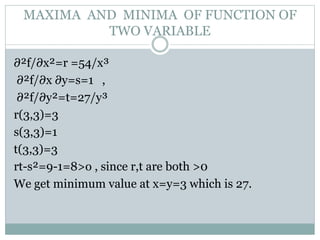
∂²f/∂x²=r =54/x³
∂²f/∂x ∂y=s=1 ,
∂²f/∂y²=t=27/y³
r(3,3)=3
s(3,3)=1
t(3,3)=3
rt-s²=9-1=8>o , since r,t are both >0
We get minimum value at x=y=3 which is 27.
MAXIMA AND MINIMA OF FUNCTION OF
TWO VARIABLE
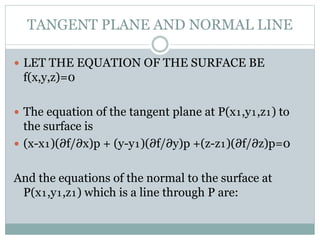
TANGENT PLANE AND NORMAL LINE
 LET THE EQUATION OF THE SURFACE BE
f(x,y,z)=0
 The equation of the tangent plane at P(x₁,y₁,z₁) to
the surface is
 (x-x₁)(∂f/∂x)p + (y-y₁)(∂f/∂y)p +(z-z₁)(∂f/∂z)p=0
And the equations of the normal to the surface at
P(x₁,y₁,z₁) which is a line through P are:
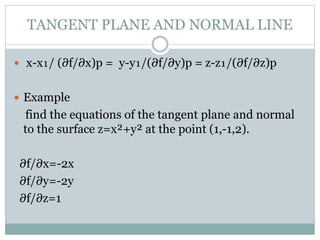
 x-x₁/ (∂f/∂x)p = y-y₁/(∂f/∂y)p = z-z₁/(∂f/∂z)p
 Example
find the equations of the tangent plane and normal
to the surface z=x²+y² at the point (1,-1,2).
∂f/∂x=-2x
∂f/∂y=-2y
∂f/∂z=1
TANGENT PLANE AND NORMAL LINE
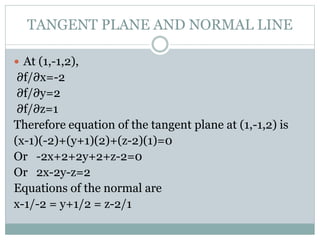
 At (1,-1,2),
∂f/∂x=-2
∂f/∂y=2
∂f/∂z=1
Therefore equation of the tangent plane at (1,-1,2) is
(x-1)(-2)+(y+1)(2)+(z-2)(1)=0
Or -2x+2+2y+2+z-2=0
Or 2x-2y-z=2
Equations of the normal are
x-1/-2 = y+1/2 = z-2/1
TANGENT PLANE AND NORMAL LINE
TAYLOR’S & MACLAURIN’S SERIES
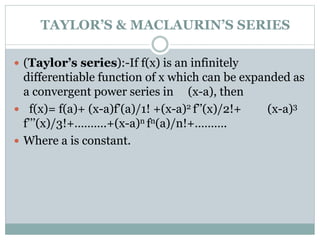
 (Taylor’s series):-If f(x) is an infinitely
differentiable function of x which can be expanded as
a convergent power series in (x-a), then
 f(x)= f(a)+ (x-a)f’(a)/1! +(x-a)2 f’’(x)/2!+ (x-a)3
f’’’(x)/3!+……….+(x-a)n fn(a)/n!+……….
 Where a is constant.
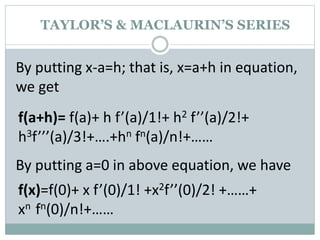
By putting x-a=h; that is, x=a+h in equation,
we get
f(a+h)= f(a)+ h f’(a)/1!+ h2 f’’(a)/2!+
h3f’’’(a)/3!+….+hn fn(a)/n!+……
By putting a=0 in above equation, we have
f(x)=f(0)+ x f’(0)/1! +x2f’’(0)/2! +……+
xn fn(0)/n!+……
TAYLOR’S & MACLAURIN’S SERIES
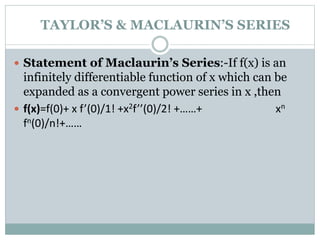
 Statement of Maclaurin’s Series:-If f(x) is an
infinitely differentiable function of x which can be
expanded as a convergent power series in x ,then
 f(x)=f(0)+ x f’(0)/1! +x2f’’(0)/2! +……+ xn
fn(0)/n!+……
TAYLOR’S & MACLAURIN’S SERIES
Expansions of some standard function
 The following are some expansion of standard
treated as standard expansions,obtained with the
help of maclaurin’s series. These standard
expansions are useful in obtaining the expansion of
oher functions.
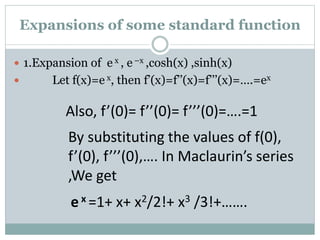
 1.Expansion of e x , e –x ,cosh(x) ,sinh(x)
 Let f(x)=e x, then f’(x)=f’’(x)=f’’’(x)=….=ex
Also, f’(0)= f’’(0)= f’’’(0)=….=1
By substituting the values of f(0),
f’(0), f’’’(0),…. In Maclaurin’s series
,We get
e x =1+ x+ x2/2!+ x3 /3!+…….
Expansions of some standard function
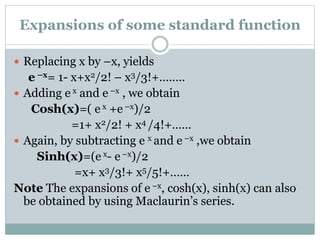
 Replacing x by –x, yields
e –x= 1- x+x2/2! – x3/3!+……..
 Adding e x and e –x , we obtain
Cosh(x)=( e x +e –x)/2
=1+ x2/2! + x4 /4!+……
 Again, by subtracting e x and e –x ,we obtain
Sinh(x)=(e x- e –x)/2
=x+ x3/3!+ x5/5!+……
Note The expansions of e –x, cosh(x), sinh(x) can also
be obtained by using Maclaurin’s series.
Expansions of some standard function
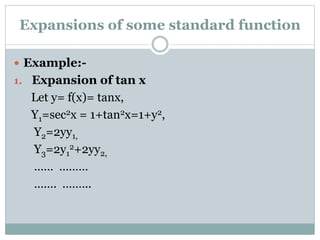
 Example:-
1. Expansion of tan x
Let y= f(x)= tanx,
Y1=sec2x = 1+tan2x=1+y2,
Y2=2yy1,
Y3=2y1
2+2yy2,
…… ………
……. .……..
Expansions of some standard function
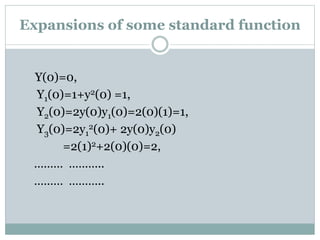
Y(0)=0,
Y1(0)=1+y2(0) =1,
Y2(0)=2y(0)y1(0)=2(0)(1)=1,
Y3(0)=2y1
2(0)+ 2y(0)y2(0)
=2(1)2+2(0)(0)=2,
……… ………..
……… ………..
Expansions of some standard function
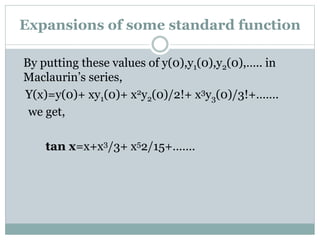
By putting these values of y(0),y1(0),y2(0),….. in
Maclaurin’s series,
Y(x)=y(0)+ xy1(0)+ x2y2(0)/2!+ x3y3(0)/3!+…….
we get,
tan x=x+x3/3+ x52/15+…….
Expansions of some standard function
LINEARIZATION
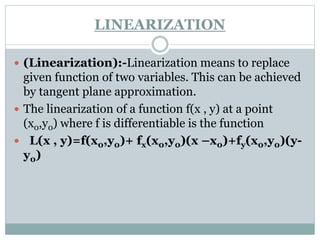
 (Linearization):-Linearization means to replace
given function of two variables. This can be achieved
by tangent plane approximation.
 The linearization of a function f(x , y) at a point
(x0,y0) where f is differentiable is the function
 L(x , y)=f(x0,y0)+ fx(x0,y0)(x –x0)+fy(x0,y0)(y-
y0)
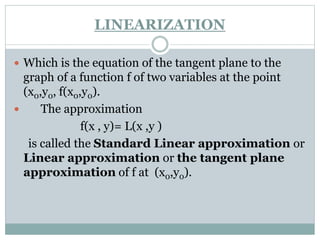
 Which is the equation of the tangent plane to the
graph of a function f of two variables at the point
(x0,y0, f(x0,y0).
 The approximation
f(x , y)= L(x ,y )
is called the Standard Linear approximation or
Linear approximation or the tangent plane
approximation of f at (x0,y0).
LINEARIZATION
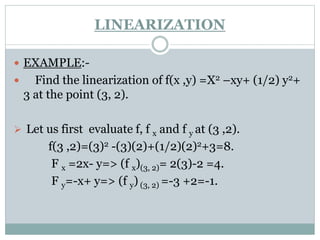
 EXAMPLE:-
 Find the linearization of f(x ,y) =X2 –xy+ (1/2) y2+
3 at the point (3, 2).
 Let us first evaluate f, f x and f y at (3 ,2).
f(3 ,2)=(3)2 -(3)(2)+(1/2)(2)2+3=8.
F x =2x- y=> (f x)(3, 2)= 2(3)-2 =4.
F y=-x+ y=> (f y) (3, 2) =-3 +2=-1.
LINEARIZATION
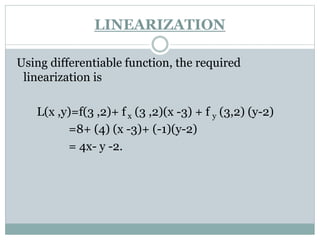
Using differentiable function, the required
linearization is
L(x ,y)=f(3 ,2)+ f x (3 ,2)(x -3) + f y (3,2) (y-2)
=8+ (4) (x -3)+ (-1)(y-2)
= 4x- y -2.
LINEARIZATION
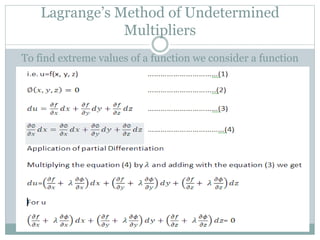
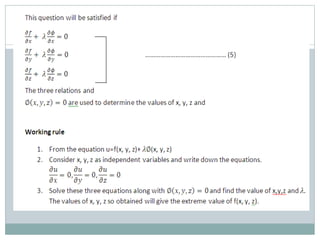
To find extreme values of a function we consider a function
of three variables with one restriction.
Lagrange’s Method of Undetermined
Multipliers
REFERENCE
CALCULUS
Dr.K.R.Kachot
Mahajan publishing house
THANK YOU

APPLICATION OF PARTIAL DIFFERENTIATION

  • 1.
    Index  MAXIMA ANDMINIMA OF FUNCTION OF TWO VARIABLE.  TANGENT PLANE AND NORMAL LINE TO A SURFACE  TAYLOR’s EXPANSION FOR FUNCTION OF TWO VARIABLES.  LAGRANGE’s METHOD OF UNDETERMINED MULTIPLES.
  • 2.
    MAXIMA AND MINIMAOF FUNCTION OF TWO VARIABLE  The Function f(x,y) is maximum at (x,y) if for all small positive or negative values of h and k; we have  f(x+h , y+k) – f(x,y) < 0  Similarly f(x,y) is minimum at (x,y) if for all small positive or negative values of h and k, we have  f(x+h , y+k) – f(x,y) > 0
  • 3.
     Thus ,fromthe defination of maximum of f(x,y) at (x,y) we note that f(x+h , y+k) – f(x,y) preserves the same sign for a maximum it is negative and for a minimum it is positive  Working rule to find maximum and minimum values of a function f(x,y)  (1) find ∂f/∂x and ∂f/∂y  (2) a necessary condition for maximum or minimum value is ∂f/∂x=0 , ∂f/∂y=0 MAXIMA AND MINIMA OF FUNCTION OF TWO VARIABLE
  • 4.
     solve simultaneousequations ∂f/∂x=0 , ∂f/∂y=0  Let (a₁,b₁) , (a₂,b₂) … be the solutions of these equations.  Find ∂²f/∂x²=r ,  ∂²f/∂x ∂y=s ,  ∂²f/∂y²=t MAXIMA AND MINIMA OF FUNCTION OF TWO VARIABLE
  • 5.
     (3) asufficient condition for maximum or minimum value is rt-s²>0.  (4 a ) if r>0 or t>0 at one or more points then those are the points of minima.  (4 b) if r<0 or t<0 at one or more points then those points are the points of maxima.  (5) if rt-s²<0 ,then there are no maximum or minimum at these points. Such points are called saddle points. MAXIMA AND MINIMA OF FUNCTION OF TWO VARIABLE
  • 6.
     (6) ifrt-s²=0 nothing can be said about the maxima or minima .it requires further investigation.  (7) if r=0 nothing can be said about the maximum or minima . It requires further investigation. MAXIMA AND MINIMA OF FUNCTION OF TWO VARIABLE
  • 7.
     Example discuss themaxima and minima of xy+27(1/x + 1/y) ∂f/∂x=y-(27/x²) , ∂f/∂y=x-(27/y²) For max. or min ,values we have ∂f/∂x=0 , ∂f/∂y=0. y-(27/x²)=0…(1) x-(27/y²)=0…(2) Giving x=y=3 MAXIMA AND MINIMA OF FUNCTION OF TWO VARIABLE
  • 8.
    ∂²f/∂x²=r =54/x³ ∂²f/∂x ∂y=s=1, ∂²f/∂y²=t=27/y³ r(3,3)=3 s(3,3)=1 t(3,3)=3 rt-s²=9-1=8>o , since r,t are both >0 We get minimum value at x=y=3 which is 27. MAXIMA AND MINIMA OF FUNCTION OF TWO VARIABLE
  • 9.
    TANGENT PLANE ANDNORMAL LINE  LET THE EQUATION OF THE SURFACE BE f(x,y,z)=0  The equation of the tangent plane at P(x₁,y₁,z₁) to the surface is  (x-x₁)(∂f/∂x)p + (y-y₁)(∂f/∂y)p +(z-z₁)(∂f/∂z)p=0 And the equations of the normal to the surface at P(x₁,y₁,z₁) which is a line through P are:
  • 10.
     x-x₁/ (∂f/∂x)p= y-y₁/(∂f/∂y)p = z-z₁/(∂f/∂z)p  Example find the equations of the tangent plane and normal to the surface z=x²+y² at the point (1,-1,2). ∂f/∂x=-2x ∂f/∂y=-2y ∂f/∂z=1 TANGENT PLANE AND NORMAL LINE
  • 11.
     At (1,-1,2), ∂f/∂x=-2 ∂f/∂y=2 ∂f/∂z=1 Thereforeequation of the tangent plane at (1,-1,2) is (x-1)(-2)+(y+1)(2)+(z-2)(1)=0 Or -2x+2+2y+2+z-2=0 Or 2x-2y-z=2 Equations of the normal are x-1/-2 = y+1/2 = z-2/1 TANGENT PLANE AND NORMAL LINE
  • 12.
    TAYLOR’S & MACLAURIN’SSERIES  (Taylor’s series):-If f(x) is an infinitely differentiable function of x which can be expanded as a convergent power series in (x-a), then  f(x)= f(a)+ (x-a)f’(a)/1! +(x-a)2 f’’(x)/2!+ (x-a)3 f’’’(x)/3!+……….+(x-a)n fn(a)/n!+……….  Where a is constant.
  • 13.
    By putting x-a=h;that is, x=a+h in equation, we get f(a+h)= f(a)+ h f’(a)/1!+ h2 f’’(a)/2!+ h3f’’’(a)/3!+….+hn fn(a)/n!+…… By putting a=0 in above equation, we have f(x)=f(0)+ x f’(0)/1! +x2f’’(0)/2! +……+ xn fn(0)/n!+…… TAYLOR’S & MACLAURIN’S SERIES
  • 14.
     Statement ofMaclaurin’s Series:-If f(x) is an infinitely differentiable function of x which can be expanded as a convergent power series in x ,then  f(x)=f(0)+ x f’(0)/1! +x2f’’(0)/2! +……+ xn fn(0)/n!+…… TAYLOR’S & MACLAURIN’S SERIES
  • 15.
    Expansions of somestandard function  The following are some expansion of standard treated as standard expansions,obtained with the help of maclaurin’s series. These standard expansions are useful in obtaining the expansion of oher functions.
  • 16.
     1.Expansion ofe x , e –x ,cosh(x) ,sinh(x)  Let f(x)=e x, then f’(x)=f’’(x)=f’’’(x)=….=ex Also, f’(0)= f’’(0)= f’’’(0)=….=1 By substituting the values of f(0), f’(0), f’’’(0),…. In Maclaurin’s series ,We get e x =1+ x+ x2/2!+ x3 /3!+……. Expansions of some standard function
  • 17.
     Replacing xby –x, yields e –x= 1- x+x2/2! – x3/3!+……..  Adding e x and e –x , we obtain Cosh(x)=( e x +e –x)/2 =1+ x2/2! + x4 /4!+……  Again, by subtracting e x and e –x ,we obtain Sinh(x)=(e x- e –x)/2 =x+ x3/3!+ x5/5!+…… Note The expansions of e –x, cosh(x), sinh(x) can also be obtained by using Maclaurin’s series. Expansions of some standard function
  • 18.
     Example:- 1. Expansionof tan x Let y= f(x)= tanx, Y1=sec2x = 1+tan2x=1+y2, Y2=2yy1, Y3=2y1 2+2yy2, …… ……… ……. .…….. Expansions of some standard function
  • 19.
  • 20.
    By putting thesevalues of y(0),y1(0),y2(0),….. in Maclaurin’s series, Y(x)=y(0)+ xy1(0)+ x2y2(0)/2!+ x3y3(0)/3!+……. we get, tan x=x+x3/3+ x52/15+……. Expansions of some standard function
  • 21.
    LINEARIZATION  (Linearization):-Linearization meansto replace given function of two variables. This can be achieved by tangent plane approximation.  The linearization of a function f(x , y) at a point (x0,y0) where f is differentiable is the function  L(x , y)=f(x0,y0)+ fx(x0,y0)(x –x0)+fy(x0,y0)(y- y0)
  • 22.
     Which isthe equation of the tangent plane to the graph of a function f of two variables at the point (x0,y0, f(x0,y0).  The approximation f(x , y)= L(x ,y ) is called the Standard Linear approximation or Linear approximation or the tangent plane approximation of f at (x0,y0). LINEARIZATION
  • 23.
     EXAMPLE:-  Findthe linearization of f(x ,y) =X2 –xy+ (1/2) y2+ 3 at the point (3, 2).  Let us first evaluate f, f x and f y at (3 ,2). f(3 ,2)=(3)2 -(3)(2)+(1/2)(2)2+3=8. F x =2x- y=> (f x)(3, 2)= 2(3)-2 =4. F y=-x+ y=> (f y) (3, 2) =-3 +2=-1. LINEARIZATION
  • 24.
    Using differentiable function,the required linearization is L(x ,y)=f(3 ,2)+ f x (3 ,2)(x -3) + f y (3,2) (y-2) =8+ (4) (x -3)+ (-1)(y-2) = 4x- y -2. LINEARIZATION
  • 25.
    To find extremevalues of a function we consider a function of three variables with one restriction. Lagrange’s Method of Undetermined Multipliers
  • 29.
  • 30.