PHYSISORPTION,
CHEMISORPTION AND WORK
FUNCTION CHANGE INDUCED
BY ADSORBATES
ANEETTA DAVIS
MSc NS & T, 2nd SEM
MOUNT CARMEL COLLEGE
ADSORPTION
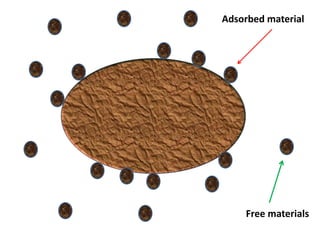
The accumulation of molecular
species at the surface of a solid or
liquid rather than in the bulk is
called adsorption.
Free materials
Adsorbed material
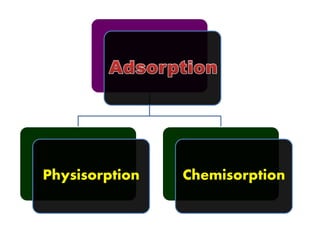
Physisorption Chemisorption
If accumulation of gas molecules on
the surface of solids occurs due to
weak van der Waals’ forces of
attraction, the adsorption is called
physisorption.
Characteristics of Physisorption
1. Non-specific nature: An adsorbent does not show any preference
for a gas as the van der Waals’ forces are universal.
2. Easily liquefiable gases like CO2, SO2, NH3 etc, are readily
adsorbed.
3. Reversible nature: Physisortion of a gas by a solid is reversible.
4. Increases by increase of pressure.
5. Surface area of adsorbant: When the surface area of the adsorbent
increases, more gas is adsorbed, ie extent of adsorption increases.
Since adsorption is exothermic, physisorption takes place
readily at low temperature and desorption takes place at higher
temperature.
When atoms or molecules of gases
are held by solids on its surface by
chemical bonds, the adsorption is
called chemisorption.
Characteristics of Chemisorption
1. High specificity: It is highly specific and will occur only
if chemical bond formation takes between adsorbate and
adsorbent.
2. Irreversibility: Chemisorption is irreversible because the
chemical bond formed is difficult to break.
3. Chemisorption increases with temperature.
4. Increases by increase of pressure.
5. Surface area of adsorbent: When the surface area of the
adsorbent increases, more gas is adsorbed, ie extent of
adsorption increases.
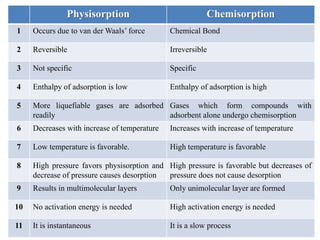
Physisorption Chemisorption
1 Occurs due to van der Waals’ force Chemical Bond
2 Reversible Irreversible
3 Not specific Specific
4 Enthalpy of adsorption is low Enthalpy of adsorption is high
5 More liquefiable gases are adsorbed
readily
Gases which form compounds with
adsorbent alone undergo chemisorption
6 Decreases with increase of temperature Increases with increase of temperature
7 Low temperature is favorable. High temperature is favorable
8 High pressure favors physisorption and
decrease of pressure causes desorption
High pressure is favorable but decreases of
pressure does not cause desorption
9 Results in multimolecular layers Only unimolecular layer are formed
10 No activation energy is needed High activation energy is needed
11 It is instantaneous It is a slow process
Isotherm models
Langmuir isotherm
In 1916, Irving Langmuir published an isotherm for gases adsorbed on
solids, which retained his name. It is an empirical isotherm derived from
a proposed kinetic mechanism. It is based on four hypotheses:
1. The surface of the adsorbent is uniform, that is, all the adsorption
sites are equal.
2. Adsorbed molecules do not interact.
3. All adsorption occurs through the same mechanism.
4. At the maximum adsorption, only a monolayer is formed: molecules
of adsorbate do not deposit on other, already adsorbed, molecules of
adsorbate, only on the free surface of the adsorbent.
Shape of Langmuir Isotherm
The Freundlich (or Classical) adsorption
isotherm
The relation between the concentration of a solute on the surface of an
adsorbent to the concentration of the solute in the liquid with which it is
in contact.
The variation of adsorption with pressure can often be represented
(especially at moderately low pressures) by the equation
where k and n are constants, n usually being greater than unity.
Taking logarithms,
Shape of Freundlich Isotherm
V
Work Function change induced by adsorption
Different material have different f. Moreover, chemisorptions
change the charge distribution and cause f change. For
semiconductor even band bending is changed.
The dipole of the adsorbate can
change f.
Under different condition (T for
example), different adsorption
bonding for the same adsorbate can
be formed on the same surface with
different f.

Physisorption chemisorption and work function change induced by adsorbates

  • 1.
    PHYSISORPTION, CHEMISORPTION AND WORK FUNCTIONCHANGE INDUCED BY ADSORBATES ANEETTA DAVIS MSc NS & T, 2nd SEM MOUNT CARMEL COLLEGE
  • 2.
    ADSORPTION The accumulation ofmolecular species at the surface of a solid or liquid rather than in the bulk is called adsorption.
  • 3.
  • 5.
  • 7.
    If accumulation ofgas molecules on the surface of solids occurs due to weak van der Waals’ forces of attraction, the adsorption is called physisorption.
  • 8.
    Characteristics of Physisorption 1.Non-specific nature: An adsorbent does not show any preference for a gas as the van der Waals’ forces are universal. 2. Easily liquefiable gases like CO2, SO2, NH3 etc, are readily adsorbed. 3. Reversible nature: Physisortion of a gas by a solid is reversible. 4. Increases by increase of pressure. 5. Surface area of adsorbant: When the surface area of the adsorbent increases, more gas is adsorbed, ie extent of adsorption increases. Since adsorption is exothermic, physisorption takes place readily at low temperature and desorption takes place at higher temperature.
  • 10.
    When atoms ormolecules of gases are held by solids on its surface by chemical bonds, the adsorption is called chemisorption.
  • 11.
    Characteristics of Chemisorption 1.High specificity: It is highly specific and will occur only if chemical bond formation takes between adsorbate and adsorbent. 2. Irreversibility: Chemisorption is irreversible because the chemical bond formed is difficult to break. 3. Chemisorption increases with temperature. 4. Increases by increase of pressure. 5. Surface area of adsorbent: When the surface area of the adsorbent increases, more gas is adsorbed, ie extent of adsorption increases.
  • 12.
    Physisorption Chemisorption 1 Occursdue to van der Waals’ force Chemical Bond 2 Reversible Irreversible 3 Not specific Specific 4 Enthalpy of adsorption is low Enthalpy of adsorption is high 5 More liquefiable gases are adsorbed readily Gases which form compounds with adsorbent alone undergo chemisorption 6 Decreases with increase of temperature Increases with increase of temperature 7 Low temperature is favorable. High temperature is favorable 8 High pressure favors physisorption and decrease of pressure causes desorption High pressure is favorable but decreases of pressure does not cause desorption 9 Results in multimolecular layers Only unimolecular layer are formed 10 No activation energy is needed High activation energy is needed 11 It is instantaneous It is a slow process
  • 13.
  • 14.
    Langmuir isotherm In 1916,Irving Langmuir published an isotherm for gases adsorbed on solids, which retained his name. It is an empirical isotherm derived from a proposed kinetic mechanism. It is based on four hypotheses: 1. The surface of the adsorbent is uniform, that is, all the adsorption sites are equal. 2. Adsorbed molecules do not interact. 3. All adsorption occurs through the same mechanism. 4. At the maximum adsorption, only a monolayer is formed: molecules of adsorbate do not deposit on other, already adsorbed, molecules of adsorbate, only on the free surface of the adsorbent.
  • 15.
  • 16.
    The Freundlich (orClassical) adsorption isotherm The relation between the concentration of a solute on the surface of an adsorbent to the concentration of the solute in the liquid with which it is in contact. The variation of adsorption with pressure can often be represented (especially at moderately low pressures) by the equation where k and n are constants, n usually being greater than unity. Taking logarithms,
  • 17.
  • 18.
    Work Function changeinduced by adsorption Different material have different f. Moreover, chemisorptions change the charge distribution and cause f change. For semiconductor even band bending is changed. The dipole of the adsorbate can change f. Under different condition (T for example), different adsorption bonding for the same adsorbate can be formed on the same surface with different f.