Orthogonal Basis
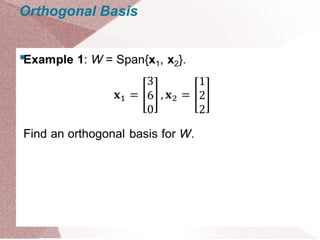
.
Find an orthogonal basis for W.

Gram-Schmidt
Algorithm to find an orthogonal basis, given a basis
1. Let first vector in orthogonal basis be first vector
in original basis
2. Next vector in orthogonal basis is component of
next vector in original basis orthogonal to the
previously found vectors.
Next vector less the projection of that vector onto subspace
defined by the set of vectors in the orthogonal set
Scaling may be convenient
1. Repeat step 2 for all other vectors in original basis
Gram-Schmidt - Example
.
Find an orthogonal basis for W.

Orthonormal Basis
 All vectors have length 1
 Normalize after find orthogonal basis
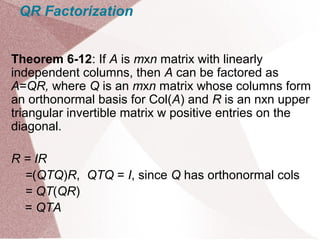
QR Factorization
Theorem 6-12: If A is mxn matrix with linearly
independent columns, then A can be factored as
A=QR, where Q is an mxn matrix whose columns form
an orthonormal basis for Col(A) and R is an nxn upper
triangular invertible matrix w positive entries on the
diagonal.
R = IR
=(QTQ)R, QTQ = I, since Q has orthonormal cols
= QT(QR)
= QTA
QR Factorization - Example

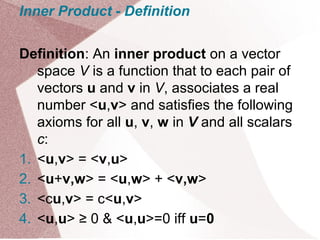
Inner Product - Definition
Definition: An inner product on a vector
space V is a function that to each pair of
vectors u and v in V, associates a real
number <u,v> and satisfies the following
axioms for all u, v, w in V and all scalars
c:
1. <u,v> = <v,u>
2. <u+v,w> = <u,w> + <v,w>
3. <cu,v> = c<u,v>
4. <u,u> ≥ 0 & <u,u>=0 iff u=0
Inner Product Space
 A vector space with an inner product is
called an inner product space.
 Example - Rn with the dot product is an
inner product space
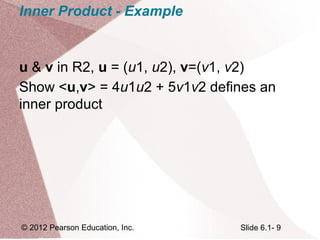
Inner Product - Example
u & v in R2, u = (u1, u2), v=(v1, v2)
Show <u,v> = 4u1u2 + 5v1v2 defines an
inner product
Slide 6.1- 9© 2012 Pearson Education, Inc.
Inner Product - Example
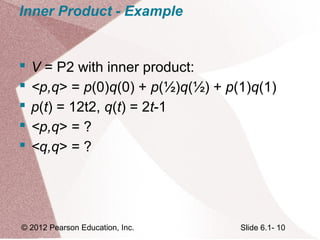
 V = P2 with inner product:
 <p,q> = p(0)q(0) + p(½)q(½) + p(1)q(1)
 p(t) = 12t2, q(t) = 2t-1
 <p,q> = ?
 <q,q> = ?
Slide 6.1- 10© 2012 Pearson Education, Inc.
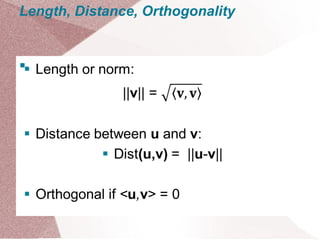
Length, Distance, Orthogonality
:
||v|| =

Example
 ||p(t)|| and ||q(t)|| from previous example
Gram-Schmidt
Let inner product be:
<p,q> = p(-2)q(-2) + p(-1)q(-1) + p(0)q(0) + p(1)q(1) + p(2)q(2)
Produce orthogonal basis for P2 by applying
Gram-Schmidt to: 1, t, t2
Inequalities
 Cauchy Schwartz Inequality:
|<u,v>| ≥ ||u|| ||v||
 Triangle Inequality
||u+v|| ≤ ||u|| + ||v||
Inner product

Inner product

  • 1.
    Orthogonal Basis . Find anorthogonal basis for W. 
  • 2.
    Gram-Schmidt Algorithm to findan orthogonal basis, given a basis 1. Let first vector in orthogonal basis be first vector in original basis 2. Next vector in orthogonal basis is component of next vector in original basis orthogonal to the previously found vectors. Next vector less the projection of that vector onto subspace defined by the set of vectors in the orthogonal set Scaling may be convenient 1. Repeat step 2 for all other vectors in original basis
  • 3.
    Gram-Schmidt - Example . Findan orthogonal basis for W. 
  • 4.
    Orthonormal Basis  Allvectors have length 1  Normalize after find orthogonal basis
  • 5.
    QR Factorization Theorem 6-12:If A is mxn matrix with linearly independent columns, then A can be factored as A=QR, where Q is an mxn matrix whose columns form an orthonormal basis for Col(A) and R is an nxn upper triangular invertible matrix w positive entries on the diagonal. R = IR =(QTQ)R, QTQ = I, since Q has orthonormal cols = QT(QR) = QTA
  • 6.
    QR Factorization -Example 
  • 7.
    Inner Product -Definition Definition: An inner product on a vector space V is a function that to each pair of vectors u and v in V, associates a real number <u,v> and satisfies the following axioms for all u, v, w in V and all scalars c: 1. <u,v> = <v,u> 2. <u+v,w> = <u,w> + <v,w> 3. <cu,v> = c<u,v> 4. <u,u> ≥ 0 & <u,u>=0 iff u=0
  • 8.
    Inner Product Space A vector space with an inner product is called an inner product space.  Example - Rn with the dot product is an inner product space
  • 9.
    Inner Product -Example u & v in R2, u = (u1, u2), v=(v1, v2) Show <u,v> = 4u1u2 + 5v1v2 defines an inner product Slide 6.1- 9© 2012 Pearson Education, Inc.
  • 10.
    Inner Product -Example  V = P2 with inner product:  <p,q> = p(0)q(0) + p(½)q(½) + p(1)q(1)  p(t) = 12t2, q(t) = 2t-1  <p,q> = ?  <q,q> = ? Slide 6.1- 10© 2012 Pearson Education, Inc.
  • 11.
  • 12.
    Example  ||p(t)|| and||q(t)|| from previous example
  • 13.
    Gram-Schmidt Let inner productbe: <p,q> = p(-2)q(-2) + p(-1)q(-1) + p(0)q(0) + p(1)q(1) + p(2)q(2) Produce orthogonal basis for P2 by applying Gram-Schmidt to: 1, t, t2
  • 14.
    Inequalities  Cauchy SchwartzInequality: |<u,v>| ≥ ||u|| ||v||  Triangle Inequality ||u+v|| ≤ ||u|| + ||v||