Veltech Dr.RR & Dr.SR
University
Subject : Construction Materials
Topic : Nano Materials
@Medicharla Ravindra Siva Sai Kumar
CONTENTS:
1.Introduction.
2.What is nanoscale?
3.What are Nanomaterials?
4.Classification of nanomaterials.
5.Application in construction.
6.Which nanomaterials are used in construction and their properties?
7.Benfits
8.Barries
INTRODUCTION
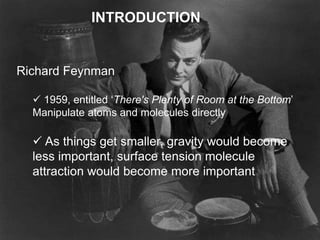
Richard Feynman
 1959, entitled ‘There's Plenty of Room at the Bottom’
Manipulate atoms and molecules directly
 As things get smaller, gravity would become
less important, surface tension molecule
attraction would become more important
Norio Taniguchi
By Professor,he meaning the processing of materials,
atom by atom or molecule by molecule (Taniguchi, 1974).
.
K Eric Drexler
1980s the term was reinvented
1986 book Engines of Creation: The Coming Era of
Nanotechnology.
He expanded the term into Nanosystems: Molecular
Machinery, Manufacturing, and Computation
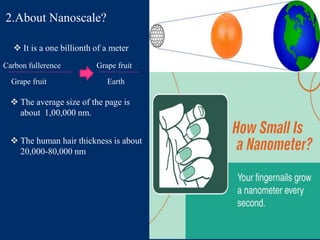
2.About Nanoscale?
 It is a one billionth of a meter
 The average size of the page is
about 1,00,000 nm.
 The human hair thickness is about
20,000-80,000 nm
Carbon fullerence
Grape fruit
Grape fruit
Earth
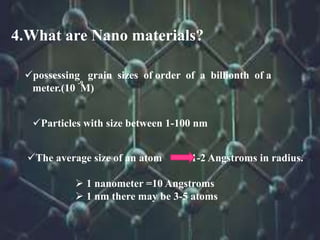
4.What are Nano materials?
possessing grain sizes of order of a billionth of a
meter.(10 M)
-9
Particles with size between 1-100 nm
The average size of an atom 1-2 Angstroms in radius.
 1 nanometer =10 Angstroms
 1 nm there may be 3-5 atoms
Nanoparticles(NPs),
Nanotubes,
Nanostructured materials,
Nanocomposites,
Nanotools (tools and scanning probe microscopes),
Nanodevices (nanosensors and Nanoeletronics).
Classification of Nanomaterials
• One dimension in nanoscale (Other two dimensions are extended)
 Thin films
 Surface Coatings
 Computer chips
• Two dimensions in nanoscale (Other one dimension is extended)
 Nano wires
 Nano tubes
• Three dimensions in nanoscale
 Nano particles
 Precipitates
 Colloids
 Quantum dots (tiny particles of semiconductor material)
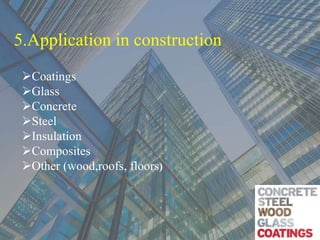
5.Application in construction
Coatings
Glass
Concrete
Steel
Insulation
Composites
Other (wood,roofs, floors)
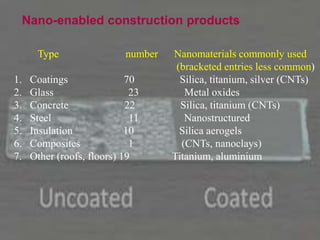
Type number Nanomaterials commonly used
(bracketed entries less common)
1. Coatings 70 Silica, titanium, silver (CNTs)
2. Glass 23 Metal oxides
3. Concrete 22 Silica, titanium (CNTs)
4. Steel 11 Nanostructured
5. Insulation 10 Silica aerogels
6. Composites 1 (CNTs, nanoclays)
7. Other (roofs, floors) 19 Titanium, aluminium
Nano-enabled construction products
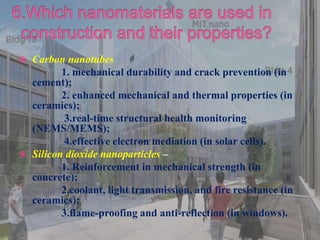
 Carbon nanotubes
1. mechanical durability and crack prevention (in
cement);
2. enhanced mechanical and thermal properties (in
ceramics);
3.real-time structural health monitoring
(NEMS/MEMS);
4.effective electron mediation (in solar cells).
 Silicon dioxide nanoparticles –
1. Reinforcement in mechanical strength (in
concrete);
2.coolant, light transmission, and fire resistance (in
ceramics);
3.flame-proofing and anti-reflection (in windows).
 Titanium dioxide nanoparticles
1.Rapid hydration, increased degree of hydration, and self-
cleaning (in concrete);
2.super hydrophilicity, anti-fogging, and fouling-resistance
(in windows);
3.non-utility electricity generation (in solar cells).
 Iron oxide nanoparticles –
1.Increased compressive strength and abrasion-resistant in
concrete.
 Copper nanoparticles –
1.weldability, corrosion resistance, and formability in steel.
 Silver nanoparticles –
1.Biocidal activity in coatings and paints.
 Quantum dots -
1.Effective electron mediation in solar cells.
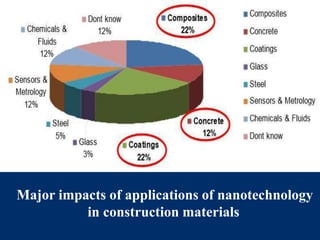
Major impacts of applications of nanotechnology
in construction materials
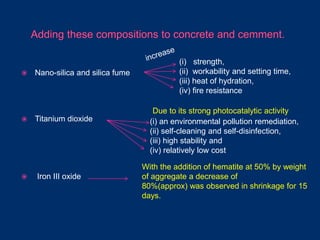
 Nano-silica and silica fume
 Titanium dioxide
 Iron III oxide
(i) strength,
(ii) workability and setting time,
(iii) heat of hydration,
(iv) fire resistance
(i) an environmental pollution remediation,
(ii) self-cleaning and self-disinfection,
(iii) high stability and
(iv) relatively low cost
Due to its strong photocatalytic activity
With the addition of hematite at 50% by weight
of aggregate a decrease of
80%(approx) was observed in shrinkage for 15
days.
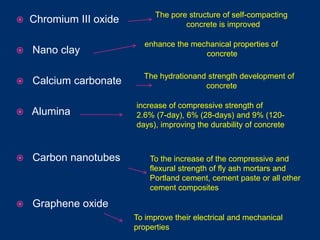
 Chromium III oxide
 Nano clay
 Calcium carbonate
 Alumina
 Carbon nanotubes
 Graphene oxide
enhance the mechanical properties of
concrete
The hydrationand strength development of
concrete
The pore structure of self-compacting
concrete is improved
increase of compressive strength of
2.6% (7-day), 6% (28-days) and 9% (120-
days), improving the durability of concrete
To the increase of the compressive and
flexural strength of fly ash mortars and
Portland cement, cement paste or all other
cement composites
To improve their electrical and mechanical
properties
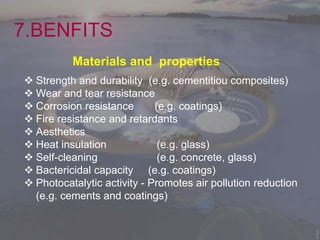
7.BENFITS
Materials and properties
 Strength and durability (e.g. cementitiou composites)
 Wear and tear resistance
 Corrosion resistance (e.g. coatings)
 Fire resistance and retardants
 Aesthetics
 Heat insulation (e.g. glass)
 Self-cleaning (e.g. concrete, glass)
 Bactericidal capacity (e.g. coatings)
 Photocatalytic activity - Promotes air pollution reduction
(e.g. cements and coatings)
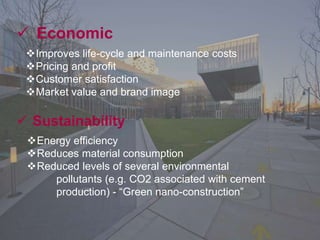
 Economic
Improves life-cycle and maintenance costs
Pricing and profit
Customer satisfaction
Market value and brand image
 Sustainability
Energy efficiency
Reduces material consumption
Reduced levels of several environmental
pollutants (e.g. CO2 associated with cement
production) - “Green nano-construction”
 Costs and manufacturing
 Costs of materials and equipment
 Costs of commercialization
 High initial investment by nanotechnology companies
 Lack of properly trained personnel and costs of
training
 Environmental
 Safety and security concerns
 Potential toxicity to the workers.
 Social
Regulatory and legal issues
Scepticism of the main industry stakeholders and
consumers
 Nanotitanium and nanozinc are added
to sun protection creams
 Nano silica is used as a filler and
whitener in toothpastes .
 Nano silver is used for its anti-microbial
properties, as well as being used in medical
and food hygiene applications
M.Ravindra SSK
Cvil engineering
B-Tech 2nd year
Veltech university
Chennai.

Nanomaterials

  • 1.
    Veltech Dr.RR &Dr.SR University Subject : Construction Materials Topic : Nano Materials @Medicharla Ravindra Siva Sai Kumar
  • 2.
    CONTENTS: 1.Introduction. 2.What is nanoscale? 3.Whatare Nanomaterials? 4.Classification of nanomaterials. 5.Application in construction. 6.Which nanomaterials are used in construction and their properties? 7.Benfits 8.Barries
  • 3.
    INTRODUCTION Richard Feynman  1959,entitled ‘There's Plenty of Room at the Bottom’ Manipulate atoms and molecules directly  As things get smaller, gravity would become less important, surface tension molecule attraction would become more important
  • 4.
    Norio Taniguchi By Professor,hemeaning the processing of materials, atom by atom or molecule by molecule (Taniguchi, 1974). . K Eric Drexler 1980s the term was reinvented 1986 book Engines of Creation: The Coming Era of Nanotechnology. He expanded the term into Nanosystems: Molecular Machinery, Manufacturing, and Computation
  • 5.
    2.About Nanoscale?  Itis a one billionth of a meter  The average size of the page is about 1,00,000 nm.  The human hair thickness is about 20,000-80,000 nm Carbon fullerence Grape fruit Grape fruit Earth
  • 6.
    4.What are Nanomaterials? possessing grain sizes of order of a billionth of a meter.(10 M) -9 Particles with size between 1-100 nm The average size of an atom 1-2 Angstroms in radius.  1 nanometer =10 Angstroms  1 nm there may be 3-5 atoms
  • 7.
    Nanoparticles(NPs), Nanotubes, Nanostructured materials, Nanocomposites, Nanotools (toolsand scanning probe microscopes), Nanodevices (nanosensors and Nanoeletronics).
  • 8.
    Classification of Nanomaterials •One dimension in nanoscale (Other two dimensions are extended)  Thin films  Surface Coatings  Computer chips • Two dimensions in nanoscale (Other one dimension is extended)  Nano wires  Nano tubes • Three dimensions in nanoscale  Nano particles  Precipitates  Colloids  Quantum dots (tiny particles of semiconductor material)
  • 9.
  • 10.
    Type number Nanomaterialscommonly used (bracketed entries less common) 1. Coatings 70 Silica, titanium, silver (CNTs) 2. Glass 23 Metal oxides 3. Concrete 22 Silica, titanium (CNTs) 4. Steel 11 Nanostructured 5. Insulation 10 Silica aerogels 6. Composites 1 (CNTs, nanoclays) 7. Other (roofs, floors) 19 Titanium, aluminium Nano-enabled construction products
  • 11.
     Carbon nanotubes 1.mechanical durability and crack prevention (in cement); 2. enhanced mechanical and thermal properties (in ceramics); 3.real-time structural health monitoring (NEMS/MEMS); 4.effective electron mediation (in solar cells).  Silicon dioxide nanoparticles – 1. Reinforcement in mechanical strength (in concrete); 2.coolant, light transmission, and fire resistance (in ceramics); 3.flame-proofing and anti-reflection (in windows).
  • 12.
     Titanium dioxidenanoparticles 1.Rapid hydration, increased degree of hydration, and self- cleaning (in concrete); 2.super hydrophilicity, anti-fogging, and fouling-resistance (in windows); 3.non-utility electricity generation (in solar cells).  Iron oxide nanoparticles – 1.Increased compressive strength and abrasion-resistant in concrete.  Copper nanoparticles – 1.weldability, corrosion resistance, and formability in steel.  Silver nanoparticles – 1.Biocidal activity in coatings and paints.  Quantum dots - 1.Effective electron mediation in solar cells.
  • 13.
    Major impacts ofapplications of nanotechnology in construction materials
  • 14.
     Nano-silica andsilica fume  Titanium dioxide  Iron III oxide (i) strength, (ii) workability and setting time, (iii) heat of hydration, (iv) fire resistance (i) an environmental pollution remediation, (ii) self-cleaning and self-disinfection, (iii) high stability and (iv) relatively low cost Due to its strong photocatalytic activity With the addition of hematite at 50% by weight of aggregate a decrease of 80%(approx) was observed in shrinkage for 15 days.
  • 15.
     Chromium IIIoxide  Nano clay  Calcium carbonate  Alumina  Carbon nanotubes  Graphene oxide enhance the mechanical properties of concrete The hydrationand strength development of concrete The pore structure of self-compacting concrete is improved increase of compressive strength of 2.6% (7-day), 6% (28-days) and 9% (120- days), improving the durability of concrete To the increase of the compressive and flexural strength of fly ash mortars and Portland cement, cement paste or all other cement composites To improve their electrical and mechanical properties
  • 16.
    7.BENFITS Materials and properties Strength and durability (e.g. cementitiou composites)  Wear and tear resistance  Corrosion resistance (e.g. coatings)  Fire resistance and retardants  Aesthetics  Heat insulation (e.g. glass)  Self-cleaning (e.g. concrete, glass)  Bactericidal capacity (e.g. coatings)  Photocatalytic activity - Promotes air pollution reduction (e.g. cements and coatings)
  • 17.
     Economic Improves life-cycleand maintenance costs Pricing and profit Customer satisfaction Market value and brand image  Sustainability Energy efficiency Reduces material consumption Reduced levels of several environmental pollutants (e.g. CO2 associated with cement production) - “Green nano-construction”
  • 18.
     Costs andmanufacturing  Costs of materials and equipment  Costs of commercialization  High initial investment by nanotechnology companies  Lack of properly trained personnel and costs of training
  • 19.
     Environmental  Safetyand security concerns  Potential toxicity to the workers.  Social Regulatory and legal issues Scepticism of the main industry stakeholders and consumers
  • 20.
     Nanotitanium andnanozinc are added to sun protection creams  Nano silica is used as a filler and whitener in toothpastes .  Nano silver is used for its anti-microbial properties, as well as being used in medical and food hygiene applications
  • 22.
    M.Ravindra SSK Cvil engineering B-Tech2nd year Veltech university Chennai.