The Use of Engineered Nanomaterials 
in Environmental Remediation: 
Environmental, Health, and 
Regulatory Issues 
Tennessee Environmental Conference 
March 26, 2014 
Gregory Nichols, MPH, CPH 
Health Research Associate 
ORAU 
1
Outline 
• Overview 
• Types of materials 
• Sites 
• Environmental and health concerns 
• Regulations 
• Scientific and legal gaps 
2
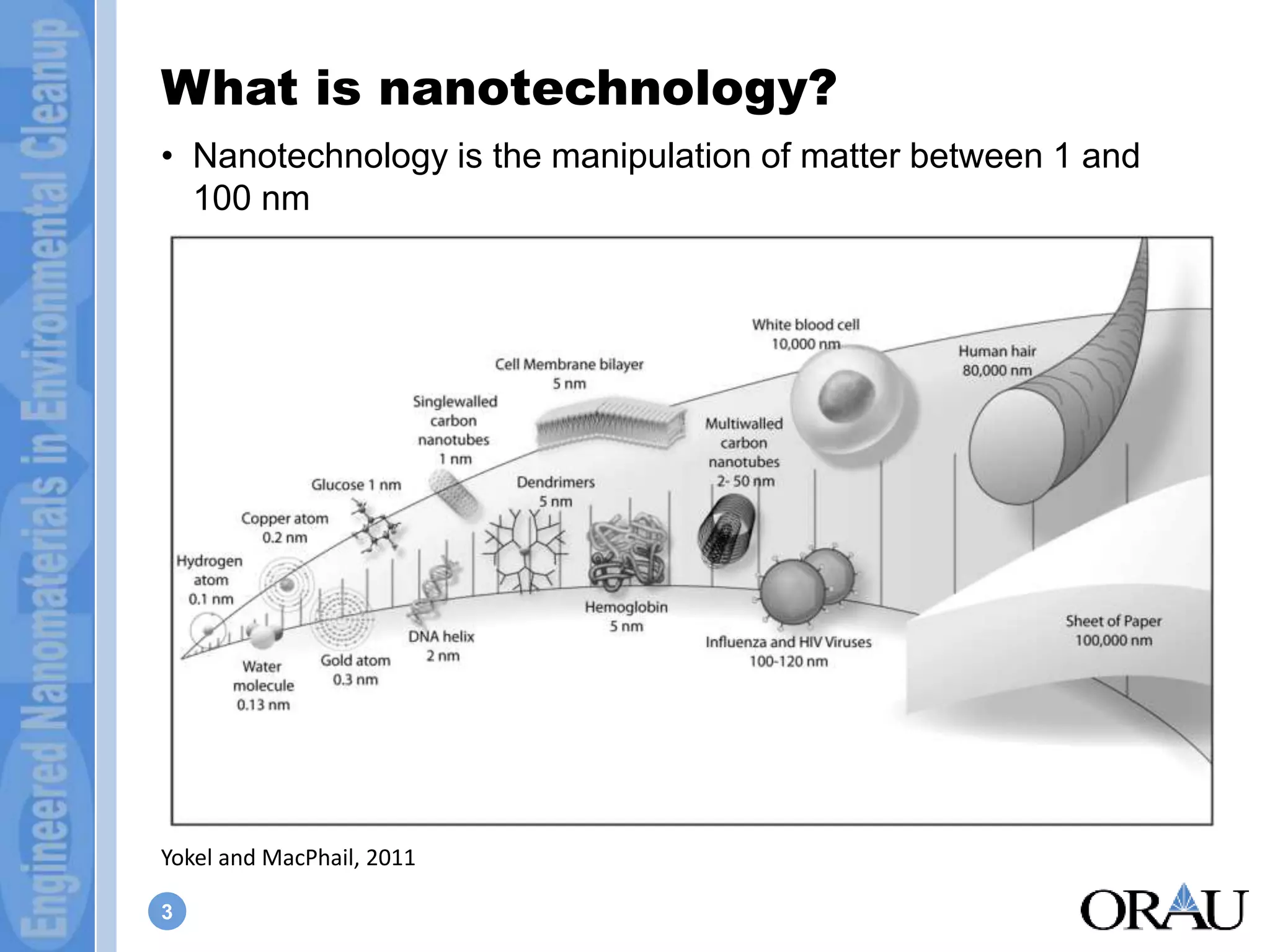
What is nanotechnology? 
• Nanotechnology is the manipulation of matter between 1 and 
100 nm 
Yokel and MacPhail, 2011 
3
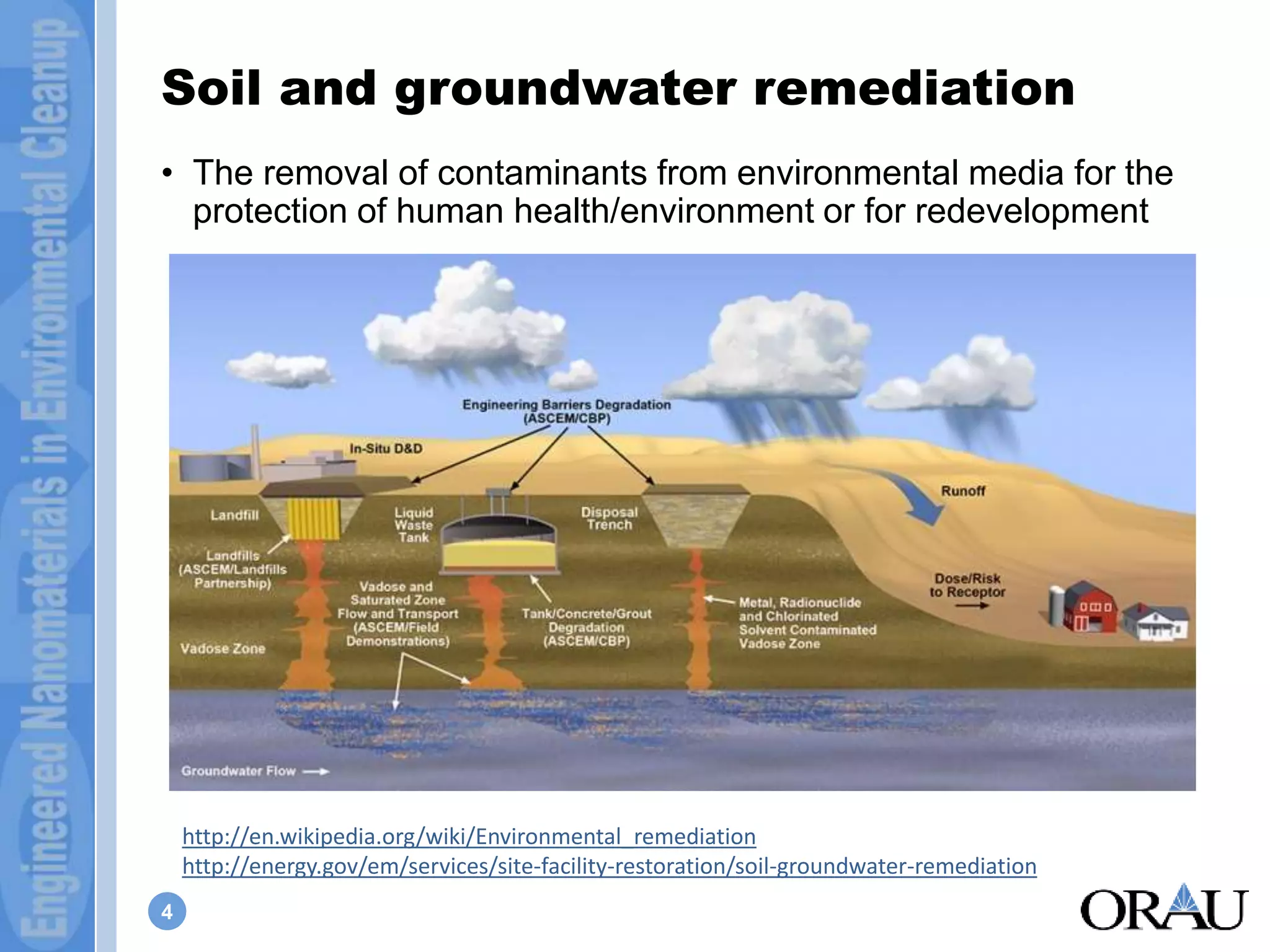
Soil and groundwater remediation 
• The removal of contaminants from environmental media for the 
protection of human health/environment or for redevelopment 
4 
http://en.wikipedia.org/wiki/Environmental_remediation 
http://energy.gov/em/services/site-facility-restoration/soil-groundwater-remediation
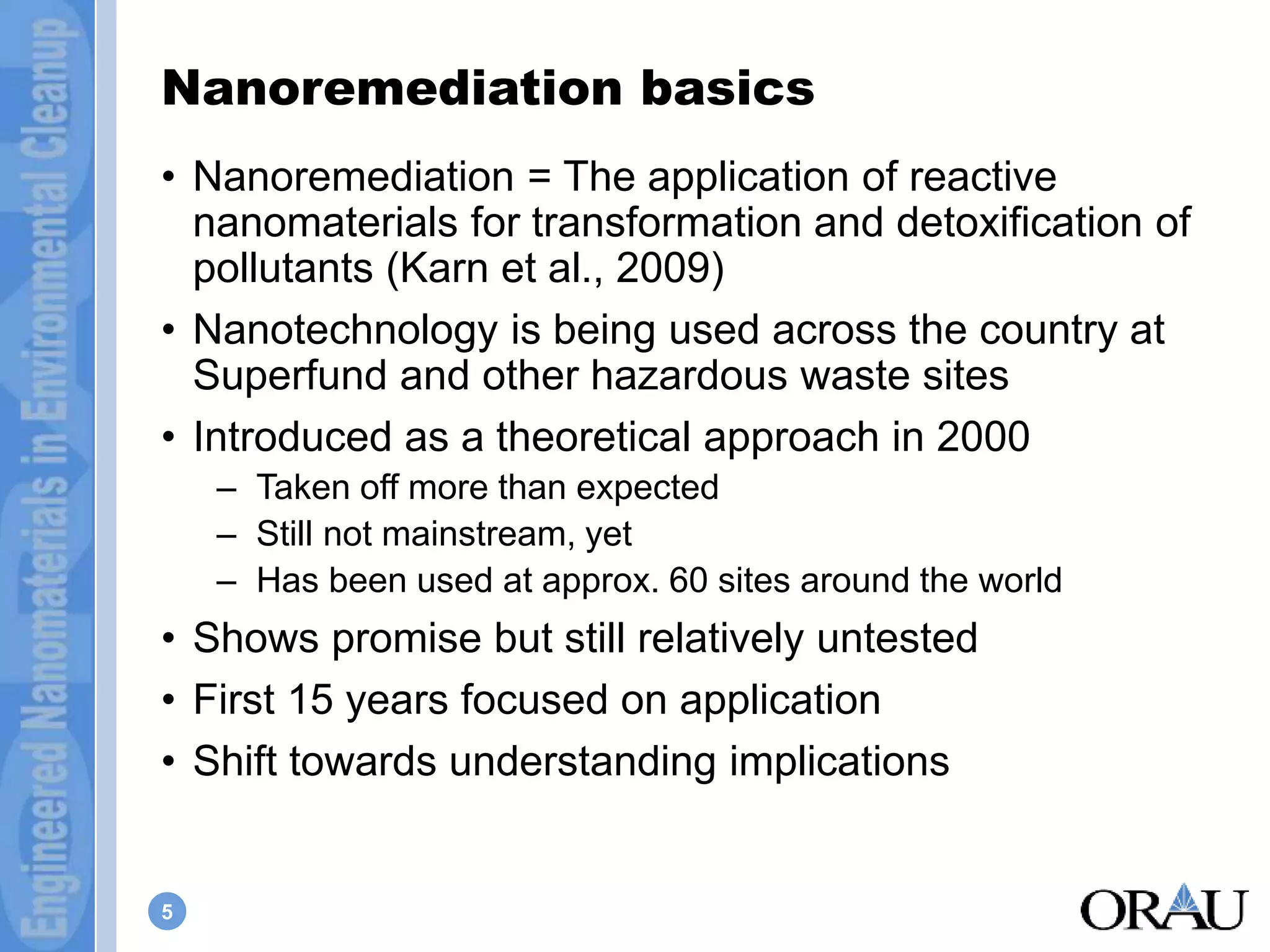
Nanoremediation basics 
• Nanoremediation = The application of reactive 
nanomaterials for transformation and detoxification of 
pollutants (Karn et al., 2009) 
• Nanotechnology is being used across the country at 
Superfund and other hazardous waste sites 
• Introduced as a theoretical approach in 2000 
5 
– Taken off more than expected 
– Still not mainstream, yet 
– Has been used at approx. 60 sites around the world 
• Shows promise but still relatively untested 
• First 15 years focused on application 
• Shift towards understanding implications
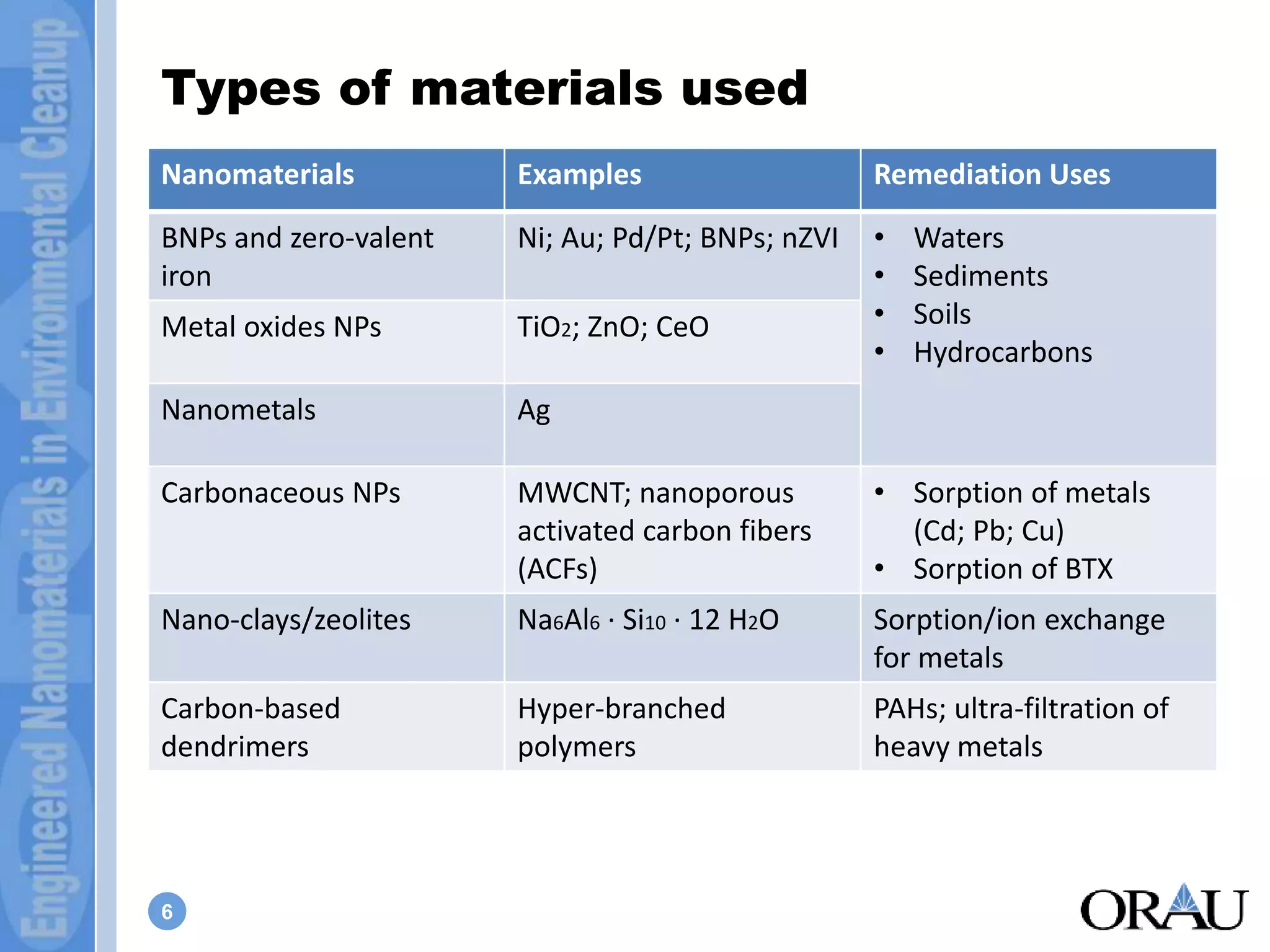
Types of materials used 
Nanomaterials Examples Remediation Uses 
BNPs and zero-valent 
iron 
6 
Ni; Au; Pd/Pt; BNPs; nZVI • Waters 
• Sediments 
• Soils 
• Hydrocarbons 
Metal oxides NPs TiO2; ZnO; CeO 
Nanometals Ag 
Carbonaceous NPs MWCNT; nanoporous 
activated carbon fibers 
(ACFs) 
• Sorption of metals 
(Cd; Pb; Cu) 
• Sorption of BTX 
Nano-clays/zeolites Na6Al6 · Si10 · 12 H2O Sorption/ion exchange 
for metals 
Carbon-based 
dendrimers 
Hyper-branched 
polymers 
PAHs; ultra-filtration of 
heavy metals
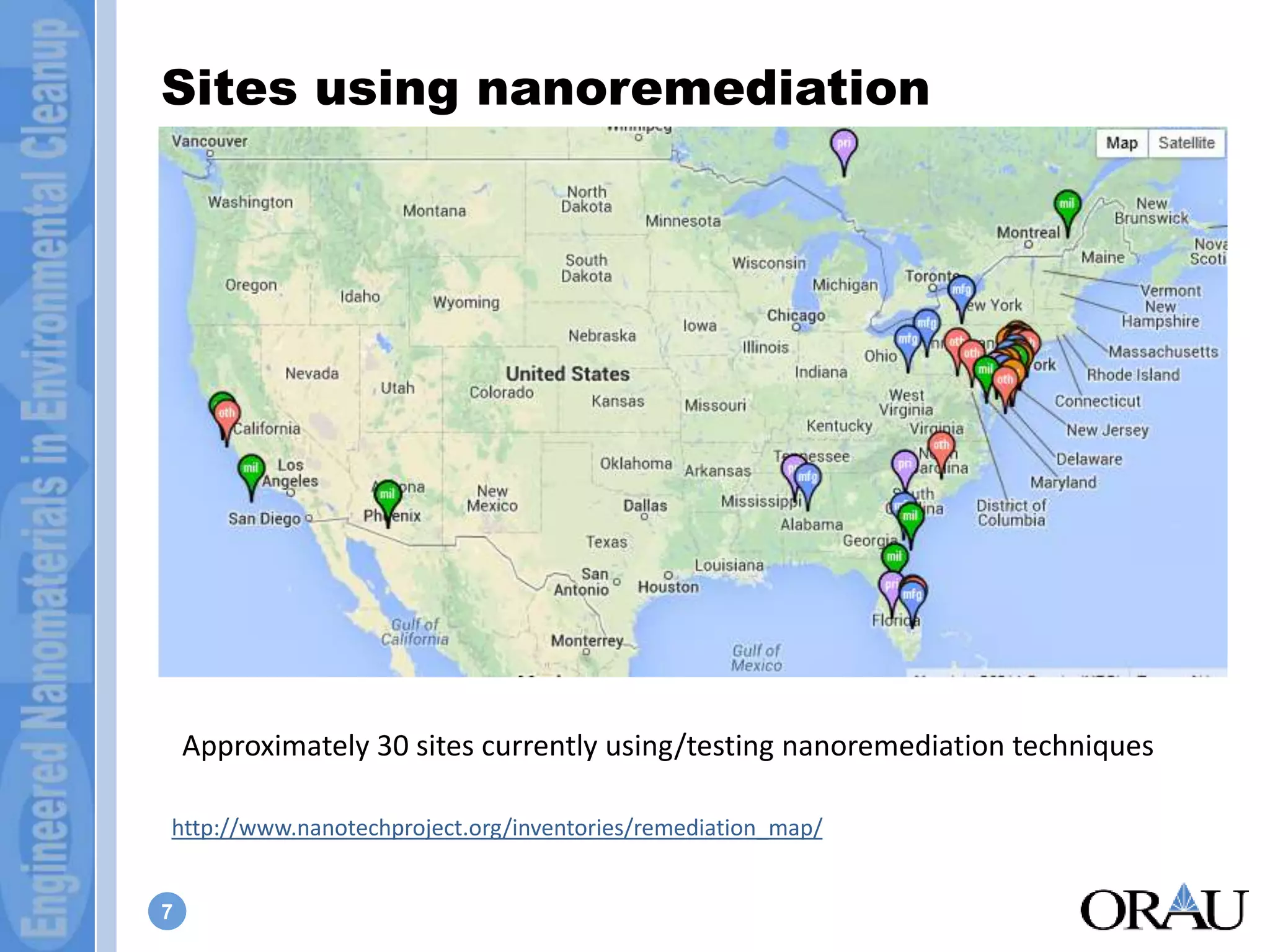
Sites using nanoremediation 
http://www.nanotechproject.org/inventories/remediation_map/ 
7 
Approximately 30 sites currently using/testing nanoremediation techniques
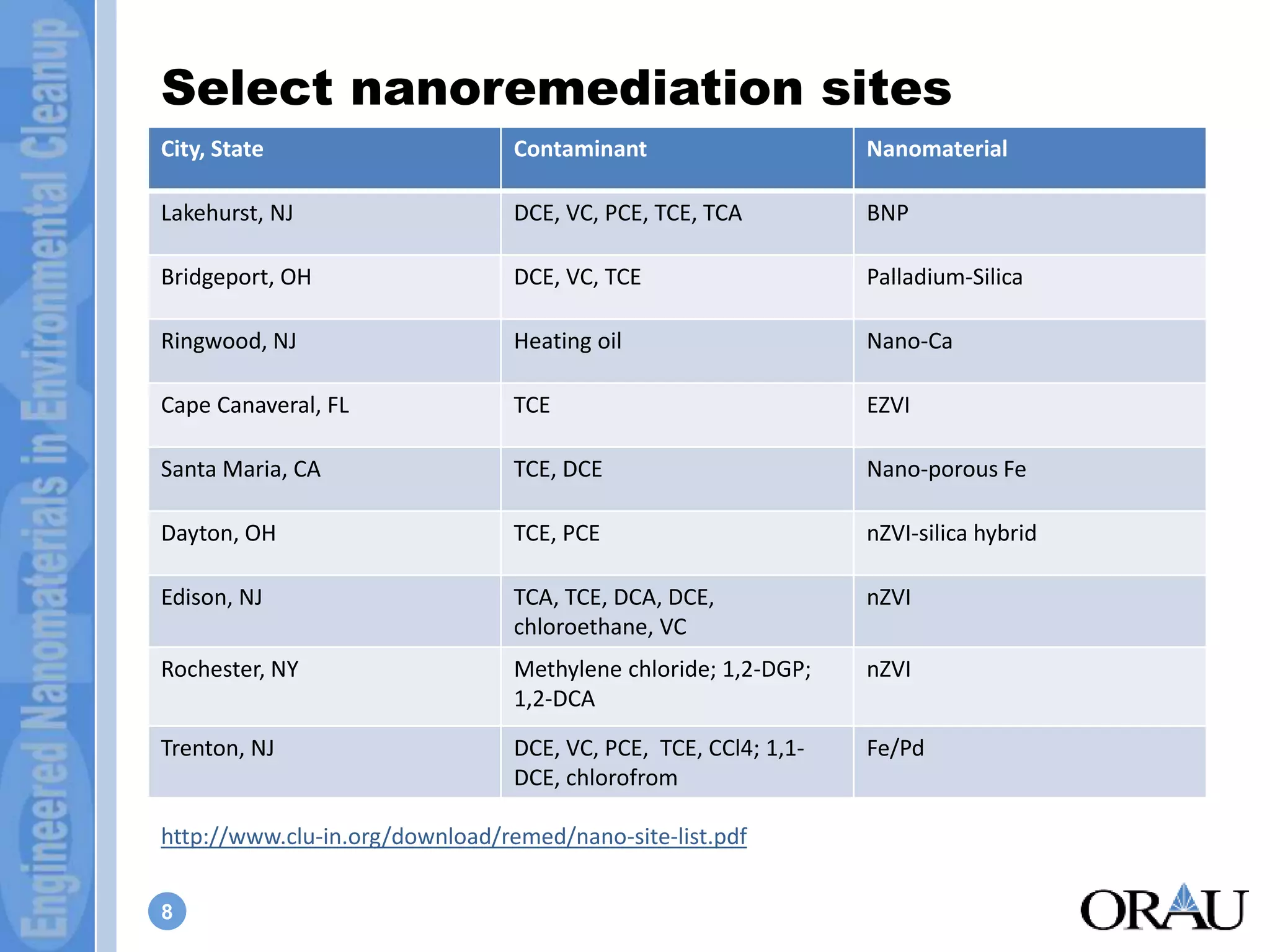
Select nanoremediation sites 
City, State Contaminant Nanomaterial 
Lakehurst, NJ DCE, VC, PCE, TCE, TCA BNP 
Bridgeport, OH DCE, VC, TCE Palladium-Silica 
Ringwood, NJ Heating oil Nano-Ca 
Cape Canaveral, FL TCE EZVI 
Santa Maria, CA TCE, DCE Nano-porous Fe 
Dayton, OH TCE, PCE nZVI-silica hybrid 
Edison, NJ TCA, TCE, DCA, DCE, 
8 
chloroethane, VC 
nZVI 
Rochester, NY Methylene chloride; 1,2-DGP; 
1,2-DCA 
nZVI 
Trenton, NJ DCE, VC, PCE, TCE, CCl4; 1,1- 
DCE, chlorofrom 
Fe/Pd 
http://www.clu-in.org/download/remed/nano-site-list.pdf
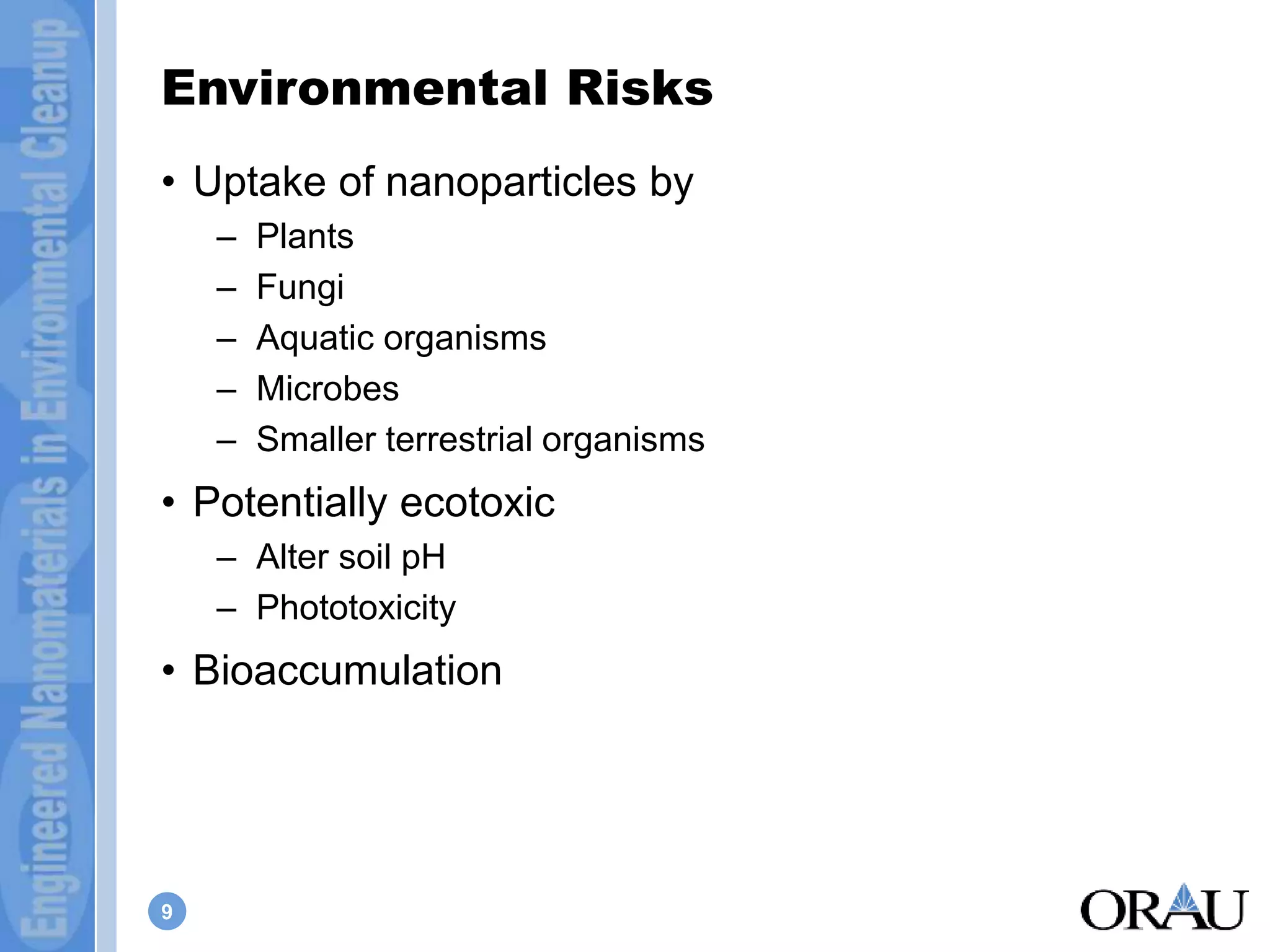
Environmental Risks 
• Uptake of nanoparticles by 
9 
– Plants 
– Fungi 
– Aquatic organisms 
– Microbes 
– Smaller terrestrial organisms 
• Potentially ecotoxic 
– Alter soil pH 
– Phototoxicity 
• Bioaccumulation
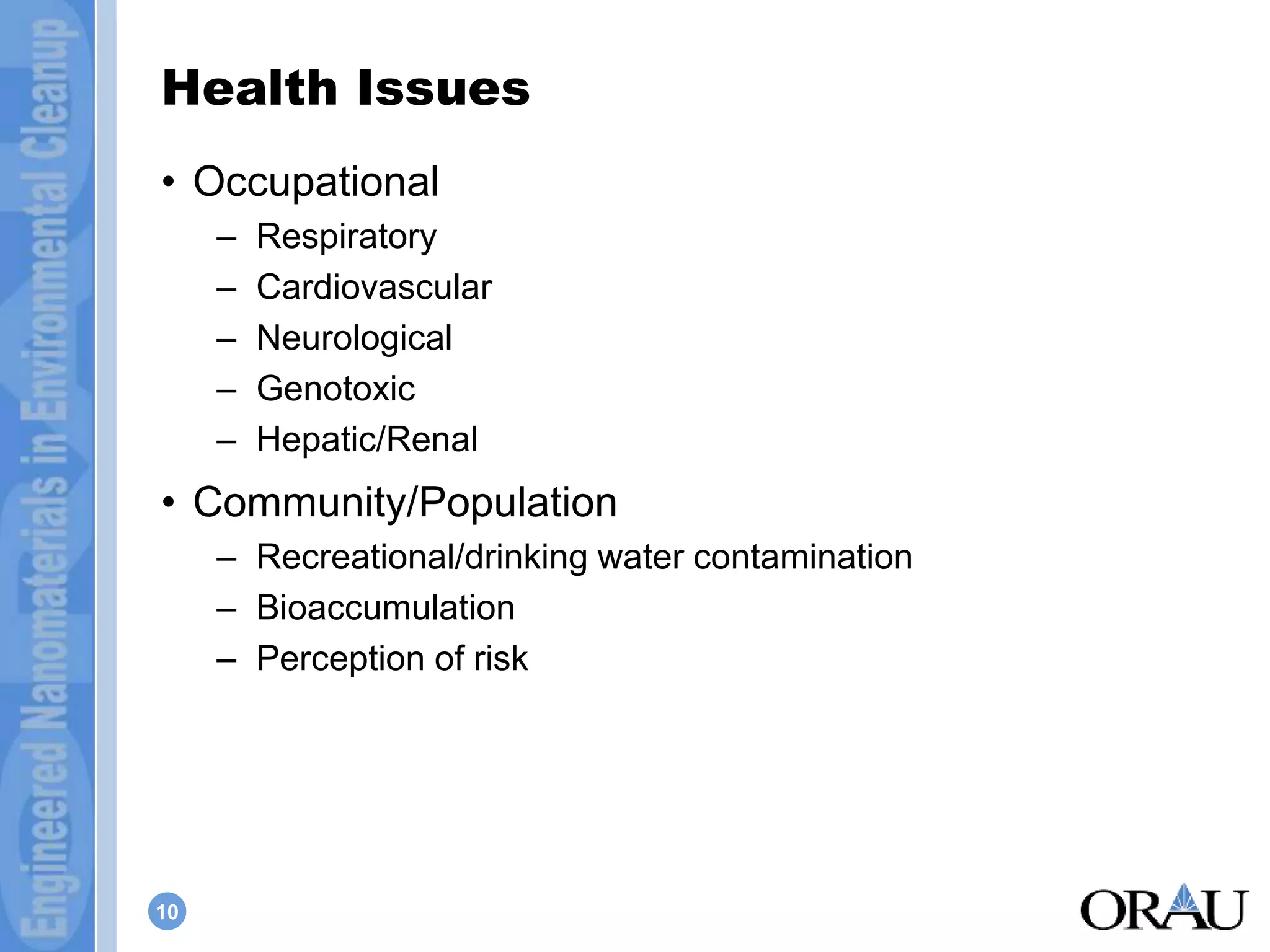
Health Issues 
• Occupational 
10 
– Respiratory 
– Cardiovascular 
– Neurological 
– Genotoxic 
– Hepatic/Renal 
• Community/Population 
– Recreational/drinking water contamination 
– Bioaccumulation 
– Perception of risk
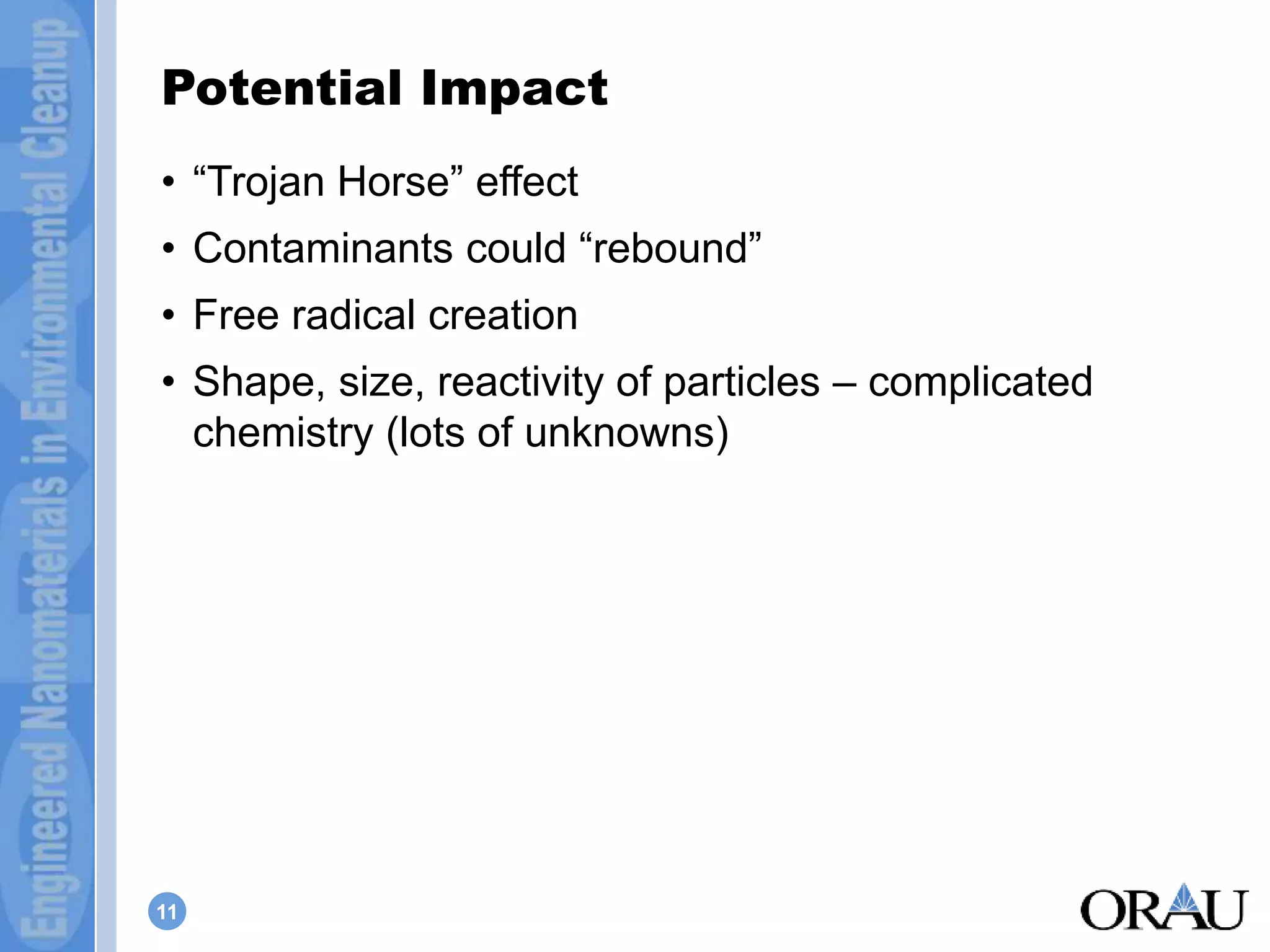
Potential Impact 
• “Trojan Horse” effect 
• Contaminants could “rebound” 
• Free radical creation 
• Shape, size, reactivity of particles – complicated 
chemistry (lots of unknowns) 
11
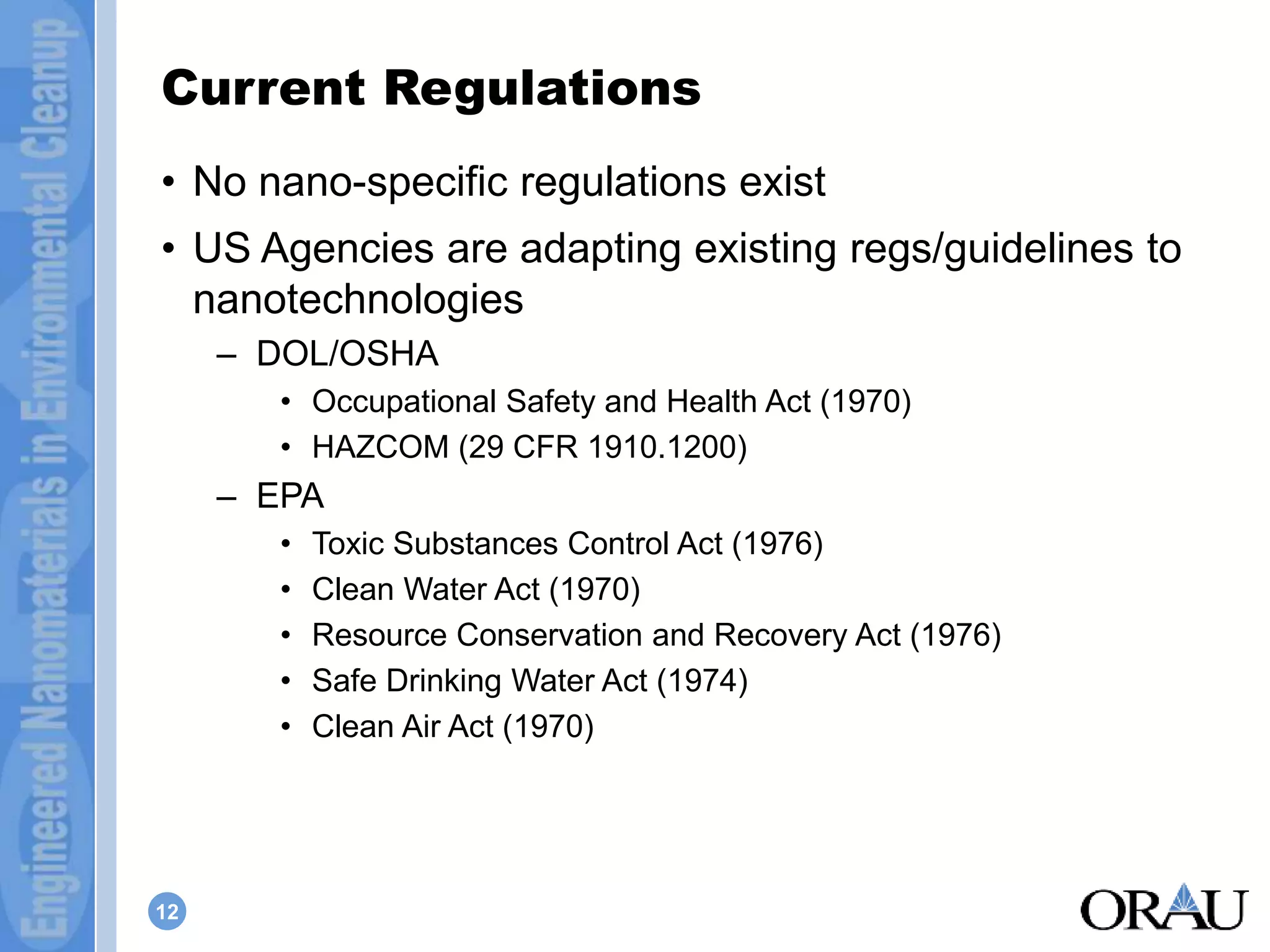
Current Regulations 
• No nano-specific regulations exist 
• US Agencies are adapting existing regs/guidelines to 
nanotechnologies 
12 
– DOL/OSHA 
• Occupational Safety and Health Act (1970) 
• HAZCOM (29 CFR 1910.1200) 
– EPA 
• Toxic Substances Control Act (1976) 
• Clean Water Act (1970) 
• Resource Conservation and Recovery Act (1976) 
• Safe Drinking Water Act (1974) 
• Clean Air Act (1970)
Current Regulations (cont’d) 
• Europe 
13 
– Registration, Evaluation, Authorization, and Restriction of 
Chemicals (REACH) 
• Global 
– Organization for Economic Cooperation and Development 
(OECD) 
– International Organization for Standardization (ISO) 
– World Health Organization (WHO) guidelines
Research needs 
• Continued remediation technology development 
14 
– “Smart” nanoparticles 
– Detection equipment (tracking/monitoring) 
– Delivery systems 
• Tools for characterizing complex subsurface 
conditions 
• Biological assessment capabilities 
– Modeling 
– Cytotoxic assays 
• Health/Environmental studies 
– Nanomaterial life-cycle 
– Risk management
Recommended actions 
• Development of standard “best – practices” 
• Standard protocol for site characterization 
• Registry/medical surveillance for workers 
• Database(s) for tracking nanomaterial 
types/quantities 
• Protocol for verifying cleanup of spent nanomaterials 
needs to be developed 
• Sharing of human health/ecological data 
• Long-term studies of ecosystem impact 
• State regulations/updated federal statutes 
15
Summary 
• While nanoremediation appears to be a very 
promising technology, many questions remain 
unanswered 
16 
– Chemical Fate and transport 
– Toxicity/Human health 
– Containment/Recovery of materials 
– Ecotoxicity 
– Community health 
• A cautious approach is recommended 
• Cooperation between industry, academia, and 
government is crucial
Thank You! 
Gregory Nichols, MPH, CPH 
Health Research Associate 
ORAU 
Occupational Exposure and Worker Health Programs 
Gregory.Nichols@orau.org 
Ph: (865) 576-3144 
17

The use of Engineered Nanomaterials in Environmental Remediation: Environmental, Health, and Regulatory Issues

  • 1.
    The Use ofEngineered Nanomaterials in Environmental Remediation: Environmental, Health, and Regulatory Issues Tennessee Environmental Conference March 26, 2014 Gregory Nichols, MPH, CPH Health Research Associate ORAU 1
  • 2.
    Outline • Overview • Types of materials • Sites • Environmental and health concerns • Regulations • Scientific and legal gaps 2
  • 3.
    What is nanotechnology? • Nanotechnology is the manipulation of matter between 1 and 100 nm Yokel and MacPhail, 2011 3
  • 4.
    Soil and groundwaterremediation • The removal of contaminants from environmental media for the protection of human health/environment or for redevelopment 4 http://en.wikipedia.org/wiki/Environmental_remediation http://energy.gov/em/services/site-facility-restoration/soil-groundwater-remediation
  • 5.
    Nanoremediation basics •Nanoremediation = The application of reactive nanomaterials for transformation and detoxification of pollutants (Karn et al., 2009) • Nanotechnology is being used across the country at Superfund and other hazardous waste sites • Introduced as a theoretical approach in 2000 5 – Taken off more than expected – Still not mainstream, yet – Has been used at approx. 60 sites around the world • Shows promise but still relatively untested • First 15 years focused on application • Shift towards understanding implications
  • 6.
    Types of materialsused Nanomaterials Examples Remediation Uses BNPs and zero-valent iron 6 Ni; Au; Pd/Pt; BNPs; nZVI • Waters • Sediments • Soils • Hydrocarbons Metal oxides NPs TiO2; ZnO; CeO Nanometals Ag Carbonaceous NPs MWCNT; nanoporous activated carbon fibers (ACFs) • Sorption of metals (Cd; Pb; Cu) • Sorption of BTX Nano-clays/zeolites Na6Al6 · Si10 · 12 H2O Sorption/ion exchange for metals Carbon-based dendrimers Hyper-branched polymers PAHs; ultra-filtration of heavy metals
  • 7.
    Sites using nanoremediation http://www.nanotechproject.org/inventories/remediation_map/ 7 Approximately 30 sites currently using/testing nanoremediation techniques
  • 8.
    Select nanoremediation sites City, State Contaminant Nanomaterial Lakehurst, NJ DCE, VC, PCE, TCE, TCA BNP Bridgeport, OH DCE, VC, TCE Palladium-Silica Ringwood, NJ Heating oil Nano-Ca Cape Canaveral, FL TCE EZVI Santa Maria, CA TCE, DCE Nano-porous Fe Dayton, OH TCE, PCE nZVI-silica hybrid Edison, NJ TCA, TCE, DCA, DCE, 8 chloroethane, VC nZVI Rochester, NY Methylene chloride; 1,2-DGP; 1,2-DCA nZVI Trenton, NJ DCE, VC, PCE, TCE, CCl4; 1,1- DCE, chlorofrom Fe/Pd http://www.clu-in.org/download/remed/nano-site-list.pdf
  • 9.
    Environmental Risks •Uptake of nanoparticles by 9 – Plants – Fungi – Aquatic organisms – Microbes – Smaller terrestrial organisms • Potentially ecotoxic – Alter soil pH – Phototoxicity • Bioaccumulation
  • 10.
    Health Issues •Occupational 10 – Respiratory – Cardiovascular – Neurological – Genotoxic – Hepatic/Renal • Community/Population – Recreational/drinking water contamination – Bioaccumulation – Perception of risk
  • 11.
    Potential Impact •“Trojan Horse” effect • Contaminants could “rebound” • Free radical creation • Shape, size, reactivity of particles – complicated chemistry (lots of unknowns) 11
  • 12.
    Current Regulations •No nano-specific regulations exist • US Agencies are adapting existing regs/guidelines to nanotechnologies 12 – DOL/OSHA • Occupational Safety and Health Act (1970) • HAZCOM (29 CFR 1910.1200) – EPA • Toxic Substances Control Act (1976) • Clean Water Act (1970) • Resource Conservation and Recovery Act (1976) • Safe Drinking Water Act (1974) • Clean Air Act (1970)
  • 13.
    Current Regulations (cont’d) • Europe 13 – Registration, Evaluation, Authorization, and Restriction of Chemicals (REACH) • Global – Organization for Economic Cooperation and Development (OECD) – International Organization for Standardization (ISO) – World Health Organization (WHO) guidelines
  • 14.
    Research needs •Continued remediation technology development 14 – “Smart” nanoparticles – Detection equipment (tracking/monitoring) – Delivery systems • Tools for characterizing complex subsurface conditions • Biological assessment capabilities – Modeling – Cytotoxic assays • Health/Environmental studies – Nanomaterial life-cycle – Risk management
  • 15.
    Recommended actions •Development of standard “best – practices” • Standard protocol for site characterization • Registry/medical surveillance for workers • Database(s) for tracking nanomaterial types/quantities • Protocol for verifying cleanup of spent nanomaterials needs to be developed • Sharing of human health/ecological data • Long-term studies of ecosystem impact • State regulations/updated federal statutes 15
  • 16.
    Summary • Whilenanoremediation appears to be a very promising technology, many questions remain unanswered 16 – Chemical Fate and transport – Toxicity/Human health – Containment/Recovery of materials – Ecotoxicity – Community health • A cautious approach is recommended • Cooperation between industry, academia, and government is crucial
  • 17.
    Thank You! GregoryNichols, MPH, CPH Health Research Associate ORAU Occupational Exposure and Worker Health Programs Gregory.Nichols@orau.org Ph: (865) 576-3144 17