Naming Compounds
Naming Compounds: Ionic Bonds 
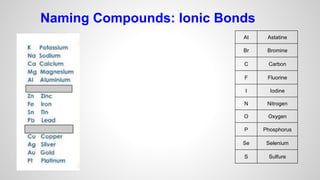
To write the name of an ionic compound, you write the 
name of the metal then the name of the nonmetal with 
the suffix -ide.
Naming Compounds: Ionic Bonds 
At Astatine 
Br Bromine 
C Carbon 
F Fluorine 
I Iodine 
N Nitrogen 
O Oxygen 
P Phosphorus 
Se Selenium 
S Sulfure
Naming Compounds: Ionic Bonds 
(transitional metals) 
To write the name of an ionic compound, you write the name of the metal then the name of the 
nonmetal with the suffix -ide. 
( Remember, transitional metals can form multiple 
types of ions; they have different oxidation states. 
When you name a compound that has a transitional 
) 
metal, you indicate which ion is involved. 
If the compound has a transition metal, indicate its oxidation state (charge of ion) with a Roman 
Numeral in parenthesis before the nonmetal. 
Copper (I) Oxide 
Copper (II) Oxide
Naming Compounds: Ionic Bonds 
(transitional metals) 
At Astatine 
Br Bromine 
C Carbon 
F Fluorine 
I Iodine 
N Nitrogen 
O Oxygen 
P Phosphorus 
Se Selenium 
S Sulfure
Naming Compounds: Ionic Bonds 
(Polyatomic Ions) 
1. Name the metal, name the 
polyatomic ion. 
1. Potassium Nitrate 
2. Name the transitional metal, 
indicate oxidation state, name the 
polyatomic ion. 
1. Copper (II) Nitrate
Naming Compounds: Ionic Bonds 
(Polyatomic Ions)
Naming Compounds: Covalent Bonds 
1. Name the least 
electronegative nonmetal 
a. indicate the number of 
atoms of said element 
with the correct prefix 
2. Name the most 
electronegative nonmetal 
a. indicate the number of 
atoms of said element 
with the correct prefix 
b. add suffix -ide
Naming Compounds: Covalent Bonds 
At Astatine 
Br Bromine 
C Carbon 
F Florine 
I Iodine 
N Nitrogen 
O Oxygen 
P Phosphorus 
Se Selenium 
S Sulfure
Naming Compounds: Covalent Bonds 
At Astatine 
Br Bromine 
C Carbon 
F Florine 
I Iodine 
N Nitrogen 
O Oxygen 
P Phosphorus 
Se Selenium 
S Sulfure

Naming Compound

  • 1.
  • 2.
    Naming Compounds: IonicBonds To write the name of an ionic compound, you write the name of the metal then the name of the nonmetal with the suffix -ide.
  • 3.
    Naming Compounds: IonicBonds At Astatine Br Bromine C Carbon F Fluorine I Iodine N Nitrogen O Oxygen P Phosphorus Se Selenium S Sulfure
  • 4.
    Naming Compounds: IonicBonds (transitional metals) To write the name of an ionic compound, you write the name of the metal then the name of the nonmetal with the suffix -ide. ( Remember, transitional metals can form multiple types of ions; they have different oxidation states. When you name a compound that has a transitional ) metal, you indicate which ion is involved. If the compound has a transition metal, indicate its oxidation state (charge of ion) with a Roman Numeral in parenthesis before the nonmetal. Copper (I) Oxide Copper (II) Oxide
  • 5.
    Naming Compounds: IonicBonds (transitional metals) At Astatine Br Bromine C Carbon F Fluorine I Iodine N Nitrogen O Oxygen P Phosphorus Se Selenium S Sulfure
  • 6.
    Naming Compounds: IonicBonds (Polyatomic Ions) 1. Name the metal, name the polyatomic ion. 1. Potassium Nitrate 2. Name the transitional metal, indicate oxidation state, name the polyatomic ion. 1. Copper (II) Nitrate
  • 7.
    Naming Compounds: IonicBonds (Polyatomic Ions)
  • 8.
    Naming Compounds: CovalentBonds 1. Name the least electronegative nonmetal a. indicate the number of atoms of said element with the correct prefix 2. Name the most electronegative nonmetal a. indicate the number of atoms of said element with the correct prefix b. add suffix -ide
  • 9.
    Naming Compounds: CovalentBonds At Astatine Br Bromine C Carbon F Florine I Iodine N Nitrogen O Oxygen P Phosphorus Se Selenium S Sulfure
  • 10.
    Naming Compounds: CovalentBonds At Astatine Br Bromine C Carbon F Florine I Iodine N Nitrogen O Oxygen P Phosphorus Se Selenium S Sulfure