Electron Configuration
Chemical Bonding
Amalene Cooper-Morgan, Ph.D.
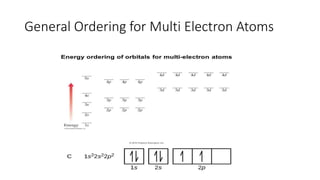
General Ordering for Multi Electron Atoms
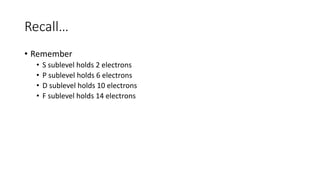
Recall…
• Remember
• S sublevel holds 2 electrons
• P sublevel holds 6 electrons
• D sublevel holds 10 electrons
• F sublevel holds 14 electrons
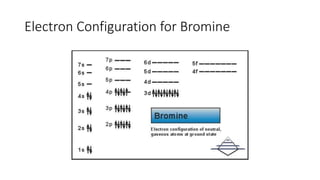
Electron Configuration for Bromine
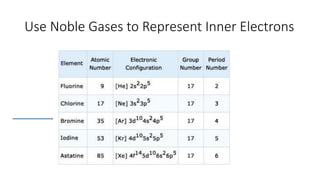
Use Noble Gases to Represent Inner Electrons
Valence Electrons
• Located in the outermost principal energy level
• For transition elements, d electrons are counted among the valence
electrons, although they aren’t in the outermost principal energy
level
• Core electrons are electrons in complete principal energy levels
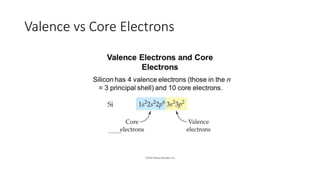
Valence vs Core Electrons
Main Group Elements
• Don’t include transition elements
• Valence electrons are in their outermost principal energy level
• Example:
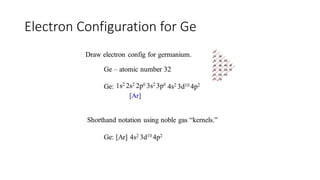
• Germanium, atomic number 32 is a main group element
• Ge n=1, 2 and 3 principal energy levels are complete (Core electrons)
• Ge n=4 is the outermost principal level (Valence electrons)
Electron Configuration for Ge
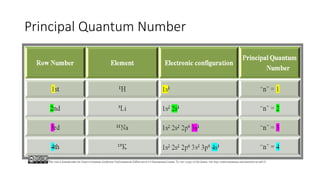
Principal Quantum Number
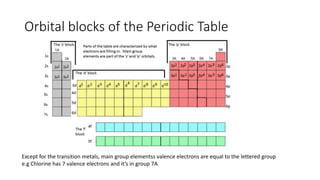
Orbital blocks of the Periodic Table
Except for the transition metals, main group elementss valence electrons are equal to the lettered group
e.g Chlorine has 7 valence electrons and it’s in group 7A
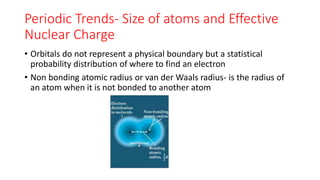
Periodic Trends- Size of atoms and Effective
Nuclear Charge
• Orbitals do not represent a physical boundary but a statistical
probability distribution of where to find an electron
• Non bonding atomic radius or van der Waals radius- is the radius of
an atom when it is not bonded to another atom
Periodic Trends- Size of atoms and Effective
Nuclear Charge
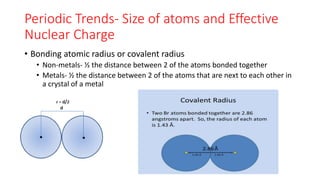
• Bonding atomic radius or covalent radius
• Non-metals- ½ the distance between 2 of the atoms bonded together
• Metals- ½ the distance between 2 of the atoms that are next to each other in
a crystal of a metal
Exceptions..
• Bonding radii of He and Ne are approximated
• They do not form either chemical bonds or metallic crystals
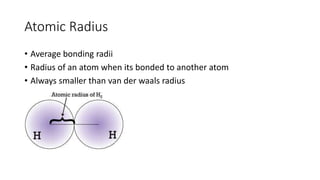
Atomic Radius
• Average bonding radii
• Radius of an atom when its bonded to another atom
• Always smaller than van der waals radius
Approximate bond length
• Sum of the atomic radii for 2 covalently bonded atoms
• Approx. bond length for ICl:
• I atomic radius = 133 pm + Cl atomic radius = 99 pm
• Total bond length = 232 pm
• Actual bond length is 232.07 pm
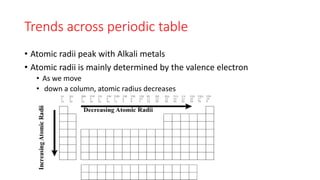
Trends across periodic table
• Atomic radii peak with Alkali metals
• Atomic radii is mainly determined by the valence electron
• As we move
• down a column, atomic radius decreases
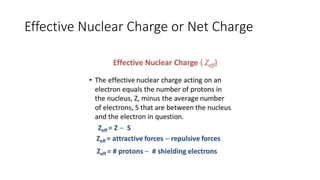
Effective Nuclear Charge or Net Charge
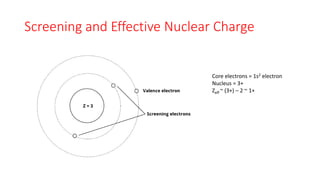
Screening and Effective Nuclear Charge
Core electrons = 1s2 electron
Nucleus = 3+
Zeff ~ (3+) – 2 ~ 1+
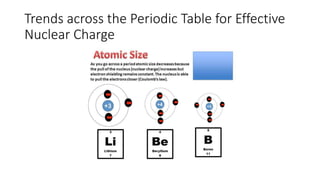
Trends across the Periodic Table for Effective
Nuclear Charge
Trends across periodic table
• As we move across a row to the right the atomic radius decreases
• Transition elements, except the first couple of elements in a column,
do NOT follow the same trend for atomic radii as main group
elements
• Atomic radius does not decrease as you cross the row from L to R
• Atomic radii stay constant
• The outermost electrons stay constant and experience a constant nuclear
charge, keeping the radius approx. constant

Electron Configuration and Chemical Bonding

  • 1.
  • 2.
    General Ordering forMulti Electron Atoms
  • 3.
    Recall… • Remember • Ssublevel holds 2 electrons • P sublevel holds 6 electrons • D sublevel holds 10 electrons • F sublevel holds 14 electrons
  • 4.
  • 5.
    Use Noble Gasesto Represent Inner Electrons
  • 6.
    Valence Electrons • Locatedin the outermost principal energy level • For transition elements, d electrons are counted among the valence electrons, although they aren’t in the outermost principal energy level • Core electrons are electrons in complete principal energy levels
  • 7.
    Valence vs CoreElectrons
  • 8.
    Main Group Elements •Don’t include transition elements • Valence electrons are in their outermost principal energy level • Example: • Germanium, atomic number 32 is a main group element • Ge n=1, 2 and 3 principal energy levels are complete (Core electrons) • Ge n=4 is the outermost principal level (Valence electrons)
  • 9.
  • 10.
  • 11.
    Orbital blocks ofthe Periodic Table Except for the transition metals, main group elementss valence electrons are equal to the lettered group e.g Chlorine has 7 valence electrons and it’s in group 7A
  • 12.
    Periodic Trends- Sizeof atoms and Effective Nuclear Charge • Orbitals do not represent a physical boundary but a statistical probability distribution of where to find an electron • Non bonding atomic radius or van der Waals radius- is the radius of an atom when it is not bonded to another atom
  • 13.
    Periodic Trends- Sizeof atoms and Effective Nuclear Charge • Bonding atomic radius or covalent radius • Non-metals- ½ the distance between 2 of the atoms bonded together • Metals- ½ the distance between 2 of the atoms that are next to each other in a crystal of a metal
  • 14.
    Exceptions.. • Bonding radiiof He and Ne are approximated • They do not form either chemical bonds or metallic crystals
  • 15.
    Atomic Radius • Averagebonding radii • Radius of an atom when its bonded to another atom • Always smaller than van der waals radius
  • 16.
    Approximate bond length •Sum of the atomic radii for 2 covalently bonded atoms • Approx. bond length for ICl: • I atomic radius = 133 pm + Cl atomic radius = 99 pm • Total bond length = 232 pm • Actual bond length is 232.07 pm
  • 17.
    Trends across periodictable • Atomic radii peak with Alkali metals • Atomic radii is mainly determined by the valence electron • As we move • down a column, atomic radius decreases
  • 18.
  • 19.
    Screening and EffectiveNuclear Charge Core electrons = 1s2 electron Nucleus = 3+ Zeff ~ (3+) – 2 ~ 1+
  • 20.
    Trends across thePeriodic Table for Effective Nuclear Charge
  • 21.
    Trends across periodictable • As we move across a row to the right the atomic radius decreases • Transition elements, except the first couple of elements in a column, do NOT follow the same trend for atomic radii as main group elements • Atomic radius does not decrease as you cross the row from L to R • Atomic radii stay constant • The outermost electrons stay constant and experience a constant nuclear charge, keeping the radius approx. constant