Biochemistry
Moisés Sánchez Gómez & Javier Hernandez Puchot
What it studies?
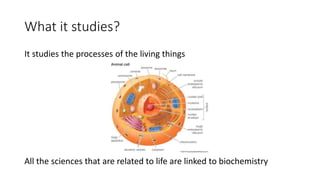
It studies the processes of the living things
All the sciences that are related to life are linked to biochemistry
It once was generally believed that life and its materials had some
essential property or substance
Many years ago, the scientist thought that living things could only
produce certain substances.
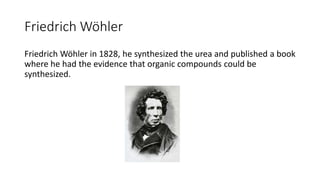
Friedrich Wöhler
Friedrich Wöhler in 1828, he synthesized the urea and published a book
where he had the evidence that organic compounds could be
synthesized.
QUICK QUESTION!!
• Who was Friedrich Wöhler?
Main classes of molecules
• carbohydrates
• lipids
• Proteins
• nucleic acids
Monomers and polymers
Monomers are microscopic molecules that they link to make larger
chains named polymers
The monomers when they are linked they can synthesis biological
polymers.
Monomers make different chains, depending on the function they are
needed
Examples of monomers
• monosaccharides
• glycerol and fatty acids
• nucleotides
• amino acids
QUICK QUESTION!!!
• Name the main clases of molecules. (4)
Monosaccharides
Monosaccharides link to make carbohydrates and carbohydrates are
used to provide energy to a organism.
Glycerol and fatty acids
Glycerol and fatty acids link to make lipids. Lipids are use as energy
providers and in cell membranes
Some lipids are bad, others are good
Nucleotides
Nucleotides link to make DNA and RNA. The DNA gives mthe
instruction of how to make the poby and its functions, the RNA is for
making copies of DNA.
Quick QUESTION!!!
• Does Glycerol and fatty acids link to make Proteins? (true or false)
Aminoacids
• Aminoacids are organic compounds made up of amine which is (-
NH2) and carboxylic acid (-COOH).
• The main elements of an aminoacid are H, C, O and N.
Carbohydrates
• A carbohydrates is a molecule that contains H, O and C.
• And is a synonym of a saccharide.
Lipids
• A lipid is an organic compound that their solubility is in organic
solvents (like acetone, chloroform, etc) and also in wáter.
QUICK QUESTION!!!
• What is BIO CHEMISTRY?
Proteins
• They are molecules or “macromolecules” that consist in a chain of
aminoacid residues.
• They function in the metabolic reactions, replicating DNA, etc.
Bibliography
• “Biochemistry” https://en.wikipedia.org/ Wikimedia Foundation 18/06/15
• Gauthier, Nicholas “Monomers: Types & Examples” http://study.com/ BBB
18/06/15
• “Nucleotide” http://www.ncbi.nlm.nih.gov/ USA.gov 18/06/15
• “Aminoacids” https://en.wikipedia.org/ Wikimedia Foundation 20/06/15
• “Carbohydrates” https://en.wikipedia.org/ Wikimedia Foundation
20/06/15
• “Lipids” https://2chemistry.msu.edu / William Resch
20/06/15
“proteins” https://en.wikipedia.org/ Wikimedia Foundation
20/06/15

Biochemistry

  • 1.
    Biochemistry Moisés Sánchez Gómez& Javier Hernandez Puchot
  • 2.
    What it studies? Itstudies the processes of the living things All the sciences that are related to life are linked to biochemistry
  • 3.
    It once wasgenerally believed that life and its materials had some essential property or substance Many years ago, the scientist thought that living things could only produce certain substances.
  • 4.
    Friedrich Wöhler Friedrich Wöhlerin 1828, he synthesized the urea and published a book where he had the evidence that organic compounds could be synthesized.
  • 5.
    QUICK QUESTION!! • Whowas Friedrich Wöhler?
  • 6.
    Main classes ofmolecules • carbohydrates • lipids • Proteins • nucleic acids
  • 7.
    Monomers and polymers Monomersare microscopic molecules that they link to make larger chains named polymers The monomers when they are linked they can synthesis biological polymers. Monomers make different chains, depending on the function they are needed
  • 8.
    Examples of monomers •monosaccharides • glycerol and fatty acids • nucleotides • amino acids
  • 9.
    QUICK QUESTION!!! • Namethe main clases of molecules. (4)
  • 10.
    Monosaccharides Monosaccharides link tomake carbohydrates and carbohydrates are used to provide energy to a organism.
  • 11.
    Glycerol and fattyacids Glycerol and fatty acids link to make lipids. Lipids are use as energy providers and in cell membranes Some lipids are bad, others are good
  • 12.
    Nucleotides Nucleotides link tomake DNA and RNA. The DNA gives mthe instruction of how to make the poby and its functions, the RNA is for making copies of DNA.
  • 13.
    Quick QUESTION!!! • DoesGlycerol and fatty acids link to make Proteins? (true or false)
  • 14.
    Aminoacids • Aminoacids areorganic compounds made up of amine which is (- NH2) and carboxylic acid (-COOH). • The main elements of an aminoacid are H, C, O and N.
  • 15.
    Carbohydrates • A carbohydratesis a molecule that contains H, O and C. • And is a synonym of a saccharide.
  • 16.
    Lipids • A lipidis an organic compound that their solubility is in organic solvents (like acetone, chloroform, etc) and also in wáter.
  • 17.
    QUICK QUESTION!!! • Whatis BIO CHEMISTRY?
  • 18.
    Proteins • They aremolecules or “macromolecules” that consist in a chain of aminoacid residues. • They function in the metabolic reactions, replicating DNA, etc.
  • 19.
    Bibliography • “Biochemistry” https://en.wikipedia.org/Wikimedia Foundation 18/06/15 • Gauthier, Nicholas “Monomers: Types & Examples” http://study.com/ BBB 18/06/15 • “Nucleotide” http://www.ncbi.nlm.nih.gov/ USA.gov 18/06/15 • “Aminoacids” https://en.wikipedia.org/ Wikimedia Foundation 20/06/15 • “Carbohydrates” https://en.wikipedia.org/ Wikimedia Foundation 20/06/15 • “Lipids” https://2chemistry.msu.edu / William Resch 20/06/15 “proteins” https://en.wikipedia.org/ Wikimedia Foundation 20/06/15