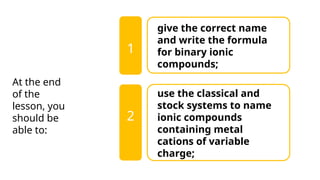
give the correctname
and write the formula
for binary ionic
compounds;
use the classical and
stock systems to name
ionic compounds
containing metal
cations of variable
charge;
1
At the end
of the
lesson, you
should be
able to:
2
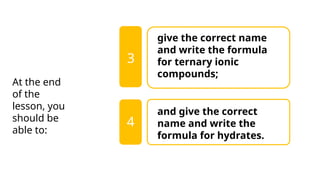
3.
give the correctname
and write the formula
for ternary ionic
compounds;
and give the correct
name and write the
formula for hydrates.
3
At the end
of the
lesson, you
should be
able to:
4
4.
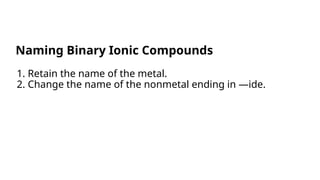
1. Retain thename of the metal.
2. Change the name of the nonmetal ending in —ide.
Naming Binary Ionic Compounds
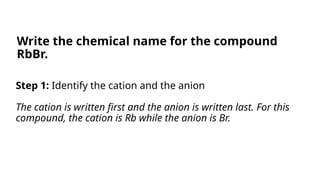
Step 1: Identifythe cation and the anion
The cation is written first and the anion is written last. For this
compound, the cation is Rb while the anion is Br.
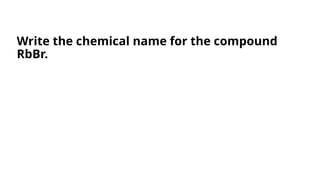
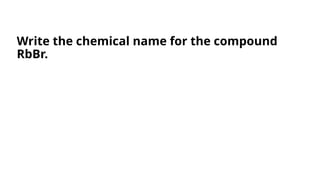
Write the chemical name for the compound
RbBr.
7.
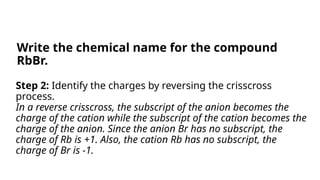
Step 2: Identifythe charges by reversing the crisscross
process.
In a reverse crisscross, the subscript of the anion becomes the
charge of the cation while the subscript of the cation becomes the
charge of the anion. Since the anion Br has no subscript, the
charge of Rb is +1. Also, the cation Rb has no subscript, the
charge of Br is -1.
Write the chemical name for the compound
RbBr.
8.
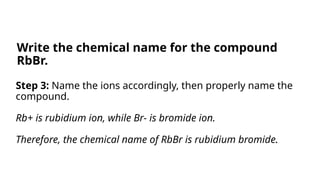
Step 3: Namethe ions accordingly, then properly name the
compound.
Rb+ is rubidium ion, while Br- is bromide ion.
Therefore, the chemical name of RbBr is rubidium bromide.
Write the chemical name for the compound
RbBr.
9.
For metals withmultiple charges and a nonmetal, there are
two ways of name compounds.
1. The classical system is mostly for elements having Latin
names and have two possible charges. Instead of
retaining the name of the metal, the Latin name of the
metal is used ending in —ous or —ic.
Naming Binary Ionic Compounds
10.
For metals withmultiple charges and a nonmetal, there are
two ways of name compounds.
2. The stock system uses Roman numerals to identify the
charge of the metal. The name of the metal is retained
while adding the charge in Roman numerals within a
parenthesis after the name of the metal.
Naming Binary Ionic Compounds
11.
1. Write thesymbol of the cation and anion. Include the
electrons lost or gained as charges.
2. Crisscross the charges.
Writing Binary Ionic Compounds
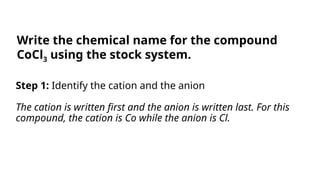
Step 1: Identifythe cation and the anion
The cation is written first and the anion is written last. For this
compound, the cation is Co while the anion is Cl.
Write the chemical name for the compound
CoCl3 using the stock system.
14.
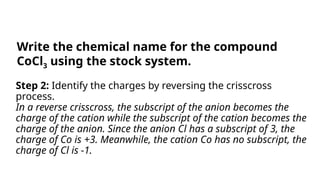
Step 2: Identifythe charges by reversing the crisscross
process.
In a reverse crisscross, the subscript of the anion becomes the
charge of the cation while the subscript of the cation becomes the
charge of the anion. Since the anion Cl has a subscript of 3, the
charge of Co is +3. Meanwhile, the cation Co has no subscript, the
charge of Cl is -1.
Write the chemical name for the compound
CoCl3 using the stock system.
15.
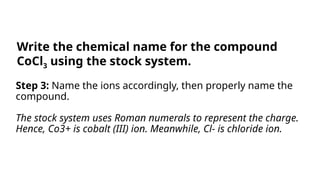
Step 3: Namethe ions accordingly, then properly name the
compound.
The stock system uses Roman numerals to represent the charge.
Hence, Co3+ is cobalt (III) ion. Meanwhile, Cl- is chloride ion.
Write the chemical name for the compound
CoCl3 using the stock system.
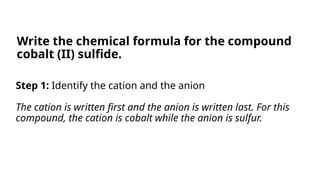
Step 1: Identifythe cation and the anion
The cation is written first and the anion is written last. For this
compound, the cation is cobalt while the anion is sulfur.
Write the chemical formula for the compound
cobalt (II) sulfide.
18.
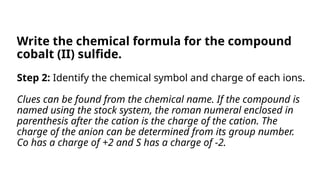
Step 2: Identifythe chemical symbol and charge of each ions.
Clues can be found from the chemical name. If the compound is
named using the stock system, the roman numeral enclosed in
parenthesis after the cation is the charge of the cation. The
charge of the anion can be determined from its group number.
Co has a charge of +2 and S has a charge of -2.
Write the chemical formula for the compound
cobalt (II) sulfide.
19.
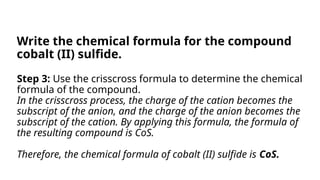
Step 3: Usethe crisscross formula to determine the chemical
formula of the compound.
In the crisscross process, the charge of the cation becomes the
subscript of the anion, and the charge of the anion becomes the
subscript of the cation. By applying this formula, the formula of
the resulting compound is CoS.
Therefore, the chemical formula of cobalt (II) sulfide is CoS.
Write the chemical formula for the compound
cobalt (II) sulfide.
20.
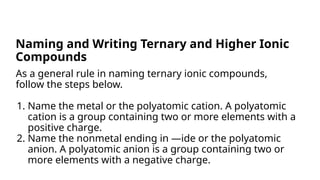
As a generalrule in naming ternary ionic compounds,
follow the steps below.
1. Name the metal or the polyatomic cation. A polyatomic
cation is a group containing two or more elements with a
positive charge.
2. Name the nonmetal ending in —ide or the polyatomic
anion. A polyatomic anion is a group containing two or
more elements with a negative charge.
Naming and Writing Ternary and Higher Ionic
Compounds
21.
To write formulasof ternary ionic compounds, follow the
steps below.
1. Write the symbol of the cation and anion. Include the
electrons lost or gained as charges.
2. Crisscross the charges. For polyatomic ions, the subscript
is written outside of the parenthesis.
Naming and Writing Ternary and Higher Ionic
Compounds
Step 1: Identifythe cation and the anion
The cation is written first and the anion is written last. For this
compound, the cation is potassium ion while the anion is nitrate
ion.
Write the chemical formula for the compound
potassium nitrate.
24.
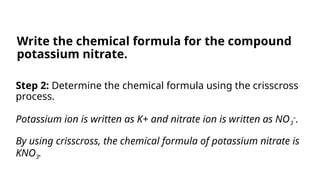
Step 2: Determinethe chemical formula using the crisscross
process.
Potassium ion is written as K+ and nitrate ion is written as NO3
–
.
By using crisscross, the chemical formula of potassium nitrate is
KNO3.
Write the chemical formula for the compound
potassium nitrate.
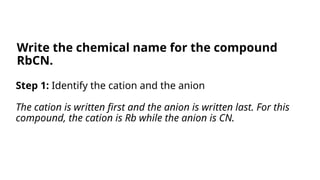
Step 1: Identifythe cation and the anion
The cation is written first and the anion is written last. For this
compound, the cation is Rb while the anion is CN.
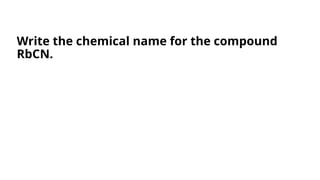
Write the chemical name for the compound
RbCN.
27.
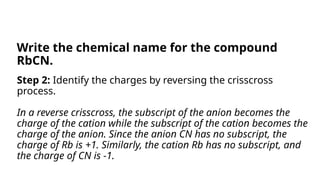
Step 2: Identifythe charges by reversing the crisscross
process.
In a reverse crisscross, the subscript of the anion becomes the
charge of the cation while the subscript of the cation becomes the
charge of the anion. Since the anion CN has no subscript, the
charge of Rb is +1. Similarly, the cation Rb has no subscript, and
the charge of CN is -1.
Write the chemical name for the compound
RbCN.
28.
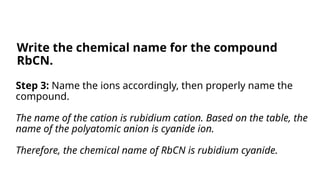
Step 3: Namethe ions accordingly, then properly name the
compound.
The name of the cation is rubidium cation. Based on the table, the
name of the polyatomic anion is cyanide ion.
Therefore, the chemical name of RbCN is rubidium cyanide.
Write the chemical name for the compound
RbCN.
29.
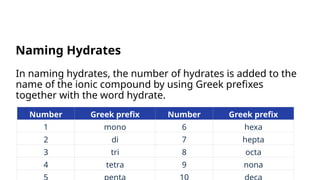
In naming hydrates,the number of hydrates is added to the
name of the ionic compound by using Greek prefixes
together with the word hydrate.
Naming Hydrates
Number Greek prefix Number Greek prefix
1 mono 6 hexa
2 di 7 hepta
3 tri 8 octa
4 tetra 9 nona
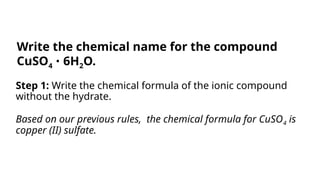
Step 1: Writethe chemical formula of the ionic compound
without the hydrate.
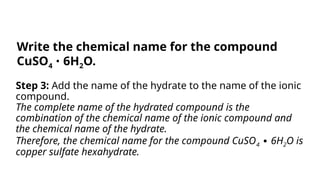
Based on our previous rules, the chemical formula for CuSO4 is
copper (II) sulfate.
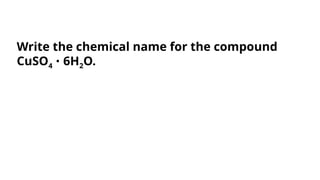
Write the chemical name for the compound
CuSO4 6H
∙ 2O.
32.
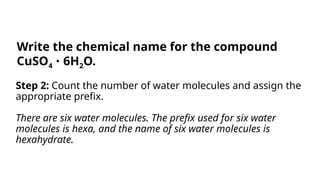
Step 2: Countthe number of water molecules and assign the
appropriate prefix.
There are six water molecules. The prefix used for six water
molecules is hexa, and the name of six water molecules is
hexahydrate.
Write the chemical name for the compound
CuSO4 6H
∙ 2O.
33.
Step 3: Addthe name of the hydrate to the name of the ionic
compound.
The complete name of the hydrated compound is the
combination of the chemical name of the ionic compound and
the chemical name of the hydrate.
Therefore, the chemical name for the compound CuSO4 6H
∙ 2O is
copper sulfate hexahydrate.
Write the chemical name for the compound
CuSO4 6H
∙ 2O.
34.
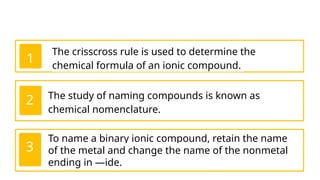
The crisscross ruleis used to determine the
chemical formula of an ionic compound.
1
The study of naming compounds is known as
chemical nomenclature.
2
To name a binary ionic compound, retain the name
of the metal and change the name of the nonmetal
ending in —ide.
3
35.
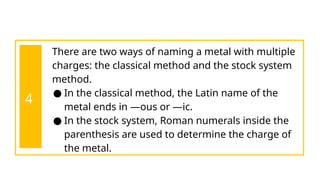
There are twoways of naming a metal with multiple
charges: the classical method and the stock system
method.
● In the classical method, the Latin name of the
metal ends in —ous or —ic.
● In the stock system, Roman numerals inside the
parenthesis are used to determine the charge of
the metal.
4
36.
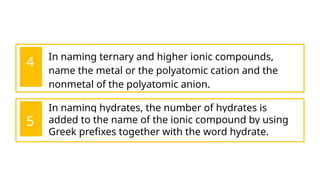
1 In namingternary and higher ionic compounds,
name the metal or the polyatomic cation and the
nonmetal of the polyatomic anion.
4
In naming hydrates, the number of hydrates is
added to the name of the ionic compound by using
Greek prefixes together with the word hydrate.
5
37.
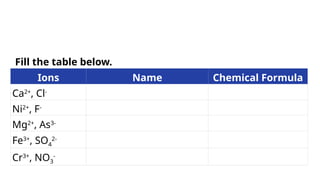
Fill the tablebelow.
Ions Name Chemical Formula
Ca2+
, Cl-
Ni2+
, F-
Mg2+
, As3-
Fe3+
, SO4
2-
Cr3+
, NO3
-
38.
Write the chemicalname for the following ionic
compounds:
1. AlN
2. NaO
3. Fe[(Fe(CN)6]
39.
Brown, Theodore L.2004. Chemistry: The Central Science (11th ed). Singapore: Pearson Education (Asia)
Pte Ltd.
Chang, Raymond. 2010. Chemistry (10th ed). New York: McGraw-Hill.
Padolina, Ma. Cristina D, et al. 2004. Conceptual and Functional Chemistry: Modular Approach.
Philippines: Vibal Publishing House, Inc. .
Pavico, Ma. Josefina F. 2013. Exploring Life through Science: The New Grade 7. Philippines: Phoenix
Publishing House, Inc. .
Silberberg, Martin S. 2009. Chemistry: The Molecular Nature of Matter and Change (5th ed). New York:
McGraw-Hill.

![Write the chemical name for the following ionic
compounds:
1. AlN
2. NaO
3. Fe[(Fe(CN)6]](https://image.slidesharecdn.com/science97-250501024041-ec883706/85/Science-9-7-3-Writing-and-Naming-Ionic-Compounds-pptx-38-320.jpg)



![7. chemical formulas and naming compnds [Autosaved].pptx](https://cdn.slidesharecdn.com/ss_thumbnails/7-230411213227-ee6c7133-thumbnail.jpg?width=640&height=640&fit=bounds)


