Name :
Mr. S.M.Safayet Ullah
Designation :
Lecturer
Department :
Department of Natural Sciences
Faculty :
Faculty of Science and Information
Technology
E-mail :
safayet.ns@diu.edu.bd
Cell-Phone :
01717497562
Reverse
Biasing,Bridge,Zener
Diode
N TYPE SC
When a small amount of pentavalent impurity added to a pure SC, It’s known
as n type SC
When any pantavalent element such as Phosphorous,
Arsenic or Antimony is added to the intrinsic Semiconductor , four electrons
are involved in covalent bonding with four neighboring pure
Semiconductor atoms.
The fifth electron is weakly bound to the parent atom. And even for lesser
thermal energy it is released Leaving the parent atom positively ionized.
N - type
Semiconductors
N-type Semiconductor
Si
Si
SiPSi
Free electron
Impure atom
(Donor)
REVERSE BIASING
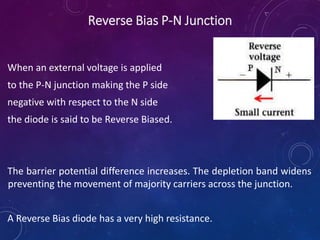
When an external voltage is applied
to the P-N junction making the P side
negative with respect to the N side
the diode is said to be Reverse Biased.
The barrier potential difference increases. The depletion band widens
preventing the movement of majority carriers across the junction.
A Reverse Bias diode has a very high resistance.
Reverse Bias P-N Junction
REVERSE BIASING
FULL WAVE BRIDGE
FULL WAVE BRIDGE RECTIFIER
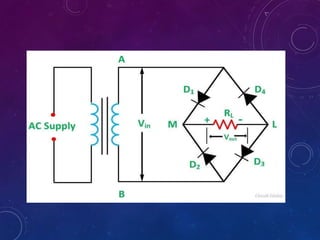
• In Full Wave Bridge Rectifier, an ordinary
transformer is used in place of a center tapped
transformer. The circuit forms a bridge connecting
the four diodes D1, D2, D3, and D4. The circuit
diagram of Full Wave Bridge Rectifier is shown
below
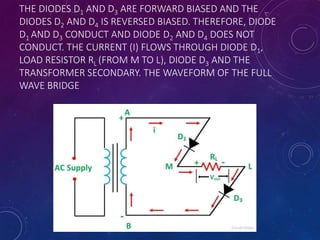
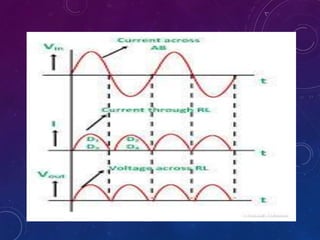
THE DIODES D1 AND D3 ARE FORWARD BIASED AND THE
DIODES D2 AND D4 IS REVERSED BIASED. THEREFORE, DIODE
D1 AND D3 CONDUCT AND DIODE D2 AND D4 DOES NOT
CONDUCT. THE CURRENT (I) FLOWS THROUGH DIODE D1,
LOAD RESISTOR RL (FROM M TO L), DIODE D3 AND THE
TRANSFORMER SECONDARY. THE WAVEFORM OF THE FULL
WAVE BRIDGE
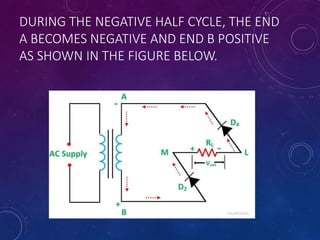
DURING THE NEGATIVE HALF CYCLE, THE END
A BECOMES NEGATIVE AND END B POSITIVE
AS SHOWN IN THE FIGURE BELOW.
OPERATION OF FULL WAVE BRIDGE RECTIFIER
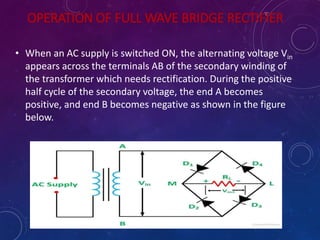
• When an AC supply is switched ON, the alternating voltage Vin
appears across the terminals AB of the secondary winding of
the transformer which needs rectification. During the positive
half cycle of the secondary voltage, the end A becomes
positive, and end B becomes negative as shown in the figure
below.
• Advantages of Full Wave Bridge Rectifier
• The center tap transformer is eliminated.
• The output is double to that of the center tapped full wave rectifier for the
same secondary voltage.
• The peak inverse voltage across each diode is one-half of the center tap
circuit of the diode.
• Disadvantages of Full Wave Bridge Rectifier
• It needs four diodes.
• The circuit is not suitable when a small voltage is required to be rectified. It
is because, in this case, the two diodes are connected in series and offer
double voltage drop due to their internal resistance.
ZENER
DIODE
17 February 2017 19
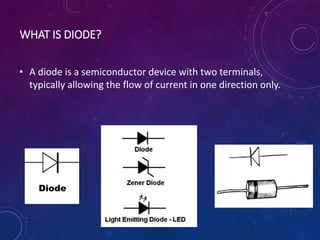
WHAT IS DIODE?
• A diode is a semiconductor device with two terminals,
typically allowing the flow of current in one direction only.
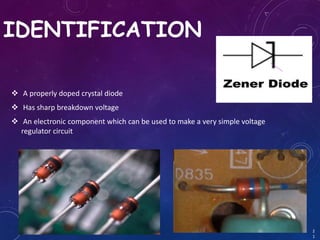
IDENTIFICATION
 A properly doped crystal diode
 Has sharp breakdown voltage
 An electronic component which can be used to make a very simple voltage
regulator circuit
17 February 2017
2
1
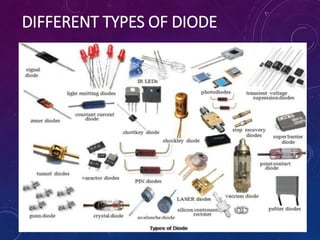
DIFFERENT TYPES OF DIODE
CHARACTERISTICS .
.
• A Zener diode is always
reverse connected
• When forward biased, its
characteristics are just like
of ordinary diode
• It has sharp breakdown
voltage, called Zener
voltage 17 February 2017 23
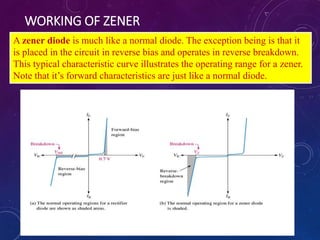
WORKING OF ZENER
A zener diode is much like a normal diode. The exception being is that it
is placed in the circuit in reverse bias and operates in reverse breakdown.
This typical characteristic curve illustrates the operating range for a zener.
Note that it’s forward characteristics are just like a normal diode.
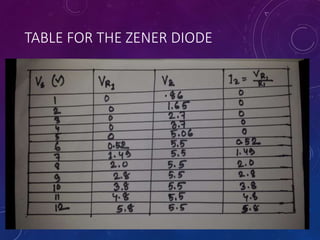
TABLE FOR THE ZENER DIODE
FINISHED
17 February 2017 27
N type-sc

N type-sc

  • 2.
    Name : Mr. S.M.SafayetUllah Designation : Lecturer Department : Department of Natural Sciences Faculty : Faculty of Science and Information Technology E-mail : safayet.ns@diu.edu.bd Cell-Phone : 01717497562
  • 4.
  • 5.
  • 6.
    When a smallamount of pentavalent impurity added to a pure SC, It’s known as n type SC When any pantavalent element such as Phosphorous, Arsenic or Antimony is added to the intrinsic Semiconductor , four electrons are involved in covalent bonding with four neighboring pure Semiconductor atoms. The fifth electron is weakly bound to the parent atom. And even for lesser thermal energy it is released Leaving the parent atom positively ionized. N - type Semiconductors
  • 7.
  • 8.
  • 9.
    When an externalvoltage is applied to the P-N junction making the P side negative with respect to the N side the diode is said to be Reverse Biased. The barrier potential difference increases. The depletion band widens preventing the movement of majority carriers across the junction. A Reverse Bias diode has a very high resistance. Reverse Bias P-N Junction
  • 10.
  • 11.
  • 12.
    FULL WAVE BRIDGERECTIFIER • In Full Wave Bridge Rectifier, an ordinary transformer is used in place of a center tapped transformer. The circuit forms a bridge connecting the four diodes D1, D2, D3, and D4. The circuit diagram of Full Wave Bridge Rectifier is shown below
  • 14.
    THE DIODES D1AND D3 ARE FORWARD BIASED AND THE DIODES D2 AND D4 IS REVERSED BIASED. THEREFORE, DIODE D1 AND D3 CONDUCT AND DIODE D2 AND D4 DOES NOT CONDUCT. THE CURRENT (I) FLOWS THROUGH DIODE D1, LOAD RESISTOR RL (FROM M TO L), DIODE D3 AND THE TRANSFORMER SECONDARY. THE WAVEFORM OF THE FULL WAVE BRIDGE
  • 15.
    DURING THE NEGATIVEHALF CYCLE, THE END A BECOMES NEGATIVE AND END B POSITIVE AS SHOWN IN THE FIGURE BELOW.
  • 16.
    OPERATION OF FULLWAVE BRIDGE RECTIFIER • When an AC supply is switched ON, the alternating voltage Vin appears across the terminals AB of the secondary winding of the transformer which needs rectification. During the positive half cycle of the secondary voltage, the end A becomes positive, and end B becomes negative as shown in the figure below.
  • 18.
    • Advantages ofFull Wave Bridge Rectifier • The center tap transformer is eliminated. • The output is double to that of the center tapped full wave rectifier for the same secondary voltage. • The peak inverse voltage across each diode is one-half of the center tap circuit of the diode. • Disadvantages of Full Wave Bridge Rectifier • It needs four diodes. • The circuit is not suitable when a small voltage is required to be rectified. It is because, in this case, the two diodes are connected in series and offer double voltage drop due to their internal resistance.
  • 19.
  • 20.
    WHAT IS DIODE? •A diode is a semiconductor device with two terminals, typically allowing the flow of current in one direction only.
  • 21.
    IDENTIFICATION  A properlydoped crystal diode  Has sharp breakdown voltage  An electronic component which can be used to make a very simple voltage regulator circuit 17 February 2017 2 1
  • 22.
  • 23.
    CHARACTERISTICS . . • AZener diode is always reverse connected • When forward biased, its characteristics are just like of ordinary diode • It has sharp breakdown voltage, called Zener voltage 17 February 2017 23
  • 24.
    WORKING OF ZENER Azener diode is much like a normal diode. The exception being is that it is placed in the circuit in reverse bias and operates in reverse breakdown. This typical characteristic curve illustrates the operating range for a zener. Note that it’s forward characteristics are just like a normal diode.
  • 26.
    TABLE FOR THEZENER DIODE
  • 27.