By
R.NAVEEN
XII „A‟
KENDRIYA VIDYALAYA MANKHURD
PHYSICS INVESTIGATORY
PROJECT
AIM
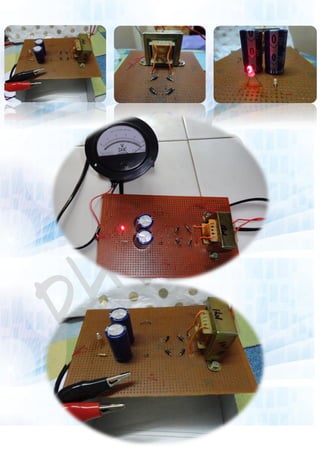
To construct a Full Wave Bridge
rectifier and show that the (AC)
alternating current is rectified into a
direct current (DC).
INDEX
1. CERTIFICATE
2. ACKNOWLEDGEMENT
3. INTRODUCTION
4. AIM
5. MATERIALS REQUIRED
6. CIRCUIT DIAGRAM
7. PROCEDURE
8. WORKING
9. BIBLIOGRAPHY
KENDRIYA VIDYALAYA MANKHURD, MUMBAI
DEPARTMENT OF PHYSICS
CERTIFICATE
This is to certify that R.NAVEEN, a student of class XII-A
has successfully completed the project titled “RECTIFIER”
under the guidance of Mrs. PROMODINI PAL (Subject
Teacher) During the academic year 2014-15 in partial
fulfillment of physics practical examination conducted by
AISSCE, Mumbai.
Signature of external examiner Signature of physics teacher
Signature of principal
ACKNOWLEDGEMENT
In the accomplishment of this project successfully, many
people have best owned upon me their blessings and the heart
pledged support, this time I am utilizing to thank all the
people who have been concerned with project.
Primarily I would thank god for being able to complete this
project with success. Then I would like to thank my principal
Mrs.A.Padmavathy and physics teacher Mrs.PROMODINI PAL,
whose valuable guidance has been the ones that helped me
patch this project and make it full proof success his suggestions
and his instructions has served as the major contributor
towards the completion of the project.
Then I would like to thank my parents and friends who have
helped me with their valuable suggestions and guidance has
been helpful in various phases of the completion of the project.
INTRODUCTION
A rectifier is an electrical device that converts alternating
current (AC), which periodically reverses direction, to direct
current (DC), which flows in only one direction. The process
is known as rectification. Rectification produces a type of DC
that encompasses active voltages and currents, which are then
adjusted into a type of constant voltage DC, although this
varies depending on the current's end-use. The current is
allowed to flow uninterrupted in one direction, and no current
is allowed to flow in the opposite direction.
Physically, rectifiers take a number of forms, including
vacuum tube diodes, mercury-arc valves, copper and selenium
oxide rectifiers, semiconductor diodes, silicon-controlled
rectifiers and other silicon-based semiconductor switches.
Rectifier circuits may be single-phase or multi-phase.
Most low power rectifiers for domestic equipment are
single-phase, but three-phase rectification is very important
for industrial applications and for the transmission of energy
as DC.
MATERIALS REQUIRED
1. Connecting Wires
2. A plug
3. Single Lead Wire- 2m
4. Three Nuts & Bolts 2-3cm length
5. Circuit Board
6. A Transformer (12V)
7. A Resistor
8. P-N Junction Diodes (4nos)
9. A LED
10.Insulation Tape, Blades, Soldering
Wax, Soldering Lead, Soldering Iron &
Sand Paper
CIRCUIT DIAGRAM
PROCEDURE
Take the transformer and attach it to one end of the circuit board.
Attach the plug with the wire of desired length and connect it to
the transformer AC In. now, take four diodes and connect the 4 diodes
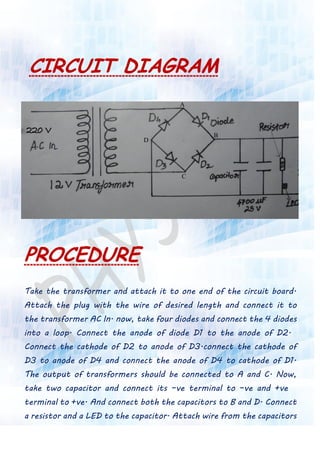
into a loop. Connect the anode of diode D1 to the anode of D2.
Connect the cathode of D2 to anode of D3.connect the cathode of
D3 to anode of D4 and connect the anode of D4 to cathode of D1.
The output of transformers should be connected to A and C. Now,
take two capacitor and connect its –ve terminal to –ve and +ve
terminal to +ve. And connect both the capacitors to B and D. Connect
a resistor and a LED to the capacitor. Attach wire from the capacitors
A
B
D
C
and connect it to the output device.
WORKING
When the AC is supplied to the transformer, it step down the 240V
main supply to 12V. It has a capability of delivering 700mA. The 12
volts AC appearing across the secondary is the RMS value. The four
diodes labelled D1 to D4 are arranged in “series pairs” with only two
diodes conducting current during each half cycle. The four diodes
labelled D1 to D4 are arranged in “series pairs” with only two diodes
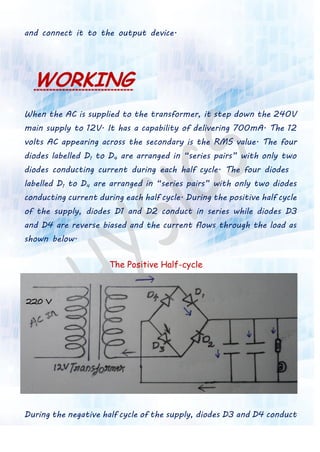
conducting current during each half cycle. During the positive half cycle
of the supply, diodes D1 and D2 conduct in series while diodes D3
and D4 are reverse biased and the current flows through the load as
shown below.
The Positive Half-cycle
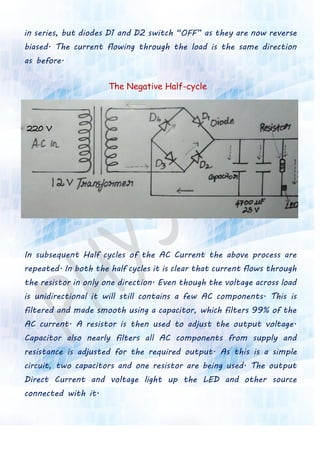
During the negative half cycle of the supply, diodes D3 and D4 conduct
in series, but diodes D1 and D2 switch “OFF” as they are now reverse
biased. The current flowing through the load is the same direction
as before.
The Negative Half-cycle
In subsequent Half cycles of the AC Current the above process are
repeated. In both the half cycles it is clear that current flows through
the resistor in only one direction. Even though the voltage across load
is unidirectional it will still contains a few AC components. This is
filtered and made smooth using a capacitor, which filters 99% of the
AC current. A resistor is then used to adjust the output voltage.
Capacitor also nearly filters all AC components from supply and
resistance is adjusted for the required output. As this is a simple
circuit, two capacitors and one resistor are being used. The output
Direct Current and voltage light up the LED and other source
connected with it.
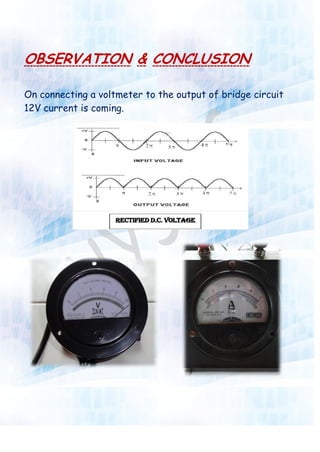
OBSERVATION & CONCLUSION
On connecting a voltmeter to the output of bridge circuit
12V current is coming.
PRECAUTIONS
1. Keep safe yourself from high voltage.
2. Solder the wire safely.
3. While soldering don’t touch the soldering tip.
4. Solder under adult supervision.
USES
Most electronic device cannot withstand very high voltage or
alternating current due to its intense high power. The use of
batteries in all devices is not practical as their replacement and
durability is a huge problem as the devise has to be dismantled each
time for such replacement. So these rectifiers are used in most of
the electronic devices like TV‟s, Radios, Chargers and Lightings etc.
The common uses of rectifiers are to supply polarized voltage for
welding, detection of amplitude modulated radio signals.
BIBLIOGRAPHY
1. HELP FROM TEACHERS 2. HELP FROM INTERNET
3. NCERT TEXTBOOK
WEBSITES
www.google.com
www.scribd.com
www.wikipedia.com
THANK YOU

Physics investigatory project on RECTIFIER

  • 1.
    By R.NAVEEN XII „A‟ KENDRIYA VIDYALAYAMANKHURD PHYSICS INVESTIGATORY PROJECT
  • 2.
    AIM To construct aFull Wave Bridge rectifier and show that the (AC) alternating current is rectified into a direct current (DC).
  • 3.
    INDEX 1. CERTIFICATE 2. ACKNOWLEDGEMENT 3.INTRODUCTION 4. AIM 5. MATERIALS REQUIRED 6. CIRCUIT DIAGRAM 7. PROCEDURE 8. WORKING 9. BIBLIOGRAPHY
  • 4.
    KENDRIYA VIDYALAYA MANKHURD,MUMBAI DEPARTMENT OF PHYSICS CERTIFICATE This is to certify that R.NAVEEN, a student of class XII-A has successfully completed the project titled “RECTIFIER” under the guidance of Mrs. PROMODINI PAL (Subject Teacher) During the academic year 2014-15 in partial fulfillment of physics practical examination conducted by AISSCE, Mumbai. Signature of external examiner Signature of physics teacher Signature of principal
  • 5.
    ACKNOWLEDGEMENT In the accomplishmentof this project successfully, many people have best owned upon me their blessings and the heart pledged support, this time I am utilizing to thank all the people who have been concerned with project. Primarily I would thank god for being able to complete this project with success. Then I would like to thank my principal Mrs.A.Padmavathy and physics teacher Mrs.PROMODINI PAL, whose valuable guidance has been the ones that helped me patch this project and make it full proof success his suggestions and his instructions has served as the major contributor towards the completion of the project. Then I would like to thank my parents and friends who have helped me with their valuable suggestions and guidance has been helpful in various phases of the completion of the project.
  • 6.
    INTRODUCTION A rectifier isan electrical device that converts alternating current (AC), which periodically reverses direction, to direct current (DC), which flows in only one direction. The process is known as rectification. Rectification produces a type of DC that encompasses active voltages and currents, which are then adjusted into a type of constant voltage DC, although this varies depending on the current's end-use. The current is allowed to flow uninterrupted in one direction, and no current is allowed to flow in the opposite direction. Physically, rectifiers take a number of forms, including vacuum tube diodes, mercury-arc valves, copper and selenium oxide rectifiers, semiconductor diodes, silicon-controlled rectifiers and other silicon-based semiconductor switches. Rectifier circuits may be single-phase or multi-phase. Most low power rectifiers for domestic equipment are single-phase, but three-phase rectification is very important for industrial applications and for the transmission of energy as DC.
  • 7.
    MATERIALS REQUIRED 1. ConnectingWires 2. A plug 3. Single Lead Wire- 2m 4. Three Nuts & Bolts 2-3cm length 5. Circuit Board 6. A Transformer (12V) 7. A Resistor 8. P-N Junction Diodes (4nos) 9. A LED 10.Insulation Tape, Blades, Soldering Wax, Soldering Lead, Soldering Iron & Sand Paper
  • 9.
    CIRCUIT DIAGRAM PROCEDURE Take thetransformer and attach it to one end of the circuit board. Attach the plug with the wire of desired length and connect it to the transformer AC In. now, take four diodes and connect the 4 diodes into a loop. Connect the anode of diode D1 to the anode of D2. Connect the cathode of D2 to anode of D3.connect the cathode of D3 to anode of D4 and connect the anode of D4 to cathode of D1. The output of transformers should be connected to A and C. Now, take two capacitor and connect its –ve terminal to –ve and +ve terminal to +ve. And connect both the capacitors to B and D. Connect a resistor and a LED to the capacitor. Attach wire from the capacitors A B D C
  • 10.
    and connect itto the output device. WORKING When the AC is supplied to the transformer, it step down the 240V main supply to 12V. It has a capability of delivering 700mA. The 12 volts AC appearing across the secondary is the RMS value. The four diodes labelled D1 to D4 are arranged in “series pairs” with only two diodes conducting current during each half cycle. The four diodes labelled D1 to D4 are arranged in “series pairs” with only two diodes conducting current during each half cycle. During the positive half cycle of the supply, diodes D1 and D2 conduct in series while diodes D3 and D4 are reverse biased and the current flows through the load as shown below. The Positive Half-cycle During the negative half cycle of the supply, diodes D3 and D4 conduct
  • 11.
    in series, butdiodes D1 and D2 switch “OFF” as they are now reverse biased. The current flowing through the load is the same direction as before. The Negative Half-cycle In subsequent Half cycles of the AC Current the above process are repeated. In both the half cycles it is clear that current flows through the resistor in only one direction. Even though the voltage across load is unidirectional it will still contains a few AC components. This is filtered and made smooth using a capacitor, which filters 99% of the AC current. A resistor is then used to adjust the output voltage. Capacitor also nearly filters all AC components from supply and resistance is adjusted for the required output. As this is a simple circuit, two capacitors and one resistor are being used. The output Direct Current and voltage light up the LED and other source connected with it.
  • 12.
    OBSERVATION & CONCLUSION Onconnecting a voltmeter to the output of bridge circuit 12V current is coming.
  • 13.
    PRECAUTIONS 1. Keep safeyourself from high voltage. 2. Solder the wire safely. 3. While soldering don’t touch the soldering tip. 4. Solder under adult supervision.
  • 14.
    USES Most electronic devicecannot withstand very high voltage or alternating current due to its intense high power. The use of batteries in all devices is not practical as their replacement and durability is a huge problem as the devise has to be dismantled each time for such replacement. So these rectifiers are used in most of the electronic devices like TV‟s, Radios, Chargers and Lightings etc. The common uses of rectifiers are to supply polarized voltage for welding, detection of amplitude modulated radio signals. BIBLIOGRAPHY 1. HELP FROM TEACHERS 2. HELP FROM INTERNET 3. NCERT TEXTBOOK WEBSITES www.google.com www.scribd.com www.wikipedia.com
  • 15.