p-n JUNCTION
It is a single crystal of Ge
or Si doped in such a
manner that one half
portion of its acts as p
type semiconductor and
the other half as n type
semiconductor.
The term junction
implies the boundary or
region of transition
between n type and p
type semiconductor
material.
Fig: Diode representations: PN-
junction model, schematic symbol,
physical part.
fig:-Diode under forward bias
Few characteristics of forward bias:-
> Barrier potential decreases.
> Movement of majority charge carriers
i.e.. holes from p-side to n-side towards
the junction.
>Effective resistance across the p-n
junction decreases.
Working of a p-n
Junction
1.Forward biasing
If the positive terminal
of the battery is
connected to the p-side
and the negative
terminal to the n-side ,
then the p-n junction is
said to be forward
biased.
fig:-Diode under reverse bias
Few characteristics of reverse bias:-
> Barrier potential across the junction
increases.
>Movement of majority charge carriers
i.e.. electrons away from the junction.
>Effective resistance across the p-n
junction increases.
2. Reverse biasing
If the positive terminal
of a battery is connected
to the n-side and the
negative terminal to the
p-side , then the p-n
junction is said to be
reversed biased.
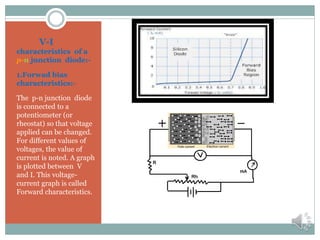
V-I
characteristics of a
p-n junction diode:-
1.Forwad bias
characteristics:-
The p-n junction diode
is connected to a
potentiometer (or
rheostat) so that voltage
applied can be changed.
For different values of
voltages, the value of
current is noted. A graph
is plotted between V
and I. This voltage-
current graph is called
Forward characteristics.
Features of Graph:
1.The V-I graph is not
straight line i.e.. A
junction diode doesn’t
follow Ohm’s law.
2.Initially current
increases very slowly
almost negligibly , till the
voltage across the diode
crosses a certain value ,
called threshold-voltage
or cut-in voltage . The
value of cut –in voltage is
about 0.2 for a Ge diode
and 0.7 for a Si diode.
3.After the cut-in voltage,
the diode current
increases
rapidly(exponentially),
even for a very small
increase in the bias
voltage.
Figure: Increasing forward bias from (a) to (b) decreases depletion region thickness.
2.Reverse bias
characteristics:-
The p-n junction diode
is connected to a
potentiometer(or
rheostat) so that the
voltage the diode can be
changed. For different
values of voltage, the
value of current is noted
. A graph is plotted
between V and I. This
voltage-current graph is
called Reverse
characteristics.
Features of Graph:-
1.When the diode is reverse
biased , the reverse bias
voltage, the reverse bias
voltage produce very less
current, about a few
microamperes which almost
remain constant with bias
.This small current is called
Reverse saturation current.
2.When the reverse voltage
across p-n junction reaches
a sufficiently high value, the
reverse current increases to
a large value. This voltage at
which breakdown of
junction takes place is
called Zener breakdown
voltage or peak-inverse
voltage of the diode.
THANK
YOU

P n junction diode

  • 2.
    p-n JUNCTION It isa single crystal of Ge or Si doped in such a manner that one half portion of its acts as p type semiconductor and the other half as n type semiconductor. The term junction implies the boundary or region of transition between n type and p type semiconductor material. Fig: Diode representations: PN- junction model, schematic symbol, physical part.
  • 3.
    fig:-Diode under forwardbias Few characteristics of forward bias:- > Barrier potential decreases. > Movement of majority charge carriers i.e.. holes from p-side to n-side towards the junction. >Effective resistance across the p-n junction decreases. Working of a p-n Junction 1.Forward biasing If the positive terminal of the battery is connected to the p-side and the negative terminal to the n-side , then the p-n junction is said to be forward biased.
  • 4.
    fig:-Diode under reversebias Few characteristics of reverse bias:- > Barrier potential across the junction increases. >Movement of majority charge carriers i.e.. electrons away from the junction. >Effective resistance across the p-n junction increases. 2. Reverse biasing If the positive terminal of a battery is connected to the n-side and the negative terminal to the p-side , then the p-n junction is said to be reversed biased.
  • 5.
    V-I characteristics of a p-njunction diode:- 1.Forwad bias characteristics:- The p-n junction diode is connected to a potentiometer (or rheostat) so that voltage applied can be changed. For different values of voltages, the value of current is noted. A graph is plotted between V and I. This voltage- current graph is called Forward characteristics.
  • 6.
    Features of Graph: 1.TheV-I graph is not straight line i.e.. A junction diode doesn’t follow Ohm’s law. 2.Initially current increases very slowly almost negligibly , till the voltage across the diode crosses a certain value , called threshold-voltage or cut-in voltage . The value of cut –in voltage is about 0.2 for a Ge diode and 0.7 for a Si diode. 3.After the cut-in voltage, the diode current increases rapidly(exponentially), even for a very small increase in the bias voltage. Figure: Increasing forward bias from (a) to (b) decreases depletion region thickness.
  • 7.
    2.Reverse bias characteristics:- The p-njunction diode is connected to a potentiometer(or rheostat) so that the voltage the diode can be changed. For different values of voltage, the value of current is noted . A graph is plotted between V and I. This voltage-current graph is called Reverse characteristics.
  • 8.
    Features of Graph:- 1.Whenthe diode is reverse biased , the reverse bias voltage, the reverse bias voltage produce very less current, about a few microamperes which almost remain constant with bias .This small current is called Reverse saturation current. 2.When the reverse voltage across p-n junction reaches a sufficiently high value, the reverse current increases to a large value. This voltage at which breakdown of junction takes place is called Zener breakdown voltage or peak-inverse voltage of the diode.
  • 9.