JAWAHAR NAVODAYA VIDYALAYA
ALIRAJPUR(M.P)
PHYSICS
INVESTIGATORY
PROJECT
2017-18
Arvind
Baghel
Class-12th
A
Certificate
Certifiedthat theproject work entitled TransistorsasanAmplifierandSwitch carried
out by Master ARVIND BAGHEL ,of class XII ‘A’ is a bonafidework in partial
fulfilmentof AISSCEinthesubject computer science prescribed by the CentralBoard
of
Secondary Education, during theyear 2017-2018. It is certified that all
corrections/suggestions indicated for Internal Assessment havebeen incorporated in
theReport deposited in thedepartmental library. Theproject report has been
approved as it satisfies theacademic requirements in respect of theProject work
prescribed for thesaid examination.
Mrs.
PGT PHYSICS Principal signature
AKNOWLEDGEMENT
Through this acknowledgement we
express our sincere
gratitude to all those people who have
been associated with the project and
have helped us with it and made it a
worthwhile
experience.
We extend our thanks to Smt. Nutan
Punj, the principal of this fine
establishment KV DRDO for being pillar
of support
throughout the process.
We would like to express our gratitude
towards our parents our parents for
their co-operations and encouragement
which helped us in the completion of
this project.
We would also like to express our
thanks to Smt. Monika
Chakraborty, the head of physics
department of KV DRDO who gave us this
opportunity to learn the subject with
a practical approach, guided us and
gave us valuable suggestions regarding
the project.
INDEX
INTODUCTION
EXPERIMENT
MATERIAL REQUIRED
PHOTO OF THE CIRCUIT
THEORY
CIRCUIT DIAGRAM
CIRCUIT EXPANATION
PROCEDURE
OBSERVATION
CALCULATION
CONCLUSION
RESULT
PRECAUTION
SOURCES OF ERORRS
BIBLIOGRAPHY
INTRODUCTION
The invention of the bipolar
transistor in 1948 ushered in a revolution in electronics. Technical
feats previously requiring relatively large, mechanically fragile,
power-hungry vacuum tubes were suddenly achievable with tiny,
mechanically rugged, power-thrifty specks of crystalline silicon. This
revolution made possible the design and manufacture of
lightweight, inexpensive electronic devices that we now take for
granted. Understanding how transistors function is of paramount
importance to anyone interested in understanding modern
electronics.
A bipolar transistor consists of a three-layer “sandwich” of
doped (extrinsic) semiconductor materials, either P-N-P in Figure
below (b) or N-P-N at (d). Each layer forming the
transistor has a specific name, and each layer is provided with
a wire contact for connection to a circuit. The schematic
symbols are shown in Figure below (a) and (d).
Q. BJT transistor
(a) PNP schematic symbol , (b) layout , (c) NPN symbol , (d) layout
The functional difference between a PNP transistor and an
NPN transistor is the proper biasing (polarity) of the junctions
when operating. For any given state of operation, the current
directions and voltage polarities for each kind of transistor are
exactly opposite each other.
Bipolar transistors work as current-controlled
current regulators. In other words, transistors restrict the
amount of current passed according to a smaller, controlling
current. The main current that is controlled goes from collector
to emitter, or from emitter to collector, depending on the type
of transistor it is (PNP or NPN, respectively). The small current
that controls the main current goes from base to emitter, or
from emitter to base, once again depending on the kind of
transistor it is (PNP or NPN, respectively). According to the
standards of semiconductor symbology, the arrow always
points against the direction of electron flow. (Figure below)
Q.Small Base-Emitter current controls large Collector-Emitter
current flowing against emitter arrow.
Bipolar transistors are called bipolar because the main flow of
electrons through them takes place in two types of semiconductor
material: P and N, as the main current goes from emitter to collector
(or vice versa). In other words, two types of charge carriers—
electrons and holes—comprise this main current through the
transistor.
As you can see, the controlling current and
the controlled current always mesh together through the
emitter wire, and their electrons always flow against the
direction of the transistor’s arrow. This is the first and foremost
rule in the use of transistors: all currents must be going in the
proper directions for the device to work as a current regulator.
The small, controlling current is usually referred to simply as
the base current because it is the only current that goes
through the base wire of the transistor. Conversely, the large,
controlled current is referred to as the collector current because it is
the only current that goes through the collector wire. The emitter
current is the sum of the base and collector currents, in compliance
with Kirchhoff’s Current Law.
No current through the base of the transistor, shuts it off like an
open switch and prevents current through the collector. A base
current, turns the transistor on like a closed switch and allows
a proportional amount of current through the collector.
Collector current is primarily limited by the base current,
regardless of the amount of voltage available to push it. The
next section will explore in more detail the use of bipolar
transistors as switching elements.
EXPERIMENT
Transistor as Amplifier and Switch
Materials Required
1. Breadboard
2. Transistor:BC547(NPN)
3. Preset : 10 k ohm
4.LED
5. Resistor: 330 ohm
ColourCode: 330ohm – Orange OrangeBrownGold
6. 9V Battery
7.Connection wirePieces
8.Multimeter
PHOTO
OF
CIRCUIT
THEORY
In common emitter circuit of a transistor, emitter base make
input section and is forward biased and emitter collector
junction make output section and is reverse biased.
The variation in the output voltage w.r.t. the variationin
input voltage for a transistor are shown in figure.
The amount of amplificationis decided by the β (beta) of the
transistor.
𝛽 = ℎ𝑓𝑒 = 𝐼 𝐶 /𝐼 𝐵
Where,
IC is the collectorcurrent.
IB is the base current.
β is an intrinsic property of the transistor. Different
transistors
have different betas.
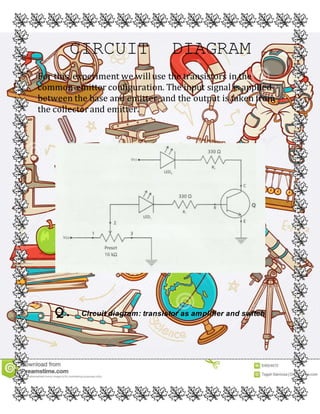
CIRCUIT DIAGRAM
For this, experiment we willuse the transistors in the
common-emitter configuration. The input signal is applied
between the base and emitter, and the output is taken from
the collectorand emitter.
Q. Circuit diagram: transistor as amplifier and switch
CIRCUIT EXPLANATION
1. In this circuit two same-colored LEDs are used
so that the effect of amplification can be clearly
seen.
2. The emitter of the transistor is grounded.
3. A preset (10 kΩ) is used in the circuit. It is used
as a voltage divider to apply different voltages at the
base. To use preset as a voltage divider, either of the
side terminals is given Vcc and the other ground.
4. The middle terminal of the preset is connected in
series with the positive terminal of LED1. The
negative terminal of LED1 is connected in series
with a resistor R1 (330 Ω). The other end of the
resistor is connected to the base of the transistor.
5. One end of resistor, R2 (330 Ω) is connected to
the collector. The other end of the corresponding
resistor is connected to the negative terminal of
LED2.
6. The positive terminal of LED2 is connected to
Vcc.
PROCEDURE
1. Make the circuit diagram (on breadboard, if possible).
2. Make all connections neat, cleanand tight.
3. Now, set a particular input voltage (VI) using the preset,
and measure it. Also, measure the voltages at the base
(VB) and collector(VC) and compare them.
4. Measure the base current (IB) and the collectorcurrent
(IC) and verify the amplificationfactor.
5. Now, rotate the preset to a position, where both the LEDs
glow brightly. At this position, measure the input voltage
(VI) at the middle terminal of the preset. Also, measure
the voltages at the base (VB) and collector(VC) and
compare them.
6. Again, measure the base current (VB) and the collector
(VC) current and verify the amplificationfactor.
OBSERVATION
1. For thefirstreading :-
 Q.VI = 3.02 V
Q.VB = 0.63 V
Q.VC = 6.36 V
Q.IB = 9 μA
Q.IC = 3.22 mA = 3220 Μa
2. For the second reading :-
Q.VI = 8.29 V
Q.VB = 0.89 V
Q.VC = 0.03 V
Q.IB = 12.27 mA
Q.IC = 15.98 mA
Calcula
tion
1. For the first reading :-
Q. Current Gain, β = hfe= IC /IB =3220 / 9 ≅ 358
Q.Voltage Gain, A = VO / VI = 6.36 / 3.02 ≅ 2.1
Q.Power Gain, P = β * A = 358 * 2 = 716
2. For the second reading :-
Q. Current Gain, β = hfe= IC / IB = 15.98 / 12.27 =
1.3
Q. Voltage Gain, A = VO / VI = 0.03 / 8.29 ≅ 3.6 X 10-
3
Q.Power Gain, P = β * A = 1.3 * 3.6 X 10-3 = 359
Conclusion
Q. For the first readings, VB is less than the collector
voltage VC. Since the base voltage is less than the
collector voltage, we can say that the base ‐ collector
junction is reverse biased. This is a necessary
condition for the transistor to be in the active region. The
value of β (hFE) for this transistor should be between
100 ‐ 400. The calculated value, 358, lies in this range.
This means that the transistor is in the active region.
Q. So, in the active region, the transistor acts as an
amplifier as long as the base ‐ emitter junction is
forward biased and the base ‐ collector junction is
reverse biased.
Q. Now, for the second reading, on comparing the
base
and the collector voltages, we can see that the base
voltage VB is more than the collector voltage VC. Since
the base voltage is more than the collector voltage, we
can say that the base ‐ collector junction is forward
biased. This is a necessary condition for the transistor
to be in the saturation region. Also, the collector voltage
is close to zero volt (ground).
Q. The value of β (hFE), 1.3, is less than the ideal gain
(100) of a transistor. This means, the transistor does
not act as an amplifier in this case, it acts like a
switch. In the saturation region, the collector - emitter
voltage VCE is reduced to almost 0 V. We can see that
the value of the collector voltage with respect to the
emitter (ground) is 0.03 V. The collector and emitter
act as two terminals of the switch, which get nearly
shorted.
RESULT
Q. In the active region, the transistor acts as an amplifier
as long as the base ‐ emitter junction is forward biased
and the base ‐ collector junction is reverse biased.
Q. A transistor gets saturated when its base ‐ emitter
junction and base ‐ collectorjunction are forward
biased. In saturation, the potential difference
between the emitter and the collectoris
approximatelyequal to zero volt. This voltage across
the collector ‐ emitter junction is called the
collector - emitter saturation voltage. The value of
the saturation region for the NPN transistor in my
project is around 0.25 ‐ 0.6 V.
PRECAUTION
1. All connections should be neat, clean and tight.
2. The input voltage should be increases gradually.
3. Don’t connect the terminals of the battery to each other.
SOURCES OF ERRORS
Q. The transistor may be faulty.
BIBLIOGRAPHY
Q. Guidance from Teacher
Q. NCERT Class 12 th Physics book
Q. Comprehensive Physics Practical Book
Q. www.cooljunk.in/physics-project-kit
Q. www.google.com

Arvind

  • 1.
  • 2.
    Certificate Certifiedthat theproject workentitled TransistorsasanAmplifierandSwitch carried out by Master ARVIND BAGHEL ,of class XII ‘A’ is a bonafidework in partial fulfilmentof AISSCEinthesubject computer science prescribed by the CentralBoard of Secondary Education, during theyear 2017-2018. It is certified that all corrections/suggestions indicated for Internal Assessment havebeen incorporated in theReport deposited in thedepartmental library. Theproject report has been approved as it satisfies theacademic requirements in respect of theProject work prescribed for thesaid examination. Mrs. PGT PHYSICS Principal signature
  • 3.
    AKNOWLEDGEMENT Through this acknowledgementwe express our sincere gratitude to all those people who have been associated with the project and have helped us with it and made it a worthwhile experience. We extend our thanks to Smt. Nutan Punj, the principal of this fine establishment KV DRDO for being pillar of support throughout the process. We would like to express our gratitude towards our parents our parents for their co-operations and encouragement which helped us in the completion of this project. We would also like to express our thanks to Smt. Monika
  • 4.
    Chakraborty, the headof physics department of KV DRDO who gave us this opportunity to learn the subject with a practical approach, guided us and gave us valuable suggestions regarding the project. INDEX INTODUCTION EXPERIMENT MATERIAL REQUIRED PHOTO OF THE CIRCUIT THEORY CIRCUIT DIAGRAM CIRCUIT EXPANATION PROCEDURE OBSERVATION CALCULATION
  • 5.
    CONCLUSION RESULT PRECAUTION SOURCES OF ERORRS BIBLIOGRAPHY INTRODUCTION Theinvention of the bipolar transistor in 1948 ushered in a revolution in electronics. Technical feats previously requiring relatively large, mechanically fragile, power-hungry vacuum tubes were suddenly achievable with tiny, mechanically rugged, power-thrifty specks of crystalline silicon. This revolution made possible the design and manufacture of lightweight, inexpensive electronic devices that we now take for granted. Understanding how transistors function is of paramount importance to anyone interested in understanding modern electronics. A bipolar transistor consists of a three-layer “sandwich” of doped (extrinsic) semiconductor materials, either P-N-P in Figure below (b) or N-P-N at (d). Each layer forming the transistor has a specific name, and each layer is provided with a wire contact for connection to a circuit. The schematic symbols are shown in Figure below (a) and (d).
  • 6.
    Q. BJT transistor (a)PNP schematic symbol , (b) layout , (c) NPN symbol , (d) layout The functional difference between a PNP transistor and an NPN transistor is the proper biasing (polarity) of the junctions when operating. For any given state of operation, the current directions and voltage polarities for each kind of transistor are exactly opposite each other. Bipolar transistors work as current-controlled current regulators. In other words, transistors restrict the amount of current passed according to a smaller, controlling current. The main current that is controlled goes from collector to emitter, or from emitter to collector, depending on the type of transistor it is (PNP or NPN, respectively). The small current that controls the main current goes from base to emitter, or from emitter to base, once again depending on the kind of transistor it is (PNP or NPN, respectively). According to the standards of semiconductor symbology, the arrow always points against the direction of electron flow. (Figure below)
  • 7.
    Q.Small Base-Emitter currentcontrols large Collector-Emitter current flowing against emitter arrow.
  • 8.
    Bipolar transistors arecalled bipolar because the main flow of electrons through them takes place in two types of semiconductor material: P and N, as the main current goes from emitter to collector (or vice versa). In other words, two types of charge carriers— electrons and holes—comprise this main current through the transistor. As you can see, the controlling current and the controlled current always mesh together through the emitter wire, and their electrons always flow against the direction of the transistor’s arrow. This is the first and foremost rule in the use of transistors: all currents must be going in the proper directions for the device to work as a current regulator. The small, controlling current is usually referred to simply as the base current because it is the only current that goes through the base wire of the transistor. Conversely, the large, controlled current is referred to as the collector current because it is the only current that goes through the collector wire. The emitter current is the sum of the base and collector currents, in compliance with Kirchhoff’s Current Law. No current through the base of the transistor, shuts it off like an open switch and prevents current through the collector. A base current, turns the transistor on like a closed switch and allows a proportional amount of current through the collector. Collector current is primarily limited by the base current, regardless of the amount of voltage available to push it. The next section will explore in more detail the use of bipolar transistors as switching elements.
  • 9.
    EXPERIMENT Transistor as Amplifierand Switch Materials Required 1. Breadboard 2. Transistor:BC547(NPN) 3. Preset : 10 k ohm 4.LED 5. Resistor: 330 ohm ColourCode: 330ohm – Orange OrangeBrownGold 6. 9V Battery 7.Connection wirePieces 8.Multimeter
  • 10.
  • 11.
    THEORY In common emittercircuit of a transistor, emitter base make input section and is forward biased and emitter collector junction make output section and is reverse biased. The variation in the output voltage w.r.t. the variationin input voltage for a transistor are shown in figure. The amount of amplificationis decided by the β (beta) of the transistor. 𝛽 = ℎ𝑓𝑒 = 𝐼 𝐶 /𝐼 𝐵 Where, IC is the collectorcurrent. IB is the base current. β is an intrinsic property of the transistor. Different transistors have different betas.
  • 12.
    CIRCUIT DIAGRAM For this,experiment we willuse the transistors in the common-emitter configuration. The input signal is applied between the base and emitter, and the output is taken from the collectorand emitter. Q. Circuit diagram: transistor as amplifier and switch
  • 13.
    CIRCUIT EXPLANATION 1. Inthis circuit two same-colored LEDs are used so that the effect of amplification can be clearly seen. 2. The emitter of the transistor is grounded. 3. A preset (10 kΩ) is used in the circuit. It is used as a voltage divider to apply different voltages at the base. To use preset as a voltage divider, either of the side terminals is given Vcc and the other ground. 4. The middle terminal of the preset is connected in series with the positive terminal of LED1. The negative terminal of LED1 is connected in series with a resistor R1 (330 Ω). The other end of the resistor is connected to the base of the transistor. 5. One end of resistor, R2 (330 Ω) is connected to the collector. The other end of the corresponding resistor is connected to the negative terminal of LED2. 6. The positive terminal of LED2 is connected to Vcc.
  • 14.
    PROCEDURE 1. Make thecircuit diagram (on breadboard, if possible). 2. Make all connections neat, cleanand tight. 3. Now, set a particular input voltage (VI) using the preset, and measure it. Also, measure the voltages at the base (VB) and collector(VC) and compare them. 4. Measure the base current (IB) and the collectorcurrent (IC) and verify the amplificationfactor. 5. Now, rotate the preset to a position, where both the LEDs glow brightly. At this position, measure the input voltage (VI) at the middle terminal of the preset. Also, measure the voltages at the base (VB) and collector(VC) and compare them. 6. Again, measure the base current (VB) and the collector (VC) current and verify the amplificationfactor.
  • 15.
    OBSERVATION 1. For thefirstreading:-  Q.VI = 3.02 V Q.VB = 0.63 V Q.VC = 6.36 V Q.IB = 9 μA Q.IC = 3.22 mA = 3220 Μa 2. For the second reading :- Q.VI = 8.29 V Q.VB = 0.89 V Q.VC = 0.03 V Q.IB = 12.27 mA Q.IC = 15.98 mA
  • 16.
    Calcula tion 1. For thefirst reading :- Q. Current Gain, β = hfe= IC /IB =3220 / 9 ≅ 358 Q.Voltage Gain, A = VO / VI = 6.36 / 3.02 ≅ 2.1 Q.Power Gain, P = β * A = 358 * 2 = 716
  • 17.
    2. For thesecond reading :- Q. Current Gain, β = hfe= IC / IB = 15.98 / 12.27 = 1.3 Q. Voltage Gain, A = VO / VI = 0.03 / 8.29 ≅ 3.6 X 10- 3 Q.Power Gain, P = β * A = 1.3 * 3.6 X 10-3 = 359
  • 18.
    Conclusion Q. For thefirst readings, VB is less than the collector voltage VC. Since the base voltage is less than the collector voltage, we can say that the base ‐ collector junction is reverse biased. This is a necessary condition for the transistor to be in the active region. The value of β (hFE) for this transistor should be between 100 ‐ 400. The calculated value, 358, lies in this range. This means that the transistor is in the active region. Q. So, in the active region, the transistor acts as an amplifier as long as the base ‐ emitter junction is forward biased and the base ‐ collector junction is reverse biased. Q. Now, for the second reading, on comparing the base and the collector voltages, we can see that the base voltage VB is more than the collector voltage VC. Since the base voltage is more than the collector voltage, we can say that the base ‐ collector junction is forward biased. This is a necessary condition for the transistor to be in the saturation region. Also, the collector voltage is close to zero volt (ground).
  • 19.
    Q. The valueof β (hFE), 1.3, is less than the ideal gain (100) of a transistor. This means, the transistor does not act as an amplifier in this case, it acts like a switch. In the saturation region, the collector - emitter voltage VCE is reduced to almost 0 V. We can see that the value of the collector voltage with respect to the emitter (ground) is 0.03 V. The collector and emitter act as two terminals of the switch, which get nearly shorted.
  • 20.
    RESULT Q. In theactive region, the transistor acts as an amplifier as long as the base ‐ emitter junction is forward biased and the base ‐ collector junction is reverse biased. Q. A transistor gets saturated when its base ‐ emitter junction and base ‐ collectorjunction are forward biased. In saturation, the potential difference between the emitter and the collectoris approximatelyequal to zero volt. This voltage across the collector ‐ emitter junction is called the collector - emitter saturation voltage. The value of the saturation region for the NPN transistor in my project is around 0.25 ‐ 0.6 V.
  • 21.
    PRECAUTION 1. All connectionsshould be neat, clean and tight. 2. The input voltage should be increases gradually. 3. Don’t connect the terminals of the battery to each other. SOURCES OF ERRORS Q. The transistor may be faulty. BIBLIOGRAPHY Q. Guidance from Teacher Q. NCERT Class 12 th Physics book Q. Comprehensive Physics Practical Book Q. www.cooljunk.in/physics-project-kit Q. www.google.com