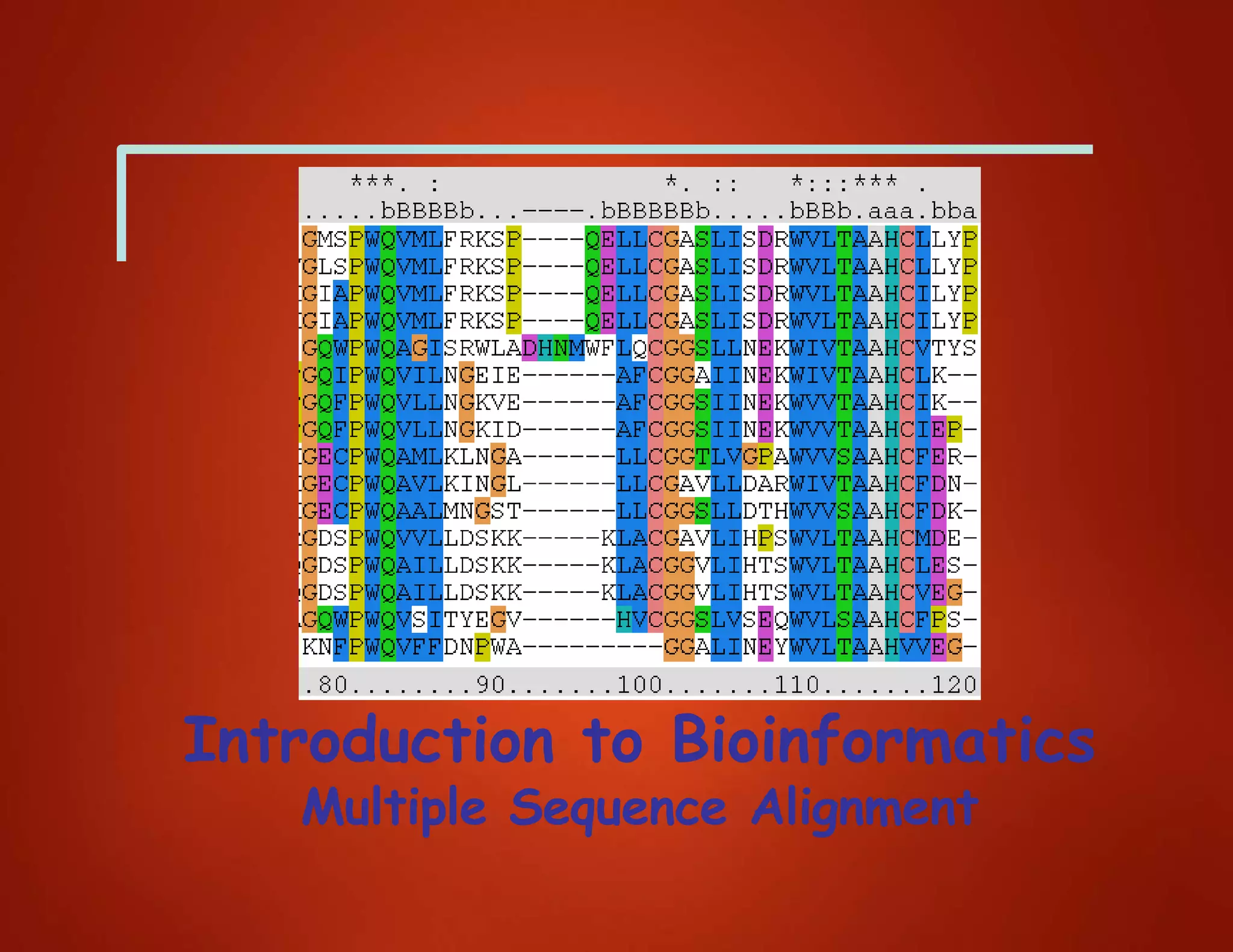
Introduction to Bioinformatics
Multiple Sequence Alignment
Why Multiple Sequence Alignment?
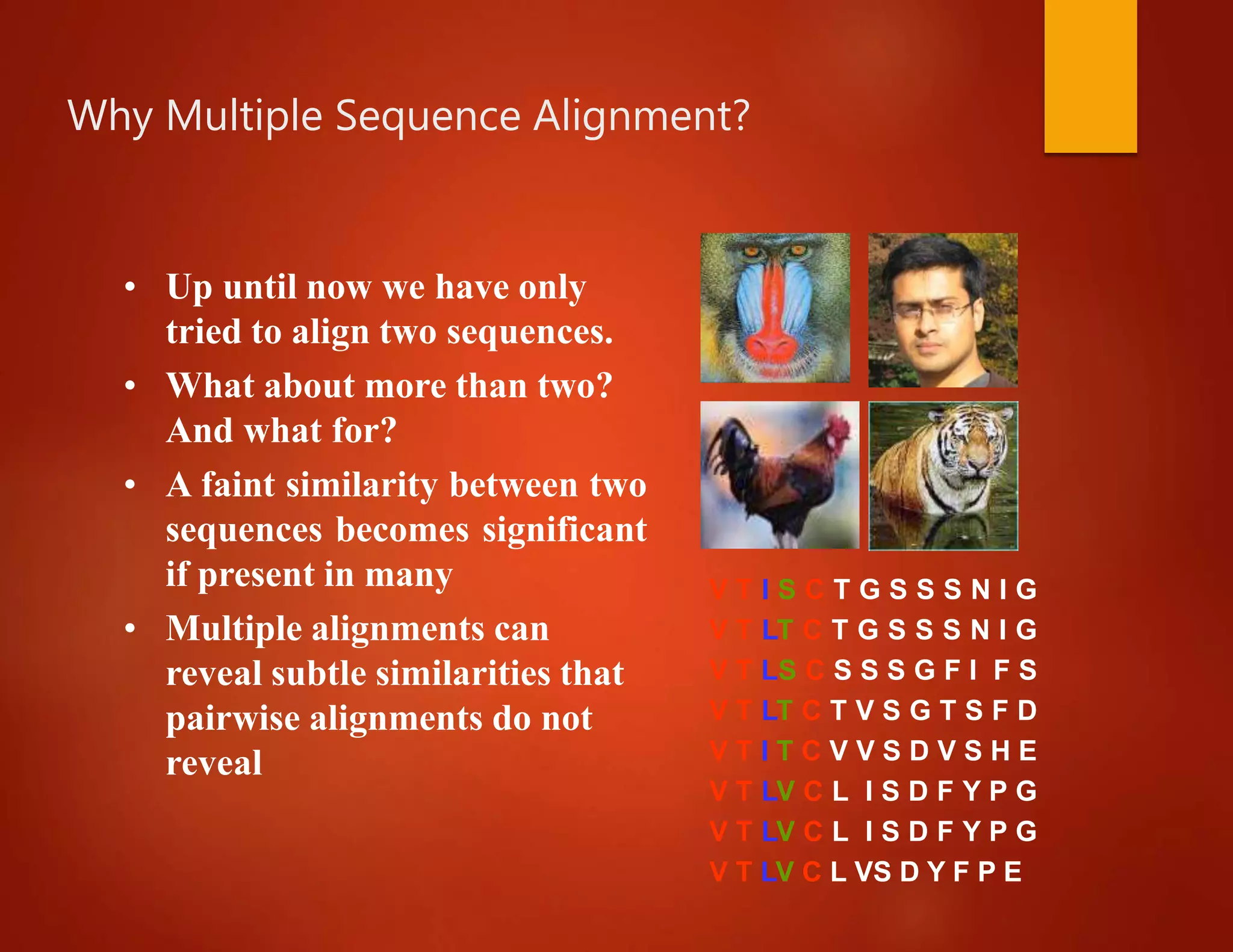
• Up until now we have only
tried to align two sequences.
• What about more than two?
And what for?
• A faint similarity between two
sequences becomes significant
if present in many
• Multiple alignments can
reveal subtle similarities that
pairwise alignments do not
reveal
V T I S C T G S S S N I G
V T LT C T G S S S N I G
V T LS C S S S G F I F S
V T LT C T V S G T S F D
V T I T C V V S D V S H E
V T LV C L I S D F Y P G
V T LV C L VS D Y F P E
Multiple Sequence Alignment
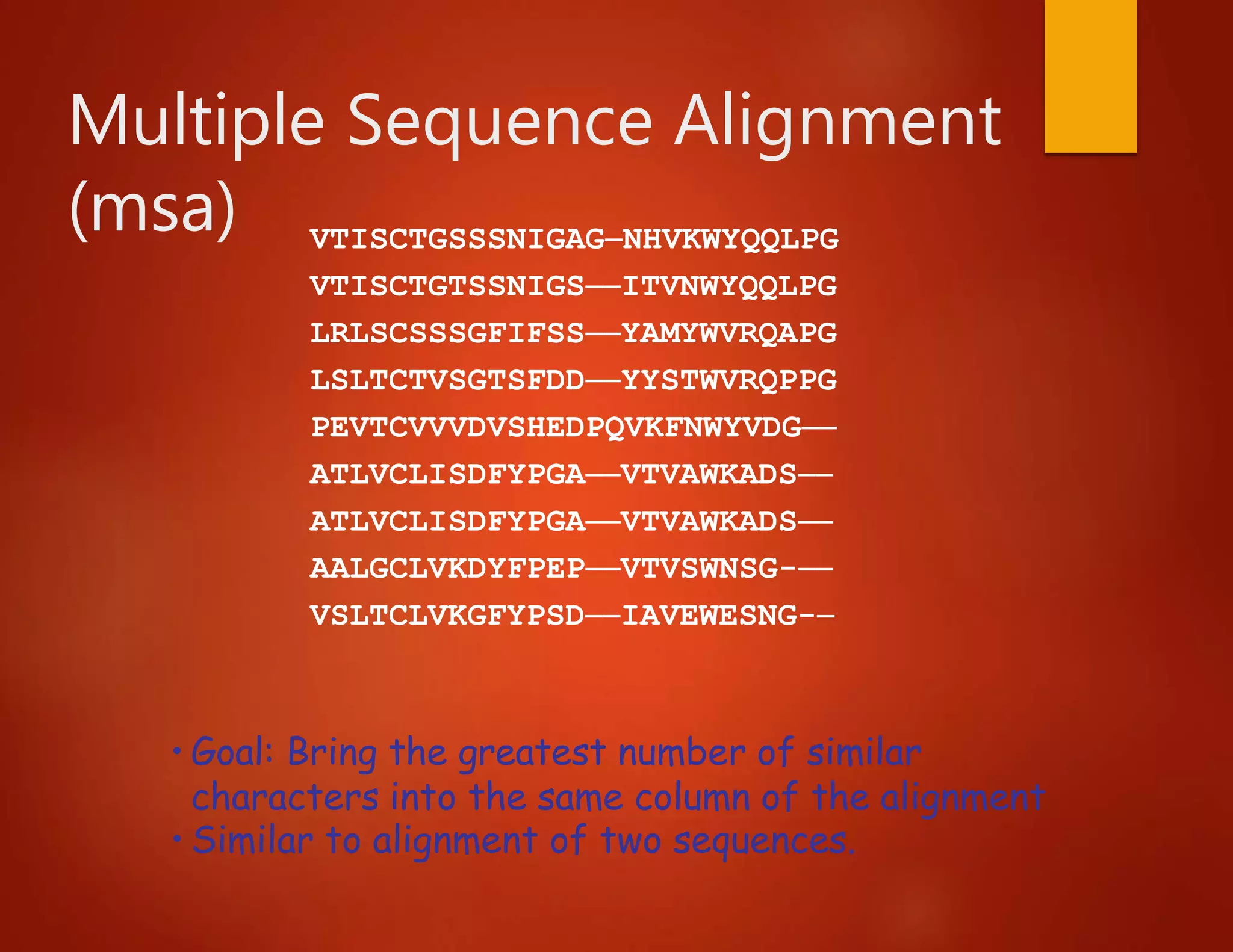
(msa) VTISCTGSSSNIGAGNHVKWYQQLPG
VTISCTGTSSNIGSITVNWYQQLPG
LRLSCSSSGFIFSSYAMYWVRQAPG
LSLTCTVSGTSFDDYYSTWVRQPPG
PEVTCVVVDVSHEDPQVKFNWYVDG
ATLVCLISDFYPGAVTVAWKADS
AALGCLVKDYFPEPVTVSWNSG-
VSLTCLVKGFYPSDIAVEWESNG-
• Goal: Bring the greatest number of similar
characters into the same column of the alignment
• Similar to alignment of two sequences.
Multiple Sequence Alignment: Motivation
• Correspondence. Find out which parts “do the same thing”
– Similar genes are conserved across widely divergent species,
often performing similar functions
• Structure prediction
– Use knowledge of structure of one or more members of a
protein MSA to predict structure of other members
– Structure is more conserved than sequence
• Create “profiles” for protein families
– Allow us to search for other members of the family
• Genome assembly: Automated reconstruction of “contig”
maps of genomic fragments such as ESTs
• msa is the starting point for phylogenetic analysis
• msa often allows to detect weakly conserved regions which
pairwise alignment can’t
Multiple Sequence Alignment: Approaches
• Optimal Global Alignments -
– Generalization of Dynamic programming
– Find alignment that maximizes a score function
– Computationally expensive: Time grows as product
of sequence lengths
• Global Progressive Alignments - Match closely-
related sequences first using a guide tree
• Global Iterative Alignments - Multiple re-building
attempts to find best alignment
• Local alignments
– Profile analysis,
– Block analysis
– Patterns searching and/or Statistical methods
Global msa: Challenges
• Computationally Expensive
– If msa includes matches, mismatches and gaps and also
accounts the degree of variation then global msa can be
applied to only a few sequences
• Difficult to score
– Multiple comparison necessary in each column of the msa for
a cumulative score
– Placement of gaps and scoring of substitution is more difficult
• Difficulty increases with diversity
– Relatively easy for a set of closely related sequences
– Identifying the correct ancestry relationships for a set of
distantly related sequences is more challenging
– Even difficult if some members are more alike compared
to others
Global msa: Dynamic
Programming
• The two-sequence alignment algorithm (Needleman-
Wunsch) can be generalized to any number of
sequences.
• E.g., for three sequences X, Y, W
define C[i,j,k] = score of optimum
alignment
 among X[1..i], Y[1..j], W[1..k]
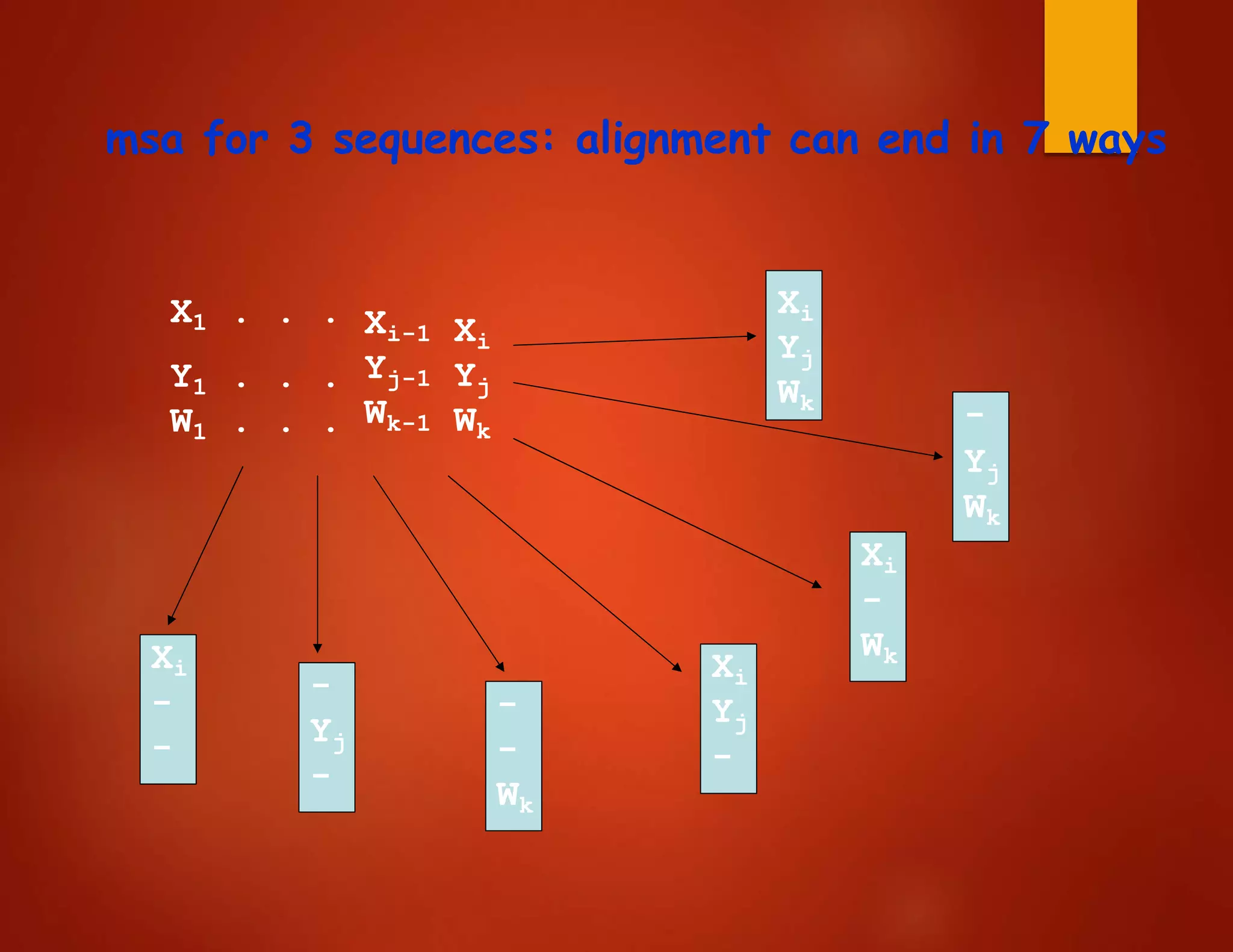
• As for two sequences, divide possible alignments into
different classes, depending on how they end.
– Devise recurrence relations for C[i,j,k]
– C[i,j,k] is the maximum out of all possibilities
Xi
Yj
Wk
msa for 3 sequences: alignment can end in 7 ways
Xi-1
Yj-1
Wk-1
Xi
Yj
Wk
-
Yj
Wk
Xi
-
Wk
Xi
Yj
-
-
-
Wk
-
Yj
-
Xi
-
-
X1 . . .
Y1 . . .
W1 . . .
Aligning Three Sequences
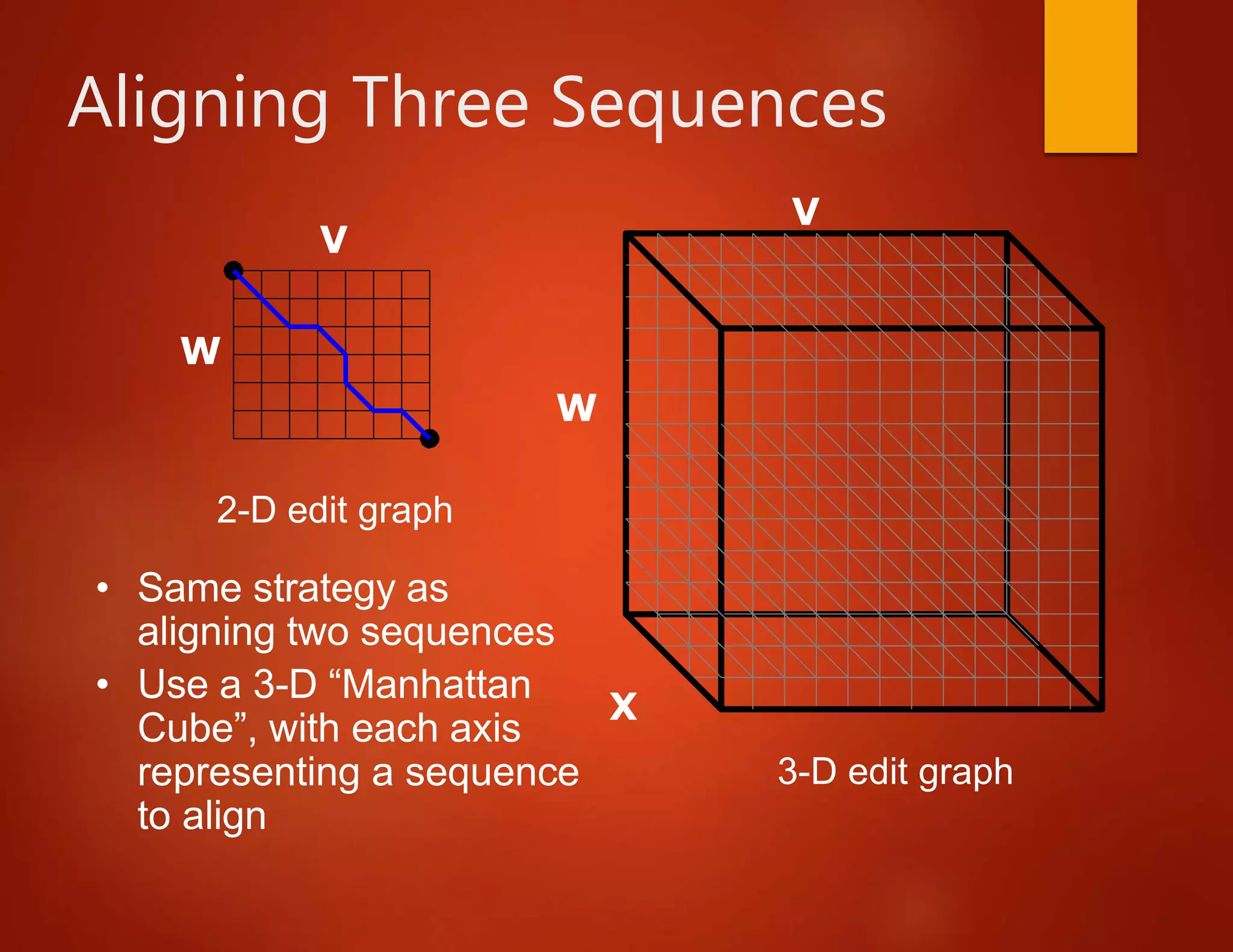
• Same strategy as
aligning two sequences
• Use a 3-D “Manhattan
Cube”, with each axis
representing a sequence
to align
V
W
2-D edit graph
3-D edit graph
V
W
X
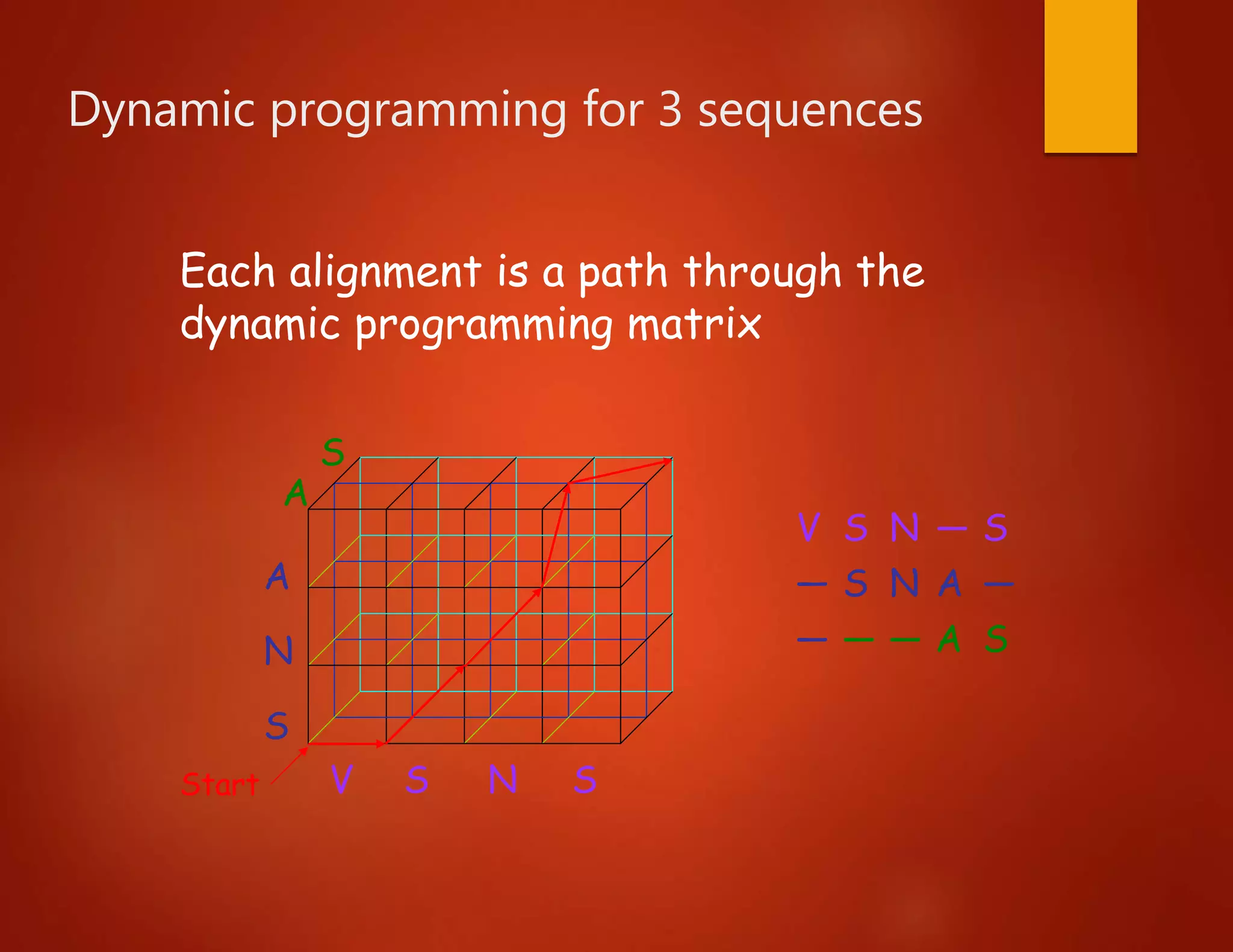
Dynamic programming for 3 sequences
V S N — S
— S N A —
— — — A S
V S N S
A
N
S
Each alignment is a path through the
dynamic programming matrix
S
A
Start
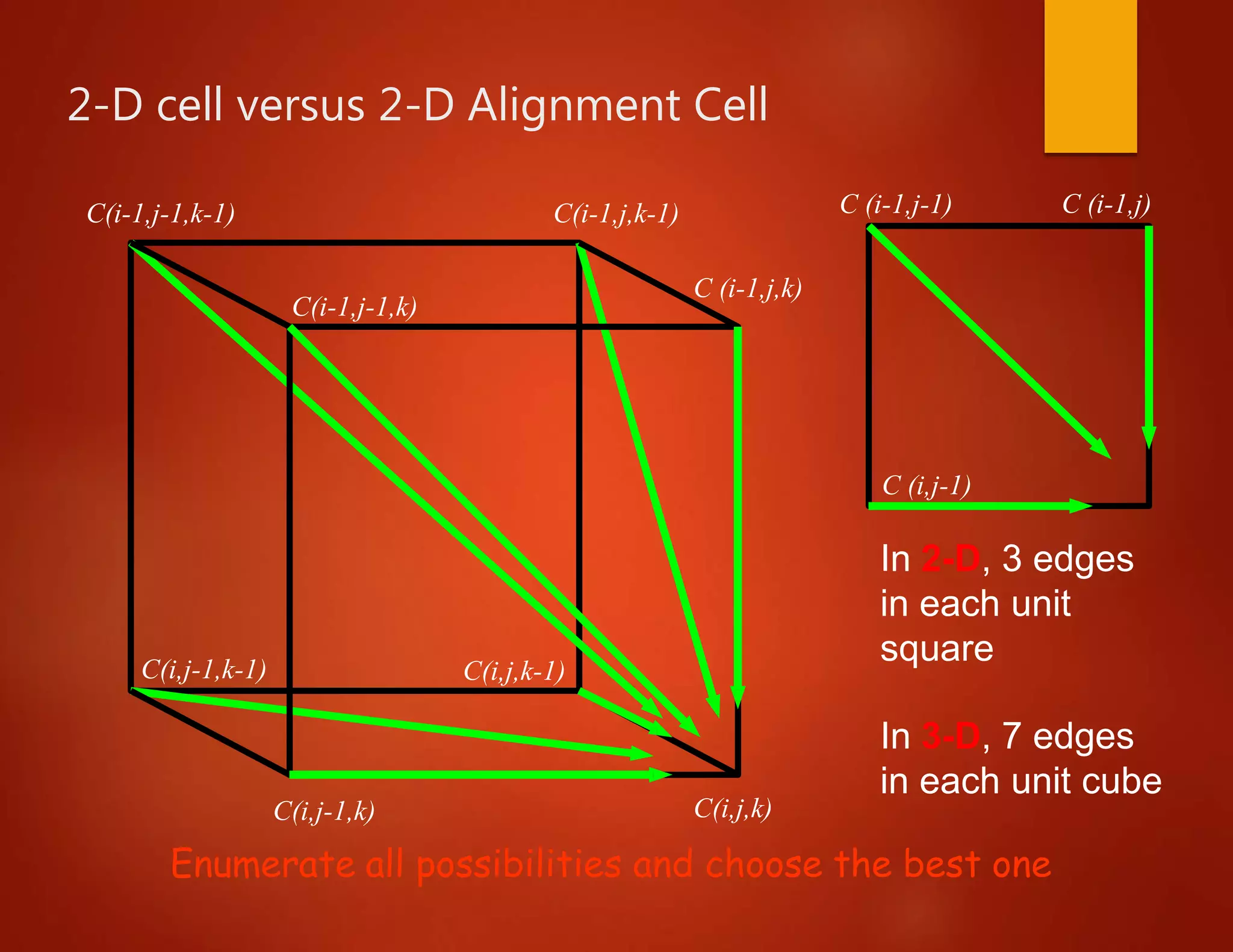
2-D cell versus 2-D Alignment Cell
In 3-D, 7 edges
in each unit cube
In 2-D, 3 edges
in each unit
square
C(i-1,j-1,k-1) C(i-1,j,k-1)
C(i,j-1,k)
C(i-1,j-1,k)
C (i-1,j,k)
C(i,j,k)
C(i,j,k-1)C(i,j-1,k-1)
Enumerate all possibilities and choose the best one
C (i-1,j-1) C (i-1,j)
C (i,j-1)
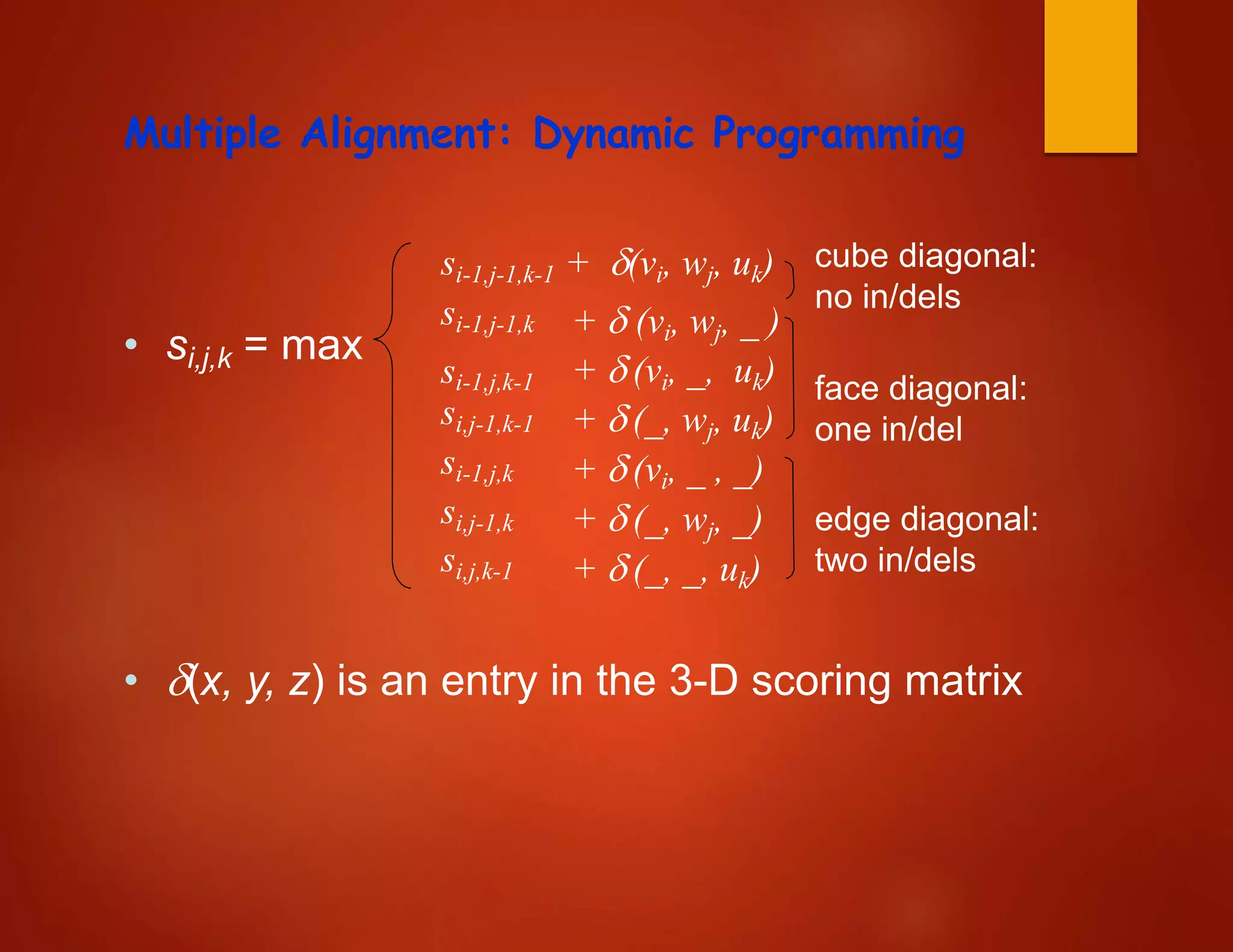
Multiple Alignment: Dynamic Programming
• si,j,k = max
• (x, y, z) is an entry in the 3-D scoring matrix
si-1,j-1,k-1 + (vi, wj, uk)
si-1,j-1,k +  (vi, wj, _ )
si-1,j,k-1 +  (v , _, u )i k
si,j-1,k-1
si-1,j,k
si,j-1,k
si,j,k-1
+  (_, wj, uk)
+  (vi, _ , _)
+  (_, wj, _)
+  (_, _, uk)
cube diagonal:
no in/dels
face diagonal:
one in/del
edge diagonal:
two in/dels
• Reading Materials
– Chapter 5: Bioinformatics Sequence and Genome
analysis – David W. Mount
• 2nd Edition: Page 170~194
• 1st Edition: Page 140~165
– Cédric Notredame, Desmond G. Higgins and Jaap Heringa “T-
coffee: a novel method for fast and accurate multiple
sequence alignment”, Journal of Molecular Biology, Volume
302, Issue 1, 8 September 2000, Pages 205-217
– Christopher Lee, Catherine Grasso and Mark F. Sharlow,
“Multiple sequence alignment using partial order graphs”
Bioinformatics Vol. 18 no. 3 2002, Pages 452-464
– Cédric Notredame and Desmond G. Higgins “SAGA: sequence
alignment by genetic algorithm”, Nucleic Acids Res. 1996 Apr
15;24(8):1515-24.

Bioinformatics lesson

  • 1.
  • 2.
    Why Multiple SequenceAlignment? • Up until now we have only tried to align two sequences. • What about more than two? And what for? • A faint similarity between two sequences becomes significant if present in many • Multiple alignments can reveal subtle similarities that pairwise alignments do not reveal V T I S C T G S S S N I G V T LT C T G S S S N I G V T LS C S S S G F I F S V T LT C T V S G T S F D V T I T C V V S D V S H E V T LV C L I S D F Y P G V T LV C L I S D F Y P G V T LV C L VS D Y F P E
  • 3.
    Multiple Sequence Alignment (msa)VTISCTGSSSNIGAGNHVKWYQQLPG VTISCTGTSSNIGSITVNWYQQLPG LRLSCSSSGFIFSSYAMYWVRQAPG LSLTCTVSGTSFDDYYSTWVRQPPG PEVTCVVVDVSHEDPQVKFNWYVDG ATLVCLISDFYPGAVTVAWKADS ATLVCLISDFYPGAVTVAWKADS AALGCLVKDYFPEPVTVSWNSG- VSLTCLVKGFYPSDIAVEWESNG- • Goal: Bring the greatest number of similar characters into the same column of the alignment • Similar to alignment of two sequences.
  • 4.
    Multiple Sequence Alignment:Motivation • Correspondence. Find out which parts “do the same thing” – Similar genes are conserved across widely divergent species, often performing similar functions • Structure prediction – Use knowledge of structure of one or more members of a protein MSA to predict structure of other members – Structure is more conserved than sequence • Create “profiles” for protein families – Allow us to search for other members of the family • Genome assembly: Automated reconstruction of “contig” maps of genomic fragments such as ESTs • msa is the starting point for phylogenetic analysis • msa often allows to detect weakly conserved regions which pairwise alignment can’t
  • 5.
    Multiple Sequence Alignment:Approaches • Optimal Global Alignments - – Generalization of Dynamic programming – Find alignment that maximizes a score function – Computationally expensive: Time grows as product of sequence lengths • Global Progressive Alignments - Match closely- related sequences first using a guide tree • Global Iterative Alignments - Multiple re-building attempts to find best alignment • Local alignments – Profile analysis, – Block analysis – Patterns searching and/or Statistical methods
  • 6.
    Global msa: Challenges •Computationally Expensive – If msa includes matches, mismatches and gaps and also accounts the degree of variation then global msa can be applied to only a few sequences • Difficult to score – Multiple comparison necessary in each column of the msa for a cumulative score – Placement of gaps and scoring of substitution is more difficult • Difficulty increases with diversity – Relatively easy for a set of closely related sequences – Identifying the correct ancestry relationships for a set of distantly related sequences is more challenging – Even difficult if some members are more alike compared to others
  • 7.
    Global msa: Dynamic Programming •The two-sequence alignment algorithm (Needleman- Wunsch) can be generalized to any number of sequences. • E.g., for three sequences X, Y, W define C[i,j,k] = score of optimum alignment  among X[1..i], Y[1..j], W[1..k] • As for two sequences, divide possible alignments into different classes, depending on how they end. – Devise recurrence relations for C[i,j,k] – C[i,j,k] is the maximum out of all possibilities
  • 8.
    Xi Yj Wk msa for 3sequences: alignment can end in 7 ways Xi-1 Yj-1 Wk-1 Xi Yj Wk - Yj Wk Xi - Wk Xi Yj - - - Wk - Yj - Xi - - X1 . . . Y1 . . . W1 . . .
  • 9.
    Aligning Three Sequences •Same strategy as aligning two sequences • Use a 3-D “Manhattan Cube”, with each axis representing a sequence to align V W 2-D edit graph 3-D edit graph V W X
  • 10.
    Dynamic programming for3 sequences V S N — S — S N A — — — — A S V S N S A N S Each alignment is a path through the dynamic programming matrix S A Start
  • 11.
    2-D cell versus2-D Alignment Cell In 3-D, 7 edges in each unit cube In 2-D, 3 edges in each unit square C(i-1,j-1,k-1) C(i-1,j,k-1) C(i,j-1,k) C(i-1,j-1,k) C (i-1,j,k) C(i,j,k) C(i,j,k-1)C(i,j-1,k-1) Enumerate all possibilities and choose the best one C (i-1,j-1) C (i-1,j) C (i,j-1)
  • 12.
    Multiple Alignment: DynamicProgramming • si,j,k = max • (x, y, z) is an entry in the 3-D scoring matrix si-1,j-1,k-1 + (vi, wj, uk) si-1,j-1,k +  (vi, wj, _ ) si-1,j,k-1 +  (v , _, u )i k si,j-1,k-1 si-1,j,k si,j-1,k si,j,k-1 +  (_, wj, uk) +  (vi, _ , _) +  (_, wj, _) +  (_, _, uk) cube diagonal: no in/dels face diagonal: one in/del edge diagonal: two in/dels
  • 13.
    • Reading Materials –Chapter 5: Bioinformatics Sequence and Genome analysis – David W. Mount • 2nd Edition: Page 170~194 • 1st Edition: Page 140~165 – Cédric Notredame, Desmond G. Higgins and Jaap Heringa “T- coffee: a novel method for fast and accurate multiple sequence alignment”, Journal of Molecular Biology, Volume 302, Issue 1, 8 September 2000, Pages 205-217 – Christopher Lee, Catherine Grasso and Mark F. Sharlow, “Multiple sequence alignment using partial order graphs” Bioinformatics Vol. 18 no. 3 2002, Pages 452-464 – Cédric Notredame and Desmond G. Higgins “SAGA: sequence alignment by genetic algorithm”, Nucleic Acids Res. 1996 Apr 15;24(8):1515-24.