AMZAD KHAN
INTRODUCTION: DIODE
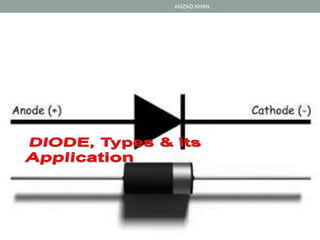
• The diode is the simplest and most fundamental non-
linear circuit element.
• Like a resistor,, its has two terminals
• Unlike a resistor, it has a non-linear current voltage
characteristics.
• Its uses in rectifiers is the most common application.
AMZAD KHAN
Physical structure of Diode
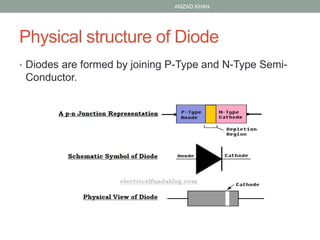
• Diodes are formed by joining P-Type and N-Type Semi-
Conductor.
AMZAD KHAN
• Diode is an electric device which allow current to flow only
in one direction
• The voltage applied to the semi conductor diode is
referred to as bias voltage.
• There are two types of bias voltage-
• Forward Biased.
• Reversed Biased.
AMZAD KHAN
Forward Biased
• +ve terminal of battery connected with p-type
• - ve terminal of battery connected with n-type
• Maximum current flow through the diode during forward
biasing.
• The D.R is small in forward biased p-n junction.
AMZAD KHAN
Reversed biased
• + ve terminal of battery connected with n-type
• - ve terminal of battery connected with p- type
• Extremely small current flow through the diode during
revers biasing.
• The D.R is large in forward biased p- n junction.
AMZAD KHAN
Types of diode
• P-N Junction Diode
• LED Diode
• Photo Diode
• Zener Diode
AMZAD KHAN
1. A diode (one way value) is a PN Junction with p-type on
one side and n-type on the other. When a positive
voltage is applied to the p-type side (forward bias), it
shrinks and overcomes the depletion zone, causing the
current to flow from the p-type to the n-type side.
2. A Light- emitting diode (LED) are made of two- lead
semiconductor light source. It is a p-n junction diode,,
which emits light when activate.
3. A Photodiode is a semiconductor device that converts
light into current. A small amount of current is also
produced when no light is present.
4. A Zener Diode is diode which allows current to flow in
the forward direction in the same manner as an ideal
diode, but also permits it to flow in the reverse direction
when the voltage is above a certain value known as
the breakdown voltage.
AMZAD KHAN
Application of diode Circuit
• Rectifier Circuit
• Half-wave rectifier
• Full- wave rectifier
• Bridge rectifier
AMZAD KHAN
Rectifier
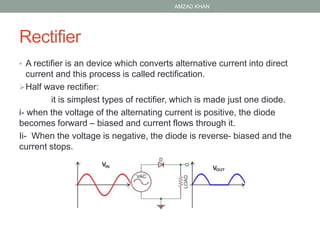
• A rectifier is an device which converts alternative current into direct
current and this process is called rectification.
Half wave rectifier:
it is simplest types of rectifier, which is made just one diode.
i- when the voltage of the alternating current is positive, the diode
becomes forward – biased and current flows through it.
Ii- When the voltage is negative, the diode is reverse- biased and the
current stops.
AMZAD KHAN
Full wave rectifier:
This rectifier is essentially made of two half- wave rectifiers
and can be made with two diodes.
i. When the voltage of the alternating current is positive
one of the diodes become forward biased whereas the
other gets reverse biased. Hence, current flows through
the forward biased diode.
ii. When the voltage of the alternating current is negative
one of the diodes become forward biased whereas the
other gets reverse biased. Hence, current flows through
the forward biased diode.
iii. Thus, current flows at least through one of the diodes at
a time.
AMZAD KHAN
Full Wave Diagram
AMZAD KHAN
Bridge Rectifier
A bridge rectifier is an arrangement of four or mode diodes
in bridge circuit configuration which provides the same
output polarity for either input polarity. It is used for
converting an alternating current (AC) input into a direct
current (DC) output.
1. The main advantage of the bridge circuit is that it does
not require a special center tapped transformer, thereby
reducing its size and cost.
2. The single secondary winding is connected to one side
of the diode bridge network and the load to the other
side as shown below.
AMZAD KHAN
AMZAD KHAN

Topic 5 diode

  • 1.
  • 2.
    INTRODUCTION: DIODE • Thediode is the simplest and most fundamental non- linear circuit element. • Like a resistor,, its has two terminals • Unlike a resistor, it has a non-linear current voltage characteristics. • Its uses in rectifiers is the most common application. AMZAD KHAN
  • 3.
    Physical structure ofDiode • Diodes are formed by joining P-Type and N-Type Semi- Conductor. AMZAD KHAN
  • 4.
    • Diode isan electric device which allow current to flow only in one direction • The voltage applied to the semi conductor diode is referred to as bias voltage. • There are two types of bias voltage- • Forward Biased. • Reversed Biased. AMZAD KHAN
  • 5.
    Forward Biased • +veterminal of battery connected with p-type • - ve terminal of battery connected with n-type • Maximum current flow through the diode during forward biasing. • The D.R is small in forward biased p-n junction. AMZAD KHAN
  • 6.
    Reversed biased • +ve terminal of battery connected with n-type • - ve terminal of battery connected with p- type • Extremely small current flow through the diode during revers biasing. • The D.R is large in forward biased p- n junction. AMZAD KHAN
  • 7.
    Types of diode •P-N Junction Diode • LED Diode • Photo Diode • Zener Diode AMZAD KHAN
  • 8.
    1. A diode(one way value) is a PN Junction with p-type on one side and n-type on the other. When a positive voltage is applied to the p-type side (forward bias), it shrinks and overcomes the depletion zone, causing the current to flow from the p-type to the n-type side. 2. A Light- emitting diode (LED) are made of two- lead semiconductor light source. It is a p-n junction diode,, which emits light when activate. 3. A Photodiode is a semiconductor device that converts light into current. A small amount of current is also produced when no light is present. 4. A Zener Diode is diode which allows current to flow in the forward direction in the same manner as an ideal diode, but also permits it to flow in the reverse direction when the voltage is above a certain value known as the breakdown voltage. AMZAD KHAN
  • 9.
    Application of diodeCircuit • Rectifier Circuit • Half-wave rectifier • Full- wave rectifier • Bridge rectifier AMZAD KHAN
  • 10.
    Rectifier • A rectifieris an device which converts alternative current into direct current and this process is called rectification. Half wave rectifier: it is simplest types of rectifier, which is made just one diode. i- when the voltage of the alternating current is positive, the diode becomes forward – biased and current flows through it. Ii- When the voltage is negative, the diode is reverse- biased and the current stops. AMZAD KHAN
  • 11.
    Full wave rectifier: Thisrectifier is essentially made of two half- wave rectifiers and can be made with two diodes. i. When the voltage of the alternating current is positive one of the diodes become forward biased whereas the other gets reverse biased. Hence, current flows through the forward biased diode. ii. When the voltage of the alternating current is negative one of the diodes become forward biased whereas the other gets reverse biased. Hence, current flows through the forward biased diode. iii. Thus, current flows at least through one of the diodes at a time. AMZAD KHAN
  • 12.
  • 13.
    Bridge Rectifier A bridgerectifier is an arrangement of four or mode diodes in bridge circuit configuration which provides the same output polarity for either input polarity. It is used for converting an alternating current (AC) input into a direct current (DC) output. 1. The main advantage of the bridge circuit is that it does not require a special center tapped transformer, thereby reducing its size and cost. 2. The single secondary winding is connected to one side of the diode bridge network and the load to the other side as shown below. AMZAD KHAN
  • 14.