Semiconductors and Diode
Applications
A Comprehensive Overview
Intrinsic/Extrinsic Semiconductors,
Diodes, and Applications
Outline
• • Introduction to Semiconductors
• • Intrinsic and Extrinsic Semiconductors
• • Energy Band Diagrams
• • PN Junction Diode and V-I Characteristics
• • Zener Diode and Breakdown
• • Light Emitting Diode (LED)
• • Diode Applications: Rectifiers
• • PIV, DC/RMS, Ripple Factor
• • Voltage Regulation using Zener Diode
Introduction to Semiconductors
• • Materials with conductivity between
conductors and insulators
• • Conductivity changes with temperature,
impurities, or light
• • Used in electronic devices for control and
amplification
Types of Semiconductors
• 1. Intrinsic Semiconductors
• 2. Extrinsic Semiconductors
Intrinsic Semiconductors
• • Pure semiconductor material (e.g., Silicon,
Germanium)
• • Equal number of electrons and holes
• • Conductivity depends on temperature
Extrinsic Semiconductors
• • Doped with impurities to improve
conductivity
• • Two types:
• – N-type: excess electrons
• – P-type: excess holes
N-type Semiconductor
• • Doped with pentavalent atoms (Phosphorus,
Arsenic)
• • Extra electron acts as majority carrier
• • Holes are minority carriers
P-type Semiconductor
• • Doped with trivalent atoms (Boron, Gallium)
• • Creates holes as majority carriers
• • Electrons are minority carriers
Energy Band Diagrams
• • Valence Band – filled with electrons
• • Conduction Band – free electrons move here
• • Forbidden Energy Gap separates them
• • Smaller gap → higher conductivity
PN Junction Diode
• • Formed by joining P-type and N-type
semiconductors
• • Depletion region forms at the junction
• • Allows current flow in one direction
V-I Characteristics of Diode
• • Forward Bias: current increases
exponentially after threshold
• • Reverse Bias: small leakage current
• • Breakdown occurs at high reverse voltage
Zener Diode
• • Specially designed to operate in reverse
breakdown region
• • Used for voltage regulation
Breakdown Mechanisms
• 1. Avalanche Breakdown – due to carrier
collision
• 2. Zener Breakdown – due to strong electric
field
Light Emitting Diode (LED)
• • Forward-biased diode emits light
• • Made from direct band-gap materials (e.g.,
GaAs, GaP)
• • Color depends on band gap energy
Diode Applications – Rectifiers
• • Convert AC to DC
• • Types:
• – Half-wave Rectifier
• – Full-wave Rectifier
• – Bridge Rectifier
Half-Wave Rectifier
• • Uses one diode
• • Conducts during one half cycle of AC
• • Simple but inefficient
Full-Wave Rectifier
• • Uses two diodes and center-tapped
transformer
• • Conducts during both halves of AC
• • Higher efficiency than half-wave
Bridge Rectifier
• • Uses four diodes in bridge configuration
• • Eliminates need for center-tapped
transformer
• • Provides full-wave rectification
PIV, DC & RMS Derivation
• • Peak Inverse Voltage (PIV): Maximum
reverse voltage diode can withstand
• • DC Output Voltage: Average value of
rectified output
• • RMS Value: Equivalent AC value
Ripple Factor
• • Measure of residual AC in output
• • Ripple Factor = Vrms / Vdc
• • Lower ripple → smoother DC
Voltage Regulation using Zener
Diode
• • Zener diode connected in reverse bias
• • Maintains constant output voltage
• • Acts as voltage regulator
C Filter and Ripple Reduction
• • Capacitor filter smooths pulsating DC
• • Capacitor charges during conduction and
discharges during non-conduction
• • Reduces ripple
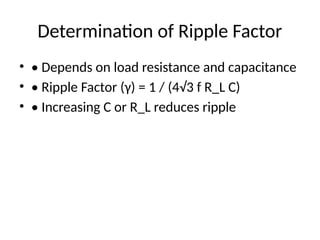
Determination of Ripple Factor
• • Depends on load resistance and capacitance
• • Ripple Factor (γ) = 1 / (4√3 f R_L C)
• • Increasing C or R_L reduces ripple
Summary
• • Semiconductors form base of modern
electronics
• • Diodes used for rectification, regulation, and
light emission
• • Proper design ensures efficiency and
stability
Applications
• • Power supplies
• • Voltage regulators
• • Signal processing
• • LEDs in displays and indicators

Semiconductors_and_Diode_Applications.pptx

  • 1.
    Semiconductors and Diode Applications AComprehensive Overview Intrinsic/Extrinsic Semiconductors, Diodes, and Applications
  • 2.
    Outline • • Introductionto Semiconductors • • Intrinsic and Extrinsic Semiconductors • • Energy Band Diagrams • • PN Junction Diode and V-I Characteristics • • Zener Diode and Breakdown • • Light Emitting Diode (LED) • • Diode Applications: Rectifiers • • PIV, DC/RMS, Ripple Factor • • Voltage Regulation using Zener Diode
  • 3.
    Introduction to Semiconductors •• Materials with conductivity between conductors and insulators • • Conductivity changes with temperature, impurities, or light • • Used in electronic devices for control and amplification
  • 4.
    Types of Semiconductors •1. Intrinsic Semiconductors • 2. Extrinsic Semiconductors
  • 5.
    Intrinsic Semiconductors • •Pure semiconductor material (e.g., Silicon, Germanium) • • Equal number of electrons and holes • • Conductivity depends on temperature
  • 6.
    Extrinsic Semiconductors • •Doped with impurities to improve conductivity • • Two types: • – N-type: excess electrons • – P-type: excess holes
  • 7.
    N-type Semiconductor • •Doped with pentavalent atoms (Phosphorus, Arsenic) • • Extra electron acts as majority carrier • • Holes are minority carriers
  • 8.
    P-type Semiconductor • •Doped with trivalent atoms (Boron, Gallium) • • Creates holes as majority carriers • • Electrons are minority carriers
  • 9.
    Energy Band Diagrams •• Valence Band – filled with electrons • • Conduction Band – free electrons move here • • Forbidden Energy Gap separates them • • Smaller gap → higher conductivity
  • 10.
    PN Junction Diode •• Formed by joining P-type and N-type semiconductors • • Depletion region forms at the junction • • Allows current flow in one direction
  • 11.
    V-I Characteristics ofDiode • • Forward Bias: current increases exponentially after threshold • • Reverse Bias: small leakage current • • Breakdown occurs at high reverse voltage
  • 12.
    Zener Diode • •Specially designed to operate in reverse breakdown region • • Used for voltage regulation
  • 13.
    Breakdown Mechanisms • 1.Avalanche Breakdown – due to carrier collision • 2. Zener Breakdown – due to strong electric field
  • 14.
    Light Emitting Diode(LED) • • Forward-biased diode emits light • • Made from direct band-gap materials (e.g., GaAs, GaP) • • Color depends on band gap energy
  • 15.
    Diode Applications –Rectifiers • • Convert AC to DC • • Types: • – Half-wave Rectifier • – Full-wave Rectifier • – Bridge Rectifier
  • 16.
    Half-Wave Rectifier • •Uses one diode • • Conducts during one half cycle of AC • • Simple but inefficient
  • 17.
    Full-Wave Rectifier • •Uses two diodes and center-tapped transformer • • Conducts during both halves of AC • • Higher efficiency than half-wave
  • 18.
    Bridge Rectifier • •Uses four diodes in bridge configuration • • Eliminates need for center-tapped transformer • • Provides full-wave rectification
  • 19.
    PIV, DC &RMS Derivation • • Peak Inverse Voltage (PIV): Maximum reverse voltage diode can withstand • • DC Output Voltage: Average value of rectified output • • RMS Value: Equivalent AC value
  • 20.
    Ripple Factor • •Measure of residual AC in output • • Ripple Factor = Vrms / Vdc • • Lower ripple → smoother DC
  • 21.
    Voltage Regulation usingZener Diode • • Zener diode connected in reverse bias • • Maintains constant output voltage • • Acts as voltage regulator
  • 22.
    C Filter andRipple Reduction • • Capacitor filter smooths pulsating DC • • Capacitor charges during conduction and discharges during non-conduction • • Reduces ripple
  • 23.
    Determination of RippleFactor • • Depends on load resistance and capacitance • • Ripple Factor (γ) = 1 / (4√3 f R_L C) • • Increasing C or R_L reduces ripple
  • 24.
    Summary • • Semiconductorsform base of modern electronics • • Diodes used for rectification, regulation, and light emission • • Proper design ensures efficiency and stability
  • 25.
    Applications • • Powersupplies • • Voltage regulators • • Signal processing • • LEDs in displays and indicators

Editor's Notes

  • #3 Semiconductors are the foundation of modern electronics — transistors, diodes, ICs are all based on semiconductor materials like silicon and germanium.
  • #5 Intrinsic semiconductors are free of impurities. At room temperature, few electrons jump from the valence band to the conduction band, creating holes.
  • #6 Adding impurities introduces free charge carriers, making semiconductors more conductive and controllable.
  • #9 Energy band diagrams help visualize how electrons transition from valence to conduction bands, determining material behavior.
  • #12 Zener diodes maintain a constant voltage across a load even when supply voltage or load current varies.