Mutations and Genetic
    Engineering
Mutations
• Types of mutations
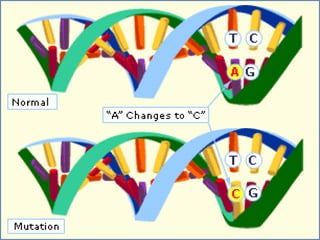
  – Point Mutations or Substitutions: causes
    the replacement of a single base nucleotide
    with another nucleotide

     • Missense- code for a different amino
       acid
     • Nonsense- code for a stop, which can
       shorten the protein
     • Silent- code for the same amino acid
       (AA)
Mutations
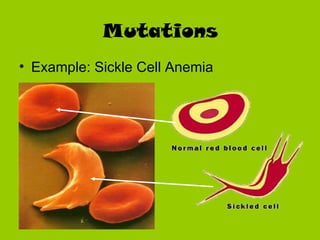
• Example: Sickle Cell Anemia
Mutations
• Types of mutations
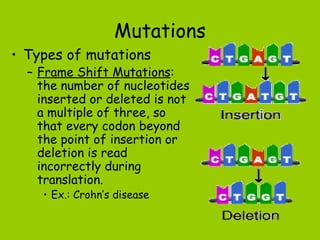
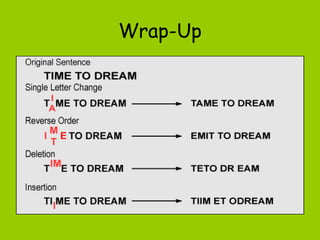
  – Frame Shift Mutations:
    the number of nucleotides
    inserted or deleted is not
    a multiple of three, so
    that every codon beyond
    the point of insertion or
    deletion is read
    incorrectly during
    translation.
    • Ex.: Crohn’s disease
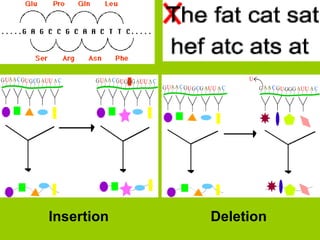
Insertion   Deletion
Mutations
• Types of mutations
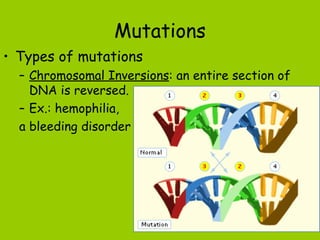
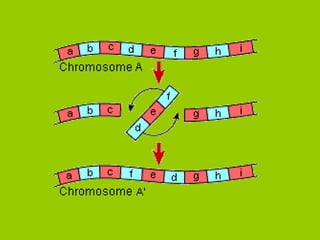
  – Chromosomal Inversions: an entire section of
    DNA is reversed.
  – Ex.: hemophilia,
  a bleeding disorder
Human Genome Project
•   The Human Genome Project is a
    collaborative effort of scientists around
    the world to map the entire gene sequence
    of organisms.


•   This information will be useful in
    detection, prevention, and treatment of
    many genetic diseases.
Wrap-Up
DNA Technologies
• DNA technologies allow
  scientists to identify,
  study, and modify
  genes.

• Forensic identification
  is an example of the
  application of DNA
  technology.
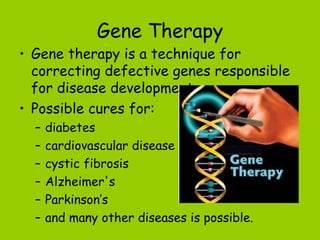
Gene Therapy
• Gene therapy is a technique for
  correcting defective genes responsible
  for disease development.
• Possible cures for:
  –   diabetes
  –   cardiovascular disease
  –   cystic fibrosis
  –   Alzheimer's
  –   Parkinson’s
  –   and many other diseases is possible.
Genetic Engineering
•   The human manipulation of the genetic
    material of a cell.
•   Recombinant DNA- Genetically
    engineered DNA prepared by splicing
    genes from one species into the cells
    of a different species. Such DNA
    becomes part of the host's genetic
    makeup and is replicated.
A Brief History of Genetic
            Engineering
• The name is new, the practice is not.
• Plants and animals have been bred for
  thousands of years.
• Human breeding has also been done now and
  then.
• All of this has worked by trying to enhance
  desired characteristics, without knowing how
  they are transmitted.
Prospects for
          Genetic Engineering
• Designing plants & animals “from scratch”
   – This is not going to happen anytime soon
• Transgenic Engineering
   – Putting genetic information from one type of plant or
     animal into another
• Cloning
   – Making genetic copies of an existing plant or animal
• Let’s look at the latter two of these.
Transgenic Organisms
• An organism is called “transgenic” if it has
  genetic information added to it from a
  different type of organism.
• Viruses do something of this sort when
  they infect plants, animals or humans.
• Humans have begun to do this with plants
  and animals.
• We are not yet making flying pigs!
Advantages of Transgenic
          Engineering
• Plants:
  – More disease-resistant
  – Larger yields
  – More transportable
  – More nutritious
• Animals:
  – Make proteins for medicinal purposes
  – Make organs for transplant to humans
Concerns about
      Transgenic Engineering
• Plants:
  – Are they safe to eat?
  – Will they harm wildlife?
  – Will some become super-pest weeds?
  – Replace or contaminate natural plants?
• Animals:
  – Will they be harmful?
  – Replace or contaminate natural animals?
Cloning
• A “clone” is a copy of something.
• Computers that mimic IBMs are called “clones.”
• In genetics, a clone is a genetic copy of another
  organism.
• Clones occur naturally:
  – Asexual breeding in plants & lower animals
  – Identical twins (triplets) in higher animals
A Brief History
                  of Cloning
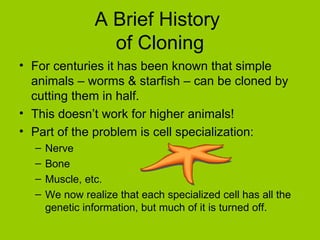
• For centuries it has been known that simple
  animals – worms & starfish – can be cloned by
  cutting them in half.
• This doesn’t work for higher animals!
• Part of the problem is cell specialization:
  –   Nerve
  –   Bone
  –   Muscle, etc.
  –   We now realize that each specialized cell has all the
      genetic information, but much of it is turned off.
Cloning in the
             20th Century
• We now realize that each specialized cell
  has all the genetic information, but much
  of it is turned off.
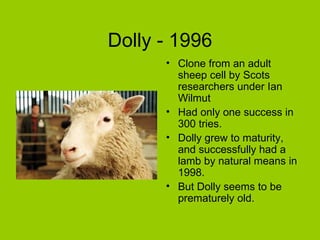
Dolly - 1996
      • Clone from an adult
        sheep cell by Scots
        researchers under Ian
        Wilmut
      • Had only one success in
        300 tries.
      • Dolly grew to maturity,
        and successfully had a
        lamb by natural means in
        1998.
      • But Dolly seems to be
        prematurely old.
Genetic Engineering
•   Genetic engineering techniques are used in
    a variety of industries, in agriculture, in
    basic research, and in medicine.

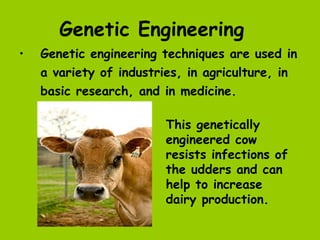
                         This genetically
                         engineered cow
                         resists infections of
                         the udders and can
                         help to increase
                         dairy production.
Genetic Engineering
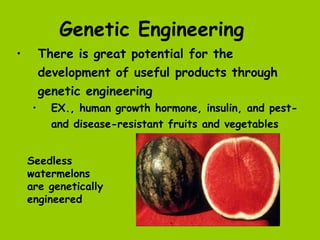
•        There is great potential for the
         development of useful products through
         genetic engineering
     •     EX., human growth hormone, insulin, and pest-
           and disease-resistant fruits and vegetables


    Seedless
    watermelons
    are genetically
    engineered
Genetic Engineering
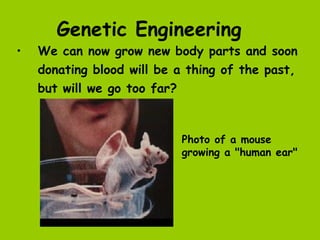
•   We can now grow new body parts and soon
    donating blood will be a thing of the past,
    but will we go too far?


                           Photo of a mouse
                           growing a "human ear"

Mutation powerpoint

  • 1.
  • 2.
    Mutations • Types ofmutations – Point Mutations or Substitutions: causes the replacement of a single base nucleotide with another nucleotide • Missense- code for a different amino acid • Nonsense- code for a stop, which can shorten the protein • Silent- code for the same amino acid (AA)
  • 4.
  • 5.
    Mutations • Types ofmutations – Frame Shift Mutations: the number of nucleotides inserted or deleted is not a multiple of three, so that every codon beyond the point of insertion or deletion is read incorrectly during translation. • Ex.: Crohn’s disease
  • 6.
    Insertion Deletion
  • 7.
    Mutations • Types ofmutations – Chromosomal Inversions: an entire section of DNA is reversed. – Ex.: hemophilia, a bleeding disorder
  • 9.
    Human Genome Project • The Human Genome Project is a collaborative effort of scientists around the world to map the entire gene sequence of organisms. • This information will be useful in detection, prevention, and treatment of many genetic diseases.
  • 10.
  • 11.
    DNA Technologies • DNAtechnologies allow scientists to identify, study, and modify genes. • Forensic identification is an example of the application of DNA technology.
  • 12.
    Gene Therapy • Genetherapy is a technique for correcting defective genes responsible for disease development. • Possible cures for: – diabetes – cardiovascular disease – cystic fibrosis – Alzheimer's – Parkinson’s – and many other diseases is possible.
  • 13.
    Genetic Engineering • The human manipulation of the genetic material of a cell. • Recombinant DNA- Genetically engineered DNA prepared by splicing genes from one species into the cells of a different species. Such DNA becomes part of the host's genetic makeup and is replicated.
  • 14.
    A Brief Historyof Genetic Engineering • The name is new, the practice is not. • Plants and animals have been bred for thousands of years. • Human breeding has also been done now and then. • All of this has worked by trying to enhance desired characteristics, without knowing how they are transmitted.
  • 15.
    Prospects for Genetic Engineering • Designing plants & animals “from scratch” – This is not going to happen anytime soon • Transgenic Engineering – Putting genetic information from one type of plant or animal into another • Cloning – Making genetic copies of an existing plant or animal • Let’s look at the latter two of these.
  • 16.
    Transgenic Organisms • Anorganism is called “transgenic” if it has genetic information added to it from a different type of organism. • Viruses do something of this sort when they infect plants, animals or humans. • Humans have begun to do this with plants and animals. • We are not yet making flying pigs!
  • 17.
    Advantages of Transgenic Engineering • Plants: – More disease-resistant – Larger yields – More transportable – More nutritious • Animals: – Make proteins for medicinal purposes – Make organs for transplant to humans
  • 18.
    Concerns about Transgenic Engineering • Plants: – Are they safe to eat? – Will they harm wildlife? – Will some become super-pest weeds? – Replace or contaminate natural plants? • Animals: – Will they be harmful? – Replace or contaminate natural animals?
  • 19.
    Cloning • A “clone”is a copy of something. • Computers that mimic IBMs are called “clones.” • In genetics, a clone is a genetic copy of another organism. • Clones occur naturally: – Asexual breeding in plants & lower animals – Identical twins (triplets) in higher animals
  • 20.
    A Brief History of Cloning • For centuries it has been known that simple animals – worms & starfish – can be cloned by cutting them in half. • This doesn’t work for higher animals! • Part of the problem is cell specialization: – Nerve – Bone – Muscle, etc. – We now realize that each specialized cell has all the genetic information, but much of it is turned off.
  • 21.
    Cloning in the 20th Century • We now realize that each specialized cell has all the genetic information, but much of it is turned off.
  • 22.
    Dolly - 1996 • Clone from an adult sheep cell by Scots researchers under Ian Wilmut • Had only one success in 300 tries. • Dolly grew to maturity, and successfully had a lamb by natural means in 1998. • But Dolly seems to be prematurely old.
  • 23.
    Genetic Engineering • Genetic engineering techniques are used in a variety of industries, in agriculture, in basic research, and in medicine. This genetically engineered cow resists infections of the udders and can help to increase dairy production.
  • 24.
    Genetic Engineering • There is great potential for the development of useful products through genetic engineering • EX., human growth hormone, insulin, and pest- and disease-resistant fruits and vegetables Seedless watermelons are genetically engineered
  • 25.
    Genetic Engineering • We can now grow new body parts and soon donating blood will be a thing of the past, but will we go too far? Photo of a mouse growing a "human ear"