GOVT. ARTS & SCIENCE COLLEGE
RATLAM
Topic : GENETIC ENGINEERING
Submitted to: Submitted by:
Ms Kanushri Ranawat Shivangi Soni
M.SC FINAL
BIOTECHNOLOGY
1
INDEX
• Introduction
• Steps involved in Genetic Engineering
• Tools used in Genetic Engineering
 Gene of interest (DNA insert)
 Restriction Enzymes
 Vector
 Host cell
• Gene transfer methods
• In vitro production of Insulin
• Transgenic plant
• Transgenic animal
• Application
2
HISTORY
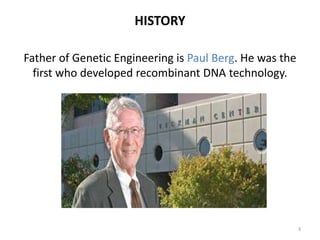
Father of Genetic Engineering is Paul Berg. He was the
first who developed recombinant DNA technology.
3
THE BEGINNING
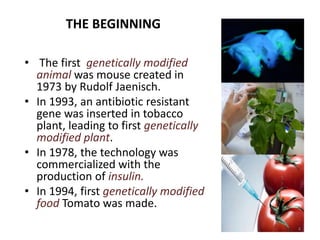
• The first genetically modified
animal was mouse created in
1973 by Rudolf Jaenisch.
• In 1993, an antibiotic resistant
gene was inserted in tobacco
plant, leading to first genetically
modified plant.
• In 1978, the technology was
commercialized with the
production of insulin.
• In 1994, first genetically modified
food Tomato was made.
4
DEFINATION
The change in genetic make up of living cells by
inserting desired gene through a vector in called
genetic engineering (GE).
5
TERMS
• Gene: The gene is small piece of DNA that
encodes for a specific protein.
• Recombinant DNA: The DNA formed by joining
DNA segment of two different organism.
• Recombinant DNA technology: The technique by
which gene of interest is transferred to the host.
• Genetically modified organism: The organism
whose genetic make up is altered/changed using
rDNA technology.
6
PROCEDURE
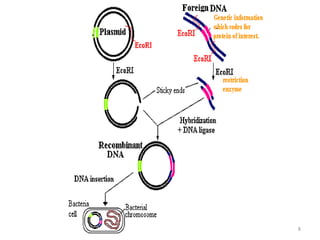
• Isolation of desired DNA fragment(gene of interest)
with the help of restriction enzymes.
• Isolation of DNA vector.
• Construction of rDNA. In this gene of interest is
inserted into the vector.
• Introduction of vector containing recombinant into
the host cell.
• Multiplication of Host cells containing recombinant
DNA.
• Expression of cloned gene.
• Selection of Recombinant cells.
7
8
Selection of transformed cell
9
TOOLS USED IN GENETIC ENGINEERING
1. Restriction Endonuclease(RE):
These are the enzyme which cleaves the DNA from
particular sequence.
The sequence from where it cleaves the DNA is called
as recognition sequence. Recognition site can be 4 to
8 bp long.
It breaks the nucleotide bond of base pair.
10
TYPES OF RESTRICTION ENDONUCLEASE
• Type I : Made up of three non-identical subunit.
Require ATP, mg2+ for activation. They cleave the
DNA 1000 bp away from the recognition.
• Type II : Require only mg2+. Made of two identical
subunit. Cleaves DNA from recognition site. These
are widely used enzyme. More than 300 enzyme are
discovered.
• Type III : Cleave 26 bp away from recognition site.
11
CLEAVAGE TYPE
Blunt end ->
Sticky end ->
12
EXAMPLE OF RESTRICTION ENDONUCLEASE
Restriction
endonuclease
Source(organism) Recognition
sequence
AluI Arthrobacter luteus AG/CT
TC/GA
BamHI Bacillus
amyloliquefaciens
G/GATCC
CCTAG/G
EcoRI Escherichia coli G/AATTC
CTTAA/G
HindII H. influenza A/AGCTT
TTCGA/A
TaqI Thermus aquaticus T/CGA
AGC/T
13
2) Gene library
The gene of interest (DNA fragment) is stored
in gene library. There are two gene library
available.
Genomic library : A collection clones contain
all DNA segments of the genome of an
organism is called Genomic library.
cDNA library : A collection of clones each of
which carries a cDNA of an organism is called
cDNA.
14
3) VECTOR
A vector is a DNA molecule that
has the ability to replicate
autonomously in an host cell and
into which the DNA fragment to
be cloned.
Any extra chromosomal small
genome/DNA, self replicating
e.G :- Plasmid(pBR322,
pUC18/19), Phage(λ phage,
phage M13), Cosmid, Phasmid,
BAC, YAC.
15
PROPERTIES OF GOOD VECTOR
• Should have origin of
replication.
• Should be less than
10kb in size.
• Easy to isolate and
purify.
• Easily introduced to
host cell.
• Should contain unique
target site for many RE.
16
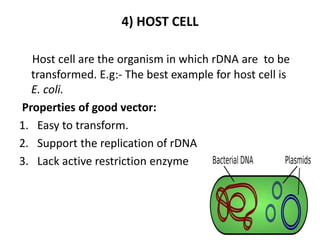
4) HOST CELL
Host cell are the organism in which rDNA are to be
transformed. E.g:- The best example for host cell is
E. coli.
Properties of good vector:
1. Easy to transform.
2. Support the replication of rDNA
3. Lack active restriction enzyme
17
GENE TRANSFER METHOD
The transfer of rDNA into a bacterial cell or plant cell
or animal cell is called gene transfer.
The host cell contain an rDNA is known as transformed
cell or recombinant.
The rDNA in cell replicates independently of the
chromosomal DNA of cell.
The desired foreign gene present in the rDNA express
its characters in host cell.
18
METHODS
In prokaryotes
• Transformation
• Transduction
• Electroporation
In eukaryotes
• Tranfection
• Electroporation
• Ultrasonication
• Bombardment
• Microinjection
19
In vitro PRODUCTION OF INSULIN
• Isolation of gene
responsible for insulin
production
• Isolation of plasmid
• Gene insertion in
plasmid
• Introduction of rDNA in
host
• Multiplication of
recombinant host cell.
20
TRANSGENIC PLANT
The plant that have been
genetically engineered.
They are :-
• Herbicide resistance
• Insect resistance
• Virus resistance
• Improved storage
• Altered flower color
• Environmental stress
resistance
• Improved nutritional
quality
21
E.g. BT COTTON
• Bt cotton is genetically
modified organism
(GMO)cotton variety, which
produce insecticide to
bollworm.
22
TRANSGENIC ANIMAL
Genetically manipulated
animal having an
introduced gene are
called transgenic
animal.
Transgenic mice, sheep,
cattle, goats, pigs,
poultry and fishes have
been developed by
using GE.
23
E.g. GLOFISH
The glow fish is a
genetically modified
fluorescent fish.
Done by
bioluminescence, which
are found in fireflies or
lightning bugs.
A enzyme called as
luciferase is taken from
firefly and is inserted in
fish which make them
to glow.
24
APPLICATION
• Agriculture
Improved crops
High yield
Resistant
High nutritional value
Long storage
• Medicine
Production of insulin and human growth hormone
• Animal husbandry
High milk production
High yield of wool
25
Thank you…
26

Genetic engineering

  • 1.
    GOVT. ARTS &SCIENCE COLLEGE RATLAM Topic : GENETIC ENGINEERING Submitted to: Submitted by: Ms Kanushri Ranawat Shivangi Soni M.SC FINAL BIOTECHNOLOGY 1
  • 2.
    INDEX • Introduction • Stepsinvolved in Genetic Engineering • Tools used in Genetic Engineering  Gene of interest (DNA insert)  Restriction Enzymes  Vector  Host cell • Gene transfer methods • In vitro production of Insulin • Transgenic plant • Transgenic animal • Application 2
  • 3.
    HISTORY Father of GeneticEngineering is Paul Berg. He was the first who developed recombinant DNA technology. 3
  • 4.
    THE BEGINNING • Thefirst genetically modified animal was mouse created in 1973 by Rudolf Jaenisch. • In 1993, an antibiotic resistant gene was inserted in tobacco plant, leading to first genetically modified plant. • In 1978, the technology was commercialized with the production of insulin. • In 1994, first genetically modified food Tomato was made. 4
  • 5.
    DEFINATION The change ingenetic make up of living cells by inserting desired gene through a vector in called genetic engineering (GE). 5
  • 6.
    TERMS • Gene: Thegene is small piece of DNA that encodes for a specific protein. • Recombinant DNA: The DNA formed by joining DNA segment of two different organism. • Recombinant DNA technology: The technique by which gene of interest is transferred to the host. • Genetically modified organism: The organism whose genetic make up is altered/changed using rDNA technology. 6
  • 7.
    PROCEDURE • Isolation ofdesired DNA fragment(gene of interest) with the help of restriction enzymes. • Isolation of DNA vector. • Construction of rDNA. In this gene of interest is inserted into the vector. • Introduction of vector containing recombinant into the host cell. • Multiplication of Host cells containing recombinant DNA. • Expression of cloned gene. • Selection of Recombinant cells. 7
  • 8.
  • 9.
  • 10.
    TOOLS USED INGENETIC ENGINEERING 1. Restriction Endonuclease(RE): These are the enzyme which cleaves the DNA from particular sequence. The sequence from where it cleaves the DNA is called as recognition sequence. Recognition site can be 4 to 8 bp long. It breaks the nucleotide bond of base pair. 10
  • 11.
    TYPES OF RESTRICTIONENDONUCLEASE • Type I : Made up of three non-identical subunit. Require ATP, mg2+ for activation. They cleave the DNA 1000 bp away from the recognition. • Type II : Require only mg2+. Made of two identical subunit. Cleaves DNA from recognition site. These are widely used enzyme. More than 300 enzyme are discovered. • Type III : Cleave 26 bp away from recognition site. 11
  • 12.
    CLEAVAGE TYPE Blunt end-> Sticky end -> 12
  • 13.
    EXAMPLE OF RESTRICTIONENDONUCLEASE Restriction endonuclease Source(organism) Recognition sequence AluI Arthrobacter luteus AG/CT TC/GA BamHI Bacillus amyloliquefaciens G/GATCC CCTAG/G EcoRI Escherichia coli G/AATTC CTTAA/G HindII H. influenza A/AGCTT TTCGA/A TaqI Thermus aquaticus T/CGA AGC/T 13
  • 14.
    2) Gene library Thegene of interest (DNA fragment) is stored in gene library. There are two gene library available. Genomic library : A collection clones contain all DNA segments of the genome of an organism is called Genomic library. cDNA library : A collection of clones each of which carries a cDNA of an organism is called cDNA. 14
  • 15.
    3) VECTOR A vectoris a DNA molecule that has the ability to replicate autonomously in an host cell and into which the DNA fragment to be cloned. Any extra chromosomal small genome/DNA, self replicating e.G :- Plasmid(pBR322, pUC18/19), Phage(λ phage, phage M13), Cosmid, Phasmid, BAC, YAC. 15
  • 16.
    PROPERTIES OF GOODVECTOR • Should have origin of replication. • Should be less than 10kb in size. • Easy to isolate and purify. • Easily introduced to host cell. • Should contain unique target site for many RE. 16
  • 17.
    4) HOST CELL Hostcell are the organism in which rDNA are to be transformed. E.g:- The best example for host cell is E. coli. Properties of good vector: 1. Easy to transform. 2. Support the replication of rDNA 3. Lack active restriction enzyme 17
  • 18.
    GENE TRANSFER METHOD Thetransfer of rDNA into a bacterial cell or plant cell or animal cell is called gene transfer. The host cell contain an rDNA is known as transformed cell or recombinant. The rDNA in cell replicates independently of the chromosomal DNA of cell. The desired foreign gene present in the rDNA express its characters in host cell. 18
  • 19.
    METHODS In prokaryotes • Transformation •Transduction • Electroporation In eukaryotes • Tranfection • Electroporation • Ultrasonication • Bombardment • Microinjection 19
  • 20.
    In vitro PRODUCTIONOF INSULIN • Isolation of gene responsible for insulin production • Isolation of plasmid • Gene insertion in plasmid • Introduction of rDNA in host • Multiplication of recombinant host cell. 20
  • 21.
    TRANSGENIC PLANT The plantthat have been genetically engineered. They are :- • Herbicide resistance • Insect resistance • Virus resistance • Improved storage • Altered flower color • Environmental stress resistance • Improved nutritional quality 21
  • 22.
    E.g. BT COTTON •Bt cotton is genetically modified organism (GMO)cotton variety, which produce insecticide to bollworm. 22
  • 23.
    TRANSGENIC ANIMAL Genetically manipulated animalhaving an introduced gene are called transgenic animal. Transgenic mice, sheep, cattle, goats, pigs, poultry and fishes have been developed by using GE. 23
  • 24.
    E.g. GLOFISH The glowfish is a genetically modified fluorescent fish. Done by bioluminescence, which are found in fireflies or lightning bugs. A enzyme called as luciferase is taken from firefly and is inserted in fish which make them to glow. 24
  • 25.
    APPLICATION • Agriculture Improved crops Highyield Resistant High nutritional value Long storage • Medicine Production of insulin and human growth hormone • Animal husbandry High milk production High yield of wool 25
  • 26.