Benchmark 4 Review Notes

       Honors Biology
Scientific Method Review

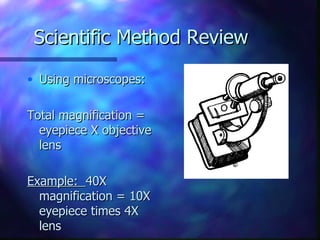
• Using microscopes:

Total magnification =
  eyepiece X objective
  lens

Example: 40X
  magnification = 10X
  eyepiece times 4X
  lens
Scientific Method Review
           (con’t.)
Independent Variable:   Dependent Variable:

• Always graphed on     • Always graphed on
  the X-axis              the Y-axis

• What “I” set up in    • What I measure as
  an experiment           the experiment
                          progresses
Scientific Method (con’t.)

• Positive Exponents:   • Negative Exponents

Positive exponents add Negative exponents
  zeros to the end of a  add zeroes to the
  number, making the     FRONT of a number,
  number larger than     making the number
  10                     smaller than 1

Example: 102 = 100 Example: 10-2 =
                     0.01
Scientific Method Review
           (con’t.)
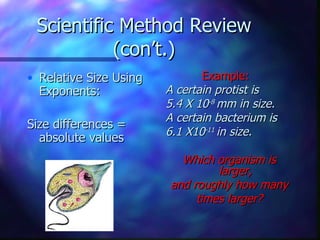
• Relative Size Using          Example:
  Exponents:            A certain protist is
                        5.4 X 10⁻⁸ mm in size.
                        A certain bacterium is
Size differences =
                        6.1 X10⁻¹¹ in size.
  absolute values
                          Which organism is
                                 larger,
                        and roughly how many
                             times larger?
Biomolecules Review

 Organic Molecules:
                        Inorganic Molecules:
 • Contain carbon (C)
   in their structure
                        • DO NOT contain
                          carbon (C) in their
 • Examples include       structure
   nucleic acids,
   proteins, lipids,
                        • Examples include
   carbohydrates, and
                          minerals and water
   vitamins
Quick Facts: Carbohydrates

• Quick source of        • The mitochondria
                           breaks glucose in to
  energy                   ATP during cellular
                           respiration
• Built from
  monosaccharides        • Because glucose is
                           soluble in polar water
• Glucose, made            molecules, it is moved
                           from our digestive
  during                   system to cells via the
  photosynthesis, is a     circulatory system
  carbohydrate
Quick Facts: Lipids

• Used in animals and
  humans to store energy • Waxes waterproof
  long-term                feathers and leaves.
                           This prevents plant
                           cells from bursting due
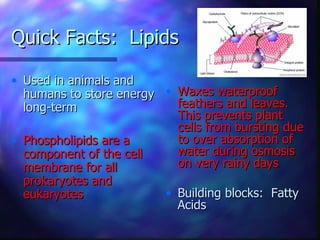
• Phospholipids are a      to over absorption of
  component of the cell    water during osmosis
  membrane for all         on very rainy days
  prokaryotes and
  eukaryotes             • Building blocks: Fatty
                           Acids
Quick Facts: Nucleic Acids
                           • RNA bases:
                                A—U
• Built from nucleotides        G—C

• Two types: DNA and       • DNA is double-stranded
  RNA                        and held in the nucleus
                             of eukaryotes
• DNA bases:
    A—T                    • RNA is single-stranded
    C—G
Quick Facts: Proteins
                       • Enzymes, catalysts of
                         chemical reactions,
                         are one type of
• Assembled by linking   protein
  amino acids at the
  ribosomes             • Enzymes typically end
                          in –ase. Each type of
• Physical result of      enzyme has its own
  gene reading and        optimum temperature
  assembly (DNA—          and pH range in
                          which it works best.
  mRNA—protein)
Quick Facts: Vitamins and Minerals

 • Important Vitamins    • Important Minerals

 C – Wound healing       Calcium – strong
 D – strong bones and      bones
   teeth                 Potassium – Muscle
 K – Muscle regulation     regulation
                         Iron – Oxygen
                           transport in blood
                           via the circulatory
                           system
Cell Structure and Function
                              • Eukaryotes
• Prokaryotes
                              DO have a TRUE nucleus
Have NO nucleus or nuclear      surrounded by a nuclear
  membrane                      membrane

  Possess cell membranes,       Have many complex
  DNA, ribosomes,               organelles to help perform
  cytoplasm and a cell wall     complex functions for
  like structure called a       multicellular life
  capsule
                              Examples: Plant and animal
Example: Bacteria               cells
Producers: Sources of Energy
• Autotrophs (producers) perform both cellular respiration
  and photosynthesis

• Plants use their chloroplasts to photosynthesize
• Chemosynthesis: Performed by archaebacteria to create
  glucose and oxygen from carbon dioxide and inorganic
  compounds

• Equation for photosynthesis:
Sunlight + carbon dioxide + water  glucose (sugar)
  + oxygen
Harnessing Sources of Energy
• Heterotrophs must consume glucose
  because they cannot make it within their
  bodies

• Cellular respiration refines glucose in to ATP for
  cellular functions in heterotrophs and autotrophs

 • Cellular Respiration Equation:
 Glucose + Oxygen  ATP + Carbon Dioxide + Water
             (Happens in the mitochondria)
Homeostasis
 Many processes we studied this year help maintain body
                         balance

• KIDNEYS and the EXCRETORY SYSTEM help
  remove wastes created in the cells

• OSMOSIS and DIFFUSION regulate the
  movement of important nutrients and water into
  the cells

• MITOCHONDRIA create the needed ATP for
  cellular functions and muscle firing
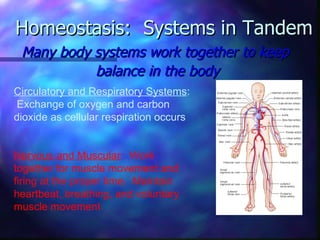
Homeostasis: Systems in Tandem
 Many body systems work together to keep
           balance in the body
Circulatory and Respiratory Systems:
 Exchange of oxygen and carbon
dioxide as cellular respiration occurs


Nervous and Muscular: Work
together for muscle movement and
firing at the proper time. Maintain
heartbeat, breathing, and voluntary
muscle movement
Active and Passive Transport
                            PASSIVE TRANSPORT
 ACTIVE TRANSPORT            does not require ATP
      requires ATP         • Substance move from
• Substances move from       high concentration to
  low concentration to       low concentration (with
  high concentration         the gradient)
  (against the gradient)
                           • Ex: Osmosis and
• Ex: sodium potassium       diffusion
  pump/ion pumps
Asexual Reproduction

• Creates clones

• Major types:
  • Vegetative – used by plants
  • Binary Fission – used by bacteria
  • Budding – Used by sponges and
    hydra
  • Fragmentation – used by starfish
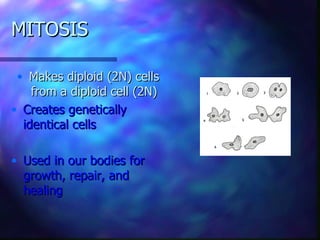
MITOSIS

 • Makes diploid (2N) cells
    from a diploid cell (2N)
• Creates genetically
  identical cells

• Used in our bodies for
  growth, repair, and
  healing
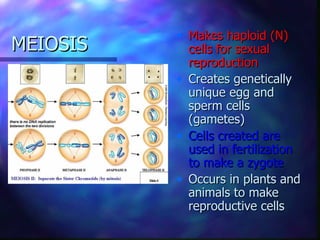
• Makes haploid (N)
MEIOSIS     cells for sexual
            reproduction
          • Creates genetically
            unique egg and
            sperm cells
            (gametes)
          • Cells created are
            used in fertilization
            to make a zygote
          • Occurs in plants and
            animals to make
            reproductive cells
Application Questions
•   One species of Amazonian frog has 124
    chromosomes in each cell. How many
    chromosomes are in its egg cells?

•   A bacterial cell in the Amazon reproduces
    by binary fission. The bacterium contains
    20 chromosomes. How many are in its
    offspring?
Genetics: Major Vocabulary
•   Homozygous dominant: DD
•   Homozygous recessive: dd
•   Heterozygous: Dd

• Genotype: Genetic makeup of an organism – use
  Punnett Squares to predict for offspring
• Phenotype: Physical characteristics of an organism
  – Pedigrees always mark phenotypes for a given
  family
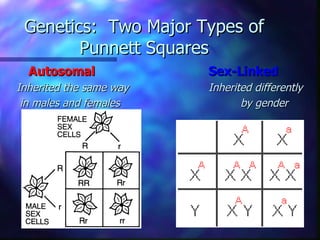
Genetics: Two Major Types of
        Punnett Squares
  Autosomal              Sex-Linked
Inherited the same way   Inherited differently
 in males and females           by gender
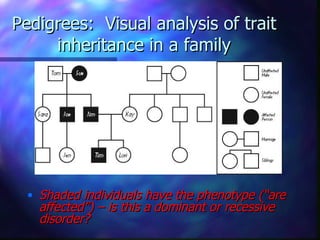
Pedigrees: Visual analysis of trait
     inheritance in a family


  • Shaded individuals have the phenotype (“are
    affected”) – is this a dominant or recessive
    disorder?
Genetic Applications
• Gene splicing:              • Gel electrophoresis:
Used to create insulin and    Used to compare band
other medicines for           patterns in DNA of
humans. Inserts a             organisms.
human gene into
bacterial cells so they can   Can be used to determine
quickly produce a protein     paternity, solve crimes,
                              and determine common
                              evolutionary ancestry
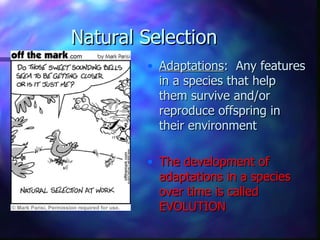
Natural Selection
        • Adaptations: Any features
          in a species that help
          them survive and/or
          reproduce offspring in
          their environment

        • The development of
          adaptations in a species
          over time is called
          EVOLUTION
Determining Relatedness

• Many modern species share common ancestors. Modern
  species evolved differently due to their different habitats.
  Embryo similarities, DNA comparison, vestigial structures, and
  homologous structures are analyzed to look for common
  ancestors.

• Homologous structures: Structures that look the
  same between species

• Vestigial structures: Structures that exist within an
  organism but serve no purpose
     (Ex: appendix in humans)
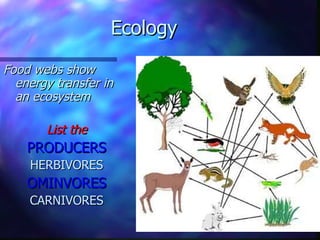
Ecology

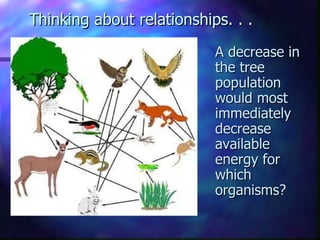
Food webs show
  energy transfer in
  an ecosystem

       List the
    PRODUCERS
    HERBIVORES
    OMINVORES
    CARNIVORES
Thinking about relationships. . .
                           A decrease in
                           the tree
                           population
                           would most
                           immediately
                           decrease
                           available
                           energy for
                           which
                           organisms?
Ecology: Basic Vocabulary
• Trophic Level: Feeding level in a food chain

• Abiotic Factor: Nonliving factor that affects an
  ecosystem (temperature, water, soil. . .)

• Biotic Factor: Living factor that affects an
  ecosystem (lion population, trees, berries. . .)

• Population: One species living in the same place
  at the same time
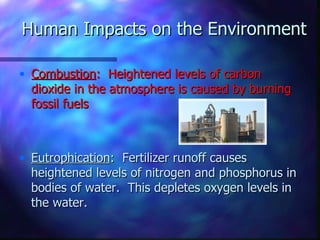
Human Impacts on the Environment

• Combustion: Heightened levels of carbon
  dioxide in the atmosphere is caused by burning
  fossil fuels


• Eutrophication: Fertilizer runoff causes
  heightened levels of nitrogen and phosphorus in
  bodies of water. This depletes oxygen levels in
  the water.

Benchmark 4 review

  • 1.
    Benchmark 4 ReviewNotes Honors Biology
  • 2.
    Scientific Method Review •Using microscopes: Total magnification = eyepiece X objective lens Example: 40X magnification = 10X eyepiece times 4X lens
  • 3.
    Scientific Method Review (con’t.) Independent Variable: Dependent Variable: • Always graphed on • Always graphed on the X-axis the Y-axis • What “I” set up in • What I measure as an experiment the experiment progresses
  • 4.
    Scientific Method (con’t.) •Positive Exponents: • Negative Exponents Positive exponents add Negative exponents zeros to the end of a add zeroes to the number, making the FRONT of a number, number larger than making the number 10 smaller than 1 Example: 102 = 100 Example: 10-2 = 0.01
  • 5.
    Scientific Method Review (con’t.) • Relative Size Using Example: Exponents: A certain protist is 5.4 X 10⁻⁸ mm in size. A certain bacterium is Size differences = 6.1 X10⁻¹¹ in size. absolute values Which organism is larger, and roughly how many times larger?
  • 6.
    Biomolecules Review OrganicMolecules: Inorganic Molecules: • Contain carbon (C) in their structure • DO NOT contain carbon (C) in their • Examples include structure nucleic acids, proteins, lipids, • Examples include carbohydrates, and minerals and water vitamins
  • 7.
    Quick Facts: Carbohydrates •Quick source of • The mitochondria breaks glucose in to energy ATP during cellular respiration • Built from monosaccharides • Because glucose is soluble in polar water • Glucose, made molecules, it is moved from our digestive during system to cells via the photosynthesis, is a circulatory system carbohydrate
  • 8.
    Quick Facts: Lipids •Used in animals and humans to store energy • Waxes waterproof long-term feathers and leaves. This prevents plant cells from bursting due • Phospholipids are a to over absorption of component of the cell water during osmosis membrane for all on very rainy days prokaryotes and eukaryotes • Building blocks: Fatty Acids
  • 9.
    Quick Facts: NucleicAcids • RNA bases: A—U • Built from nucleotides G—C • Two types: DNA and • DNA is double-stranded RNA and held in the nucleus of eukaryotes • DNA bases: A—T • RNA is single-stranded C—G
  • 10.
    Quick Facts: Proteins • Enzymes, catalysts of chemical reactions, are one type of • Assembled by linking protein amino acids at the ribosomes • Enzymes typically end in –ase. Each type of • Physical result of enzyme has its own gene reading and optimum temperature assembly (DNA— and pH range in which it works best. mRNA—protein)
  • 11.
    Quick Facts: Vitaminsand Minerals • Important Vitamins • Important Minerals C – Wound healing Calcium – strong D – strong bones and bones teeth Potassium – Muscle K – Muscle regulation regulation Iron – Oxygen transport in blood via the circulatory system
  • 12.
    Cell Structure andFunction • Eukaryotes • Prokaryotes DO have a TRUE nucleus Have NO nucleus or nuclear surrounded by a nuclear membrane membrane Possess cell membranes, Have many complex DNA, ribosomes, organelles to help perform cytoplasm and a cell wall complex functions for like structure called a multicellular life capsule Examples: Plant and animal Example: Bacteria cells
  • 13.
    Producers: Sources ofEnergy • Autotrophs (producers) perform both cellular respiration and photosynthesis • Plants use their chloroplasts to photosynthesize • Chemosynthesis: Performed by archaebacteria to create glucose and oxygen from carbon dioxide and inorganic compounds • Equation for photosynthesis: Sunlight + carbon dioxide + water  glucose (sugar) + oxygen
  • 14.
    Harnessing Sources ofEnergy • Heterotrophs must consume glucose because they cannot make it within their bodies • Cellular respiration refines glucose in to ATP for cellular functions in heterotrophs and autotrophs • Cellular Respiration Equation: Glucose + Oxygen  ATP + Carbon Dioxide + Water (Happens in the mitochondria)
  • 15.
    Homeostasis Many processeswe studied this year help maintain body balance • KIDNEYS and the EXCRETORY SYSTEM help remove wastes created in the cells • OSMOSIS and DIFFUSION regulate the movement of important nutrients and water into the cells • MITOCHONDRIA create the needed ATP for cellular functions and muscle firing
  • 16.
    Homeostasis: Systems inTandem Many body systems work together to keep balance in the body Circulatory and Respiratory Systems: Exchange of oxygen and carbon dioxide as cellular respiration occurs Nervous and Muscular: Work together for muscle movement and firing at the proper time. Maintain heartbeat, breathing, and voluntary muscle movement
  • 17.
    Active and PassiveTransport PASSIVE TRANSPORT ACTIVE TRANSPORT does not require ATP requires ATP • Substance move from • Substances move from high concentration to low concentration to low concentration (with high concentration the gradient) (against the gradient) • Ex: Osmosis and • Ex: sodium potassium diffusion pump/ion pumps
  • 18.
    Asexual Reproduction • Createsclones • Major types: • Vegetative – used by plants • Binary Fission – used by bacteria • Budding – Used by sponges and hydra • Fragmentation – used by starfish
  • 19.
    MITOSIS • Makesdiploid (2N) cells from a diploid cell (2N) • Creates genetically identical cells • Used in our bodies for growth, repair, and healing
  • 20.
    • Makes haploid(N) MEIOSIS cells for sexual reproduction • Creates genetically unique egg and sperm cells (gametes) • Cells created are used in fertilization to make a zygote • Occurs in plants and animals to make reproductive cells
  • 21.
    Application Questions • One species of Amazonian frog has 124 chromosomes in each cell. How many chromosomes are in its egg cells? • A bacterial cell in the Amazon reproduces by binary fission. The bacterium contains 20 chromosomes. How many are in its offspring?
  • 22.
    Genetics: Major Vocabulary • Homozygous dominant: DD • Homozygous recessive: dd • Heterozygous: Dd • Genotype: Genetic makeup of an organism – use Punnett Squares to predict for offspring • Phenotype: Physical characteristics of an organism – Pedigrees always mark phenotypes for a given family
  • 23.
    Genetics: Two MajorTypes of Punnett Squares Autosomal Sex-Linked Inherited the same way Inherited differently in males and females by gender
  • 24.
    Pedigrees: Visual analysisof trait inheritance in a family • Shaded individuals have the phenotype (“are affected”) – is this a dominant or recessive disorder?
  • 25.
    Genetic Applications • Genesplicing: • Gel electrophoresis: Used to create insulin and Used to compare band other medicines for patterns in DNA of humans. Inserts a organisms. human gene into bacterial cells so they can Can be used to determine quickly produce a protein paternity, solve crimes, and determine common evolutionary ancestry
  • 26.
    Natural Selection • Adaptations: Any features in a species that help them survive and/or reproduce offspring in their environment • The development of adaptations in a species over time is called EVOLUTION
  • 27.
    Determining Relatedness • Manymodern species share common ancestors. Modern species evolved differently due to their different habitats. Embryo similarities, DNA comparison, vestigial structures, and homologous structures are analyzed to look for common ancestors. • Homologous structures: Structures that look the same between species • Vestigial structures: Structures that exist within an organism but serve no purpose (Ex: appendix in humans)
  • 28.
    Ecology Food webs show energy transfer in an ecosystem List the PRODUCERS HERBIVORES OMINVORES CARNIVORES
  • 29.
    Thinking about relationships.. . A decrease in the tree population would most immediately decrease available energy for which organisms?
  • 30.
    Ecology: Basic Vocabulary •Trophic Level: Feeding level in a food chain • Abiotic Factor: Nonliving factor that affects an ecosystem (temperature, water, soil. . .) • Biotic Factor: Living factor that affects an ecosystem (lion population, trees, berries. . .) • Population: One species living in the same place at the same time
  • 31.
    Human Impacts onthe Environment • Combustion: Heightened levels of carbon dioxide in the atmosphere is caused by burning fossil fuels • Eutrophication: Fertilizer runoff causes heightened levels of nitrogen and phosphorus in bodies of water. This depletes oxygen levels in the water.