Biology


                                                Slide
                                              1 of 30
                                            End Show
          Copyright Pearson Prentice Hall
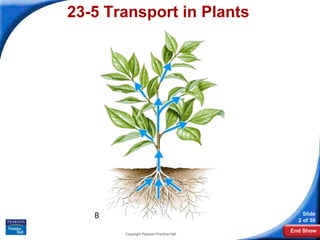
23-5 Transport in Plants


                                             Slide
                                           2 of 30
                                         End Show
       Copyright Pearson Prentice Hall
23-5 Transport in Plants                     Water Pressure


Water Pressure
 Xylem tissue forms a continuous set of tubes that
 runs from the roots through stems and out into the
 spongy mesophyll of leaves.
 Active transport and root pressure cause water to
 move from soil into plant roots.
 Capillary action and transpiration also are needed
 to transport water and minerals.

                                                                          Slide
                                                                        3 of 30
                                                                      End Show
                       Copyright Pearson Prentice Hall
23-5 Transport in Plants                     Water Pressure


How is water transported throughout a
plant?


                                                                   Slide
                                                                 4 of 30
                                                               End Show
                Copyright Pearson Prentice Hall
23-5 Transport in Plants                     Water Pressure


The combination of root pressure, capillary
action, and transpiration provides enough
force to move water through the xylem
tissue of even the tallest plant.


                                                                   Slide
                                                                 5 of 30
                                                               End Show
                Copyright Pearson Prentice Hall
23-5 Transport in Plants                     Water Pressure


Cohesion is the attraction of molecules of the same
substance to each other.
Adhesion is the attraction between unlike molecules.


                                                                           Slide
                                                                         6 of 30
                                                                       End Show
                        Copyright Pearson Prentice Hall
23-5 Transport in Plants                     Water Pressure


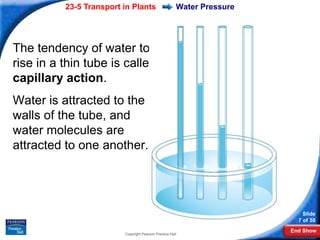
The tendency of water to
rise in a thin tube is called
capillary action.
Water is attracted to the
walls of the tube, and
water molecules are
attracted to one another.


                                                                            Slide
                                                                          7 of 30
                                                                        End Show
                         Copyright Pearson Prentice Hall
23-5 Transport in Plants                     Water Pressure


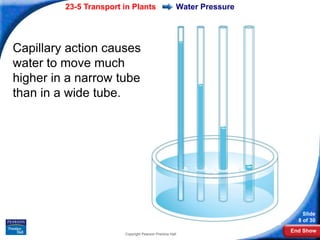
Capillary action causes
water to move much
higher in a narrow tube
than in a wide tube.


                                                                           Slide
                                                                         8 of 30
                                                                       End Show
                        Copyright Pearson Prentice Hall
23-5 Transport in Plants                     Water Pressure


Tracheids and vessel elements form hollow
connected tubes in a plant.
Capillary action in these structures causes water to
rise well above the level of the ground.


                                                                           Slide
                                                                         9 of 30
                                                                       End Show
                        Copyright Pearson Prentice Hall
23-5 Transport in Plants                     Water Pressure


Transpiration

In tall plants, the major force in water transport
comes from the evaporation of water from leaves
during transpiration.


                                                                         Slide
                                                                      10 of 30
                                                                     End Show
                      Copyright Pearson Prentice Hall
23-5 Transport in Plants                     Water Pressure


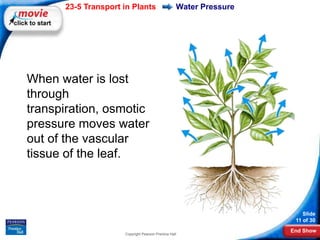
When water is lost
through
transpiration, osmotic
pressure moves water
out of the vascular
tissue of the leaf.


                                                                        Slide
                                                                     11 of 30
                                                                    End Show
                     Copyright Pearson Prentice Hall
23-5 Transport in Plants                     Water Pressure


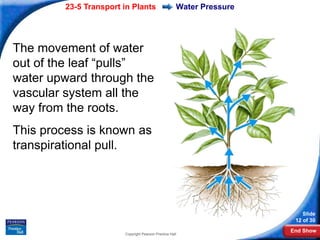
The movement of water
out of the leaf “pulls”
water upward through the
vascular system all the
way from the roots.
This process is known as
transpirational pull.


                                                                           Slide
                                                                        12 of 30
                                                                       End Show
                        Copyright Pearson Prentice Hall
23-5 Transport in Plants                     Water Pressure


Controlling Transpiration

 The water content of the leaf is kept relatively
 constant.
 When there is a lot of water, water pressure in the
 guard cells is increased and the stomata open.
 Excess water is then lost through the open
 stomata by transpiration.


                                                                           Slide
                                                                        13 of 30
                                                                       End Show
                        Copyright Pearson Prentice Hall
23-5 Transport in Plants                     Water Pressure


When water is scarce, the opposite occurs.
Water pressure in the leaf decreases. The guard cells
respond by closing the stomata.
This reduces further water loss by limiting
transpiration.
When too much water is lost, wilting occurs. When a
leaf wilts, its stomata close and transpiration slows
down. This helps a plant conserve water.

                                                                           Slide
                                                                        14 of 30
                                                                       End Show
                        Copyright Pearson Prentice Hall
23-5 Transport in Plants                     Nutrient Transport


How are the products of photosynthesis
transported throughout a plant?


                                                                       Slide
                                                                    15 of 30
                                                                   End Show
                Copyright Pearson Prentice Hall
23-5 Transport in Plants                     Nutrient Transport


Nutrient Transport
 Many plants pump sugars into their fruits.
 In cold climates, plants pump food into their roots
 for winter storage.
 This stored food must be moved back into the
 trunk and branches of the plant before growth
 begins again in the spring.


                                                                               Slide
                                                                            16 of 30
                                                                           End Show
                        Copyright Pearson Prentice Hall
23-5 Transport in Plants                     Nutrient Transport


Movement from Source to Sink

A process of phloem transport moves sugars
through a plant from a source to a sink.
A source is any cell in which sugars are produced
by photosynthesis.
A sink is any cell where the sugars are used or
stored.


                                                                             Slide
                                                                          17 of 30
                                                                         End Show
                      Copyright Pearson Prentice Hall
23-5 Transport in Plants                         Nutrient Transport


When nutrients are pumped into or
removed from the phloem system, the
change in concentration causes a
movement of fluid in that same direction.

As a result, phloem is able to move
nutrients in either direction to meet the
nutritional needs of the plant.


                                                                           Slide
                                                                        18 of 30
                                                                       End Show
                Copyright Pearson Prentice Hall
23-5 Transport in Plants                     Nutrient Transport


One idea that explains how phloem transport takes
place is called the pressure-flow hypothesis.


                                                                              Slide
                                                                           19 of 30
                                                                          End Show
                       Copyright Pearson Prentice Hall
23-5 Transport in Plants                     Nutrient Transport
                                                                    Phloem Xylem
                                                          Sugar
                                                          molecules
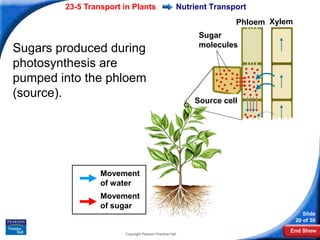
Sugars produced during
photosynthesis are
pumped into the phloem
(source).
                                                         Source cell


                 Movement
                 of water
                 Movement
                 of sugar
                                                                                      Slide
                                                                                   20 of 30
                                                                               End Show
                       Copyright Pearson Prentice Hall
23-5 Transport in Plants                     Nutrient Transport
                                                                     Phloem Xylem
                                                           Sugar
                                                           molecules
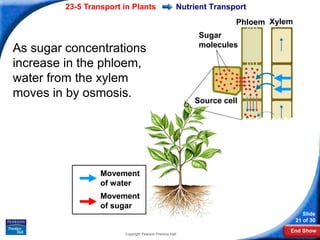
As sugar concentrations
increase in the phloem,
water from the xylem
moves in by osmosis.
                                                          Source cell


                  Movement
                  of water
                  Movement
                  of sugar
                                                                                       Slide
                                                                                    21 of 30
                                                                                End Show
                        Copyright Pearson Prentice Hall
23-5 Transport in Plants                     Nutrient Transport
                                                                     Phloem Xylem
                                                           Sugar
                                                           molecules
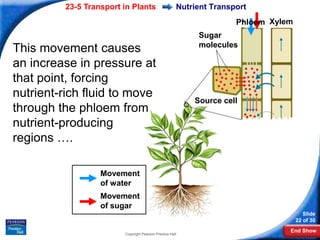
This movement causes
an increase in pressure at
that point, forcing
nutrient-rich fluid to move
                                                          Source cell
through the phloem from
nutrient-producing
regions ….

                  Movement
                  of water
                  Movement
                  of sugar
                                                                                       Slide
                                                                                    22 of 30
                                                                                End Show
                        Copyright Pearson Prentice Hall
23-5 Transport in Plants                     Nutrient Transport


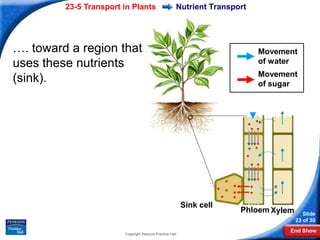
…. toward a region that                                                    Movement
uses these nutrients                                                       of water
                                                                           Movement
(sink).                                                                    of sugar


                                                          Sink cell
                                                                      Phloem Xylem      Slide
                                                                                     23 of 30
                                                                                 End Show
                        Copyright Pearson Prentice Hall
23-5 Transport in Plants                     Nutrient Transport


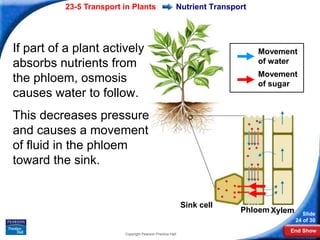
If part of a plant actively                                                 Movement
absorbs nutrients from                                                      of water
                                                                            Movement
the phloem, osmosis                                                         of sugar
causes water to follow.
This decreases pressure
and causes a movement
of fluid in the phloem
toward the sink.


                                                           Sink cell
                                                                       Phloem Xylem      Slide
                                                                                      24 of 30
                                                                                  End Show
                         Copyright Pearson Prentice Hall
23–5


       Continue to:                                     Click to Launch:
                           - or -


                                                                               Slide
                                                                            25 of 30
                                                                           End Show
                      Copyright Pearson Prentice Hall
23–5


   In a plant stem, water moves from
       a. leaves to roots through xylem.
       b. roots to leaves through xylem.
       c. leaves to roots through phloem.
       d. roots to leaves through phloem.


                                                              Slide
                                                           26 of 30
                                                          End Show
                        Copyright Pearson Prentice Hall
23–5


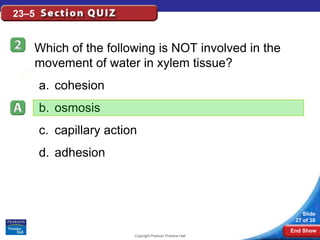
   Which of the following is NOT involved in the
   movement of water in xylem tissue?
       a. cohesion
       b. osmosis
       c. capillary action
       d. adhesion


                                                               Slide
                                                            27 of 30
                                                           End Show
                         Copyright Pearson Prentice Hall
23–5


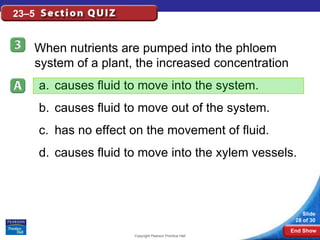
   When nutrients are pumped into the phloem
   system of a plant, the increased concentration
       a. causes fluid to move into the system.
       b. causes fluid to move out of the system.
       c. has no effect on the movement of fluid.
       d. causes fluid to move into the xylem vessels.


                                                              Slide
                                                           28 of 30
                                                          End Show
                        Copyright Pearson Prentice Hall
23–5


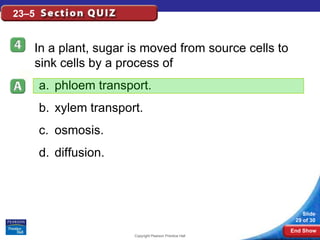
   In a plant, sugar is moved from source cells to
   sink cells by a process of
       a. phloem transport.
       b. xylem transport.
       c. osmosis.
       d. diffusion.


                                                              Slide
                                                           29 of 30
                                                          End Show
                        Copyright Pearson Prentice Hall
23–5


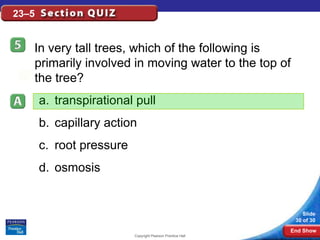
   In very tall trees, which of the following is
   primarily involved in moving water to the top of
   the tree?
       a. transpirational pull
       b. capillary action
       c. root pressure
       d. osmosis


                                                                Slide
                                                             30 of 30
                                                            End Show
                          Copyright Pearson Prentice Hall
END OF SECTION

Transport

  • 1.
    Biology Slide 1 of 30 End Show Copyright Pearson Prentice Hall
  • 2.
    23-5 Transport inPlants Slide 2 of 30 End Show Copyright Pearson Prentice Hall
  • 3.
    23-5 Transport inPlants Water Pressure Water Pressure Xylem tissue forms a continuous set of tubes that runs from the roots through stems and out into the spongy mesophyll of leaves. Active transport and root pressure cause water to move from soil into plant roots. Capillary action and transpiration also are needed to transport water and minerals. Slide 3 of 30 End Show Copyright Pearson Prentice Hall
  • 4.
    23-5 Transport inPlants Water Pressure How is water transported throughout a plant? Slide 4 of 30 End Show Copyright Pearson Prentice Hall
  • 5.
    23-5 Transport inPlants Water Pressure The combination of root pressure, capillary action, and transpiration provides enough force to move water through the xylem tissue of even the tallest plant. Slide 5 of 30 End Show Copyright Pearson Prentice Hall
  • 6.
    23-5 Transport inPlants Water Pressure Cohesion is the attraction of molecules of the same substance to each other. Adhesion is the attraction between unlike molecules. Slide 6 of 30 End Show Copyright Pearson Prentice Hall
  • 7.
    23-5 Transport inPlants Water Pressure The tendency of water to rise in a thin tube is called capillary action. Water is attracted to the walls of the tube, and water molecules are attracted to one another. Slide 7 of 30 End Show Copyright Pearson Prentice Hall
  • 8.
    23-5 Transport inPlants Water Pressure Capillary action causes water to move much higher in a narrow tube than in a wide tube. Slide 8 of 30 End Show Copyright Pearson Prentice Hall
  • 9.
    23-5 Transport inPlants Water Pressure Tracheids and vessel elements form hollow connected tubes in a plant. Capillary action in these structures causes water to rise well above the level of the ground. Slide 9 of 30 End Show Copyright Pearson Prentice Hall
  • 10.
    23-5 Transport inPlants Water Pressure Transpiration In tall plants, the major force in water transport comes from the evaporation of water from leaves during transpiration. Slide 10 of 30 End Show Copyright Pearson Prentice Hall
  • 11.
    23-5 Transport inPlants Water Pressure When water is lost through transpiration, osmotic pressure moves water out of the vascular tissue of the leaf. Slide 11 of 30 End Show Copyright Pearson Prentice Hall
  • 12.
    23-5 Transport inPlants Water Pressure The movement of water out of the leaf “pulls” water upward through the vascular system all the way from the roots. This process is known as transpirational pull. Slide 12 of 30 End Show Copyright Pearson Prentice Hall
  • 13.
    23-5 Transport inPlants Water Pressure Controlling Transpiration The water content of the leaf is kept relatively constant. When there is a lot of water, water pressure in the guard cells is increased and the stomata open. Excess water is then lost through the open stomata by transpiration. Slide 13 of 30 End Show Copyright Pearson Prentice Hall
  • 14.
    23-5 Transport inPlants Water Pressure When water is scarce, the opposite occurs. Water pressure in the leaf decreases. The guard cells respond by closing the stomata. This reduces further water loss by limiting transpiration. When too much water is lost, wilting occurs. When a leaf wilts, its stomata close and transpiration slows down. This helps a plant conserve water. Slide 14 of 30 End Show Copyright Pearson Prentice Hall
  • 15.
    23-5 Transport inPlants Nutrient Transport How are the products of photosynthesis transported throughout a plant? Slide 15 of 30 End Show Copyright Pearson Prentice Hall
  • 16.
    23-5 Transport inPlants Nutrient Transport Nutrient Transport Many plants pump sugars into their fruits. In cold climates, plants pump food into their roots for winter storage. This stored food must be moved back into the trunk and branches of the plant before growth begins again in the spring. Slide 16 of 30 End Show Copyright Pearson Prentice Hall
  • 17.
    23-5 Transport inPlants Nutrient Transport Movement from Source to Sink A process of phloem transport moves sugars through a plant from a source to a sink. A source is any cell in which sugars are produced by photosynthesis. A sink is any cell where the sugars are used or stored. Slide 17 of 30 End Show Copyright Pearson Prentice Hall
  • 18.
    23-5 Transport inPlants Nutrient Transport When nutrients are pumped into or removed from the phloem system, the change in concentration causes a movement of fluid in that same direction. As a result, phloem is able to move nutrients in either direction to meet the nutritional needs of the plant. Slide 18 of 30 End Show Copyright Pearson Prentice Hall
  • 19.
    23-5 Transport inPlants Nutrient Transport One idea that explains how phloem transport takes place is called the pressure-flow hypothesis. Slide 19 of 30 End Show Copyright Pearson Prentice Hall
  • 20.
    23-5 Transport inPlants Nutrient Transport Phloem Xylem Sugar molecules Sugars produced during photosynthesis are pumped into the phloem (source). Source cell Movement of water Movement of sugar Slide 20 of 30 End Show Copyright Pearson Prentice Hall
  • 21.
    23-5 Transport inPlants Nutrient Transport Phloem Xylem Sugar molecules As sugar concentrations increase in the phloem, water from the xylem moves in by osmosis. Source cell Movement of water Movement of sugar Slide 21 of 30 End Show Copyright Pearson Prentice Hall
  • 22.
    23-5 Transport inPlants Nutrient Transport Phloem Xylem Sugar molecules This movement causes an increase in pressure at that point, forcing nutrient-rich fluid to move Source cell through the phloem from nutrient-producing regions …. Movement of water Movement of sugar Slide 22 of 30 End Show Copyright Pearson Prentice Hall
  • 23.
    23-5 Transport inPlants Nutrient Transport …. toward a region that Movement uses these nutrients of water Movement (sink). of sugar Sink cell Phloem Xylem Slide 23 of 30 End Show Copyright Pearson Prentice Hall
  • 24.
    23-5 Transport inPlants Nutrient Transport If part of a plant actively Movement absorbs nutrients from of water Movement the phloem, osmosis of sugar causes water to follow. This decreases pressure and causes a movement of fluid in the phloem toward the sink. Sink cell Phloem Xylem Slide 24 of 30 End Show Copyright Pearson Prentice Hall
  • 25.
    23–5 Continue to: Click to Launch: - or - Slide 25 of 30 End Show Copyright Pearson Prentice Hall
  • 26.
    23–5 In a plant stem, water moves from a. leaves to roots through xylem. b. roots to leaves through xylem. c. leaves to roots through phloem. d. roots to leaves through phloem. Slide 26 of 30 End Show Copyright Pearson Prentice Hall
  • 27.
    23–5 Which of the following is NOT involved in the movement of water in xylem tissue? a. cohesion b. osmosis c. capillary action d. adhesion Slide 27 of 30 End Show Copyright Pearson Prentice Hall
  • 28.
    23–5 When nutrients are pumped into the phloem system of a plant, the increased concentration a. causes fluid to move into the system. b. causes fluid to move out of the system. c. has no effect on the movement of fluid. d. causes fluid to move into the xylem vessels. Slide 28 of 30 End Show Copyright Pearson Prentice Hall
  • 29.
    23–5 In a plant, sugar is moved from source cells to sink cells by a process of a. phloem transport. b. xylem transport. c. osmosis. d. diffusion. Slide 29 of 30 End Show Copyright Pearson Prentice Hall
  • 30.
    23–5 In very tall trees, which of the following is primarily involved in moving water to the top of the tree? a. transpirational pull b. capillary action c. root pressure d. osmosis Slide 30 of 30 End Show Copyright Pearson Prentice Hall
  • 31.