Benchmark 3 Review
Notes
           Honors Biology
Asexual Reproduction
                 Only one parent required
    Genetically identical offspring created
  Uses MITOSIS to make clone organisms
                         No gametes used
Types of Asexual
Reproduction
• Budding              Used by yeast and hydra

• Vegetative           Used by plants

• Binary Fission       Used by bacteria

      QUESTION:
      Which type of asexual reproduction
      is shown to the right???
Sexual Reproduction
• Gametes are produced by the process of meiosis
  – Crossing-Over of Meiosis I ensures genetic variation
    between offspring
  – Gametes are HAPLOID cells (N)


• Egg and sperm unit to form a zygote
  – Zygote is the first DIPLOID cell (2N) of a new
    individual. The zygote becomes a fully-formed
    individual through mitosis
Production of Gametes
If a somatic cell has 100
chromosomes. . .

• Cells undergoing        • Cells undergoing
  MITOSIS will have         MEIOSIS will have 50
  100 chromosomes           chromosomes each
  each
                          • HAPLOID cells
• DIPLOID cells created     created
Genetics Review
Genotypes              Phenotypes

• Two alleles for an   • Physical
  autosomal trait        characteristics
• HH – homozygous
  dominant             • Hh and HH create the
• Hh – heterozygous      same phenotype
• Hh – homozygous
  recessive
Punnett Squares for Autosomal
Traits
               •   What percentage of
                   children will have the
                   dominant
                   phenotype?

               •   What percentage of
                   children will have the
                   recessive
                   phenotype?
Sex-Linked Traits
• Carried on X-          • Boys receive X-
  chromosome               chromosome and its
                           alleles from MOM
• Recessive alleles
  cause disorders like   • Use a SPECIAL
  colorblindness,          Punnett Square to
  hemophilia, and          predict
  baldness
Sex-Linked Punnett Squares
•   What percent of
    males inherit the
    disorder?

•   What percent of
    females are carriers
    for the disorder?
Pedigrees
            •   Study the
                pedigree to
                the right.

            •   What kind of
                trait is shown?
                 Explain. . .
DNA and RNA
• DNA is double-         • RNA is single-
  stranded                 stranded

• Base pair rules:       • Makes a single-strand
  – A—T                    copy off an open DNA
  – C—G                    strand

• For ATT-CGA: what is   • For ATT-CGA: what is
  the complementary        the complementary
  DNA strand?              RNA strand?
Functions
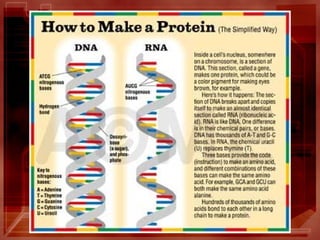
• DNA: contains thousands   • RNA:
  of genes written as
  nucleotide sequences      mRNA: carries gene information
                              from nucleus to ribosome
• Genetic code determined   rRNA (ribosome): site where
                              mRNA instructions are read
  by DNA nitrogen base
                            tRNA: carries amino acid to
  sequence                    ribosomes according to mRNA
                              instructions
• Kept in the nucleus of
  eukaryotic cells
Steps of Protein Synthesis
TRANSCRIPTION:
• DNA gene opens to attach mRNA nucleotides
• mRNA copies DNA gene in the nucleus
• DNA closes back up as mRNA exits

TRANSLATION:
• mRNA attaches to a ribosome where tRNA
   brings correct amino acids
Two Important Types of
Gene Technology
Gene splicing                   Genetic Engineering

• Genes from an organism        • Used to replace undesired
  are removed and inserted        genes of an organism with
  into another organism           better ones

Example: inserting human        Example: Glow in the dark
  insulin-producing gene in       puppies are created by
  bacteria to produce insulin     inserting the glowing gene
  quickly and economically        from jellyfish into the dog
                                  DNA
Gel Electrophoresis
• Used to determine relatedness of
  organisms

• Separates DNA bands by size

• Shorter segments travel the furthest
  through the matrix
More Matching Bands = Closer
Relatedness

Benchmark%203%20 review%20notes[1]

  • 1.
  • 2.
    Asexual Reproduction Only one parent required Genetically identical offspring created Uses MITOSIS to make clone organisms No gametes used
  • 3.
    Types of Asexual Reproduction •Budding  Used by yeast and hydra • Vegetative  Used by plants • Binary Fission  Used by bacteria QUESTION: Which type of asexual reproduction is shown to the right???
  • 4.
    Sexual Reproduction • Gametesare produced by the process of meiosis – Crossing-Over of Meiosis I ensures genetic variation between offspring – Gametes are HAPLOID cells (N) • Egg and sperm unit to form a zygote – Zygote is the first DIPLOID cell (2N) of a new individual. The zygote becomes a fully-formed individual through mitosis
  • 5.
  • 6.
    If a somaticcell has 100 chromosomes. . . • Cells undergoing • Cells undergoing MITOSIS will have MEIOSIS will have 50 100 chromosomes chromosomes each each • HAPLOID cells • DIPLOID cells created created
  • 9.
    Genetics Review Genotypes Phenotypes • Two alleles for an • Physical autosomal trait characteristics • HH – homozygous dominant • Hh and HH create the • Hh – heterozygous same phenotype • Hh – homozygous recessive
  • 10.
    Punnett Squares forAutosomal Traits • What percentage of children will have the dominant phenotype? • What percentage of children will have the recessive phenotype?
  • 11.
    Sex-Linked Traits • Carriedon X- • Boys receive X- chromosome chromosome and its alleles from MOM • Recessive alleles cause disorders like • Use a SPECIAL colorblindness, Punnett Square to hemophilia, and predict baldness
  • 12.
    Sex-Linked Punnett Squares • What percent of males inherit the disorder? • What percent of females are carriers for the disorder?
  • 13.
    Pedigrees • Study the pedigree to the right. • What kind of trait is shown? Explain. . .
  • 14.
    DNA and RNA •DNA is double- • RNA is single- stranded stranded • Base pair rules: • Makes a single-strand – A—T copy off an open DNA – C—G strand • For ATT-CGA: what is • For ATT-CGA: what is the complementary the complementary DNA strand? RNA strand?
  • 16.
    Functions • DNA: containsthousands • RNA: of genes written as nucleotide sequences mRNA: carries gene information from nucleus to ribosome • Genetic code determined rRNA (ribosome): site where mRNA instructions are read by DNA nitrogen base tRNA: carries amino acid to sequence ribosomes according to mRNA instructions • Kept in the nucleus of eukaryotic cells
  • 17.
    Steps of ProteinSynthesis TRANSCRIPTION: • DNA gene opens to attach mRNA nucleotides • mRNA copies DNA gene in the nucleus • DNA closes back up as mRNA exits TRANSLATION: • mRNA attaches to a ribosome where tRNA brings correct amino acids
  • 19.
    Two Important Typesof Gene Technology Gene splicing Genetic Engineering • Genes from an organism • Used to replace undesired are removed and inserted genes of an organism with into another organism better ones Example: inserting human Example: Glow in the dark insulin-producing gene in puppies are created by bacteria to produce insulin inserting the glowing gene quickly and economically from jellyfish into the dog DNA
  • 21.
    Gel Electrophoresis • Usedto determine relatedness of organisms • Separates DNA bands by size • Shorter segments travel the furthest through the matrix
  • 22.
    More Matching Bands= Closer Relatedness