Genetic Diversity   The sorting and recombination of genes in sexual reproduction results in a great variety of gene combinations in the offspring of any 2 parents. Do you look EXACTLY like your brothers & sisters?
Genetic Diversity   Genetically diverse populations are  more likely to survive  changing environments. Greater variation within the species makes a population  better suited to adaptation  to changes in the environment.
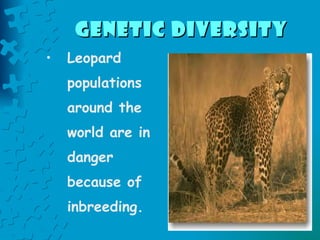
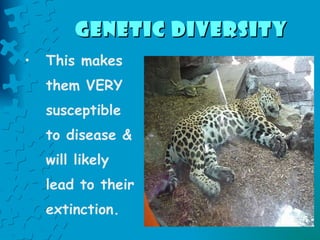
Genetic Diversity   Leopard populations around the world are in danger because of inbreeding.
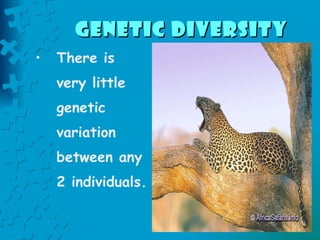
Genetic Diversity   There is very little genetic variation between any 2 individuals.
Genetic Diversity   This makes them VERY susceptible to disease & will likely lead to their extinction.
Genetic Diversity   Recombination and mutation provide for genetic diversity.   Inserting, deleting, or substituting DNA bases can alter genes.  An altered gene in a sex cell may be passed on to every cell that develops from it, causing an altered phenotype.
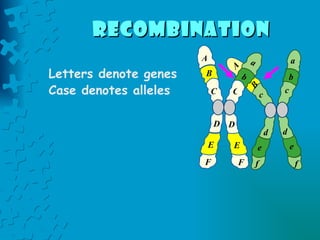
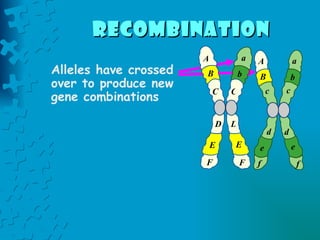
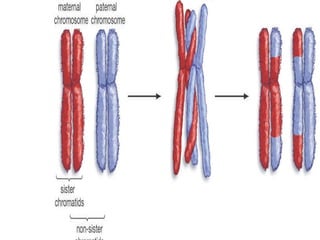
Crossing-over  the physical exchange of chromosomal material between chromatids of homologous chromosomes. Result:  Generation of new combinations of genes (alleles). recombination
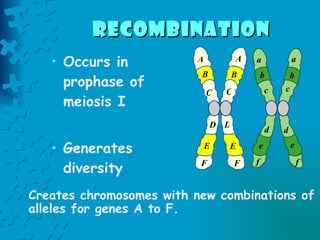
Occurs in prophase of meiosis I Generates diversity Creates chromosomes with new combinations of alleles for genes A to F. recombination   a b c d e f A B C D E F A B C D E F a b c d e f
Letters denote genes  Case denotes alleles A B C D E F a b c d e f c d e f A B a b C D E F recombination
Alleles have crossed over to produce new gene combinations A B C D E F a b c d e f c d e f A B a b C D E F recombination
 
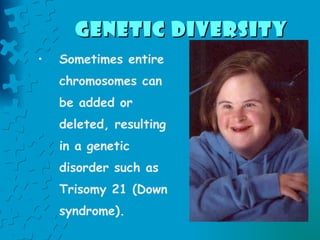
Genetic Diversity   Sometimes entire chromosomes can be added or deleted, resulting in a genetic disorder such as Trisomy 21 (Down syndrome).
Genetic Diversity   Chromosomal Errors NONDISJUNCTION:  the failure of chromosomes to separate properly in meiosis. Gametes with extra or too few chromosomes result.  Can cause diseases such as Down’s Syndrome.
Genetic Diversity   Chromosomal Errors POLYPLOIDY:  organisms with entire extra sets of chromosomes Results in the death of the fetus in animals Often occurs in plants and causes the fruits and flowers to be larger. EX.: bananas, lilies
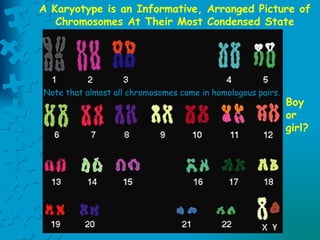
A Karyotype is an Informative, Arranged Picture of Chromosomes At Their Most Condensed State Boy or girl? Note that almost all chromosomes come in homologous pairs.
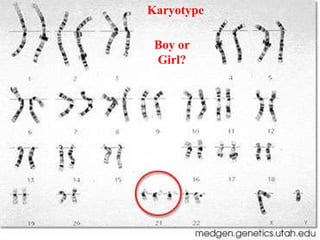
Karyotype Boy or Girl?
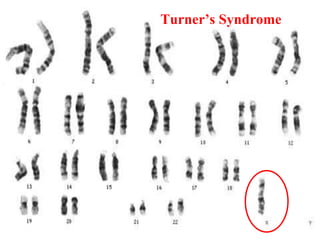
Genetic Diseases Turner's Syndrome Turner’s syndrome is a genetic disorder affecting only females, in which the patient has one X chromosome in some or all cells; or has two X chromosomes but one is damaged.
Genetic Diseases Turner's syndrome Signs of Turner syndrome include: short stature,  delayed growth of the skeleton,  shortened fourth and fifth fingers, broad chest,  and sometimes heart abnormalities.
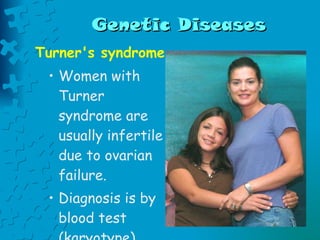
Genetic Diseases Turner's syndrome Women with Turner syndrome are usually infertile due to ovarian failure.  Diagnosis is by blood test (karyotype).
Turner’s Syndrome
Genetic Diseases Huntington’s Disease Huntington’s disease (HD) is an inherited disorder caused by the degeneration of certain nerve cells in the brain.  The gene for Huntington’s disease is codominant. HD causes bizarre involuntary movements and loss of intellectual abilities (dementia).
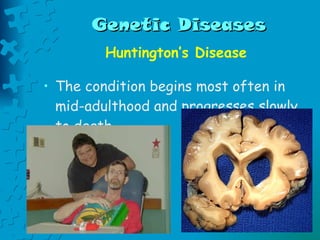
Genetic Diseases Huntington’s Disease The condition begins most often in mid-adulthood and progresses slowly to death.
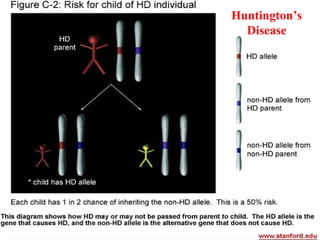
Genetic Diseases Huntington’s Disease The identification of the codominant gene for HD now makes it possible to determine who will develop this disease by examining their DNA from a blood sample in the laboratory.
Huntington’s Disease
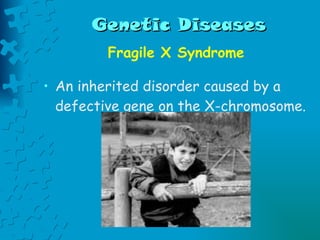
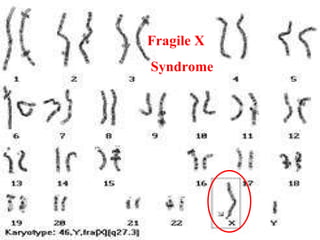
Genetic Diseases Fragile X Syndrome An inherited disorder caused by a defective gene on the X-chromosome.
Genetic Diseases Fragile X Syndrome Symptoms of Fragile X Syndrome:  mental retardation,  Enlarged testes,  and facial abnormalities in males  and mild or no effects in females.  It is the most common inherited cause of mental retardation.
Fragile X Syndrome
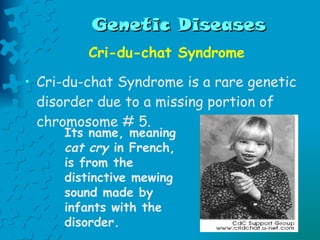
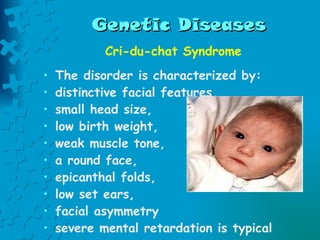
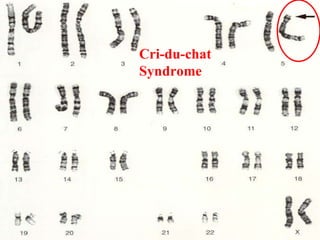
Genetic Diseases Cri-du-chat Syndrome Cri-du-chat Syndrome is a rare genetic disorder due to a missing portion of chromosome # 5.  Its name, meaning  cat cry  in French, is from the distinctive mewing sound made by infants with the disorder.
Genetic Diseases Cri-du-chat Syndrome  The disorder is characterized by: distinctive facial features,  small head size, low birth weight,  weak muscle tone,  a round face,  epicanthal folds, low set ears,  facial asymmetry severe mental retardation is typical
Cri-du-chat Syndrome
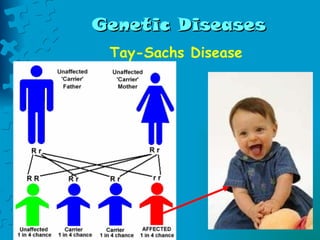
Genetic Diseases Tay-Sachs Disease A hereditary disease that affects young children almost exclusively of eastern European Jewish descent, in which an enzyme deficiency leads to the accumulation of fat in the brain and nerve tissue.
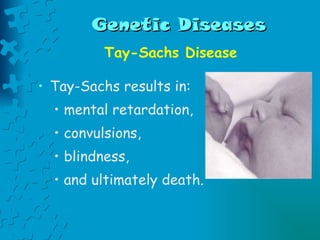
Genetic Diseases Tay-Sachs Disease Tay-Sachs results in: mental retardation,  convulsions,  blindness,  and ultimately death.
Genetic Diseases Tay-Sachs Disease
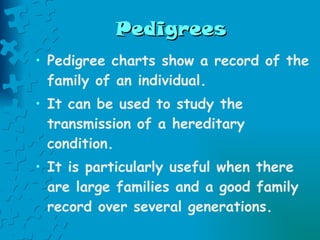
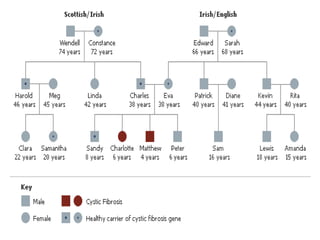
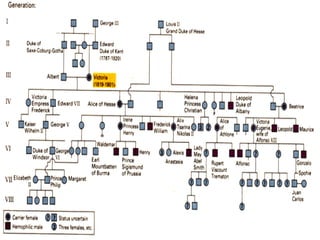
Pedigrees Pedigree charts show a record of the family of an individual.  It can be used to study the transmission of a hereditary condition.  It is particularly useful when there are large families and a good family record over several generations.


Genetics 3

  • 1.
    Genetic Diversity The sorting and recombination of genes in sexual reproduction results in a great variety of gene combinations in the offspring of any 2 parents. Do you look EXACTLY like your brothers & sisters?
  • 2.
    Genetic Diversity Genetically diverse populations are more likely to survive changing environments. Greater variation within the species makes a population better suited to adaptation to changes in the environment.
  • 3.
    Genetic Diversity Leopard populations around the world are in danger because of inbreeding.
  • 4.
    Genetic Diversity There is very little genetic variation between any 2 individuals.
  • 5.
    Genetic Diversity This makes them VERY susceptible to disease & will likely lead to their extinction.
  • 6.
    Genetic Diversity Recombination and mutation provide for genetic diversity. Inserting, deleting, or substituting DNA bases can alter genes. An altered gene in a sex cell may be passed on to every cell that develops from it, causing an altered phenotype.
  • 7.
    Crossing-over thephysical exchange of chromosomal material between chromatids of homologous chromosomes. Result: Generation of new combinations of genes (alleles). recombination
  • 8.
    Occurs in prophaseof meiosis I Generates diversity Creates chromosomes with new combinations of alleles for genes A to F. recombination a b c d e f A B C D E F A B C D E F a b c d e f
  • 9.
    Letters denote genes Case denotes alleles A B C D E F a b c d e f c d e f A B a b C D E F recombination
  • 10.
    Alleles have crossedover to produce new gene combinations A B C D E F a b c d e f c d e f A B a b C D E F recombination
  • 11.
  • 12.
    Genetic Diversity Sometimes entire chromosomes can be added or deleted, resulting in a genetic disorder such as Trisomy 21 (Down syndrome).
  • 13.
    Genetic Diversity Chromosomal Errors NONDISJUNCTION: the failure of chromosomes to separate properly in meiosis. Gametes with extra or too few chromosomes result. Can cause diseases such as Down’s Syndrome.
  • 14.
    Genetic Diversity Chromosomal Errors POLYPLOIDY: organisms with entire extra sets of chromosomes Results in the death of the fetus in animals Often occurs in plants and causes the fruits and flowers to be larger. EX.: bananas, lilies
  • 15.
    A Karyotype isan Informative, Arranged Picture of Chromosomes At Their Most Condensed State Boy or girl? Note that almost all chromosomes come in homologous pairs.
  • 16.
  • 17.
    Genetic Diseases Turner'sSyndrome Turner’s syndrome is a genetic disorder affecting only females, in which the patient has one X chromosome in some or all cells; or has two X chromosomes but one is damaged.
  • 18.
    Genetic Diseases Turner'ssyndrome Signs of Turner syndrome include: short stature, delayed growth of the skeleton, shortened fourth and fifth fingers, broad chest, and sometimes heart abnormalities.
  • 19.
    Genetic Diseases Turner'ssyndrome Women with Turner syndrome are usually infertile due to ovarian failure. Diagnosis is by blood test (karyotype).
  • 20.
  • 21.
    Genetic Diseases Huntington’sDisease Huntington’s disease (HD) is an inherited disorder caused by the degeneration of certain nerve cells in the brain. The gene for Huntington’s disease is codominant. HD causes bizarre involuntary movements and loss of intellectual abilities (dementia).
  • 22.
    Genetic Diseases Huntington’sDisease The condition begins most often in mid-adulthood and progresses slowly to death.
  • 23.
    Genetic Diseases Huntington’sDisease The identification of the codominant gene for HD now makes it possible to determine who will develop this disease by examining their DNA from a blood sample in the laboratory.
  • 24.
  • 25.
    Genetic Diseases FragileX Syndrome An inherited disorder caused by a defective gene on the X-chromosome.
  • 26.
    Genetic Diseases FragileX Syndrome Symptoms of Fragile X Syndrome: mental retardation, Enlarged testes, and facial abnormalities in males and mild or no effects in females. It is the most common inherited cause of mental retardation.
  • 27.
  • 28.
    Genetic Diseases Cri-du-chatSyndrome Cri-du-chat Syndrome is a rare genetic disorder due to a missing portion of chromosome # 5. Its name, meaning cat cry in French, is from the distinctive mewing sound made by infants with the disorder.
  • 29.
    Genetic Diseases Cri-du-chatSyndrome The disorder is characterized by: distinctive facial features, small head size, low birth weight, weak muscle tone, a round face, epicanthal folds, low set ears, facial asymmetry severe mental retardation is typical
  • 30.
  • 31.
    Genetic Diseases Tay-SachsDisease A hereditary disease that affects young children almost exclusively of eastern European Jewish descent, in which an enzyme deficiency leads to the accumulation of fat in the brain and nerve tissue.
  • 32.
    Genetic Diseases Tay-SachsDisease Tay-Sachs results in: mental retardation, convulsions, blindness, and ultimately death.
  • 33.
  • 34.
    Pedigrees Pedigree chartsshow a record of the family of an individual. It can be used to study the transmission of a hereditary condition. It is particularly useful when there are large families and a good family record over several generations.
  • 35.
  • 36.