Mutation Breeding
By- SHRIKANT YANKANCHI
Introduction
Micro- and Macro-mutations
Procedures for micro mutations
breeding/polygenic
Handling of segregating population
Screening/selection
Breeding for A Biotic and Biotic stress
Methods for Validation of mutants
Achievements of mutation breeding
Advantages and limitations of breeding
Contents......
2
Introduction
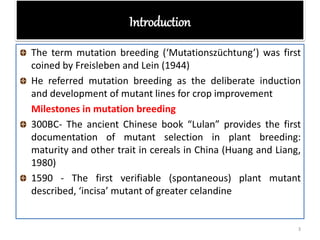
The term mutation breeding (‘Mutationszüchtung’) was first
coined by Freisleben and Lein (1944)
He referred mutation breeding as the deliberate induction
and development of mutant lines for crop improvement
Milestones in mutation breeding
300BC- The ancient Chinese book “Lulan” provides the first
documentation of mutant selection in plant breeding:
maturity and other trait in cereals in China (Huang and Liang,
1980)
1590 - The first verifiable (spontaneous) plant mutant
described, ‘incisa’ mutant of greater celandine
3
1667 -The first known description of a graft-chimera; Bizarria-
orange, Florence, Italy
1901-1904 - de Vries suggests and promotes radiation to
induce mutations in plants and animals
1907-Cramer publishes extensive examples of spontaneous
mutants in crop plants
1927 - First proof of induced mutations in plants; radium ray
treatment of Datura stramonium (Gager and Blakeslee)
1927 - Muller working with Drosphila provides proof of
mutation induction by X-rays Muller champions induced
mutation for animal and plant breeding and opens a new era
in genetics and breeding
1928 Stadler publishes the first results of mutation induction
in crop plants, barley, maize, wheat and oat, but is sceptical
about the use of induced mutation for crop improvement
4
1936 The first induced mutant variety is released, tobacco
var. ‘Chlorina’ using X-rays in Indonesia (then the Dutch
East Indes)
1942 First report of induced disease resistance in a crop
plant; X-ray induced mildew resistance in barley
(Freisleben and Lein, 1942)
1944/46 First reports of chemical induced mutation
(Auerbach and Robson, 1944)
1949 First plant mutation experiments using 60Co gamma
ray installations
1954 The first release of a mutant variety in a vegetatively
propagated crop: tulip var. Faraday with an improved
flower colour and pattern (see van Harten and Broertjes,
1989)
2000-2009 Development of high-throughput genotyping
and phenotyping using automated, robotic and
computerised systems
2000 onwards Development of TILLING populations
5
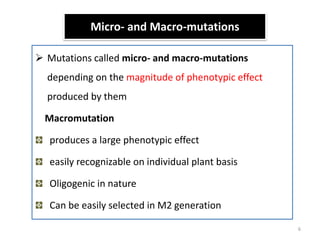
 Mutations called micro- and macro-mutations
depending on the magnitude of phenotypic effect
produced by them
Macromutation
produces a large phenotypic effect
easily recognizable on individual plant basis
Oligogenic in nature
Can be easily selected in M2 generation
Micro- and Macro-mutations
6
Micromutations
Produces Small phenotypic effect
Cannot be recognizable on individual plant basis
Detected only in group of plants and need treatment of
statistical data
Polygenic nature and selection delays till M3
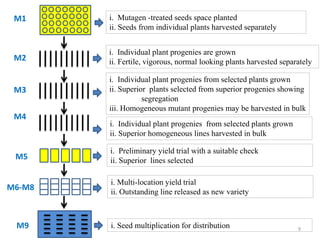
M1
M2
M3
M4
M5
M6-M8
M9
i. Mutagen -treated seeds space planted
ii. Seeds from individual plants harvested separately
i. Individual plant progenies are grown
ii. Fertile, vigorous, normal looking plants harvested separately
i. Individual plant progenies from selected plants grown
ii. Superior plants selected from superior progenies showing
segregation
iii. Homogeneous mutant progenies may be harvested in bulk
i. Individual plant progenies from selected plants grown
ii. Superior homogeneous lines harvested in bulk
i. Preliminary yield trial with a suitable check
ii. Superior lines selected
i. Multi-location yield trial
ii. Outstanding line released as new variety
i. Seed multiplication for distribution 9
1.Selection of the variety for Mutagen treatment
It should be
the best
variety
available in
crop
Seed shold be
pure
Oladosu et al, 2016
10
2.Part of the plant to be treated
Seeds
Pollen grains
Vegetative propagules
Corns
bulbs
complete plants
 Mutagen Treatments
 reduces germination
 growth rate
 vigour &
 fertility
 Mutagens generally induce a high frequency of chromosomal
changes and meiotic and mitotic irregularities
3. Dose of mutagen
12
Optimum mutagen dose is one, which produces maximum
frequency of mutations and causes the minimum killing
 Close to LD50 dose is optimum
 Varies with crops eg:- 46 krad for Vicia faba , 120-140 krad
for Brassica napus
 varies with mutagens
eg: EMS – 0.3-1.5 %, for 2-6 hours
13
Optimum dose rate of physical and chemical mutagens for
seed treatment of cereals
14
Handling of segregating population
M1 generation
Seeds treated with chemical mutagens should be
washed thoroughly and be planted as soon as possible
Large M1 generation is raised from treated seeds
(Wider spacing)
E.g :- 25,000 plants are to be grown to obtain a
useful mutation in M1 generation
Mutagens with high mutation frequency - M1
generation size can be reduced
R. Roychowdhury and J. Tah., 2013
Continued......
The M1 plants should not be allowed to cross
pollinate
M1 population should be planted 75-100 m apart
from the parental or other genotypes of the same
crop species
Mechanical isolation
M1 generation Dominant mutations are selected
each plant selfed and harvested separately for M2
M2 generation
Two methods of sowing M2 generation can be
followed
M1 plant to row where all seeds produced from a
single plant are grown in row
M1 spike or branch to row,
Oligogenic mutants with distinct features are
identified and selected
Screening/selection
Mainly three types screening/selection techniques in
M2 and subsequent generation
i) Visual
ii) Mechanical/Physical
iii) Other methods
i) Visual screening
-most effective and efficient method for
identifying mutant phenotypes
-Visual selection often is the prime basis for
selecting for disease resistance, earliness,
plant height, colour changes, ion-shattering,
adaptation to soil, climate, growing period etc.
ii) Mechanical/Physical
-Very efficient for seed size, shape, weight, density,
etc., using appropriate sieving machinery
Iii) Other methods
chemical, biochemical, physiological etc.
E.g.- Low alkaloid content mutants can be
selected using colorimetric tests
-chromatographic or electrophoresis techniques
may be used to select isolate protein variants
Methods for Validation of mutants
Genome-wide chips
Difference screening
Microarray
PCR screening
TILLING and ECO-TILLING
21
Mutation breeding for Biotic and Abiotic stress
Methods for generating mutant varieties
mutagenesis
Forward genetics
-chemicals
-radiation
Reverse genetics
Insertional mutagenesis
- Agrobacterium mediated transformation
- Virus induced gene silencing
- RNA mediated interference
- transposon tagging
TILLING
Next generation sequencing
Breeding for disease resistance
Numerous mutants have been developed through
mutation induction, showing enhanced resistance to
various diseases (virus, bacterial, and to some extent
fungi)
E.g.: locus (ml-o) - located on the short arm of
chromosome 4H in barley
Induced mutations at the locus confers resistance to
powdery mildew and barley yellow mosaic virus
Chen et al, 2014
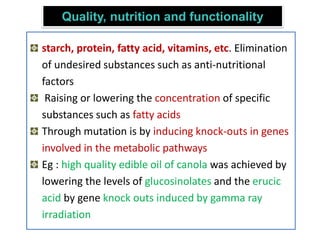
Quality, nutrition and functionality
starch, protein, fatty acid, vitamins, etc. Elimination
of undesired substances such as anti-nutritional
factors
Raising or lowering the concentration of specific
substances such as fatty acids
Through mutation is by inducing knock-outs in genes
involved in the metabolic pathways
Eg : high quality edible oil of canola was achieved by
lowering the levels of glucosinolates and the erucic
acid by gene knock outs induced by gamma ray
irradiation
Distribution of mutant crop varieties by
continents
IAEA mutant database, http://mvgs.iaea.org (2015)
Number of mutant varieties released in the
world
https://mvd.iaea.org/#!Search?page=1&size=15&sortby=Name&sort=ASC&Criteria[0][f
ield]=Country&Criteria[0][val]=136 28
Officially released mutant varieties in the FAO/IAEA
Mutant Varieties Database, July 2015
INDIA Mutant cultivars
popular mutant cultivars of chickpea
developed in India
Variety Release year Main improved attributes
Pusa-408 (Ajay) 1985, Resistant to Ascochyta blight,
high yield, profuse branching,
semi erect, maturity 140-155 d
Pusa-413 (Atul) 1985, Resistant to Fusarium wilt,
stunt virus & foot rot, high yield,
profuse branching, semi erect,
maturity 130-140 days
Pusa-417 (Girnar) 1985, High resistance to Fusarium wilt
& moderate resistance to
Ascochyta blight, stunt virus,
high yield, profuse branching,
maturity 110-130 days
Kharkwal M. C. et al (1985)
Leading rice varieties obtained by mutation breeding
Mutant rice varieties released in India for cultivation
 Gamma radiation-induced rice mutants were
released in India as high-yielding varieties under the
series ‘PNR’.
 Two early ripening and aromatic mutation- derived
rice varieties ‘PNR381’ and ‘PNR102’ currently
popular in Haryana and UP
Mutant Varieties database https://mvd.iaea.org/#!Home
The primary research centres and institutes in
India that participated in the development and
release of various mutants
 Indian Agricultural Research Institute (IARI)- New delhi
 Bhabha Atomic Research Centre- Mumbai
 Tamil Nadu Agricultural University –TN and
 National Botanical Research Institute – Lucknow, UP
Advantages
Possible to achieve instant progress in elite material
Single trait improvements can be made to an
established variety preferred by producers,
processors and/or consumers
Limited breeding effort required
Novel variation can be produced
Single gene mutants with no negative pleiotropic
effects are possible
For some mutagenic treatments such as gamma and
X-ray, there is neither residual radiation nor chemical
contamination of the treated material.
The treated material is safe to handle
Specific genes/traits can be targeted
Possible to calculate chances of success (mutation
frequency)
Limitations...
The process is generally random and unpredictable
Useful mutants are rare and predominantly recessive
Large population sizes and effective mass screening
methods are required to select rare mutants
Mutants can have strong negative pleiotropic effects
on other traits
Continued.....
Health risks: handling, chemical mutagens; radiations,
fast neutrons treatments
Most mutants are of no use to breeding even if a large
number of mutants can be produced
Field trialling and germplasm storage can be expensive
and require a lot of space and careful management if large
mutant populations are handled
References....
Text books
Plant breeding – B. D. Singh
Plant Mutation Breeding and Biotechnology - Edited
by Q.Y. Shu, B. P. Forster, H. Nakagawa
Review papers
 Principle and application of plant mutagenesis in crop
improvement: a review – By Oladosu et al., 2015
 Mutagenesis - By Rajnikant Mishra (2012)
Mutation breeding ppt

Mutation breeding ppt

  • 1.
  • 2.
    Introduction Micro- and Macro-mutations Proceduresfor micro mutations breeding/polygenic Handling of segregating population Screening/selection Breeding for A Biotic and Biotic stress Methods for Validation of mutants Achievements of mutation breeding Advantages and limitations of breeding Contents...... 2
  • 3.
    Introduction The term mutationbreeding (‘Mutationszüchtung’) was first coined by Freisleben and Lein (1944) He referred mutation breeding as the deliberate induction and development of mutant lines for crop improvement Milestones in mutation breeding 300BC- The ancient Chinese book “Lulan” provides the first documentation of mutant selection in plant breeding: maturity and other trait in cereals in China (Huang and Liang, 1980) 1590 - The first verifiable (spontaneous) plant mutant described, ‘incisa’ mutant of greater celandine 3
  • 4.
    1667 -The firstknown description of a graft-chimera; Bizarria- orange, Florence, Italy 1901-1904 - de Vries suggests and promotes radiation to induce mutations in plants and animals 1907-Cramer publishes extensive examples of spontaneous mutants in crop plants 1927 - First proof of induced mutations in plants; radium ray treatment of Datura stramonium (Gager and Blakeslee) 1927 - Muller working with Drosphila provides proof of mutation induction by X-rays Muller champions induced mutation for animal and plant breeding and opens a new era in genetics and breeding 1928 Stadler publishes the first results of mutation induction in crop plants, barley, maize, wheat and oat, but is sceptical about the use of induced mutation for crop improvement 4
  • 5.
    1936 The firstinduced mutant variety is released, tobacco var. ‘Chlorina’ using X-rays in Indonesia (then the Dutch East Indes) 1942 First report of induced disease resistance in a crop plant; X-ray induced mildew resistance in barley (Freisleben and Lein, 1942) 1944/46 First reports of chemical induced mutation (Auerbach and Robson, 1944) 1949 First plant mutation experiments using 60Co gamma ray installations 1954 The first release of a mutant variety in a vegetatively propagated crop: tulip var. Faraday with an improved flower colour and pattern (see van Harten and Broertjes, 1989) 2000-2009 Development of high-throughput genotyping and phenotyping using automated, robotic and computerised systems 2000 onwards Development of TILLING populations 5
  • 6.
     Mutations calledmicro- and macro-mutations depending on the magnitude of phenotypic effect produced by them Macromutation produces a large phenotypic effect easily recognizable on individual plant basis Oligogenic in nature Can be easily selected in M2 generation Micro- and Macro-mutations 6
  • 7.
    Micromutations Produces Small phenotypiceffect Cannot be recognizable on individual plant basis Detected only in group of plants and need treatment of statistical data Polygenic nature and selection delays till M3
  • 9.
    M1 M2 M3 M4 M5 M6-M8 M9 i. Mutagen -treatedseeds space planted ii. Seeds from individual plants harvested separately i. Individual plant progenies are grown ii. Fertile, vigorous, normal looking plants harvested separately i. Individual plant progenies from selected plants grown ii. Superior plants selected from superior progenies showing segregation iii. Homogeneous mutant progenies may be harvested in bulk i. Individual plant progenies from selected plants grown ii. Superior homogeneous lines harvested in bulk i. Preliminary yield trial with a suitable check ii. Superior lines selected i. Multi-location yield trial ii. Outstanding line released as new variety i. Seed multiplication for distribution 9
  • 10.
    1.Selection of thevariety for Mutagen treatment It should be the best variety available in crop Seed shold be pure Oladosu et al, 2016 10
  • 11.
    2.Part of theplant to be treated Seeds Pollen grains Vegetative propagules Corns bulbs complete plants
  • 12.
     Mutagen Treatments reduces germination  growth rate  vigour &  fertility  Mutagens generally induce a high frequency of chromosomal changes and meiotic and mitotic irregularities 3. Dose of mutagen 12
  • 13.
    Optimum mutagen doseis one, which produces maximum frequency of mutations and causes the minimum killing  Close to LD50 dose is optimum  Varies with crops eg:- 46 krad for Vicia faba , 120-140 krad for Brassica napus  varies with mutagens eg: EMS – 0.3-1.5 %, for 2-6 hours 13
  • 14.
    Optimum dose rateof physical and chemical mutagens for seed treatment of cereals 14
  • 15.
    Handling of segregatingpopulation M1 generation Seeds treated with chemical mutagens should be washed thoroughly and be planted as soon as possible Large M1 generation is raised from treated seeds (Wider spacing) E.g :- 25,000 plants are to be grown to obtain a useful mutation in M1 generation Mutagens with high mutation frequency - M1 generation size can be reduced R. Roychowdhury and J. Tah., 2013
  • 16.
    Continued...... The M1 plantsshould not be allowed to cross pollinate M1 population should be planted 75-100 m apart from the parental or other genotypes of the same crop species Mechanical isolation M1 generation Dominant mutations are selected each plant selfed and harvested separately for M2
  • 17.
    M2 generation Two methodsof sowing M2 generation can be followed M1 plant to row where all seeds produced from a single plant are grown in row M1 spike or branch to row, Oligogenic mutants with distinct features are identified and selected
  • 18.
    Screening/selection Mainly three typesscreening/selection techniques in M2 and subsequent generation i) Visual ii) Mechanical/Physical iii) Other methods
  • 19.
    i) Visual screening -mosteffective and efficient method for identifying mutant phenotypes -Visual selection often is the prime basis for selecting for disease resistance, earliness, plant height, colour changes, ion-shattering, adaptation to soil, climate, growing period etc.
  • 20.
    ii) Mechanical/Physical -Very efficientfor seed size, shape, weight, density, etc., using appropriate sieving machinery Iii) Other methods chemical, biochemical, physiological etc. E.g.- Low alkaloid content mutants can be selected using colorimetric tests -chromatographic or electrophoresis techniques may be used to select isolate protein variants
  • 21.
    Methods for Validationof mutants Genome-wide chips Difference screening Microarray PCR screening TILLING and ECO-TILLING 21
  • 22.
    Mutation breeding forBiotic and Abiotic stress
  • 23.
    Methods for generatingmutant varieties mutagenesis Forward genetics -chemicals -radiation Reverse genetics Insertional mutagenesis - Agrobacterium mediated transformation - Virus induced gene silencing - RNA mediated interference - transposon tagging TILLING Next generation sequencing
  • 24.
    Breeding for diseaseresistance Numerous mutants have been developed through mutation induction, showing enhanced resistance to various diseases (virus, bacterial, and to some extent fungi) E.g.: locus (ml-o) - located on the short arm of chromosome 4H in barley Induced mutations at the locus confers resistance to powdery mildew and barley yellow mosaic virus Chen et al, 2014
  • 25.
    Quality, nutrition andfunctionality starch, protein, fatty acid, vitamins, etc. Elimination of undesired substances such as anti-nutritional factors Raising or lowering the concentration of specific substances such as fatty acids Through mutation is by inducing knock-outs in genes involved in the metabolic pathways Eg : high quality edible oil of canola was achieved by lowering the levels of glucosinolates and the erucic acid by gene knock outs induced by gamma ray irradiation
  • 27.
    Distribution of mutantcrop varieties by continents IAEA mutant database, http://mvgs.iaea.org (2015)
  • 28.
    Number of mutantvarieties released in the world https://mvd.iaea.org/#!Search?page=1&size=15&sortby=Name&sort=ASC&Criteria[0][f ield]=Country&Criteria[0][val]=136 28
  • 30.
    Officially released mutantvarieties in the FAO/IAEA Mutant Varieties Database, July 2015
  • 31.
  • 32.
    popular mutant cultivarsof chickpea developed in India Variety Release year Main improved attributes Pusa-408 (Ajay) 1985, Resistant to Ascochyta blight, high yield, profuse branching, semi erect, maturity 140-155 d Pusa-413 (Atul) 1985, Resistant to Fusarium wilt, stunt virus & foot rot, high yield, profuse branching, semi erect, maturity 130-140 days Pusa-417 (Girnar) 1985, High resistance to Fusarium wilt & moderate resistance to Ascochyta blight, stunt virus, high yield, profuse branching, maturity 110-130 days Kharkwal M. C. et al (1985)
  • 33.
    Leading rice varietiesobtained by mutation breeding
  • 34.
    Mutant rice varietiesreleased in India for cultivation
  • 35.
     Gamma radiation-inducedrice mutants were released in India as high-yielding varieties under the series ‘PNR’.  Two early ripening and aromatic mutation- derived rice varieties ‘PNR381’ and ‘PNR102’ currently popular in Haryana and UP Mutant Varieties database https://mvd.iaea.org/#!Home
  • 36.
    The primary researchcentres and institutes in India that participated in the development and release of various mutants  Indian Agricultural Research Institute (IARI)- New delhi  Bhabha Atomic Research Centre- Mumbai  Tamil Nadu Agricultural University –TN and  National Botanical Research Institute – Lucknow, UP
  • 37.
    Advantages Possible to achieveinstant progress in elite material Single trait improvements can be made to an established variety preferred by producers, processors and/or consumers Limited breeding effort required Novel variation can be produced Single gene mutants with no negative pleiotropic effects are possible For some mutagenic treatments such as gamma and X-ray, there is neither residual radiation nor chemical contamination of the treated material. The treated material is safe to handle Specific genes/traits can be targeted Possible to calculate chances of success (mutation frequency)
  • 38.
    Limitations... The process isgenerally random and unpredictable Useful mutants are rare and predominantly recessive Large population sizes and effective mass screening methods are required to select rare mutants Mutants can have strong negative pleiotropic effects on other traits
  • 39.
    Continued..... Health risks: handling,chemical mutagens; radiations, fast neutrons treatments Most mutants are of no use to breeding even if a large number of mutants can be produced Field trialling and germplasm storage can be expensive and require a lot of space and careful management if large mutant populations are handled
  • 40.
    References.... Text books Plant breeding– B. D. Singh Plant Mutation Breeding and Biotechnology - Edited by Q.Y. Shu, B. P. Forster, H. Nakagawa Review papers  Principle and application of plant mutagenesis in crop improvement: a review – By Oladosu et al., 2015  Mutagenesis - By Rajnikant Mishra (2012)

Editor's Notes

  • #14 LD50 dose is the dose of mutagen which would kill 50% of the treated individuals
  • #16 because recombination will lead to generation of new variability that will be difficult to separate from effects of mutation
  • #26 Quality usually refers to the composition of organic compounds produced and stored by plants, such as starch, protein, fatty acid, vitamins, etc.
  • #39 e.g. high lysine/protein in barley and low lignin/high digestibility in maize are associated with low yields