What makes an organism the way that it is? NATURE vs. NURTURE · Traits that are expressed through genes can be inherited. Characteristics that are acquired through environmental influences, such as injuries or practiced skills, cannot be inherited.
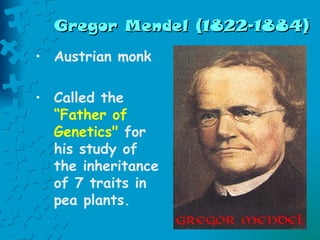
Gregor Mendel (1822-1884)   Austrian monk Called the  “Father of Genetics"  for his study of the inheritance of 7 traits in pea plants.
Gregor Mendel (1822-1884) The traits that Mendel chose to study were easily observable in 2 distinct forms. EX.:  Stem Height - tall vs. short Pod Shape - round vs. wrinkled Flower Color – white vs. purple Seed Color – green vs. yellow
Gregor Mendel (1822-1884)   The significance of Mendel's work was not recognized until the turn of the 20 th  century Its rediscovery prompted the foundation of genetics.
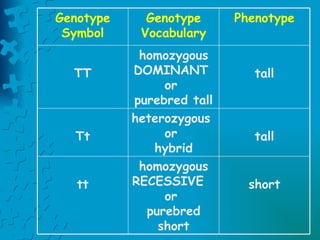
Genotype Symbol Genotype Vocabulary Phenotype TT homozygous DOMINANT  or  purebred tall tall Tt heterozygous  or  hybrid tall tt homozygous RECESSIVE   or  purebred short short
Geneticists apply mathematical  principles of probability  to Mendel’s laws of heredity in order to predict the results of simple genetic crosses
Mendel’s laws of heredity are based on his mathematical analysis of observations of patterns of the inheritance of traits. The laws of probability govern simple genetic recombinations. To see this we use a  Punnett Square
Punnett Squares   To complete a Punnett square, we use a letter to represent each allele.  We represent the dominant allele with a capital letter, and the recessive allele is given the same letter but in lowercase.
Punnett Squares   For the pea plant flowers:   dominant:  purple color =  P    recessive:  white color = p.  If both parents are purebred, then the purple colored parent must be  PP  and the white colored parent must be  pp .
How can we predict these results? We complete the possible combinations. P p P P P p p p P P p p Homozygous-recessive Homozygous-dominant
These results show that all the F 1  (1 st  filial generation) offspring are all purple colored hybrids. 100% purple offspring P P p Pp Pp p Pp Pp
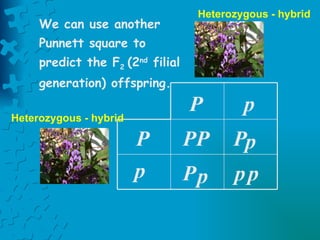
P P P P p p p p P p P p We can use another Punnett square to predict the F 2  (2 nd  filial generation) offspring. Heterozygous - hybrid Heterozygous - hybrid
P P P P p p p p P p P p The results are always mathematically the same, a  3:1   ratio with  75% purple & 25% white offspring Heterozygous - hybrid Heterozygous - hybrid Phenotypic ratio 3:1 Genotypic ratio 1:2:1
codominance   Not all alleles are dominant and recessive.  Some alleles are equally strong and neither are masked by the other.  Alleles which are equally strong are said to be  " codominant " .
codominance   When both alleles are present, they are both expressed in the phenotype. The hybrid is a blend of both alleles. When expressing codominant alleles, both alleles are represented by  different capitalized letters .
R W R R R W W W R R W W Homozygous Homozygous Codominance:   F 1  generation
R W R R R W W W R R W W Codominance:   F 1  generation 100% pink offspring
R R R R W W W W R W R W Heterozygous Heterozygous Codominance:   F 2  generation
R R R R W W W W R W R W Heterozygous Codominance:   F 2  generation A 1:2 :1   ratio with  25% red, 50% pink & 25% white offspring Heterozygous
I A I B I B I A   I O I O I O I O I A I O I B I O   Codominance: in humans   Blood Type: phenotypic ratio 1:1:1:1 1 type A 1 type B 1 type AB 1 type O
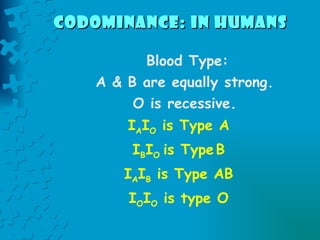
Codominance: in humans   Blood Type: A & B are equally strong. O is recessive. I A I O  is Type A I B I O  is Type   B I A I B  is Type AB I O I O  is type O

Genetics 2

  • 1.
    What makes anorganism the way that it is? NATURE vs. NURTURE · Traits that are expressed through genes can be inherited. Characteristics that are acquired through environmental influences, such as injuries or practiced skills, cannot be inherited.
  • 2.
    Gregor Mendel (1822-1884) Austrian monk Called the “Father of Genetics" for his study of the inheritance of 7 traits in pea plants.
  • 3.
    Gregor Mendel (1822-1884)The traits that Mendel chose to study were easily observable in 2 distinct forms. EX.: Stem Height - tall vs. short Pod Shape - round vs. wrinkled Flower Color – white vs. purple Seed Color – green vs. yellow
  • 4.
    Gregor Mendel (1822-1884) The significance of Mendel's work was not recognized until the turn of the 20 th century Its rediscovery prompted the foundation of genetics.
  • 5.
    Genotype Symbol GenotypeVocabulary Phenotype TT homozygous DOMINANT or purebred tall tall Tt heterozygous or hybrid tall tt homozygous RECESSIVE  or purebred short short
  • 6.
    Geneticists apply mathematical principles of probability to Mendel’s laws of heredity in order to predict the results of simple genetic crosses
  • 7.
    Mendel’s laws ofheredity are based on his mathematical analysis of observations of patterns of the inheritance of traits. The laws of probability govern simple genetic recombinations. To see this we use a Punnett Square
  • 8.
    Punnett Squares To complete a Punnett square, we use a letter to represent each allele. We represent the dominant allele with a capital letter, and the recessive allele is given the same letter but in lowercase.
  • 9.
    Punnett Squares For the pea plant flowers: dominant: purple color = P recessive: white color = p. If both parents are purebred, then the purple colored parent must be PP and the white colored parent must be pp .
  • 10.
    How can wepredict these results? We complete the possible combinations. P p P P P p p p P P p p Homozygous-recessive Homozygous-dominant
  • 11.
    These results showthat all the F 1 (1 st filial generation) offspring are all purple colored hybrids. 100% purple offspring P P p Pp Pp p Pp Pp
  • 12.
    P P PP p p p p P p P p We can use another Punnett square to predict the F 2 (2 nd filial generation) offspring. Heterozygous - hybrid Heterozygous - hybrid
  • 13.
    P P PP p p p p P p P p The results are always mathematically the same, a 3:1 ratio with 75% purple & 25% white offspring Heterozygous - hybrid Heterozygous - hybrid Phenotypic ratio 3:1 Genotypic ratio 1:2:1
  • 14.
    codominance Not all alleles are dominant and recessive. Some alleles are equally strong and neither are masked by the other. Alleles which are equally strong are said to be " codominant " .
  • 15.
    codominance When both alleles are present, they are both expressed in the phenotype. The hybrid is a blend of both alleles. When expressing codominant alleles, both alleles are represented by different capitalized letters .
  • 16.
    R W RR R W W W R R W W Homozygous Homozygous Codominance: F 1 generation
  • 17.
    R W RR R W W W R R W W Codominance: F 1 generation 100% pink offspring
  • 18.
    R R RR W W W W R W R W Heterozygous Heterozygous Codominance: F 2 generation
  • 19.
    R R RR W W W W R W R W Heterozygous Codominance: F 2 generation A 1:2 :1 ratio with 25% red, 50% pink & 25% white offspring Heterozygous
  • 20.
    I A IB I B I A I O I O I O I O I A I O I B I O Codominance: in humans Blood Type: phenotypic ratio 1:1:1:1 1 type A 1 type B 1 type AB 1 type O
  • 21.
    Codominance: in humans Blood Type: A & B are equally strong. O is recessive. I A I O is Type A I B I O is Type B I A I B is Type AB I O I O is type O