



Muscle and exercise
physiology
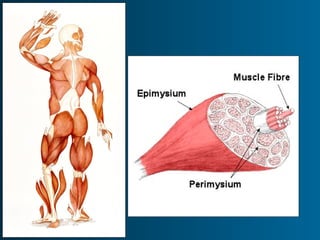
The muscle cell is called
• Myofibril
• Muscle fiber
• Sarcomere
• Fascicle
Lecture plan
• Muscle structure
• Muscle types
• Exercise physiology
• Types of exercise
• Prescribing exercises
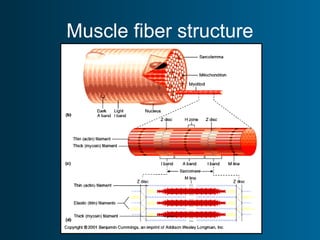
Muscle fiber structure
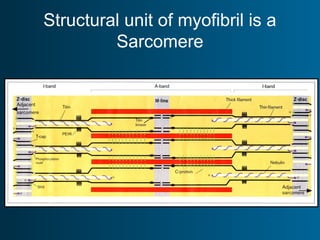
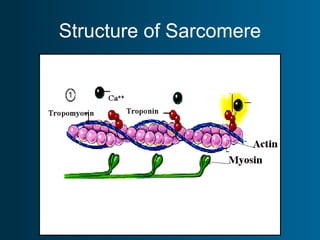
Structural unit of myofibril is a
Sarcomere
Structure of Sarcomere
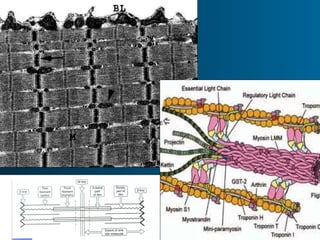
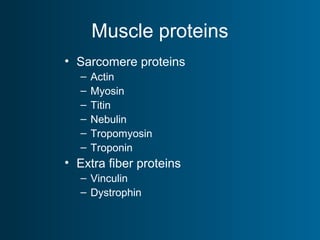
Muscle proteins
• Sarcomere proteins
– Actin
– Myosin
– Titin
– Nebulin
– Tropomyosin
– Troponin
• Extra fiber proteins
– Vinculin
– Dystrophin
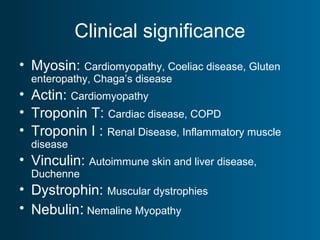
Clinical significance
• Myosin: Cardiomyopathy, Coeliac disease, Gluten
enteropathy, Chaga’s disease
• Actin: Cardiomyopathy
• Troponin T: Cardiac disease, COPD
• Troponin I : Renal Disease, Inflammatory muscle
disease
• Vinculin: Autoimmune skin and liver disease,
Duchenne
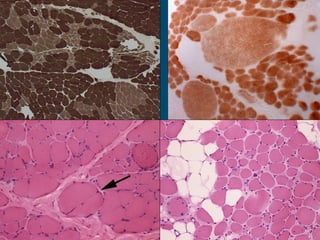
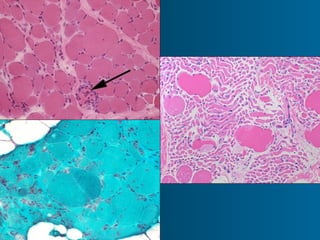
• Dystrophin: Muscular dystrophies
• Nebulin: Nemaline Myopathy
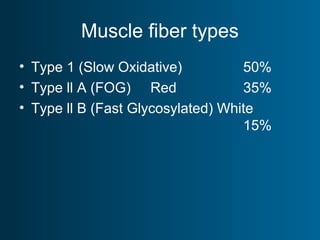
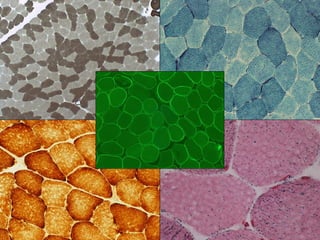
Muscle fiber types
• Type 1 (Slow Oxidative) 50%
• Type ll A (FOG) Red 35%
• Type ll B (Fast Glycosylated) White
15%
Muscle physiology
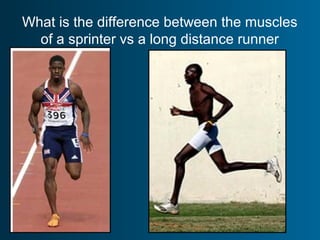
What is the difference between the muscles
of a sprinter vs a long distance runner
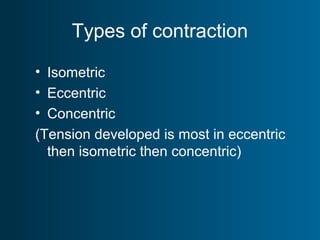
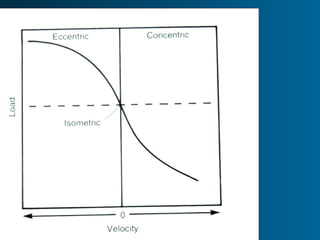
Types of contraction
• Isometric
• Eccentric
• Concentric
(Tension developed is most in eccentric
then isometric then concentric)
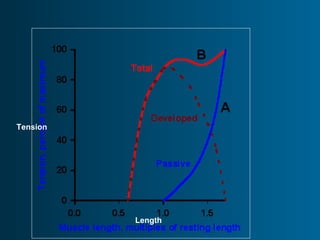
Frank Starlings law
• Force of contraction is proportional to the
stretch
Length
Tension
Define
• Hyperplasia
• Hypertrophy
Exercise physiology
What is therapeutic exercise?
• Customised exercise prescribed for
specific therapeutic benefit
Vestibular exercises, abdominal exercises
Types of exercises
• Strength building (bulk)
• Endurance building
• Mobility improving (ROM)
• Aerobic exercises
• Relaxing (TROM)
• Proprioception and balance improving
Special exercises
Stability improving
Examples
• Strength- weight training
• Endurance- repetitive exercises (cycling,
jogging, swimming)
• Mobility- ROM exercises, stretching
• Relaxing- Yoga
• Aerobic – rhythmic dance
• Proprioception- Swedish ball, Theraband,
inclined plane etc
Stabilisation- core Stabilisation
Composite exercise programmes
• Combine the benefits of all above
• Grade them sequentially
– Start with strength, endurance, stabilisation
and ROM
– Upgrade to proprioception
– Relaxation last
• Ensure that exercise programme is
continued
Which is ideal?
– Structured therapeutic exercise
– Playing basket ball
Rational of exercise therapy
GASS
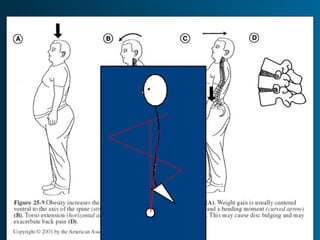
• Generalized well being and weight reduction
removes illness behaviour
• Aerobic activity increases circulation and
psychological well being
• Stretching of muscle and ligaments so that they can
stretch with less pain
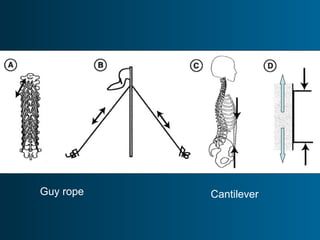
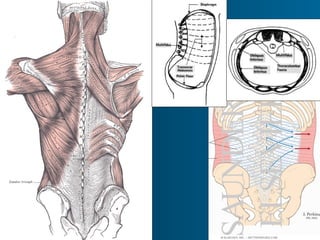
• Strengthening the guy ropes and cantilevers so that
they can bear more load
Am. Academy Neuro Surgeons
Examples
• ACL reconstruction-Goals
– Improve range of movement
– Strengthen the dynamic stabilisers of the
knee
– Improve proprioception of the reconstructed
and natural ligaments
Priority=Stabilization
ACL reconstruction
• ROM: active and passive/ assisted
stretching
• Strengthening: increasing weights-Quads,
Hams, Gastroc
• Proprioceptive: wobble board, Swedish
ball, inclined plane, beech games
Total shoulder replacement
• ROM: active and passive/ assisted
stretching
• Strengthening: increasing weights-Deltoid,
Spinatii, Subscap, Lats, Pecs, Trapezius
• Endurance: increasing cycles for above
• Proprioceptive: classical dancing
• Priority=Stabilization: limiting TROM
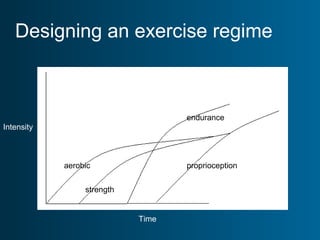
Designing an exercise regime
Time
Intensity
aerobic
strength
endurance
proprioception
• What is the rationale for doing exercises
for IVDP?
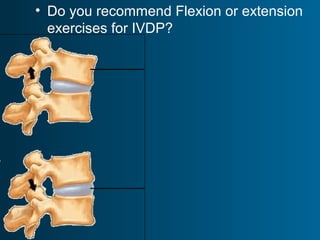
• Do you recommend Flexion or extension
exercises for IVDP?
• Flexion exercises- Williams
• Extension exercises-McKenzie, Cyriax,
Maitland
• Core stabilisation exercises
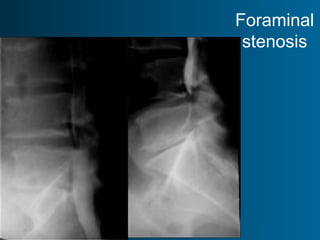
Foraminal
stenosis
Guy rope Cantilever
Prescribing exercises for low back
pain
• Depends on pain pattern
– Fatigue endurance
– Mechanical pain stabilisation
– TROM pain and stiffness stretching
• Depends on Pathology
– Spondylolisthesis no extension
– IVDP sciatic stretch
Goals of exercise therapy in LBP
• Increase stable zone
• Improve mobility
• Improve strength
• Improve endurance (effort tolerance)
• Increase proprioception (prevent injury)
• Empower the patient to help himself
• Prevent deconditioning
Exercise therapy do’s and don’t’s
• Avoid bending
• Avoid lifting
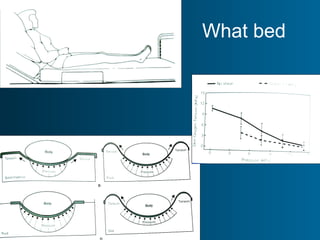
• Sleep on hard bed
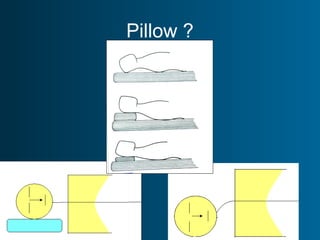
• Avoid pillow
• Avoid 2 wheelers
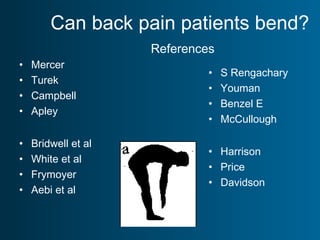
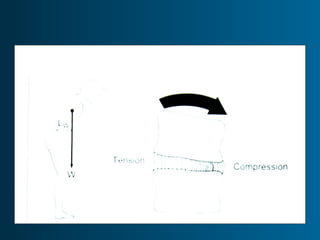
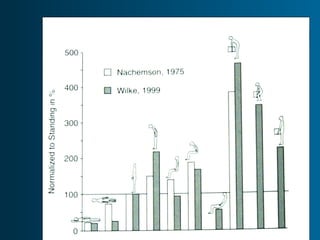
Can back pain patients bend?
References
• Mercer
• Turek
• Campbell
• Apley
• Bridwell et al
• White et al
• Frymoyer
• Aebi et al
• S Rengachary
• Youman
• Benzel E
• McCullough
• Harrison
• Price
• Davidson
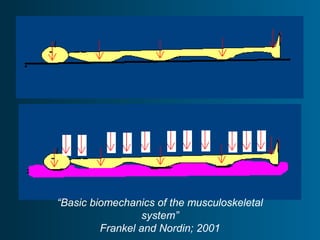
“Basic biomechanics of the musculoskeletal
system”
Frankel and Nordin; 2001
What bed
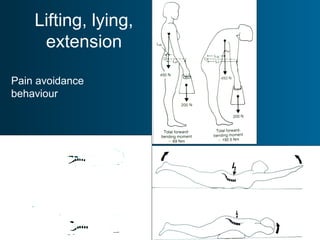
Lifting, lying,
extension
Pain avoidance
behaviour
Pillow ?
Exercise in low back pain
• Should be tailored to the type of pain
pattern
• And the pathology
• Eg:
– Effort intolerance type of pain
– Spondylolisthesis
Effort intolerance
• Example: doing house work; standing for
long, sitting for long
Extensor strengthening without
extension
• Example: extension of the spine causes
impingement of the facets- spondylolysis
• Yet extensor strengthening is important for
spondylolisthesis
• How to achieve this?
• Diagonal lifts; Dying bug exercises
Postural LBP
Postural back pain
Bad posture causing back pain is best
treated by postural corrective devices (car
seat back rest)
Yes
No
Postural LBP
• Of the chronic 80% are P.LBP
• Does not mean bad posture
• Means bad postural muscles
• Reflects urban life style and stressful
living
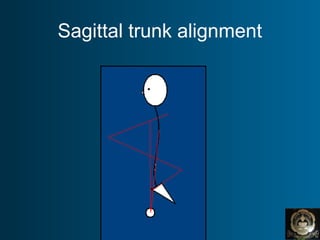
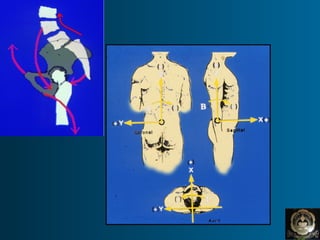
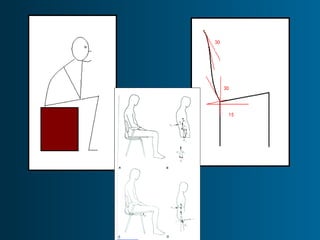
Sagittal trunk alignment
Postural LBP
the person
• Young adult (male> female)
• Obese/ asthenic
• Sedentary employment
• Stressful life style
• Lack of physical activity
• 2 wheeler travel
Postural LBP
Pain pattern
• Dull aching
• Increased by sitting/ standingIncreased by sitting/ standing
• Decreased by walking
• Not aggravated by bending/ squatting
• Bilateral para-spinal pain
• No Radiculopathy
• Normal or non-contributary
investigations
Therapy
• Enhance strength and ENDURANCE of
the postural muscles
Core stabilisation exercises
• Improve pain free range of movements
• Prevent recurrent injury by strength and
proprioception
Summary
• Exercise therapy is not a random act of
ignorance
• Customised, carefully planned, scientific
THANK YOU
Deconditioning syndrome
Illness behaviour

Muscle physiology final

  • 1.
  • 2.
    The muscle cellis called • Myofibril • Muscle fiber • Sarcomere • Fascicle
  • 3.
    Lecture plan • Musclestructure • Muscle types • Exercise physiology • Types of exercise • Prescribing exercises
  • 5.
  • 6.
    Structural unit ofmyofibril is a Sarcomere
  • 8.
  • 9.
    Muscle proteins • Sarcomereproteins – Actin – Myosin – Titin – Nebulin – Tropomyosin – Troponin • Extra fiber proteins – Vinculin – Dystrophin
  • 10.
    Clinical significance • Myosin:Cardiomyopathy, Coeliac disease, Gluten enteropathy, Chaga’s disease • Actin: Cardiomyopathy • Troponin T: Cardiac disease, COPD • Troponin I : Renal Disease, Inflammatory muscle disease • Vinculin: Autoimmune skin and liver disease, Duchenne • Dystrophin: Muscular dystrophies • Nebulin: Nemaline Myopathy
  • 11.
    Muscle fiber types •Type 1 (Slow Oxidative) 50% • Type ll A (FOG) Red 35% • Type ll B (Fast Glycosylated) White 15%
  • 15.
  • 16.
    What is thedifference between the muscles of a sprinter vs a long distance runner
  • 17.
    Types of contraction •Isometric • Eccentric • Concentric (Tension developed is most in eccentric then isometric then concentric)
  • 19.
    Frank Starlings law •Force of contraction is proportional to the stretch
  • 20.
  • 21.
  • 22.
  • 23.
    What is therapeuticexercise? • Customised exercise prescribed for specific therapeutic benefit Vestibular exercises, abdominal exercises
  • 24.
    Types of exercises •Strength building (bulk) • Endurance building • Mobility improving (ROM) • Aerobic exercises • Relaxing (TROM) • Proprioception and balance improving Special exercises Stability improving
  • 25.
    Examples • Strength- weighttraining • Endurance- repetitive exercises (cycling, jogging, swimming) • Mobility- ROM exercises, stretching • Relaxing- Yoga • Aerobic – rhythmic dance • Proprioception- Swedish ball, Theraband, inclined plane etc Stabilisation- core Stabilisation
  • 26.
    Composite exercise programmes •Combine the benefits of all above • Grade them sequentially – Start with strength, endurance, stabilisation and ROM – Upgrade to proprioception – Relaxation last • Ensure that exercise programme is continued
  • 27.
    Which is ideal? –Structured therapeutic exercise – Playing basket ball
  • 28.
    Rational of exercisetherapy GASS • Generalized well being and weight reduction removes illness behaviour • Aerobic activity increases circulation and psychological well being • Stretching of muscle and ligaments so that they can stretch with less pain • Strengthening the guy ropes and cantilevers so that they can bear more load Am. Academy Neuro Surgeons
  • 29.
    Examples • ACL reconstruction-Goals –Improve range of movement – Strengthen the dynamic stabilisers of the knee – Improve proprioception of the reconstructed and natural ligaments Priority=Stabilization
  • 30.
    ACL reconstruction • ROM:active and passive/ assisted stretching • Strengthening: increasing weights-Quads, Hams, Gastroc • Proprioceptive: wobble board, Swedish ball, inclined plane, beech games
  • 31.
    Total shoulder replacement •ROM: active and passive/ assisted stretching • Strengthening: increasing weights-Deltoid, Spinatii, Subscap, Lats, Pecs, Trapezius • Endurance: increasing cycles for above • Proprioceptive: classical dancing • Priority=Stabilization: limiting TROM
  • 32.
    Designing an exerciseregime Time Intensity aerobic strength endurance proprioception
  • 33.
    • What isthe rationale for doing exercises for IVDP?
  • 34.
    • Do yourecommend Flexion or extension exercises for IVDP?
  • 35.
    • Flexion exercises-Williams • Extension exercises-McKenzie, Cyriax, Maitland • Core stabilisation exercises
  • 37.
  • 38.
  • 41.
    Prescribing exercises forlow back pain • Depends on pain pattern – Fatigue endurance – Mechanical pain stabilisation – TROM pain and stiffness stretching • Depends on Pathology – Spondylolisthesis no extension – IVDP sciatic stretch
  • 42.
    Goals of exercisetherapy in LBP • Increase stable zone • Improve mobility • Improve strength • Improve endurance (effort tolerance) • Increase proprioception (prevent injury) • Empower the patient to help himself • Prevent deconditioning
  • 43.
    Exercise therapy do’sand don’t’s • Avoid bending • Avoid lifting • Sleep on hard bed • Avoid pillow • Avoid 2 wheelers
  • 44.
    Can back painpatients bend? References • Mercer • Turek • Campbell • Apley • Bridwell et al • White et al • Frymoyer • Aebi et al • S Rengachary • Youman • Benzel E • McCullough • Harrison • Price • Davidson
  • 46.
    “Basic biomechanics ofthe musculoskeletal system” Frankel and Nordin; 2001
  • 47.
  • 48.
  • 50.
  • 51.
    Exercise in lowback pain • Should be tailored to the type of pain pattern • And the pathology • Eg: – Effort intolerance type of pain – Spondylolisthesis
  • 52.
    Effort intolerance • Example:doing house work; standing for long, sitting for long
  • 53.
    Extensor strengthening without extension •Example: extension of the spine causes impingement of the facets- spondylolysis • Yet extensor strengthening is important for spondylolisthesis • How to achieve this? • Diagonal lifts; Dying bug exercises
  • 54.
  • 55.
    Postural back pain Badposture causing back pain is best treated by postural corrective devices (car seat back rest) Yes No
  • 56.
    Postural LBP • Ofthe chronic 80% are P.LBP • Does not mean bad posture • Means bad postural muscles • Reflects urban life style and stressful living
  • 57.
  • 60.
    Postural LBP the person •Young adult (male> female) • Obese/ asthenic • Sedentary employment • Stressful life style • Lack of physical activity • 2 wheeler travel
  • 61.
    Postural LBP Pain pattern •Dull aching • Increased by sitting/ standingIncreased by sitting/ standing • Decreased by walking • Not aggravated by bending/ squatting • Bilateral para-spinal pain • No Radiculopathy • Normal or non-contributary investigations
  • 62.
    Therapy • Enhance strengthand ENDURANCE of the postural muscles
  • 63.
    Core stabilisation exercises •Improve pain free range of movements • Prevent recurrent injury by strength and proprioception
  • 64.
    Summary • Exercise therapyis not a random act of ignorance • Customised, carefully planned, scientific
  • 65.
  • 66.
  • 67.