PRESENTED BY : JWANIKA VANSIYA
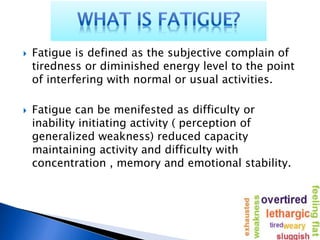
 Fatigue is defined as the subjective complain of
tiredness or diminished energy level to the point
of interfering with normal or usual activities.
 Fatigue can be menifested as difficulty or
inability initiating activity ( perception of
generalized weakness) reduced capacity
maintaining activity and difficulty with
concentration , memory and emotional stability.
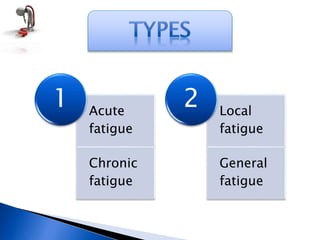
Acute
fatigue
Chronic
fatigue
1 Local
fatigue
General
fatigue
2
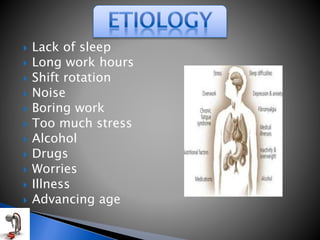
 Lack of sleep
 Long work hours
 Shift rotation
 Noise
 Boring work
 Too much stress
 Alcohol
 Drugs
 Worries
 Illness
 Advancing age
.
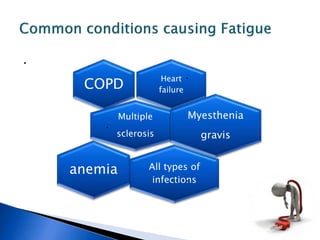
Heart
failure
.
COPD
Multiple
sclerosis
.
Myesthenia
gravis
All types of
infections.
anemia
 Forgetfulness
 Poor communication
 Impaired decision-making skills
 Lack of alertness
 Slow reaction time
 Quick of anger
 No sense of humor
 Lack of interest
 Always tired
history
Physical examination
Laboratory studies
 ID : Age, Gender, Nationality, Occupation
 Chief complain
 Onset : abrupt or gradual, related to event or
illness
 Course : stable, improving or worsening?
 Factors that alleviate or exacerbate symptoms
 Impact on daily life- ability to work
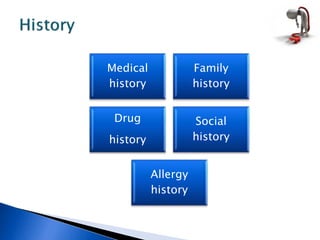
Medical
history
Family
history
Drug
history
Social
history
Allergy
history
 When the fatigue is started, how long it lasts,
and what makes it better or worse?
 Symptoms or side effects, such as pain, the
patient having from the cancer or the
treatments.
 Medicines being taken.
 Sleeping and resting habits.
 Eating habits and changes in appetite or
weight.
 Whether the patient has depression, anxiety
 Health habits and past illnesses and
treatments.
 How the fatigue affects being able to work.
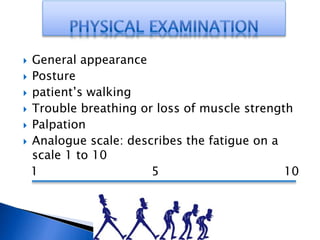
 General appearance
 Posture
 patient’s walking
 Trouble breathing or loss of muscle strength
 Palpation
 Analogue scale: describes the fatigue on a
scale 1 to 10
1 5 10
 Anemia: pallor, tachycardia, systolic ejection
murmur
 Goitre or thyroid nodule: dry skin, delayed
deep tendon reflexes, peri orbital puffiness,
 Hyperthyroidism: weight loss, hyper reflexia,
fine tremor, atrial fibrillation.
 Addison’s disease: hypotension, scar,
pigmentation in skin creases
 Heart failure: elevated jugular venous
pressure, ankle edema
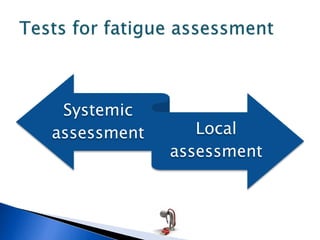
Systemic
assessment Local
assessment
Anaerobic fatigue:
 Assessment of the fatigue during anaerobic
power performance when vigorous exercises
continues for more than few seconds .
 Anaerobic fatigue is the percentage decline in
the power output during the test.
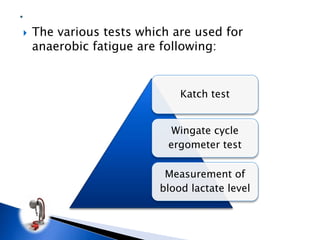
 The various tests which are used for
anaerobic fatigue are following:
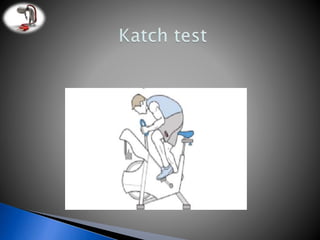
Katch test
Wingate cycle
ergometer test
Measurement of
blood lactate level
 Procedure
 Test scores:
• Peak power output = force * distance
(num of revolutions*distance per revolution
divided by time in minutes)(5secs=o.o83min)
• Anaerobic fatigue=high power output – low power
output divided by high power output* 100
 if a man weighing 73.3 kg performs wingate test
on a Monark cycle ergometer (6.0 m traveled per
pedal revolution) with an applied resistance of
5.5kg (73.3*0.075=5.49 rounded off to 5.5kg),
pedal revolution at 5 secs interval is 12,10,8,7,6,5
(48 total revolution in 30 seconds)
 Peak power output= force*distance divided by time
5.5kg*(12*6)divided by 0.083 min
4753kg.m/min or 776.8 watts
 Anaerobic fatigue=high power output-low power output
divided by high power output * 100
High power output is 776.8 W
Low power output= force*distance divided
by time
5.5 * (5*6) divided by 0.083
1980.8 kg.m/min = 323.7 W
Anaerobic fatigue = 776.8-323.7 divided by 776.8*100=58.3%
 Fatigue is reached the amount of lactate in
the muscle and blood is maximum.
 Measurement of lactate in blood can give an
idea regarding the extent of fatigue.
Measurement of aerobic capacity
• vo2 max = co * arteriovenous o2 diffrence
• Arteriovenous o2=arterial o2- venous o2
Measurement of energy expanditure
• Spirometry testing
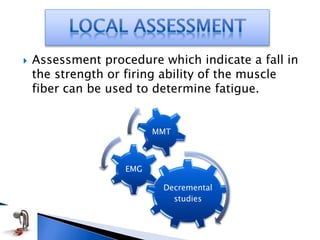
 Assessment procedure which indicate a fall in
the strength or firing ability of the muscle
fiber can be used to determine fatigue.
Decremental
studies
EMG
MMT
 Brief fatigue inventory
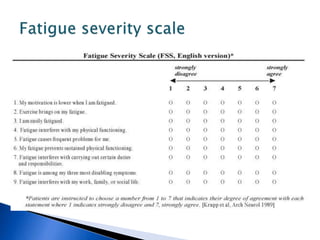
 Fatigue severity scale
 Piper fatigue inventory
 Depending on the findings in the history and
physical examination, blood tests and other
imagine studies may be ordered.
 CBC (complete blood count)
 Blood sugar
 TSH
 Tests for deficiency in vitamin B12, D,folic
acid and iron
 ESR
1. Exercise physiology. McArdle, Katch and
Katch
2. Physiology of sport and exercise. Jack H.
wilmore, W. Lany Kenney.
3. Physiotherapy in neuro-condition. Glady
Fatigue assessment

Fatigue assessment

  • 1.
    PRESENTED BY :JWANIKA VANSIYA
  • 2.
     Fatigue isdefined as the subjective complain of tiredness or diminished energy level to the point of interfering with normal or usual activities.  Fatigue can be menifested as difficulty or inability initiating activity ( perception of generalized weakness) reduced capacity maintaining activity and difficulty with concentration , memory and emotional stability.
  • 3.
  • 4.
     Lack ofsleep  Long work hours  Shift rotation  Noise  Boring work  Too much stress  Alcohol  Drugs  Worries  Illness  Advancing age
  • 5.
  • 6.
     Forgetfulness  Poorcommunication  Impaired decision-making skills  Lack of alertness  Slow reaction time  Quick of anger  No sense of humor  Lack of interest  Always tired
  • 7.
  • 8.
     ID :Age, Gender, Nationality, Occupation  Chief complain  Onset : abrupt or gradual, related to event or illness  Course : stable, improving or worsening?  Factors that alleviate or exacerbate symptoms  Impact on daily life- ability to work
  • 9.
  • 10.
     When thefatigue is started, how long it lasts, and what makes it better or worse?  Symptoms or side effects, such as pain, the patient having from the cancer or the treatments.  Medicines being taken.  Sleeping and resting habits.  Eating habits and changes in appetite or weight.  Whether the patient has depression, anxiety
  • 11.
     Health habitsand past illnesses and treatments.  How the fatigue affects being able to work.
  • 12.
     General appearance Posture  patient’s walking  Trouble breathing or loss of muscle strength  Palpation  Analogue scale: describes the fatigue on a scale 1 to 10 1 5 10
  • 13.
     Anemia: pallor,tachycardia, systolic ejection murmur  Goitre or thyroid nodule: dry skin, delayed deep tendon reflexes, peri orbital puffiness,  Hyperthyroidism: weight loss, hyper reflexia, fine tremor, atrial fibrillation.  Addison’s disease: hypotension, scar, pigmentation in skin creases  Heart failure: elevated jugular venous pressure, ankle edema
  • 14.
  • 15.
    Anaerobic fatigue:  Assessmentof the fatigue during anaerobic power performance when vigorous exercises continues for more than few seconds .  Anaerobic fatigue is the percentage decline in the power output during the test.
  • 16.
     The varioustests which are used for anaerobic fatigue are following: Katch test Wingate cycle ergometer test Measurement of blood lactate level
  • 18.
     Procedure  Testscores: • Peak power output = force * distance (num of revolutions*distance per revolution divided by time in minutes)(5secs=o.o83min) • Anaerobic fatigue=high power output – low power output divided by high power output* 100
  • 19.
     if aman weighing 73.3 kg performs wingate test on a Monark cycle ergometer (6.0 m traveled per pedal revolution) with an applied resistance of 5.5kg (73.3*0.075=5.49 rounded off to 5.5kg), pedal revolution at 5 secs interval is 12,10,8,7,6,5 (48 total revolution in 30 seconds)  Peak power output= force*distance divided by time 5.5kg*(12*6)divided by 0.083 min 4753kg.m/min or 776.8 watts
  • 20.
     Anaerobic fatigue=highpower output-low power output divided by high power output * 100 High power output is 776.8 W Low power output= force*distance divided by time 5.5 * (5*6) divided by 0.083 1980.8 kg.m/min = 323.7 W Anaerobic fatigue = 776.8-323.7 divided by 776.8*100=58.3%
  • 21.
     Fatigue isreached the amount of lactate in the muscle and blood is maximum.  Measurement of lactate in blood can give an idea regarding the extent of fatigue.
  • 22.
    Measurement of aerobiccapacity • vo2 max = co * arteriovenous o2 diffrence • Arteriovenous o2=arterial o2- venous o2 Measurement of energy expanditure • Spirometry testing
  • 23.
     Assessment procedurewhich indicate a fall in the strength or firing ability of the muscle fiber can be used to determine fatigue. Decremental studies EMG MMT
  • 24.
     Brief fatigueinventory  Fatigue severity scale  Piper fatigue inventory
  • 26.
     Depending onthe findings in the history and physical examination, blood tests and other imagine studies may be ordered.  CBC (complete blood count)  Blood sugar  TSH  Tests for deficiency in vitamin B12, D,folic acid and iron  ESR
  • 27.
    1. Exercise physiology.McArdle, Katch and Katch 2. Physiology of sport and exercise. Jack H. wilmore, W. Lany Kenney. 3. Physiotherapy in neuro-condition. Glady