Prepared By :- Dr. Bindesh D. Patel, PT
Deputy Registrar
P P Savani University
Effect of exercise on body systems
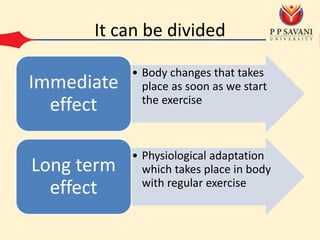
It can be divided
• Body changes that takes
place as soon as we start
the exercise
Immediate
effect
• Physiological adaptation
which takes place in body
with regular exercise
Long term
effect
• The rapid increase in energy requirements during
exercise requires equally rapid circulatory
adjustments to meet the increased need for
oxygen and nutrients to remove the end-products
of metabolism such as carbon dioxide and lactic
acid and to dissipate excess heat.
• The shift in body metabolism occurs through a
coordinated activity of all the systems of the
body: neuromuscular, respiratory, cardiovascular,
metabolic, and hormonal.
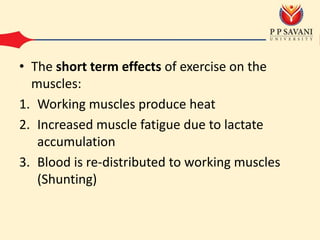
• The short term effects of exercise on the
muscles:
1. Working muscles produce heat
2. Increased muscle fatigue due to lactate
accumulation
3. Blood is re-distributed to working muscles
(Shunting)
Cardiovascular System
• On
– Blood
– Blood volume
– Blood pressure
– Venous return
– Cardiac output
– Heart rate
– Blood flow to skeletal muscle
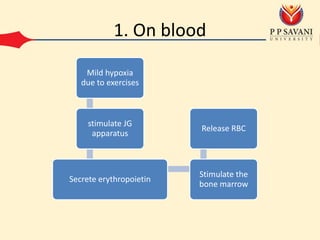
1. On blood
Mild hypoxia
due to exercises
stimulate JG
apparatus
Secrete erythropoietin
Stimulate the
bone marrow
Release RBC
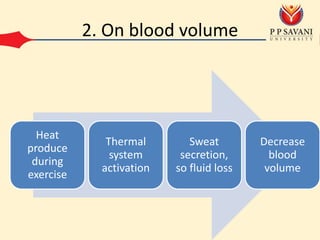
2. On blood volume
Heat
produce
during
exercise
Thermal
system
activation
Sweat
secretion,
so fluid loss
Decrease
blood
volume
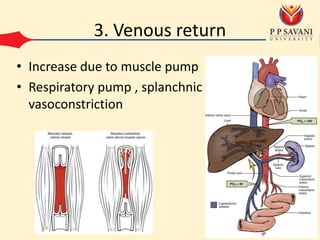
3. Venous return
• Increase due to muscle pump
• Respiratory pump , splanchnic
vasoconstriction
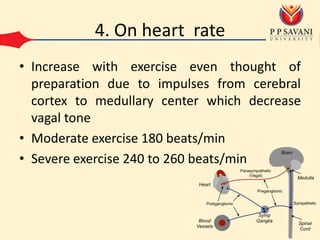
4. On heart rate
• Increase with exercise even thought of
preparation due to impulses from cerebral
cortex to medullary center which decrease
vagal tone
• Moderate exercise 180 beats/min
• Severe exercise 240 to 260 beats/min
• Increase in HR is due to
– Impulses from proprioceptor. These impulses act
through higher centers and increase HR
– Increased CO2 tension which acts through
medullary centers
– Rise in body temperature, which acts on cardiac
centers via hypothalamus, increased temperature
also stimulates SA node directly
– Circulating catecholamines secreted during
exercise
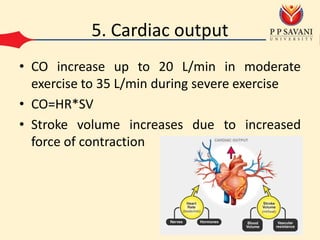
5. Cardiac output
• CO increase up to 20 L/min in moderate
exercise to 35 L/min during severe exercise
• CO=HR*SV
• Stroke volume increases due to increased
force of contraction
6. Blood pressure
• Isotonic exercise
– Increase systolic pressure due to HR and SV but
diastolic pressure reduce due to decrease
peripheral resistance (Vasodilation).
• Isometric exercises
– Increase systolic as well as diastolic pressure due
to increase peripheral resistance
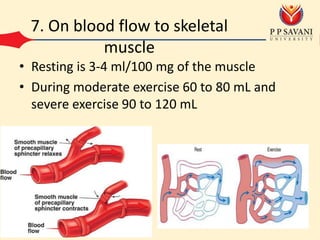
7. On blood flow to skeletal
muscle
• Resting is 3-4 ml/100 mg of the muscle
• During moderate exercise 60 to 80 mL and
severe exercise 90 to 120 mL
RESPIRATORY SYSTEM
• Pulmonary Ventilation
• Diffusion capacity of O2
• Consumption of O2
• O2 dept
• Vo2 max
• Respiratory Quotient
Effect on
1. Pulmonary ventilation :
• It is amount of air that enters and leaves the
lungs in 1 min
• In normal condition PV=TV*RR
6 ltr=500 ml *12
• During exercise
60 ltr=2000 ml* 30
• In severe exercise it can go upto 100 ltr per
minute also.
• Factors responsible for increased MV:
– Higher center
– Chemoreceptor's (central, peripheral)
– Proprioception
– Body Temperature
– Acidosis
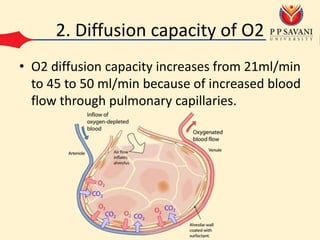
2. Diffusion capacity of O2
• O2 diffusion capacity increases from 21ml/min
to 45 to 50 ml/min because of increased blood
flow through pulmonary capillaries.
3. Consumption of O2
• O2 consumption increases during exercise by
muscles.
• Vasodilatation cause greater blood flow to
muscle
• Which causes greater oxygen supply to muscle
• Oxygen utilization by muscle is directly
proportional to amount of oxygen available.
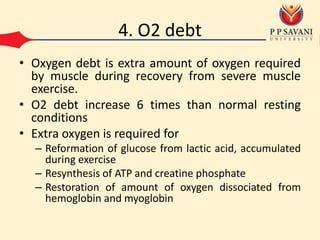
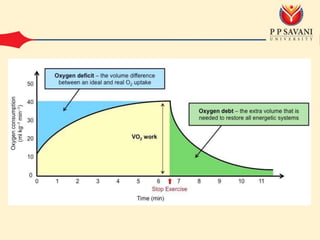
4. O2 debt
• Oxygen debt is extra amount of oxygen required
by muscle during recovery from severe muscle
exercise.
• O2 debt increase 6 times than normal resting
conditions
• Extra oxygen is required for
– Reformation of glucose from lactic acid, accumulated
during exercise
– Resynthesis of ATP and creatine phosphate
– Restoration of amount of oxygen dissociated from
hemoglobin and myoglobin
5. Effect on vo2 max
• It is amount of o2 consumed under maximum
aerobic metabolism.
• VO2 max= CO*Amount of O2 consumed by
muscle
• In normal health
• Male - 35 to 40 ml/kg body weight per minute
• Female - 30 to 35 ml/kg body weight per minute
• During exercise it increase by 50%
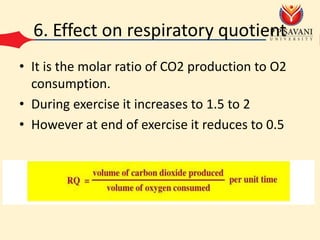
6. Effect on respiratory quotient
• It is the molar ratio of CO2 production to O2
consumption.
• During exercise it increases to 1.5 to 2
• However at end of exercise it reduces to 0.5
Physiological adaptation
• Changes in the cardiovascular and respiratory
systems as well as changes in muscle
metabolism occur following endurance
training. These changes are reflected both at
rest and with exercise.
Metabolic adaptation
• Mitochondria
– It increases number, size and enzyme activity of
mitochondria in muscle fibers, which increases capacity to
generate ATP.
• Fat metabolism
– Exercise increases the oxidation of fatty acids for energy
during rest and sub-maximal exercise.
– Trained muscles capacity also increase to use
intramuscular triacylglycerols as the primary source for
fatty acid oxidation.
– Other factors contribution to fat mobilization
• Greater blood flow
• More fat mobilizing and fat metabolizing enzymes
• Enhanced muscle mitochondrial capacity
• Decreased catecholamine release
• Carbohydrate metabolism
– Increases capacity to oxidize carbohydrate during
maximal exercise.
– Large quantity of pyruvate flow through aerobic
pathway
– Reduced carbohydrate as fuel and increased fatty
acid combustion is result of
• Decreased glycogen use
• Reduced glucose production
• Reduced use of plasma-borne glucose
Muscular System adaptation
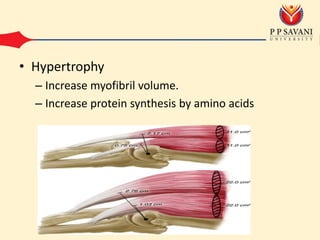
• Hypertrophy
– Increase myofibril volume.
– Increase protein synthesis by amino acids
• Hyperplasia
– Increase no of muscle fiber.
– Due to longitudinal splitting of fiber.
• Muscle fiber adaptation
– Long distance trainer have high protein of slow
twitch muscle fiber.
– Sprinters have fast twitch muscle fiber.
• Body composition
– Strengthening exercise cause decrease fatty mass and
increase lean body mass
– Endurance exercise cause only decrease fatty mass.
• Bone
– Regular weight bearing exercise increases bone
mineral density
– Also prevent risk of fracture, injury, and age related
bone loss changes.
• Connective tissue adaptation
– Increase tensile strength of tendons & ligaments
– Increase Strength in tendon mainly at
myotendinous junction
– Strength in ligament at ligament-bone interface
– Connective tissue around muscle fiber strongly
provide support.
– Eccentric loading exercise improve Non contractile
tissue strength
• Endurance training
– Better capacity to extract Oxygen
– Increase vascularity & capillary bed density
– Increase muscle glycogen store.
• Strength training
– Increase size of muscle fiber
– Increase contractile protein actin & myosin
– Increase production of cross bridges for force
contraction
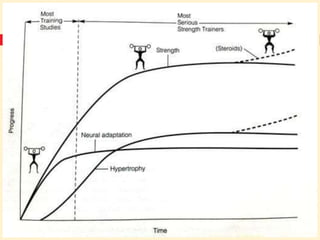
Nervous system adaptation
• Exercise increases Neural drive (It is a measure of
the combined motor unit recruitment and rate
coding of active motor units within a muscle)
• Increased motor unit firing
• Increases nerve excitability and NCV
• Increases dimension of both pre-synaptic and
post-synaptic component of NMJ. These is
associated with a greater number of pre-synaptic
vesicles containing neurotransmitters upon its
release. It results in more efficient nerve to
muscle communication and less fatigue.
Cardiovascular system adaptation
• Changes at rest
– A reduction in the resting pulse rate occurs in some
individuals because of a decrease in sympathetic drive
– A decrease in blood pressure occurs in some
individuals with a decrease in peripheral vascular
resistance. The largest decrease is in systolic blood
pressure and is most apparent in hypertensive
individuals.
– An increase in blood volume and hemoglobin may
occur. This facilitates the oxygen delivery capacity of
the system.
• Changes During Exercise
– A reduction in the pulse rate occurs in some
individuals
– Increased stroke volume may occur because of an
increase in myocardial contractility and an increase in
ventricular volume
– Increased cardiac output may occur as a result of the
increased stroke volume
– Increased extraction of oxygen by the working muscle
occurs in some individuals because of enzymatic and
biochemical changes in the muscle
– Decreased blood flow per kilogram of the working
muscle may occur even though increasing
amounts of blood are shunted to the exercising
muscle. The increase in extraction of oxygen from
the blood compensates for this change.
– Decreased myocardial oxygen consumption (pulse
rate times systolic blood pressure) for any given
intensity of exercise may occur as a result of a
decreased pulse rate with or without a modest
decrease in blood pressure
Respiratory system adaptation
• Changes at Rest
– Larger lung volumes develop because of improved
pulmonary function, with no change in tidal
volume.
– Larger diffusion capacities develop because of
larger lung volumes and greater alveolar-capillary
surface area.
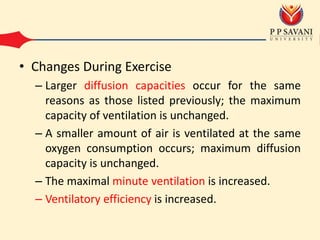
• Changes During Exercise
– Larger diffusion capacities occur for the same
reasons as those listed previously; the maximum
capacity of ventilation is unchanged.
– A smaller amount of air is ventilated at the same
oxygen consumption occurs; maximum diffusion
capacity is unchanged.
– The maximal minute ventilation is increased.
– Ventilatory efficiency is increased.
Endocrine System Adaptation
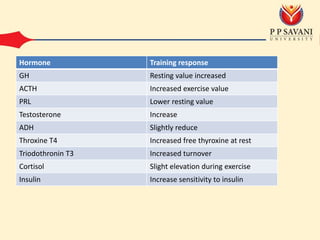
Hormone Training response
GH Resting value increased
ACTH Increased exercise value
PRL Lower resting value
Testosterone Increase
ADH Slightly reduce
Throxine T4 Increased free thyroxine at rest
Triodothronin T3 Increased turnover
Cortisol Slight elevation during exercise
Insulin Increase sensitivity to insulin
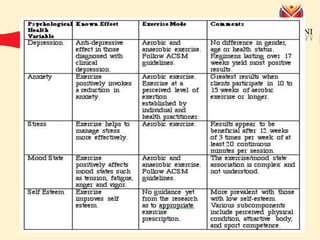
PSYCHOLOGICAL EFFECT
References
• Therapeutic exercise Carolyn kisner & Colby
• Essential of Medical physiology
• Exercise Physiology Integrating theory and application.
• Essentials of exercise physiology
• Exercise physiology McArdle ; Katch and Katch
Thank you
Please share the video and subscribe my
channel.

1. Effect of exercise on Body systems

  • 1.
    Prepared By :-Dr. Bindesh D. Patel, PT Deputy Registrar P P Savani University Effect of exercise on body systems
  • 2.
    It can bedivided • Body changes that takes place as soon as we start the exercise Immediate effect • Physiological adaptation which takes place in body with regular exercise Long term effect
  • 3.
    • The rapidincrease in energy requirements during exercise requires equally rapid circulatory adjustments to meet the increased need for oxygen and nutrients to remove the end-products of metabolism such as carbon dioxide and lactic acid and to dissipate excess heat. • The shift in body metabolism occurs through a coordinated activity of all the systems of the body: neuromuscular, respiratory, cardiovascular, metabolic, and hormonal.
  • 4.
    • The shortterm effects of exercise on the muscles: 1. Working muscles produce heat 2. Increased muscle fatigue due to lactate accumulation 3. Blood is re-distributed to working muscles (Shunting)
  • 5.
  • 6.
    • On – Blood –Blood volume – Blood pressure – Venous return – Cardiac output – Heart rate – Blood flow to skeletal muscle
  • 7.
    1. On blood Mildhypoxia due to exercises stimulate JG apparatus Secrete erythropoietin Stimulate the bone marrow Release RBC
  • 8.
    2. On bloodvolume Heat produce during exercise Thermal system activation Sweat secretion, so fluid loss Decrease blood volume
  • 9.
    3. Venous return •Increase due to muscle pump • Respiratory pump , splanchnic vasoconstriction
  • 10.
    4. On heartrate • Increase with exercise even thought of preparation due to impulses from cerebral cortex to medullary center which decrease vagal tone • Moderate exercise 180 beats/min • Severe exercise 240 to 260 beats/min
  • 11.
    • Increase inHR is due to – Impulses from proprioceptor. These impulses act through higher centers and increase HR – Increased CO2 tension which acts through medullary centers – Rise in body temperature, which acts on cardiac centers via hypothalamus, increased temperature also stimulates SA node directly – Circulating catecholamines secreted during exercise
  • 12.
    5. Cardiac output •CO increase up to 20 L/min in moderate exercise to 35 L/min during severe exercise • CO=HR*SV • Stroke volume increases due to increased force of contraction
  • 13.
    6. Blood pressure •Isotonic exercise – Increase systolic pressure due to HR and SV but diastolic pressure reduce due to decrease peripheral resistance (Vasodilation). • Isometric exercises – Increase systolic as well as diastolic pressure due to increase peripheral resistance
  • 14.
    7. On bloodflow to skeletal muscle • Resting is 3-4 ml/100 mg of the muscle • During moderate exercise 60 to 80 mL and severe exercise 90 to 120 mL
  • 15.
  • 16.
    • Pulmonary Ventilation •Diffusion capacity of O2 • Consumption of O2 • O2 dept • Vo2 max • Respiratory Quotient Effect on
  • 17.
    1. Pulmonary ventilation: • It is amount of air that enters and leaves the lungs in 1 min • In normal condition PV=TV*RR 6 ltr=500 ml *12 • During exercise 60 ltr=2000 ml* 30 • In severe exercise it can go upto 100 ltr per minute also.
  • 18.
    • Factors responsiblefor increased MV: – Higher center – Chemoreceptor's (central, peripheral) – Proprioception – Body Temperature – Acidosis
  • 19.
    2. Diffusion capacityof O2 • O2 diffusion capacity increases from 21ml/min to 45 to 50 ml/min because of increased blood flow through pulmonary capillaries.
  • 20.
    3. Consumption ofO2 • O2 consumption increases during exercise by muscles. • Vasodilatation cause greater blood flow to muscle • Which causes greater oxygen supply to muscle • Oxygen utilization by muscle is directly proportional to amount of oxygen available.
  • 21.
    4. O2 debt •Oxygen debt is extra amount of oxygen required by muscle during recovery from severe muscle exercise. • O2 debt increase 6 times than normal resting conditions • Extra oxygen is required for – Reformation of glucose from lactic acid, accumulated during exercise – Resynthesis of ATP and creatine phosphate – Restoration of amount of oxygen dissociated from hemoglobin and myoglobin
  • 23.
    5. Effect onvo2 max • It is amount of o2 consumed under maximum aerobic metabolism. • VO2 max= CO*Amount of O2 consumed by muscle • In normal health • Male - 35 to 40 ml/kg body weight per minute • Female - 30 to 35 ml/kg body weight per minute • During exercise it increase by 50%
  • 24.
    6. Effect onrespiratory quotient • It is the molar ratio of CO2 production to O2 consumption. • During exercise it increases to 1.5 to 2 • However at end of exercise it reduces to 0.5
  • 25.
    Physiological adaptation • Changesin the cardiovascular and respiratory systems as well as changes in muscle metabolism occur following endurance training. These changes are reflected both at rest and with exercise.
  • 26.
  • 27.
    • Mitochondria – Itincreases number, size and enzyme activity of mitochondria in muscle fibers, which increases capacity to generate ATP. • Fat metabolism – Exercise increases the oxidation of fatty acids for energy during rest and sub-maximal exercise. – Trained muscles capacity also increase to use intramuscular triacylglycerols as the primary source for fatty acid oxidation. – Other factors contribution to fat mobilization • Greater blood flow • More fat mobilizing and fat metabolizing enzymes • Enhanced muscle mitochondrial capacity • Decreased catecholamine release
  • 28.
    • Carbohydrate metabolism –Increases capacity to oxidize carbohydrate during maximal exercise. – Large quantity of pyruvate flow through aerobic pathway – Reduced carbohydrate as fuel and increased fatty acid combustion is result of • Decreased glycogen use • Reduced glucose production • Reduced use of plasma-borne glucose
  • 29.
  • 30.
    • Hypertrophy – Increasemyofibril volume. – Increase protein synthesis by amino acids
  • 31.
    • Hyperplasia – Increaseno of muscle fiber. – Due to longitudinal splitting of fiber. • Muscle fiber adaptation – Long distance trainer have high protein of slow twitch muscle fiber. – Sprinters have fast twitch muscle fiber.
  • 32.
    • Body composition –Strengthening exercise cause decrease fatty mass and increase lean body mass – Endurance exercise cause only decrease fatty mass. • Bone – Regular weight bearing exercise increases bone mineral density – Also prevent risk of fracture, injury, and age related bone loss changes.
  • 33.
    • Connective tissueadaptation – Increase tensile strength of tendons & ligaments – Increase Strength in tendon mainly at myotendinous junction – Strength in ligament at ligament-bone interface – Connective tissue around muscle fiber strongly provide support. – Eccentric loading exercise improve Non contractile tissue strength
  • 34.
    • Endurance training –Better capacity to extract Oxygen – Increase vascularity & capillary bed density – Increase muscle glycogen store. • Strength training – Increase size of muscle fiber – Increase contractile protein actin & myosin – Increase production of cross bridges for force contraction
  • 35.
  • 36.
    • Exercise increasesNeural drive (It is a measure of the combined motor unit recruitment and rate coding of active motor units within a muscle) • Increased motor unit firing • Increases nerve excitability and NCV • Increases dimension of both pre-synaptic and post-synaptic component of NMJ. These is associated with a greater number of pre-synaptic vesicles containing neurotransmitters upon its release. It results in more efficient nerve to muscle communication and less fatigue.
  • 38.
  • 39.
    • Changes atrest – A reduction in the resting pulse rate occurs in some individuals because of a decrease in sympathetic drive – A decrease in blood pressure occurs in some individuals with a decrease in peripheral vascular resistance. The largest decrease is in systolic blood pressure and is most apparent in hypertensive individuals. – An increase in blood volume and hemoglobin may occur. This facilitates the oxygen delivery capacity of the system.
  • 40.
    • Changes DuringExercise – A reduction in the pulse rate occurs in some individuals – Increased stroke volume may occur because of an increase in myocardial contractility and an increase in ventricular volume – Increased cardiac output may occur as a result of the increased stroke volume – Increased extraction of oxygen by the working muscle occurs in some individuals because of enzymatic and biochemical changes in the muscle
  • 41.
    – Decreased bloodflow per kilogram of the working muscle may occur even though increasing amounts of blood are shunted to the exercising muscle. The increase in extraction of oxygen from the blood compensates for this change. – Decreased myocardial oxygen consumption (pulse rate times systolic blood pressure) for any given intensity of exercise may occur as a result of a decreased pulse rate with or without a modest decrease in blood pressure
  • 42.
  • 43.
    • Changes atRest – Larger lung volumes develop because of improved pulmonary function, with no change in tidal volume. – Larger diffusion capacities develop because of larger lung volumes and greater alveolar-capillary surface area.
  • 44.
    • Changes DuringExercise – Larger diffusion capacities occur for the same reasons as those listed previously; the maximum capacity of ventilation is unchanged. – A smaller amount of air is ventilated at the same oxygen consumption occurs; maximum diffusion capacity is unchanged. – The maximal minute ventilation is increased. – Ventilatory efficiency is increased.
  • 45.
  • 46.
    Hormone Training response GHResting value increased ACTH Increased exercise value PRL Lower resting value Testosterone Increase ADH Slightly reduce Throxine T4 Increased free thyroxine at rest Triodothronin T3 Increased turnover Cortisol Slight elevation during exercise Insulin Increase sensitivity to insulin
  • 47.
  • 49.
    References • Therapeutic exerciseCarolyn kisner & Colby • Essential of Medical physiology • Exercise Physiology Integrating theory and application. • Essentials of exercise physiology • Exercise physiology McArdle ; Katch and Katch
  • 50.
  • 51.
    Please share thevideo and subscribe my channel.