MECHANISM OF
CELLULAR INJURY
PREPARED BY :-
ASAVER ALAMGIR
ROLL # 01
JAVERIA AKHTER
ROLL # 15
OUTLINE
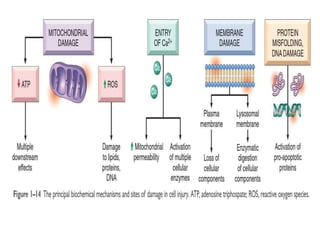
Introduction
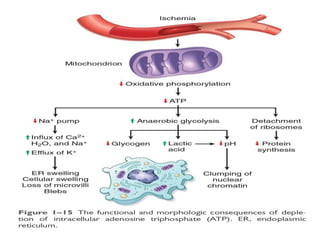
Depletion of ATP
Influx of Calcium
Mitochondrial Damage and Dysfunction
Accumulation of Oxygen-Derived Free
Radicals
Defects in Membrane Permeability
Damage to DNA and Protein
INTRODUCTION
GENERAL PRINCIPLES RELEVANT TO MOST
FORMS OF CELL INJURY :-
1. Cellular injury depends on type of injury, its
duration and its severity. e.g
brief ischemic duration reversible injury
long ischemic duration irreversible injury
2. Consequences of an injurious stimulus depends
on the type, status, adaptability and genetic
makeup of the injured cell .
3 Cell injury due to functional and biochemical
abnormalities in several essential cellular
components.
4 Multiple biochemical alterations by any
injurious insult.
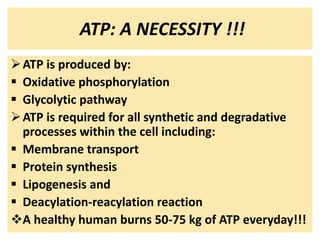
ATP: A NECESSITY !!!
ATP is produced by:
 Oxidative phosphorylation
 Glycolytic pathway
ATP is required for all synthetic and degradative
processes within the cell including:
 Membrane transport
 Protein synthesis
 Lipogenesis and
 Deacylation-reacylation reaction
A healthy human burns 50-75 kg of ATP everyday!!!
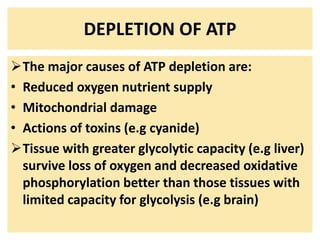
DEPLETION OF ATP
The major causes of ATP depletion are:
• Reduced oxygen nutrient supply
• Mitochondrial damage
• Actions of toxins (e.g cyanide)
Tissue with greater glycolytic capacity (e.g liver)
survive loss of oxygen and decreased oxidative
phosphorylation better than those tissues with
limited capacity for glycolysis (e.g brain)
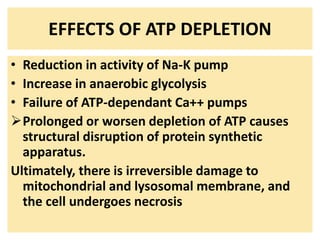
EFFECTS OF ATP DEPLETION
• Reduction in activity of Na-K pump
• Increase in anaerobic glycolysis
• Failure of ATP-dependant Ca++ pumps
Prolonged or worsen depletion of ATP causes
structural disruption of protein synthetic
apparatus.
Ultimately, there is irreversible damage to
mitochondrial and lysosomal membrane, and
the cell undergoes necrosis
MITOCHONDRIAL DAMAGE AND
DYSFUNCTION
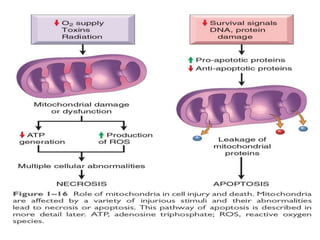
• Failure of oxidative phosphorylation leads to ATP
depletion ultimately leading to necrosis
• Abnormal oxidative phosphorylation also leads to
formation of ROS which have many deleterious
effects
• Mitochondrial damage is often associated with the
formation of high-conductance channel in
mitochondrial membrane called as mitochondrial
permeability transition pore leading to loss of
mitochondrial potential changes
• The mitochondria contain several proteins that
when released into the cytoplasm , tell the cell
there is internal injury and activate a pathway of
apoptosis.
INFLUX OF CALCIUM
• Cytosolic calcium concentration is 10,000 times
lower than the extracellular and intracellular
(mitochondrial and ER) calcium concentration
• Cytosolic free calcium is maintained by ATP-
dependant calcium transporters
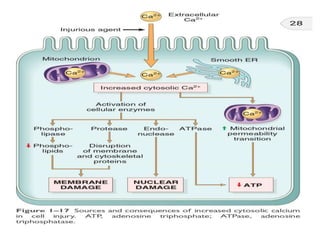
• Ischemia and toxins cause an increase in
cytosolic calcium concentration
• Increase cytosolic calcium activates enzymes
with deleterious cellular effects
• These enzymes include:
1. Phospholipases (cause membrane damage)
2. Proteases ( breakdown both membrane and
cytoskeleton proteins)
3. Endonucleases (cause DNA and chromatin
fragmentation)
4. ATPases (hastening ATP depletion )
• Increase intracellular calcium may also induce
apoptosis , by direct activation of caspases and
by increasing mitochondrial permeability
FREE RADICALS
Free radicals are chemical species with single
unpaired electron in outer orbital . Such
chemical states are:
1. Extremely unstable
2. Highly reactive
When generated in cell they attack nucleic acids
and variety of cellular proteins and lipids. They
also initiate chain reaction.
REACTIVE OXYGEN SPECIES
(ROS)
• ROS are type of oxygen-derived free radicals whose
role in cell injury is well established
• The circumstances involving damage by free
radicals include:
I. Ischemia reperfusions
II. Chemical and radiation injury
III. Toxicity from oxygen and other gases
IV. Cellular aging
V. Microbial killing by phagocytes
VI. Tissue injury caused by inflammatory cells
TYPES AND PATH OF PRODUCTION OF
ROS
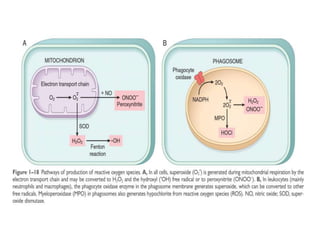
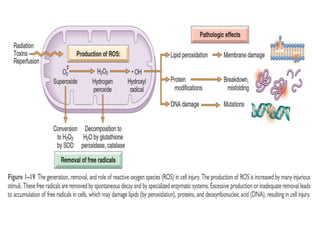
1. By partial reduction oxygen during redox
reaction that occur during mitochondrial
respiration highly reactive but short lived toxic
intermediates are generated which include:
 Superoxide which is converted to H2O2
spontaneously and by action of superoxide
dimutase. In the presence of metal such as Fe++
H2O2 is converted to highly reactive hydroxyl
radical by Fenton reaction.
2. ROS is produced in phagocytic leukocytes
mainly neutrophils and macrophages
RESPIRATORY AND OXIDATIVE
BURST
ROS is generated in phagosomes &
phagolysosomes of leukocytes by process called
respiratory burst.
In this process of phagosome membrane
catalyses generation of superoxide which is
converted to H2O2 which is then converted to
highly reactive compound hypochlorite by the
enzyme myeloperoxidase which is present in
leukocytes
Nitric oxide is another reactive free radical
produced in leukocytes and other cell. It can
react with superoxide to form a highly reactive
compound peroxynitrite , which also
participates in cell injury.
The damage caused by free radicals is determined
by their rates of production and removal.
OXIDATIVE STRESS
When the production of ROS increases the result is an
excess of these free radicals , leading to a condition
called oxidative stress.
Free radical generation is increased under several
circumstances :
• Absorption of radiant energy (ionizing radiation can
hydrolyze water into hydroxyl and hydrogen free
radicals)
• Enzymatic metabolism of exogenous chemicals e.g
CCl4
• Inflammation in which free radicals are produced
by leukocytes
REMOVAL OF FREE RADICALS
1. Free radicals are unstable & decay spontaneously.
2. There are non-enzymatic & enzymatic systems that
contribute to inactivation radicals
 Superoxide is catalysed by superoxide dimutase.
 Hydrogen peroxide is catalysed by glutathione
peroxidase 1
2 GSH + H2O2 ---> GS-SG + 2 H2O
 Catalase is one of the most active enzyme capable
of degrading millions of molecules of H2O2 per
second.
Are inEndogenous & exogenous anti-oxidants (e.g
vitamins E , A , C & beta-carrotenes) block the
formation of free radicals.
Reactive oxygen species cause cell injury by three
main reactions:
1. Lipid peroxidation of membranes
2. Cross linking & other changes in proteins
3. DNA damage
 Low concentrations of ROS are also involved in
various signalling pathways in cells thus are
involved in various physiologic reactions to avoid
their harmful effects ,their intracellular
concentrations are tightly regulated in healthy cell.
DEFECTS IN MEMBRANE PERMEABILITY
Plasma membrane can be damaged by:
• ischemia
• Various microbial toxins
• Lytic complement components
• Physical & chemical agents.
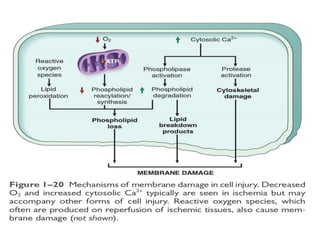
Several biochemical mechanisms may contribute to
membrane damage
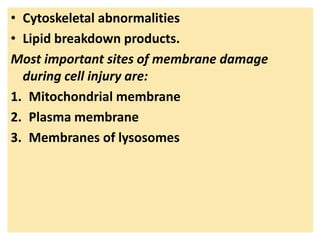
• Decreased phospholipid synthesis
• Increased phospholipid breakdown
• ROS cause injury to cell membrane by lipid
peroxidation
• Cytoskeletal abnormalities
• Lipid breakdown products.
Most important sites of membrane damage
during cell injury are:
1. Mitochondrial membrane
2. Plasma membrane
3. Membranes of lysosomes
DAMAGE TO DNA & PROTEINS
• Cells have mechanism to repair damage to
DNA but if damage is too severe the cell
initiates suicide program and dies by
apoptosis
• Accumulation of improperly folded proteins
or external triggers such as free radicals may
initiate a similar reaction
These mechanisms of cell injury typically cause
APOPTOSIS
REFERENCE: ROBBINS BASIC
PATHOLOGY
9TH EDITION
THANK YOU!!!

Presentation2

  • 2.
  • 3.
    PREPARED BY :- ASAVERALAMGIR ROLL # 01 JAVERIA AKHTER ROLL # 15
  • 4.
    OUTLINE Introduction Depletion of ATP Influxof Calcium Mitochondrial Damage and Dysfunction Accumulation of Oxygen-Derived Free Radicals Defects in Membrane Permeability Damage to DNA and Protein
  • 5.
    INTRODUCTION GENERAL PRINCIPLES RELEVANTTO MOST FORMS OF CELL INJURY :- 1. Cellular injury depends on type of injury, its duration and its severity. e.g brief ischemic duration reversible injury long ischemic duration irreversible injury 2. Consequences of an injurious stimulus depends on the type, status, adaptability and genetic makeup of the injured cell .
  • 6.
    3 Cell injurydue to functional and biochemical abnormalities in several essential cellular components. 4 Multiple biochemical alterations by any injurious insult.
  • 8.
    ATP: A NECESSITY!!! ATP is produced by:  Oxidative phosphorylation  Glycolytic pathway ATP is required for all synthetic and degradative processes within the cell including:  Membrane transport  Protein synthesis  Lipogenesis and  Deacylation-reacylation reaction A healthy human burns 50-75 kg of ATP everyday!!!
  • 9.
    DEPLETION OF ATP Themajor causes of ATP depletion are: • Reduced oxygen nutrient supply • Mitochondrial damage • Actions of toxins (e.g cyanide) Tissue with greater glycolytic capacity (e.g liver) survive loss of oxygen and decreased oxidative phosphorylation better than those tissues with limited capacity for glycolysis (e.g brain)
  • 10.
    EFFECTS OF ATPDEPLETION • Reduction in activity of Na-K pump • Increase in anaerobic glycolysis • Failure of ATP-dependant Ca++ pumps Prolonged or worsen depletion of ATP causes structural disruption of protein synthetic apparatus. Ultimately, there is irreversible damage to mitochondrial and lysosomal membrane, and the cell undergoes necrosis
  • 12.
    MITOCHONDRIAL DAMAGE AND DYSFUNCTION •Failure of oxidative phosphorylation leads to ATP depletion ultimately leading to necrosis • Abnormal oxidative phosphorylation also leads to formation of ROS which have many deleterious effects • Mitochondrial damage is often associated with the formation of high-conductance channel in mitochondrial membrane called as mitochondrial permeability transition pore leading to loss of mitochondrial potential changes
  • 13.
    • The mitochondriacontain several proteins that when released into the cytoplasm , tell the cell there is internal injury and activate a pathway of apoptosis.
  • 15.
    INFLUX OF CALCIUM •Cytosolic calcium concentration is 10,000 times lower than the extracellular and intracellular (mitochondrial and ER) calcium concentration • Cytosolic free calcium is maintained by ATP- dependant calcium transporters • Ischemia and toxins cause an increase in cytosolic calcium concentration • Increase cytosolic calcium activates enzymes with deleterious cellular effects
  • 16.
    • These enzymesinclude: 1. Phospholipases (cause membrane damage) 2. Proteases ( breakdown both membrane and cytoskeleton proteins) 3. Endonucleases (cause DNA and chromatin fragmentation) 4. ATPases (hastening ATP depletion ) • Increase intracellular calcium may also induce apoptosis , by direct activation of caspases and by increasing mitochondrial permeability
  • 18.
    FREE RADICALS Free radicalsare chemical species with single unpaired electron in outer orbital . Such chemical states are: 1. Extremely unstable 2. Highly reactive When generated in cell they attack nucleic acids and variety of cellular proteins and lipids. They also initiate chain reaction.
  • 19.
    REACTIVE OXYGEN SPECIES (ROS) •ROS are type of oxygen-derived free radicals whose role in cell injury is well established • The circumstances involving damage by free radicals include: I. Ischemia reperfusions II. Chemical and radiation injury III. Toxicity from oxygen and other gases IV. Cellular aging V. Microbial killing by phagocytes VI. Tissue injury caused by inflammatory cells
  • 21.
    TYPES AND PATHOF PRODUCTION OF ROS 1. By partial reduction oxygen during redox reaction that occur during mitochondrial respiration highly reactive but short lived toxic intermediates are generated which include:  Superoxide which is converted to H2O2 spontaneously and by action of superoxide dimutase. In the presence of metal such as Fe++ H2O2 is converted to highly reactive hydroxyl radical by Fenton reaction. 2. ROS is produced in phagocytic leukocytes mainly neutrophils and macrophages
  • 22.
    RESPIRATORY AND OXIDATIVE BURST ROSis generated in phagosomes & phagolysosomes of leukocytes by process called respiratory burst. In this process of phagosome membrane catalyses generation of superoxide which is converted to H2O2 which is then converted to highly reactive compound hypochlorite by the enzyme myeloperoxidase which is present in leukocytes
  • 23.
    Nitric oxide isanother reactive free radical produced in leukocytes and other cell. It can react with superoxide to form a highly reactive compound peroxynitrite , which also participates in cell injury. The damage caused by free radicals is determined by their rates of production and removal.
  • 24.
    OXIDATIVE STRESS When theproduction of ROS increases the result is an excess of these free radicals , leading to a condition called oxidative stress. Free radical generation is increased under several circumstances : • Absorption of radiant energy (ionizing radiation can hydrolyze water into hydroxyl and hydrogen free radicals) • Enzymatic metabolism of exogenous chemicals e.g CCl4 • Inflammation in which free radicals are produced by leukocytes
  • 25.
    REMOVAL OF FREERADICALS 1. Free radicals are unstable & decay spontaneously. 2. There are non-enzymatic & enzymatic systems that contribute to inactivation radicals  Superoxide is catalysed by superoxide dimutase.  Hydrogen peroxide is catalysed by glutathione peroxidase 1 2 GSH + H2O2 ---> GS-SG + 2 H2O  Catalase is one of the most active enzyme capable of degrading millions of molecules of H2O2 per second.
  • 26.
    Are inEndogenous &exogenous anti-oxidants (e.g vitamins E , A , C & beta-carrotenes) block the formation of free radicals. Reactive oxygen species cause cell injury by three main reactions: 1. Lipid peroxidation of membranes 2. Cross linking & other changes in proteins 3. DNA damage  Low concentrations of ROS are also involved in various signalling pathways in cells thus are involved in various physiologic reactions to avoid their harmful effects ,their intracellular concentrations are tightly regulated in healthy cell.
  • 28.
    DEFECTS IN MEMBRANEPERMEABILITY Plasma membrane can be damaged by: • ischemia • Various microbial toxins • Lytic complement components • Physical & chemical agents. Several biochemical mechanisms may contribute to membrane damage • Decreased phospholipid synthesis • Increased phospholipid breakdown • ROS cause injury to cell membrane by lipid peroxidation
  • 29.
    • Cytoskeletal abnormalities •Lipid breakdown products. Most important sites of membrane damage during cell injury are: 1. Mitochondrial membrane 2. Plasma membrane 3. Membranes of lysosomes
  • 31.
    DAMAGE TO DNA& PROTEINS • Cells have mechanism to repair damage to DNA but if damage is too severe the cell initiates suicide program and dies by apoptosis • Accumulation of improperly folded proteins or external triggers such as free radicals may initiate a similar reaction These mechanisms of cell injury typically cause APOPTOSIS
  • 33.
  • 34.