


Flexibility: Achieving Great Movement
                                      PRESENTED BY:
                        Max MARTIN BAppSc (Hons) AEP
TODAY’S AGENDA
    Why flexibility?
    The physiological basis of tightness
    What does the research say?
    Flexibility assessment
    Floor to ceiling flexibility specifics
Prescription Paradigms


Movement is a behaviour
  Developed, learned and adapted.
Faulty Posture or Movement is a SYMPTOM of
dysfunction
Stabilisers typically become hypotonic/inhibited (weak)
– ‘allowing’ faulty posture
Gross movers typically become hypertonic/facilitated
(tight) – ‘driving’ faulty posture
Why weakness?

Muscle inhibition due to pain/injury
Muscle susceptibility – eg. VMO vs VL atrophy post surgery
Muscle inactivity in chronic postures – eg. Sedentary behaviours
CNS driven protection
Why do people get tight?
Sedentary lifestyle
Injury and pain
Repetitious movement
Poor nutrition and hydration
Age (accumulation of behaviours)
Altered neuromuscular function
Why anatomical tightness?

Joint ROM can be limited by the following factors

1. Joint constraints

2. connective tissue (40%) – protective, inactivity,
   hypertonicity

3. Neurogenic constraints (voluntary and reflexive) -
   protective

4. Myogenic constraints – overload protective
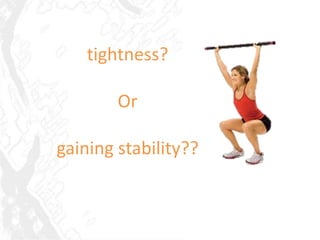
tightness?

        Or

gaining stability??
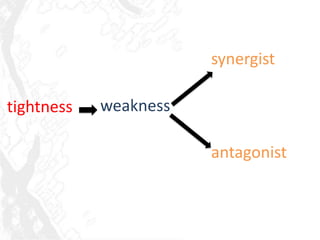
synergist

tightness   weakness

                       antagonist
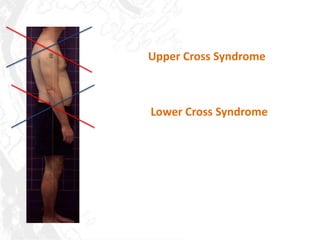
Upper Cross Syndrome


Lower Cross Syndrome
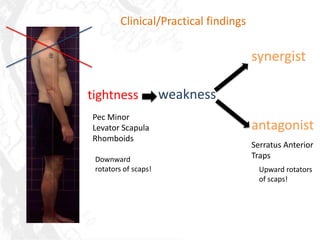
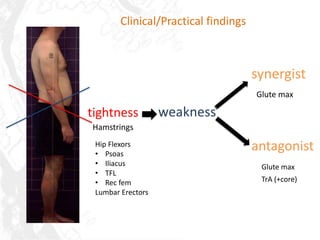
Clinical/Practical findings

                                       synergist

tightness             weakness
Pec Minor
Levator Scapula                        antagonist
Rhomboids
                                       Serratus Anterior
 Downward                              Traps
 rotators of scaps!                      Upward rotators
                                         of scaps!
Clinical/Practical findings


                                      synergist
                                      Glute max

tightness          weakness
Hamstrings
 Hip Flexors
 • Psoas
                                      antagonist
 • Iliacus                             Glute max
 • TFL
 • Rec fem                             TrA (+core)
 Lumbar Erectors
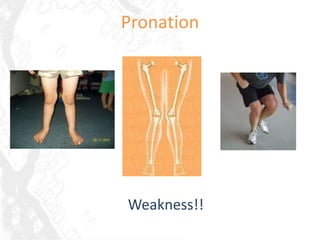
Pronation


Weakness!!
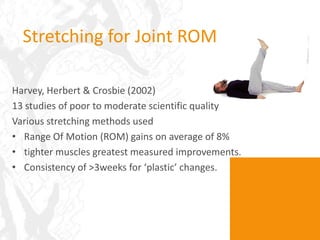
Stretching for Joint ROM

Harvey, Herbert & Crosbie (2002)
13 studies of poor to moderate scientific quality
Various stretching methods used
• Range Of Motion (ROM) gains on average of 8%
• tighter muscles greatest measured improvements.
• Consistency of >3weeks for ‘plastic’ changes.
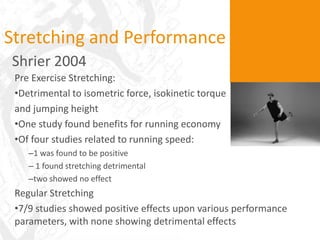
Stretching and Performance
Shrier 2004
 Pre Exercise Stretching:
 •Detrimental to isometric force, isokinetic torque
 and jumping height
 •One study found benefits for running economy
 •Of four studies related to running speed:
    –1 was found to be positive
    – 1 found stretching detrimental
    –two showed no effect
 Regular Stretching
 •7/9 studies showed positive effects upon various performance
 parameters, with none showing detrimental effects
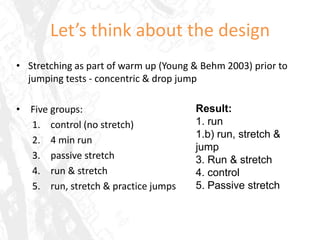
Let’s think about the design
• Stretching as part of warm up (Young & Behm 2003) prior to
  jumping tests - concentric & drop jump

• Five groups:                         Result:
  1. control (no stretch)              1. run
                                       1.b) run, stretch &
  2. 4 min run
                                       jump
  3. passive stretch                   3. Run & stretch
  4. run & stretch                     4. control
  5. run, stretch & practice jumps     5. Passive stretch
Effects of Stretching on DOMS:

Herbert & Gabriel (2002)
• Pre or Post-exercise
  stretching found to be
  ineffective in reducing
  DOMS
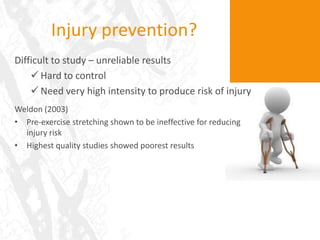
Injury prevention?
Difficult to study – unreliable results
     Hard to control
     Need very high intensity to produce risk of injury
Weldon (2003)
• Pre-exercise stretching shown to be ineffective for reducing
  injury risk
• Highest quality studies showed poorest results
Massage & DOMS
Ernst (1998)
• Post-exercise massage
  shown to be effective in
  reducing DOMS
• Poor study quality
Massage & Performance

 Hennings (2001)
  Improvements to muscle
   endurance and power
  No effect upon MVC, stride
   length, submax running
  No effect when massaged
   between exercise bouts
Massage & Joint ROM

Moraska (2005)
• Pre-exercise massage
  shown to improve ROM
• Results short term
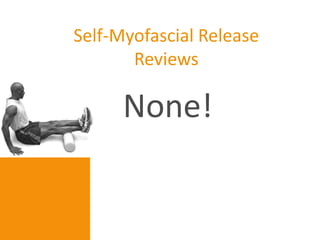
Self-Myofascial Release
       Reviews

      None!
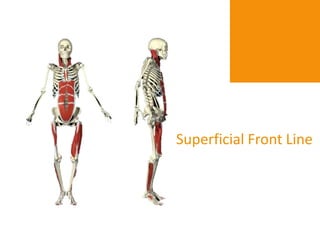
Superficial Front Line
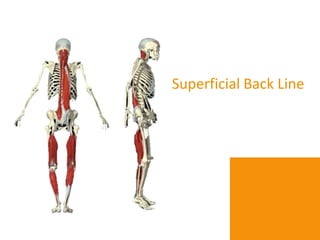
Superficial Back Line
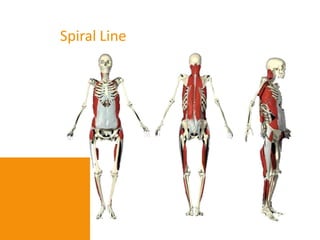
Spiral Line
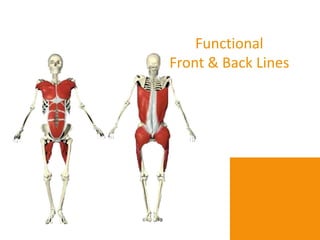
Functional
Front & Back Lines
Exercise and myofascial release

Exercise/movement is vital for myofascial release treatment

Resets neurological programming (ideal 30-60 secs post)

Both needed for permanent change
Practical programming
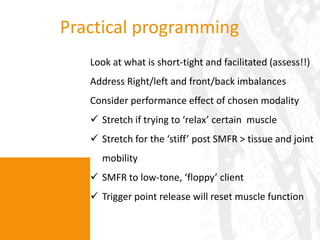
   Look at what is short-tight and facilitated (assess!!)
   Address Right/left and front/back imbalances
   Consider performance effect of chosen modality
    Stretch if trying to ‘relax’ certain muscle
    Stretch for the ‘stiff’ post SMFR > tissue and joint
     mobility
    SMFR to low-tone, ‘floppy’ client
    Trigger point release will reset muscle function
Practical programming


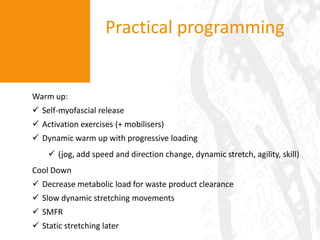
Warm up:
 Self-myofascial release
 Activation exercises (+ mobilisers)
 Dynamic warm up with progressive loading
     (jog, add speed and direction change, dynamic stretch, agility, skill)
Cool Down
 Decrease metabolic load for waste product clearance
 Slow dynamic stretching movements
 SMFR
 Static stretching later
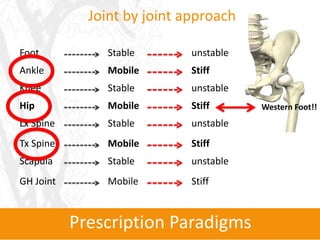
Joint by joint approach

Foot            Stable       unstable
Ankle           Mobile       Stiff
Knee            Stable       unstable
Hip             Mobile       Stiff      Western Foot!!
Lx Spine        Stable       unstable
Tx Spine        Mobile       Stiff
Scapula         Stable       unstable
GH Joint        Mobile       Stiff


           Prescription Paradigms
@iNformMaxMartin                  Corrective Exercise Australia


            PRESENTED BY:
      Max MARTIN BAppSc (Hons)AEP
max@correctiveexerciseaustralia.com

Fitness first 2012 c exa flexibility presentation

  • 1.
    Flexibility: Achieving GreatMovement PRESENTED BY: Max MARTIN BAppSc (Hons) AEP
  • 2.
    TODAY’S AGENDA Why flexibility? The physiological basis of tightness What does the research say? Flexibility assessment Floor to ceiling flexibility specifics
  • 3.
    Prescription Paradigms Movement isa behaviour Developed, learned and adapted. Faulty Posture or Movement is a SYMPTOM of dysfunction Stabilisers typically become hypotonic/inhibited (weak) – ‘allowing’ faulty posture Gross movers typically become hypertonic/facilitated (tight) – ‘driving’ faulty posture
  • 4.
    Why weakness? Muscle inhibitiondue to pain/injury Muscle susceptibility – eg. VMO vs VL atrophy post surgery Muscle inactivity in chronic postures – eg. Sedentary behaviours CNS driven protection
  • 5.
    Why do peopleget tight? Sedentary lifestyle Injury and pain Repetitious movement Poor nutrition and hydration Age (accumulation of behaviours) Altered neuromuscular function
  • 6.
    Why anatomical tightness? JointROM can be limited by the following factors 1. Joint constraints 2. connective tissue (40%) – protective, inactivity, hypertonicity 3. Neurogenic constraints (voluntary and reflexive) - protective 4. Myogenic constraints – overload protective
  • 7.
    tightness? Or gaining stability??
  • 8.
    synergist tightness weakness antagonist
  • 9.
  • 10.
    Clinical/Practical findings synergist tightness weakness Pec Minor Levator Scapula antagonist Rhomboids Serratus Anterior Downward Traps rotators of scaps! Upward rotators of scaps!
  • 11.
    Clinical/Practical findings synergist Glute max tightness weakness Hamstrings Hip Flexors • Psoas antagonist • Iliacus Glute max • TFL • Rec fem TrA (+core) Lumbar Erectors
  • 12.
  • 13.
    Stretching for JointROM Harvey, Herbert & Crosbie (2002) 13 studies of poor to moderate scientific quality Various stretching methods used • Range Of Motion (ROM) gains on average of 8% • tighter muscles greatest measured improvements. • Consistency of >3weeks for ‘plastic’ changes.
  • 14.
    Stretching and Performance Shrier2004 Pre Exercise Stretching: •Detrimental to isometric force, isokinetic torque and jumping height •One study found benefits for running economy •Of four studies related to running speed: –1 was found to be positive – 1 found stretching detrimental –two showed no effect Regular Stretching •7/9 studies showed positive effects upon various performance parameters, with none showing detrimental effects
  • 15.
    Let’s think aboutthe design • Stretching as part of warm up (Young & Behm 2003) prior to jumping tests - concentric & drop jump • Five groups: Result: 1. control (no stretch) 1. run 1.b) run, stretch & 2. 4 min run jump 3. passive stretch 3. Run & stretch 4. run & stretch 4. control 5. run, stretch & practice jumps 5. Passive stretch
  • 16.
    Effects of Stretchingon DOMS: Herbert & Gabriel (2002) • Pre or Post-exercise stretching found to be ineffective in reducing DOMS
  • 17.
    Injury prevention? Difficult tostudy – unreliable results  Hard to control  Need very high intensity to produce risk of injury Weldon (2003) • Pre-exercise stretching shown to be ineffective for reducing injury risk • Highest quality studies showed poorest results
  • 18.
    Massage & DOMS Ernst(1998) • Post-exercise massage shown to be effective in reducing DOMS • Poor study quality
  • 19.
    Massage & Performance Hennings (2001)  Improvements to muscle endurance and power  No effect upon MVC, stride length, submax running  No effect when massaged between exercise bouts
  • 20.
    Massage & JointROM Moraska (2005) • Pre-exercise massage shown to improve ROM • Results short term
  • 21.
  • 22.
  • 23.
  • 24.
  • 25.
  • 26.
    Exercise and myofascialrelease Exercise/movement is vital for myofascial release treatment Resets neurological programming (ideal 30-60 secs post) Both needed for permanent change
  • 27.
    Practical programming Look at what is short-tight and facilitated (assess!!) Address Right/left and front/back imbalances Consider performance effect of chosen modality  Stretch if trying to ‘relax’ certain muscle  Stretch for the ‘stiff’ post SMFR > tissue and joint mobility  SMFR to low-tone, ‘floppy’ client  Trigger point release will reset muscle function
  • 28.
    Practical programming Warm up: Self-myofascial release  Activation exercises (+ mobilisers)  Dynamic warm up with progressive loading  (jog, add speed and direction change, dynamic stretch, agility, skill) Cool Down  Decrease metabolic load for waste product clearance  Slow dynamic stretching movements  SMFR  Static stretching later
  • 29.
    Joint by jointapproach Foot Stable unstable Ankle Mobile Stiff Knee Stable unstable Hip Mobile Stiff Western Foot!! Lx Spine Stable unstable Tx Spine Mobile Stiff Scapula Stable unstable GH Joint Mobile Stiff Prescription Paradigms
  • 30.
    @iNformMaxMartin Corrective Exercise Australia PRESENTED BY: Max MARTIN BAppSc (Hons)AEP max@correctiveexerciseaustralia.com

Editor's Notes

  • #5 Do visual black out after “CNS protection”
  • #30 Ankle SMFR and mobsHip – ant mobs, Pelvic rot type mobs – SMFR OF PUBISTx – - PRE-TEST W WALL THUMB EXERCISE (pre-post walk) - side lying or dowel rod mobs