EXERCISE - Definition
Exercise is physical activity for conditioning
the body, improving health, and maintaining
fitness.
Purposes
• Decrease risk factors for chronic diseases and
increase health and well-being
• Improves functional strength. Functional
Strength is defined as the ability of the body to
perform work.
• Develop activity tolerance. Activity tolerance is
the type and amount of exercise/ADLs an
individual perform without experiencing
adverse effects
Benefits of Physical Exercise
1. Improves cardiopulmonary function
2. Reduces blood pressure
3. Increases muscle tone and strength
4. Greater physical endurance
5. Increases weight loss
6. Reduces blood glucose level
Contd…
7. Decreases low-density blood lipids
8. Improves physical appearance
9.Increases bone density
10.Regularizes bowel elimination
11. Promotes sleep
12.Reduces tension and depression
Contd…
Cardiovascular system: Effects includes lowering
systolic and diastolic BP and resting HR, improves
oxygenation & circulation to all body parts, and
improved cardiac efficiency. American Heart
Association (2013) recommends at least 150 minutes/
week of moderate exercise and 75 minutes/week of
vigorous exercise or combination of moderate and
vigorous exercise.
Respiratory system: increased respiratory rate and
depth, oxygen intake and carbon di oxide excretion
increase during exercise, alveolar gas exchange is
increased
Contd…
Gastrointestinal system: improving the appetite and
increase GI tract tone, facilitating peristalsis.
Metabolic/endocrine system: elevating the metabolic
rate, increase the production of body heat and waste
products and calorie use. Increasing the use of
triglycerides and fatty acid thus reduce level of
serum HbgA and cholesterol. Weight loss and
exercise stabilize blood sugar and make cells more
responsive to insulin
Contd…
Urinary system: promotes efficient renal blood flow,
the body excretes wastes more effectively.
Musculoskeletal system : increased muscle
efficiency, balance and coordination.
Psychoneurologic system: Exercise increases levels
of metabolites for neurotransmitters such as
norepinephrine and serotonin. It also improves quality
of sleep, general behavior and self concept.
Contd…
Cognitive function: positive effect on decision-
making, problem-solving process, planning, and
paying attention. Helping individual with attention
deficit/hyperactivity disorder, learning disorders, and
mood disorders
Immune system: improve circulation. Adequate rest
is important after vigorous training to allow the body
to recover.
Integumentary system: improves tone color and
turgor of skin by improving circulation
Contd…
Spiritual health: Yoga improves the mind-body-
spirit connection and establish balance in the
internal and external environment. Relaxation
response (RR) is a helpful physiological relaxation
that can be elicited through recitation of
word or phrase while sitting quietly and relaxing
your muscle.
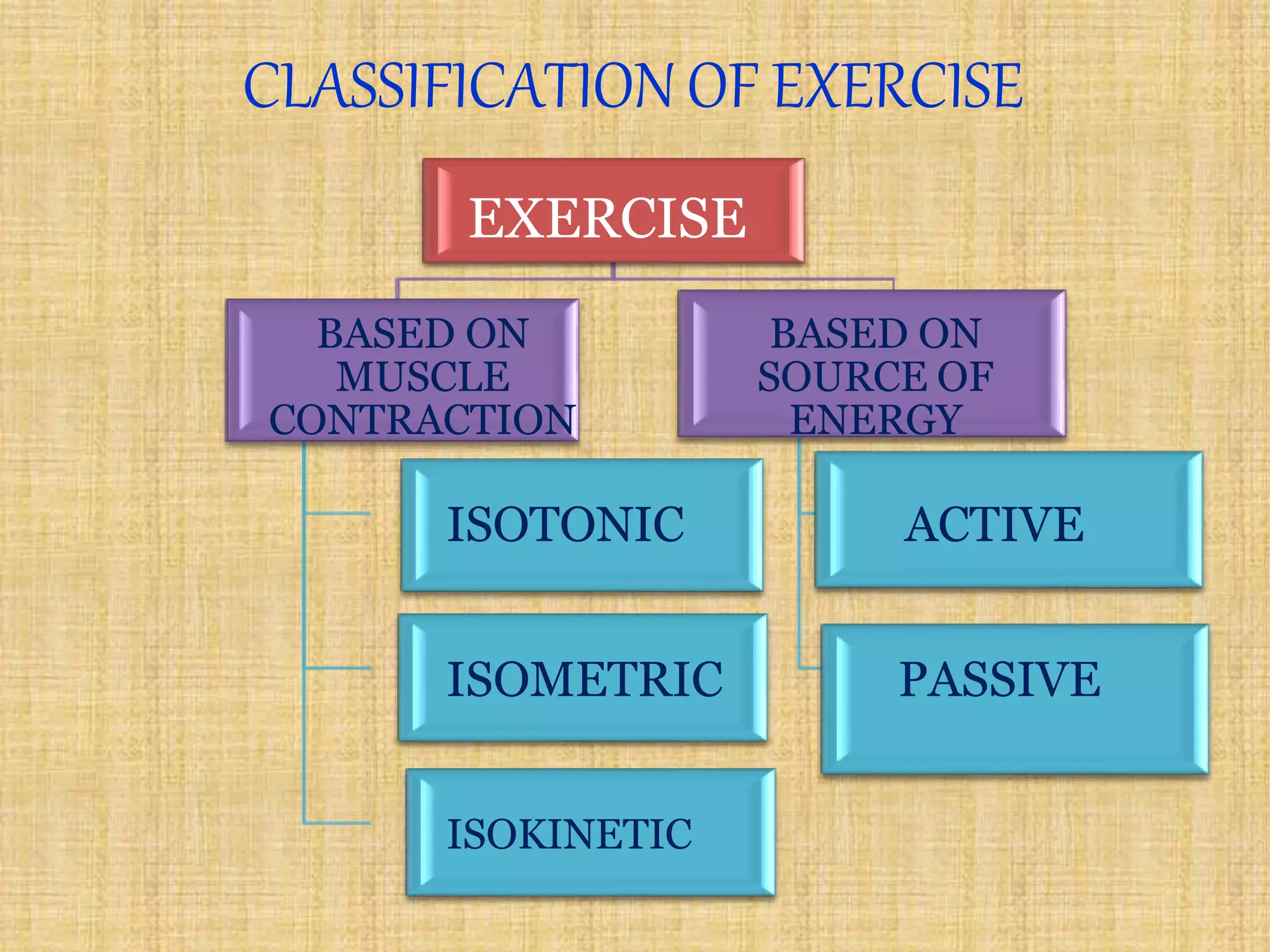
CLASSIFICATION OF EXERCISE
EXERCISE
BASED ON
MUSCLE
CONTRACTION
ISOTONIC
ISOMETRIC
ISOKINETIC
BASED ON
SOURCE OF
ENERGY
ACTIVE
PASSIVE
Isotonic exercise :
Involve muscle contraction (shortening) and active
movement.
Example: carrying out ADLs, independently
performing range-of-motion exercises, and
swimming, walking, jogging, bicycling,
moving arms & Legs.
Potential benefits include increased muscle
mass, tone, strength, improved joint mobility,
increased cardiac & respiratory function, and
increased osteoblastic (bone-building) activity.
These benefits do not occur when someone else
performs passive ROM exercises for a patient.
Isometric exercise:
Tightening or contraction of muscles without
shortening (there is no movement).
Example: contraction of gluteal & quadriceps
muscles, such as what occurs when holding a
Yoga pose.
Potential benefits are increased muscle
mass, tone, and strength, increased circulation
to the exercised body part, and increased
osteoblastic activity. Nurses should encourage
both isotonic and isometric exercises for
hospitalized patients with limited mobility.
Isokinetic Exercise:
Involves muscle contraction with resistance.
Resistance is provided by an external source.
Example: movement of leg / hand & lifting weights
against resistance for knee and elbow injuries. Using
the device, the person takes the muscles and joint
through a complete range of motion without
stopping, meeting resistance.
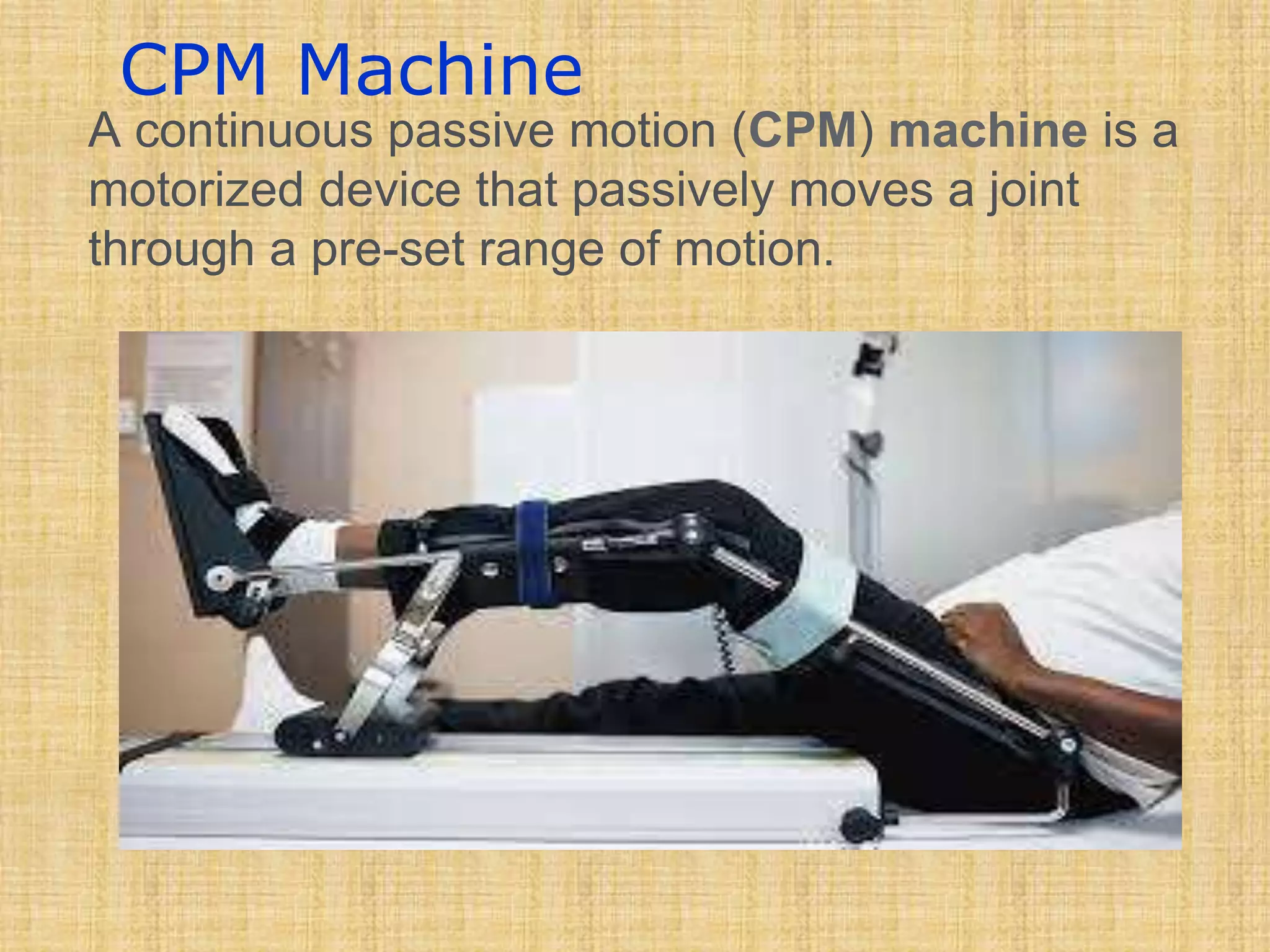
A continuous passive motion (CPM) device used
postoperatively after joint surgery (knee
replacement, anterior cruciate ligament (ACL]
repair)
CPM Machine
A continuous passive motion (CPM) machine is a
motorized device that passively moves a joint
through a pre-set range of motion.
BASED ON SOURCE OF ENERGY
• Active exercise is therapeutic activity
that the client performs independently.
• Passive exercise is therapeutic activity
that the client performs with assistance
and is provided when a client cannot move
one or more parts of the body.
Based on type of body movement
Aerobic exercises- refers to sustained (often rhythmic)
muscle movements that increase blood flow, heart rate, and
metabolic demand for oxygen over time, promoting
cardiovascular conditioning. Examples of aerobic activities
include swimming, walking, jogging, cross-country skiing,
aerobic dancing, bicycling, jumping rope, and racquetball.
Aerobic exercise may be further distinguished as having high
or low impact.
Low-impact aerobic exercises include those activities in
which at least one foot is on the ground at all times, such as
walking, rowing, or riding a stationary bicycle.
High-impact exercises include activities that are more apt to
jar the spine, such as running, jumping, or kickboxing.
Stretching exercises involve movements that allow
muscles and joints to be stretched gently through
their full range of motion, increasing flexibility.
Specific warm-up and cool down exercises, Hatha
Yoga, and some forms of dance are examples.
Benefits include increased range-of-joint
movements, improved circulation, and posture and
relaxation.
Strength and endurance exercises are components
of a variety of muscle-building programs. Weight
training, calisthenics, and specific isometric
exercises can build both strength and endurance,
increasing the power of the musculoskeletal system,
and generally improving the whole body. They may
or may not have aerobic benefit.
Movement and ADLs include housecleaning,
running after playful toddlers, climbing stairs
instead of riding in eleva tors, and so on. Household
activities can also contribute to an active lifestyle.
Range Of Motion Exercises
Definition:
The movement of a joint to the extent
possible without causing pain
Purposes:
• Promote and maintain joint mobility
• Prevent contractures and shortening of
muscles and tendons
• Increase circulation to extremities.
• Facilitate comfort for the patient
Contraindications To ROM
• Any illness/disorder where increased use
of energy or increased circulation is
hazardous.
• Example: Myocardial infarction.
swollen, inflamed joints
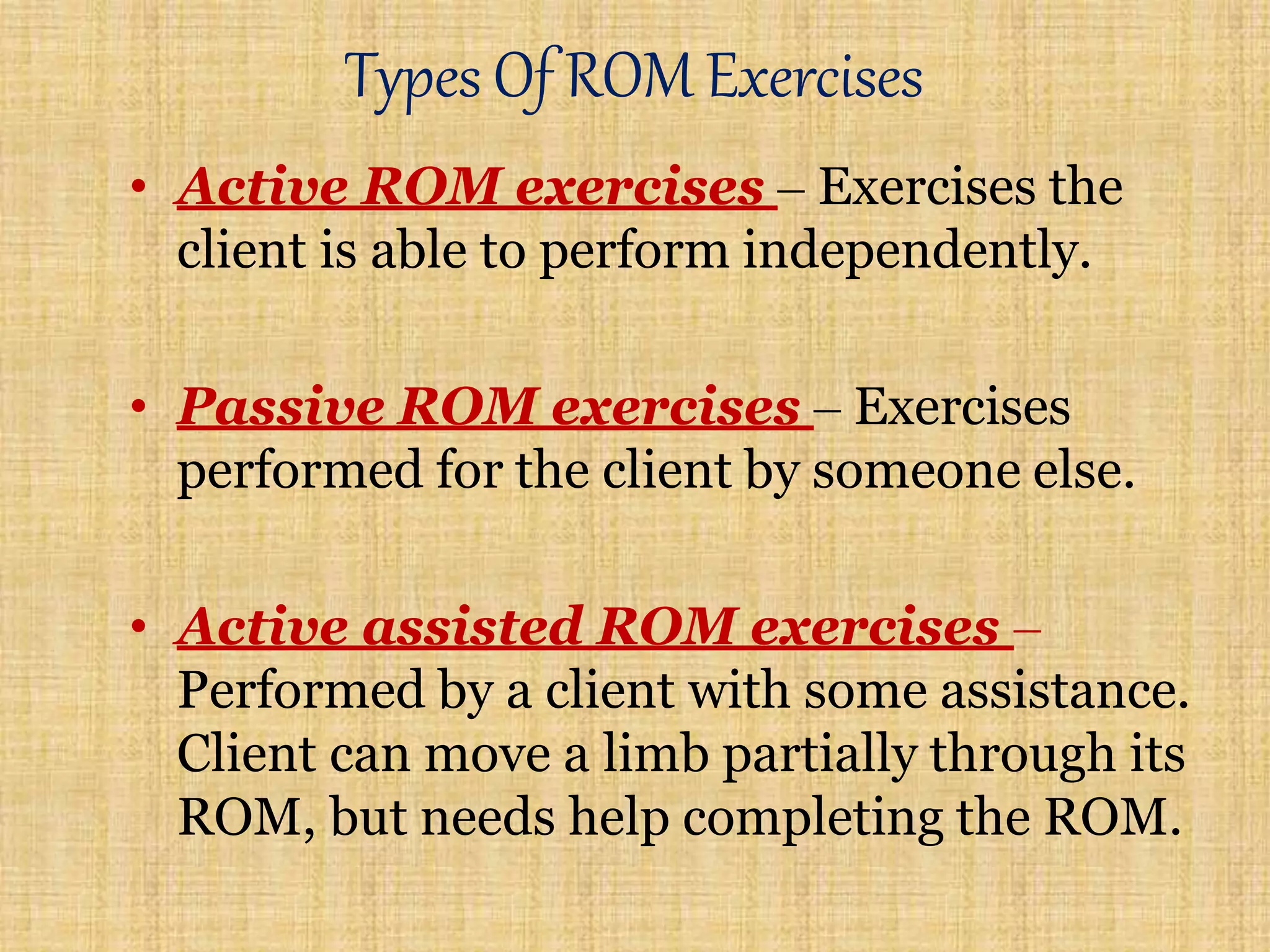
Types Of ROM Exercises
• Active ROM exercises – Exercises the
client is able to perform independently.
• Passive ROM exercises – Exercises
performed for the client by someone else.
• Active assisted ROM exercises –
Performed by a client with some assistance.
Client can move a limb partially through its
ROM, but needs help completing the ROM.
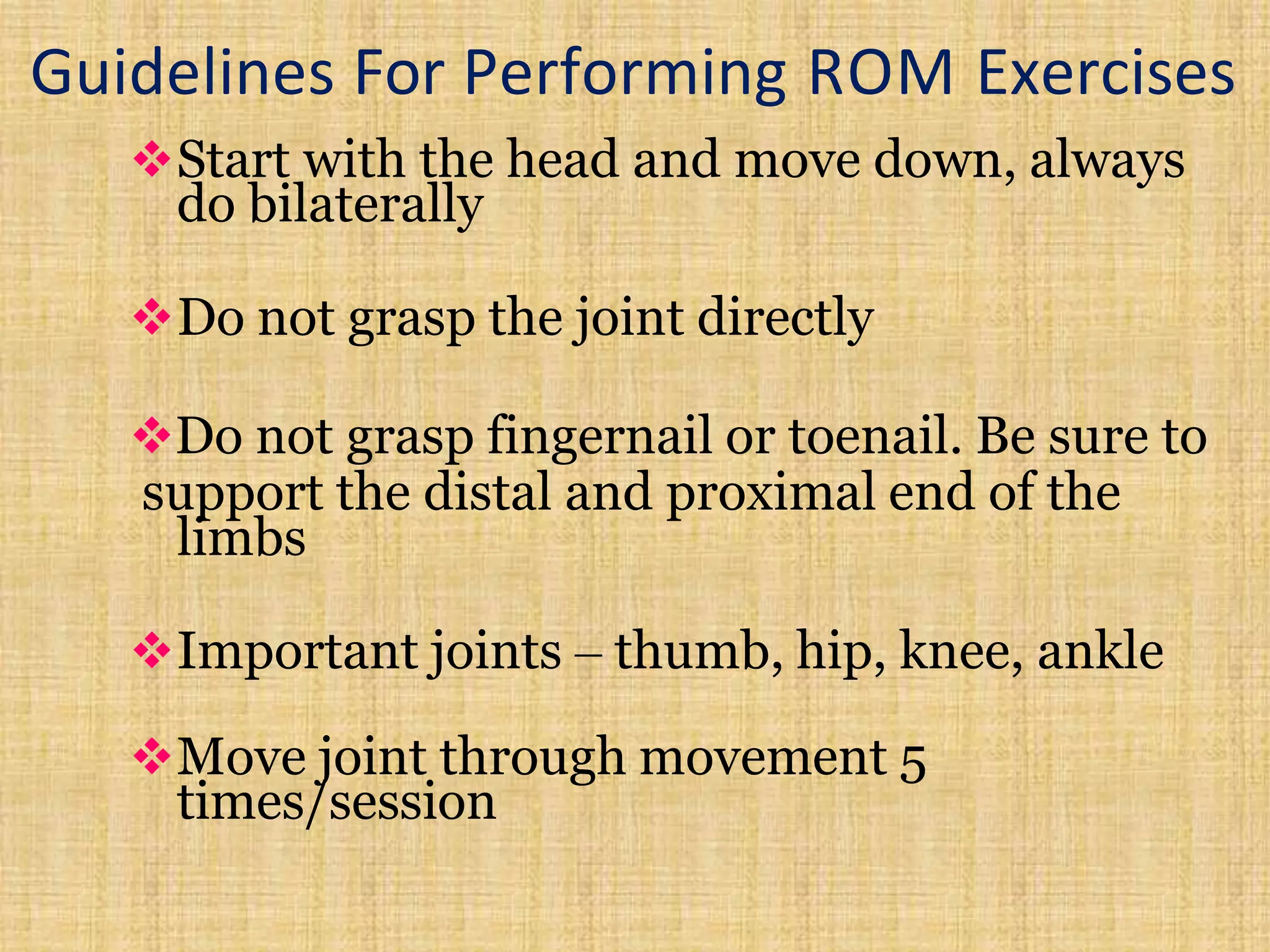
Guidelines For Performing ROM Exercises
Start with the head and move down, always
do bilaterally
Do not grasp the joint directly
Do not grasp fingernail or toenail. Be sure to
support the distal and proximal end of the
limbs
Important joints – thumb, hip, knee, ankle
Move joint through movement 5
times/session
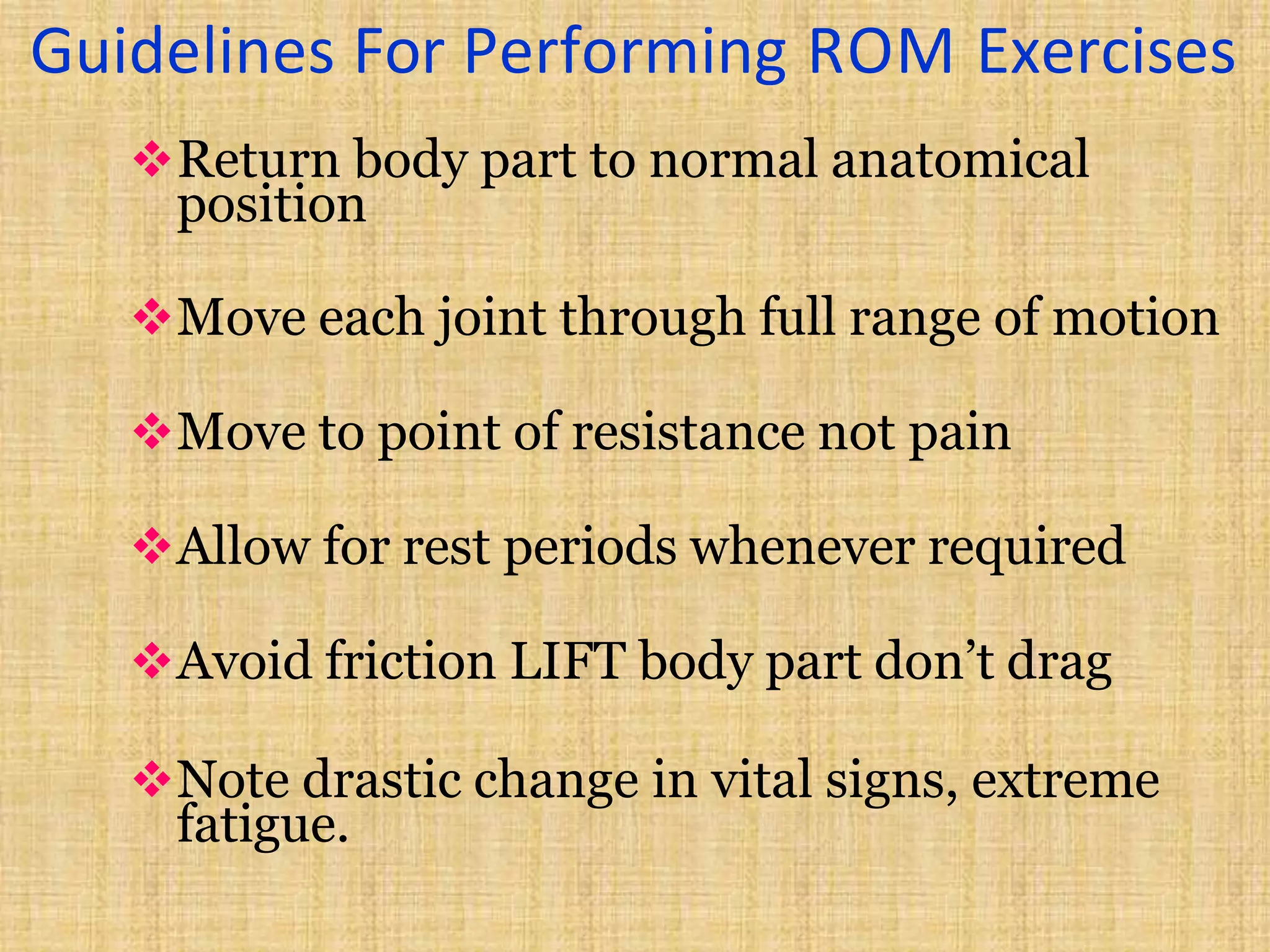
Guidelines For Performing ROM Exercises
Return body part to normal anatomical
position
Move each joint through full range of motion
Move to point of resistance not pain
Allow for rest periods whenever required
Avoid friction LIFT body part don’t drag
Note drastic change in vital signs, extreme
fatigue.
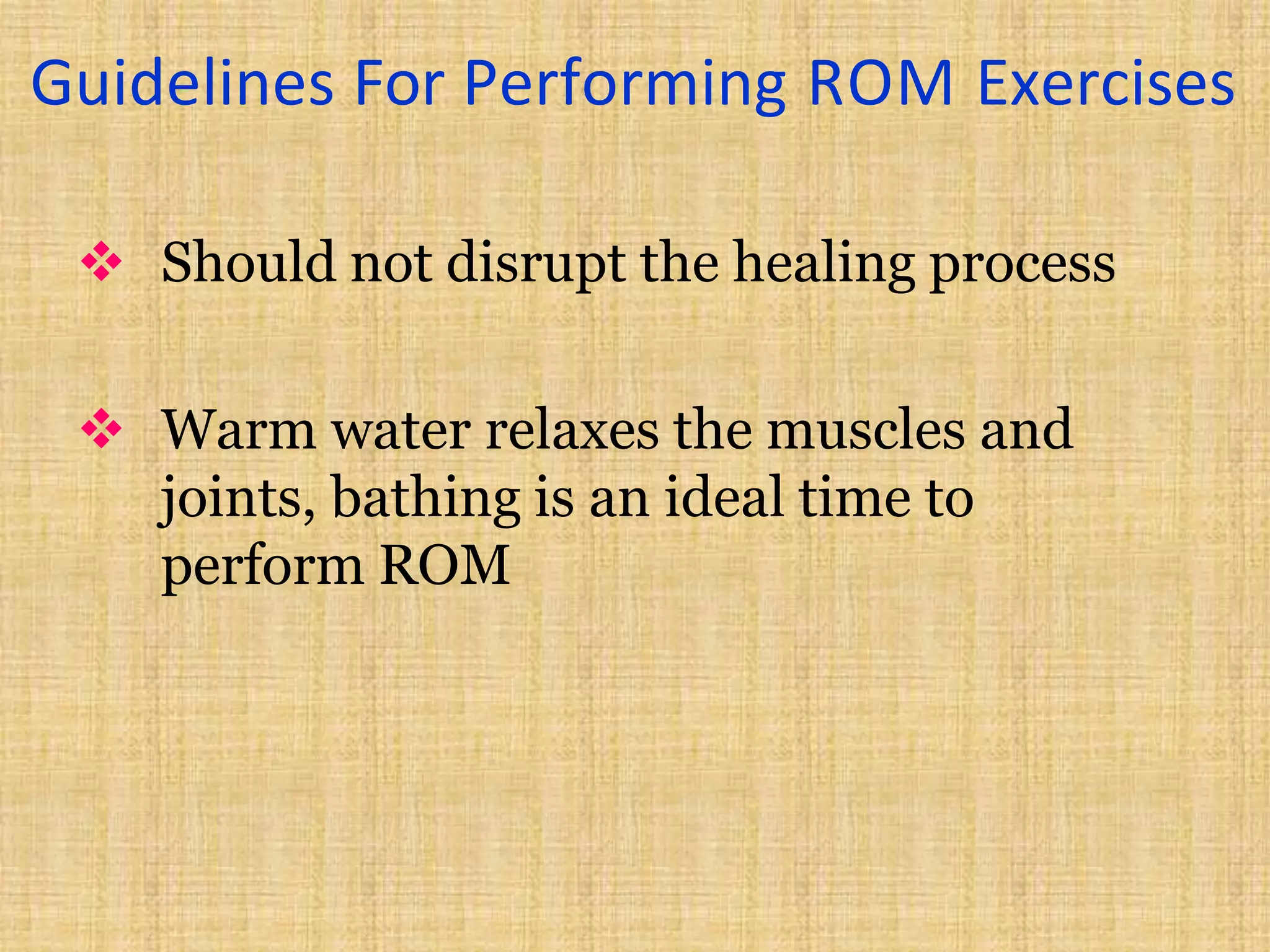
Guidelines For Performing ROM Exercises
 Should not disrupt the healing process
 Warm water relaxes the muscles and
joints, bathing is an ideal time to
perform ROM
Patient Preparation
Explain and steps and advantages of ROM
exercises.
Remove all restrictive clothing, linen, splint,
and dressings.
Drape appropriately
Raise the bed to comfortable height.
Position the patient comfortably- preferably
supine position.
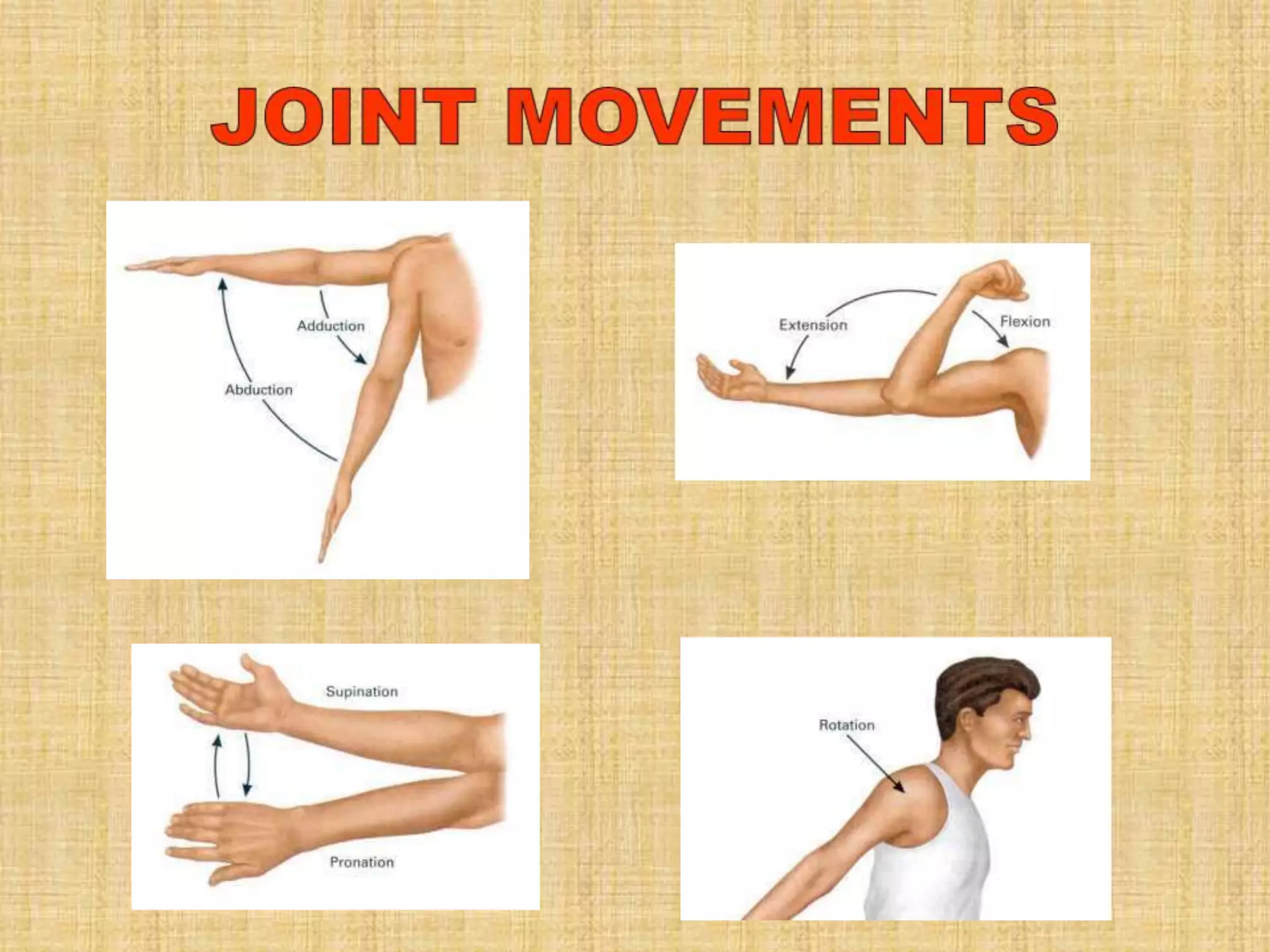
• ABDUCTION - MOVING A BODY PART AWAY FROM THE
MIDLINE OF THE BODY
• ADDUCTION - MOVING A BODY PART TOWARD THE
MIDLINE OF THE BODY
• EXTENSION - STRAIGHTENING A BODY PART
• FLEXION - BENDING A BODY PART
• ROTATION - TURNING THE JOINT
• INTERNAL ROTATION - TURNING THE JOINT INWARD
• EXTERNAL ROTATION - TURNING THE JOINT OUTWARD
• PLANTAR FLEXION - BENDING THE FOOT DOWN AT THE
ANKLE
• PRONATION - TURNING THE JOINT DOWNWARD
• SUPINATION - TURNING THE JOINT UPWARD
• INVERSION- TURNING THE SOLE OF THE FOOT
TOWARDS THE MIDLINE
• EVERSION- TURNING THE SOLE OF THE FOOT AWAY
FROM THE MID LINE
Range Of Motion Of Various
Joints
JOINT MOVEMENTS
POSSIBLE
EXAMPLE
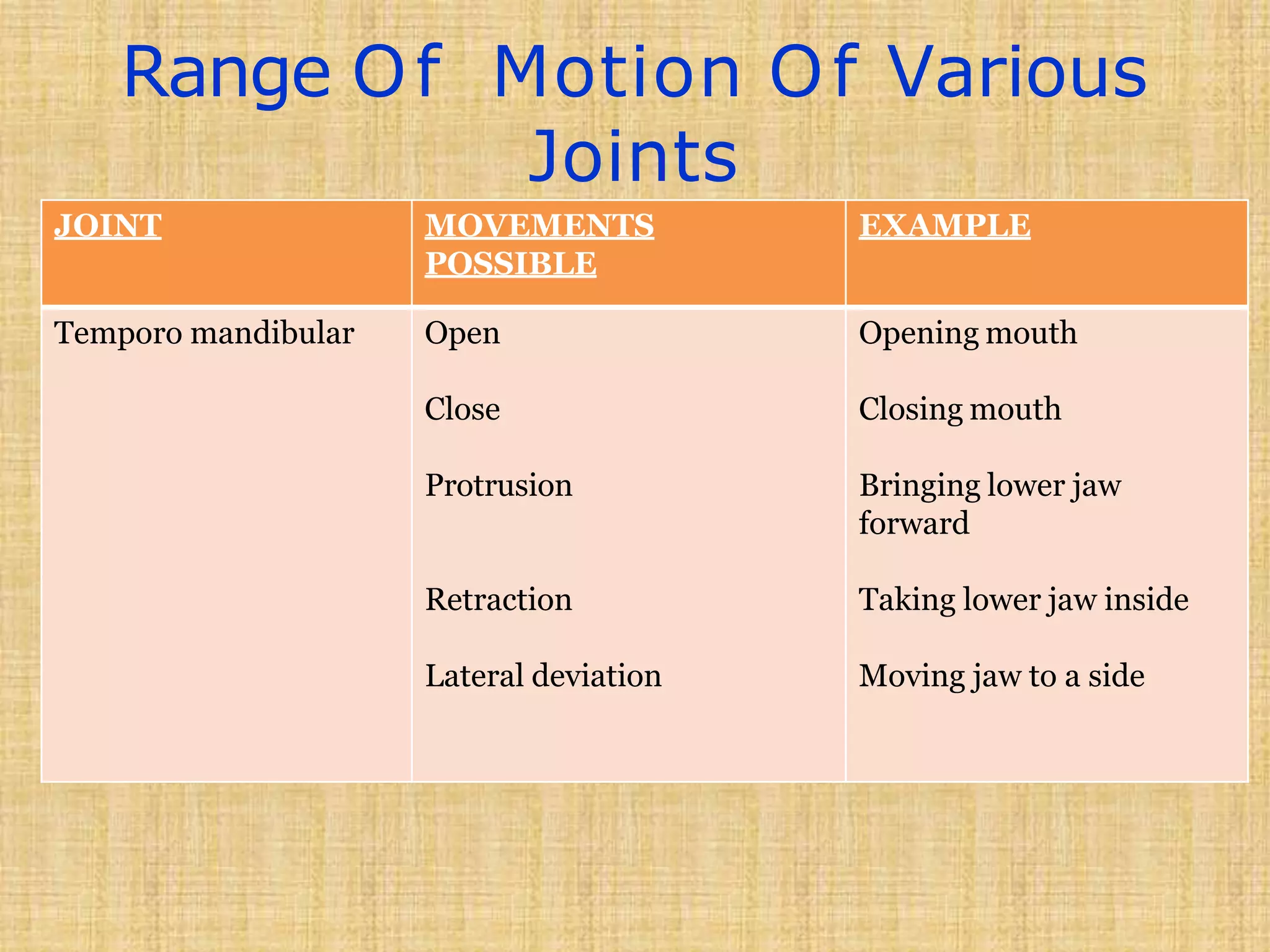
Temporo mandibular Open Opening mouth
Close Closing mouth
Protrusion Bringing lower jaw
forward
Retraction Taking lower jaw inside
Lateral deviation Moving jaw to a side
Range Of Motion Of Various
Joints
JOINT MOVEMENTS
POSSIBLE
EXAMPLE
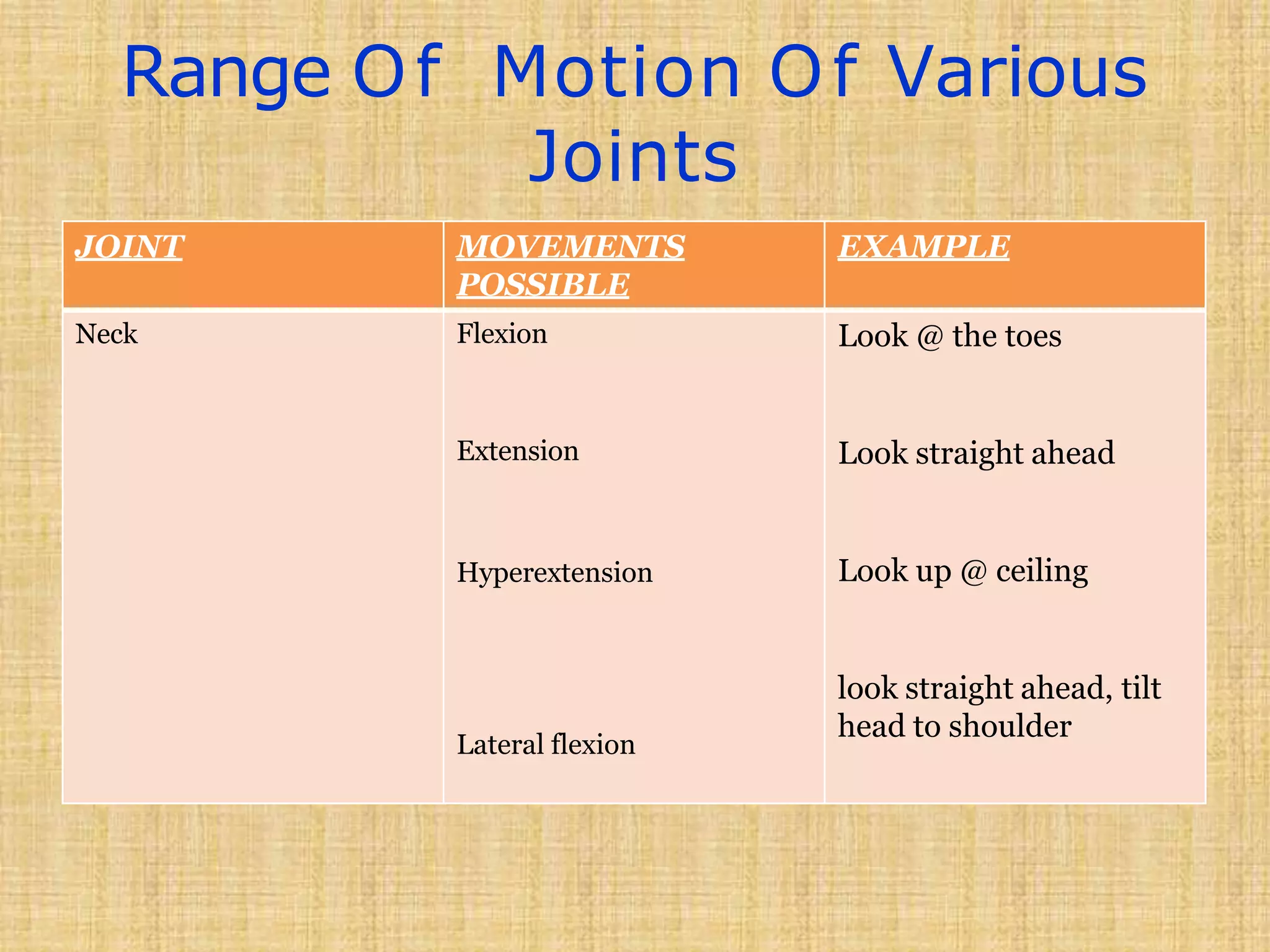
Neck Flexion
Extension
Hyperextension
Lateral flexion
Look @ the toes
Look straight ahead
Look up @ ceiling
look straight ahead, tilt
head to shoulder
Joint Movements
possible
Example
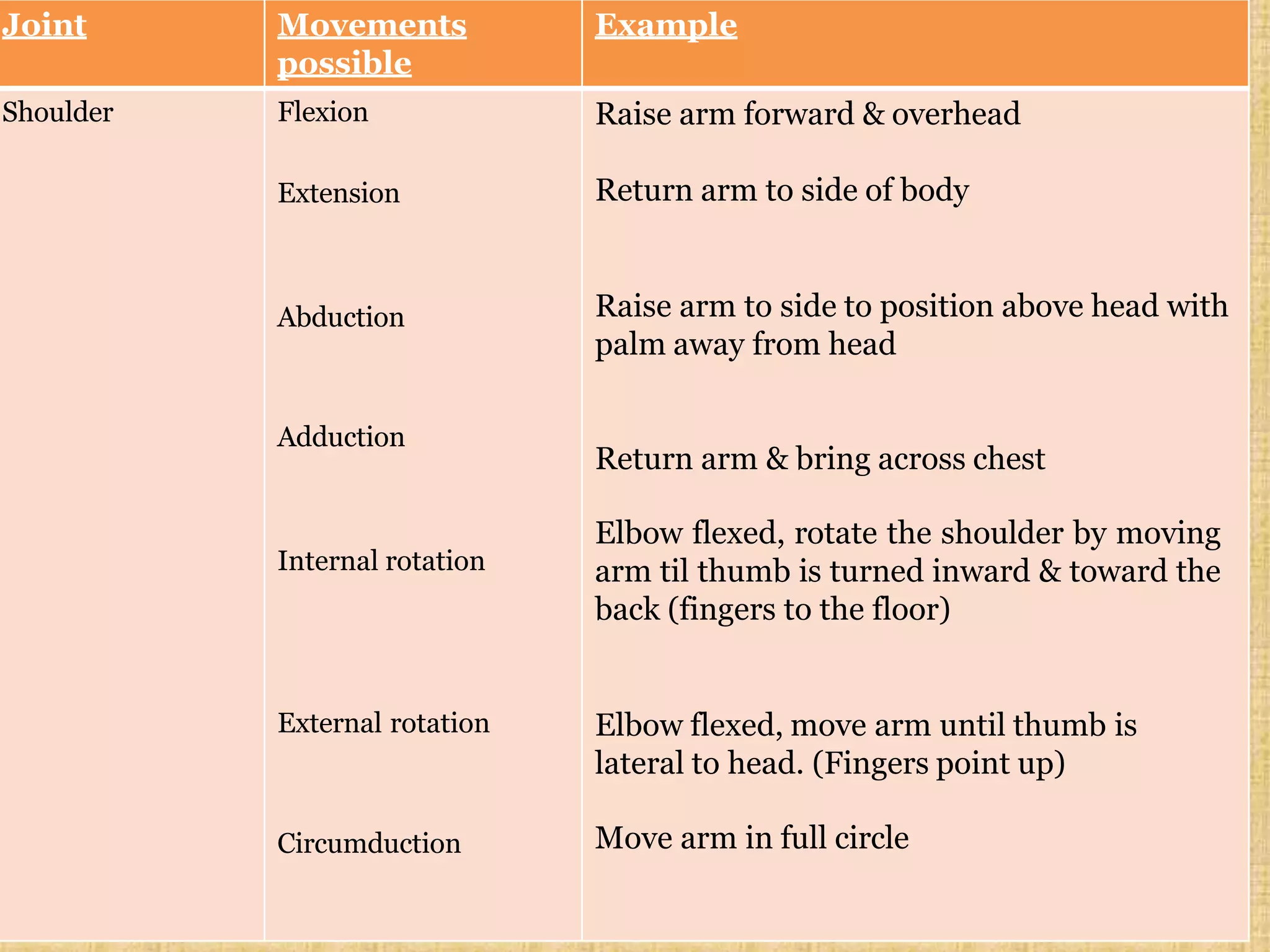
Shoulder Flexion Raise arm forward & overhead
Extension Return arm to side of body
Abduction Raise arm to side to position above head with
palm away from head
Adduction
Return arm & bring across chest
Internal rotation
Elbow flexed, rotate the shoulder by moving
arm til thumb is turned inward & toward the
back (fingers to the floor)
External rotation Elbow flexed, move arm until thumb is
lateral to head. (Fingers point up)
Circumduction Move arm in full circle
Range Of Motion Of Various
Joints
Joint Movements possible Example
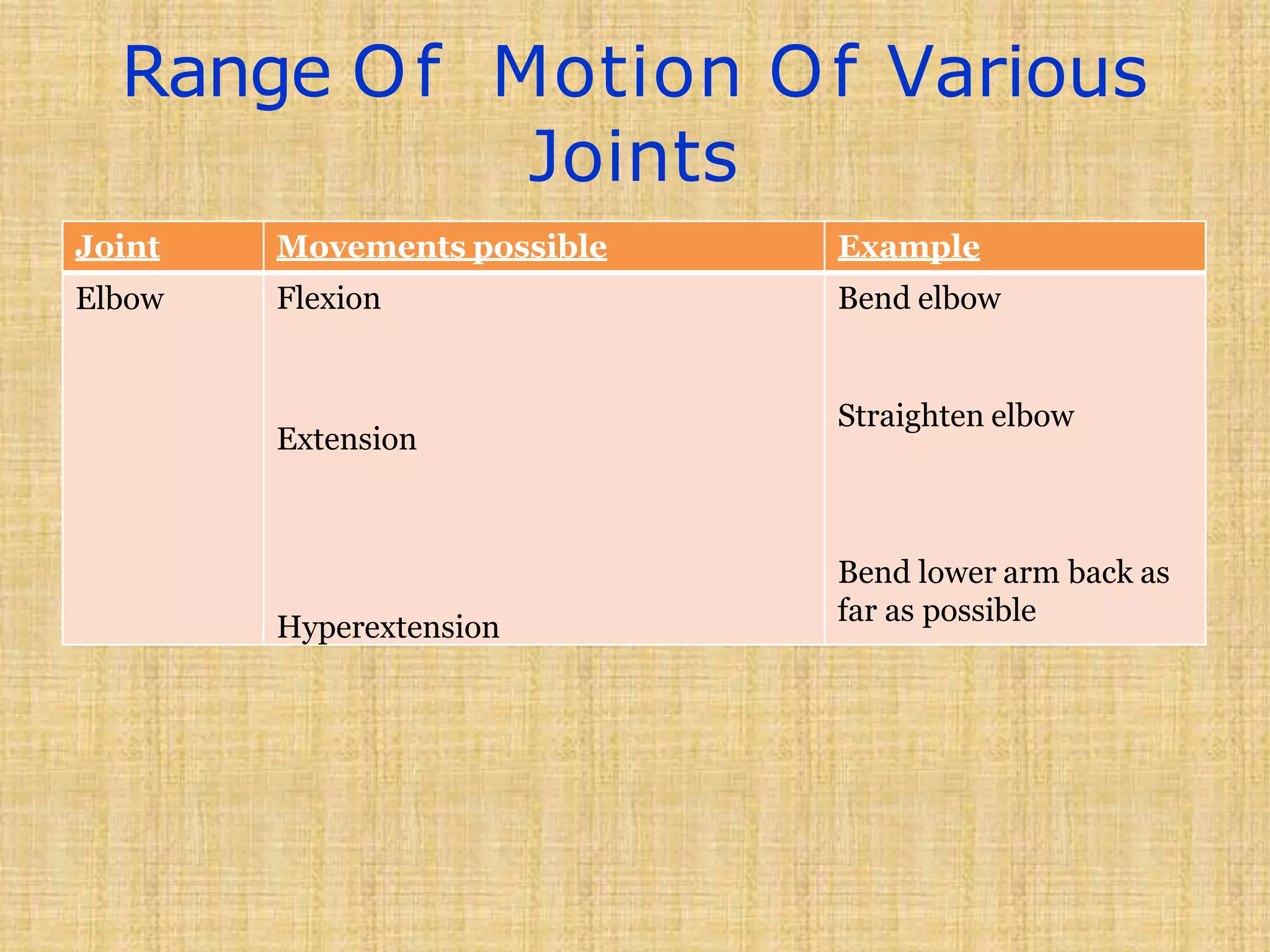
Elbow Flexion
Extension
Hyperextension
Bend elbow
Straighten elbow
Bend lower arm back as
far as possible
Range Of Motion Of Various
Joints
Joint Movements possible Example
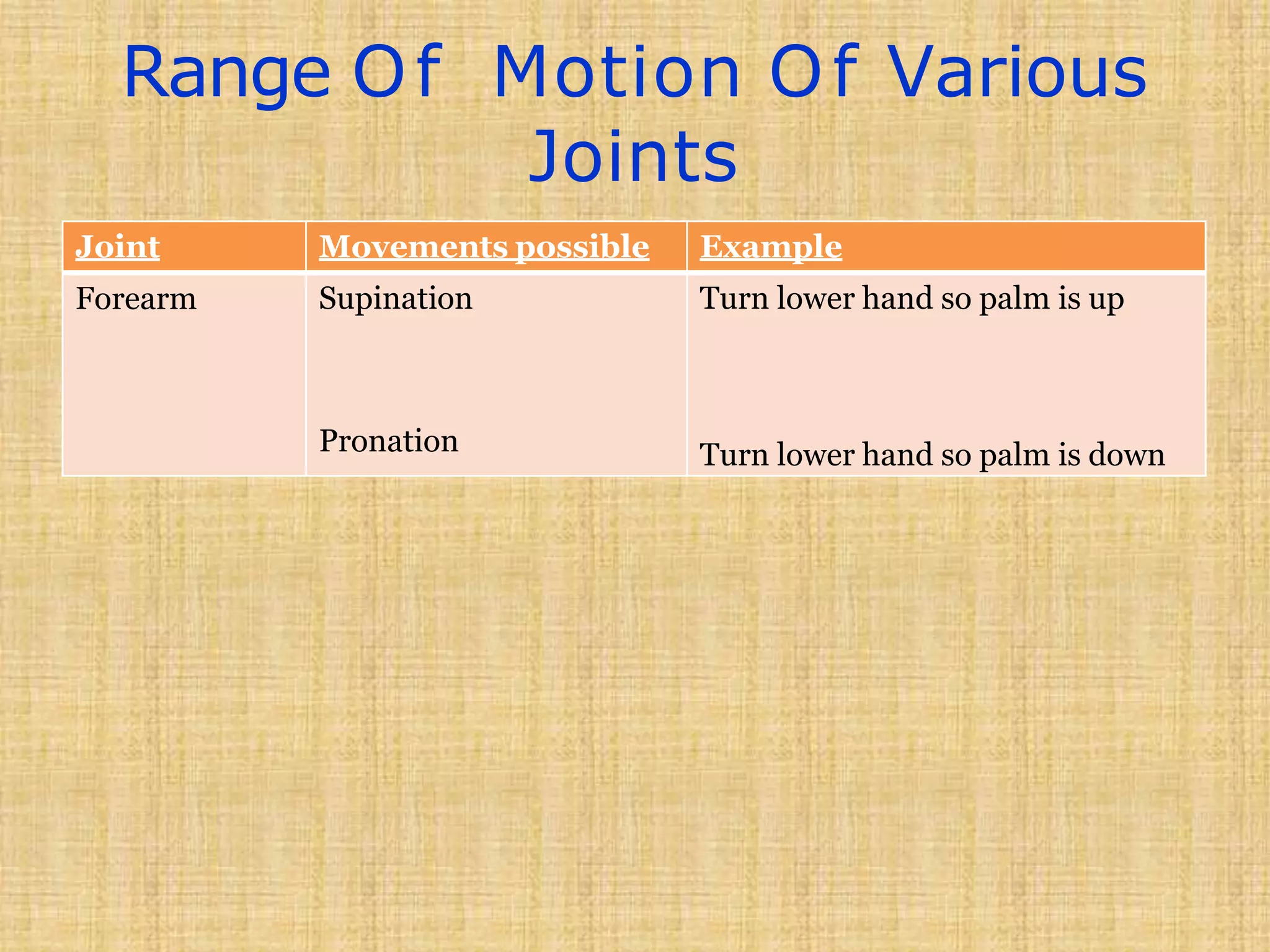
Forearm Supination
Pronation
Turn lower hand so palm is up
Turn lower hand so palm is down
Joint Movements
possible
Example
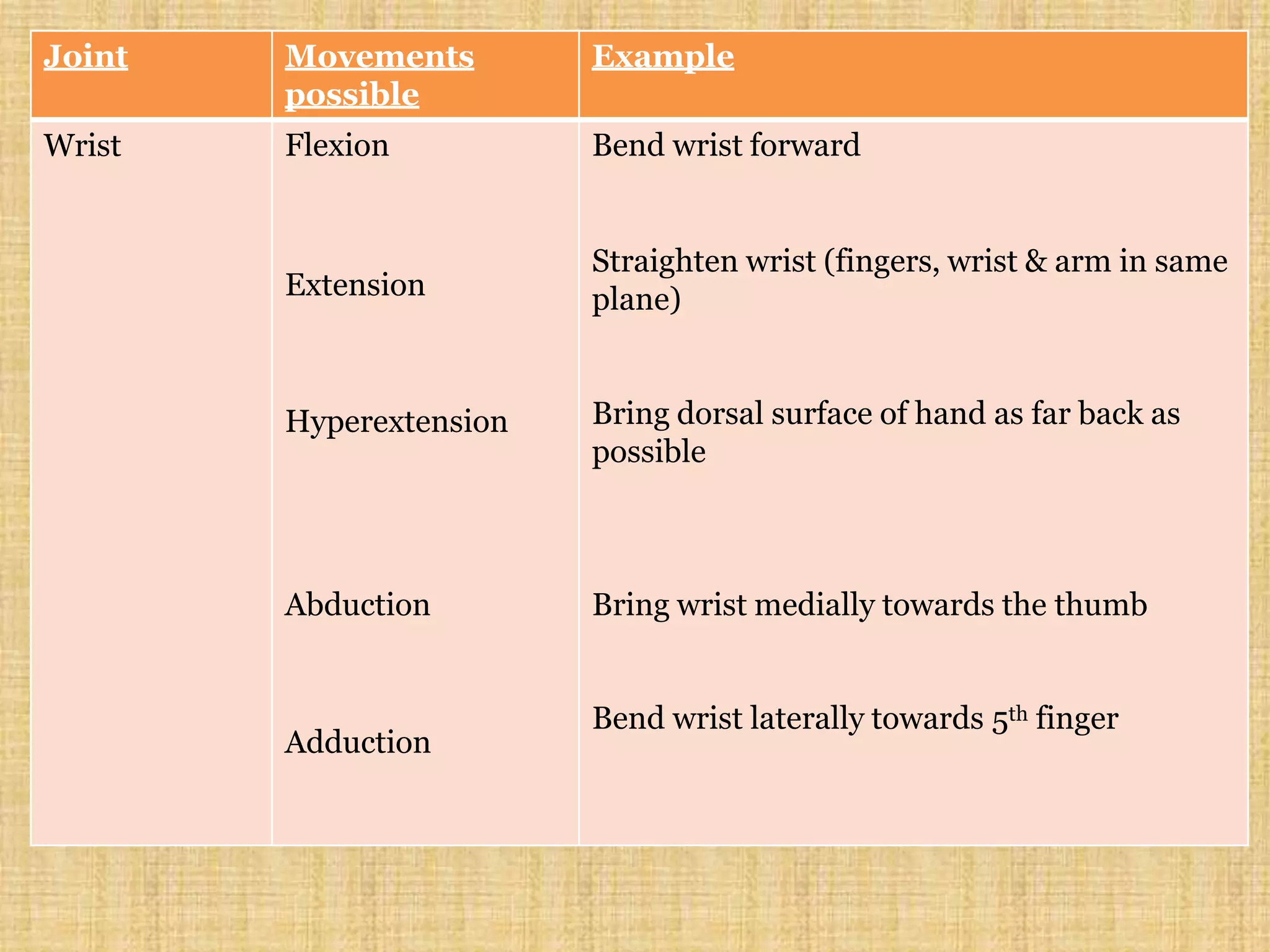
Wrist Flexion Bend wrist forward
Extension
Straighten wrist (fingers, wrist & arm in same
plane)
Hyperextension Bring dorsal surface of hand as far back as
possible
Abduction Bring wrist medially towards the thumb
Adduction
Bend wrist laterally towards 5th finger
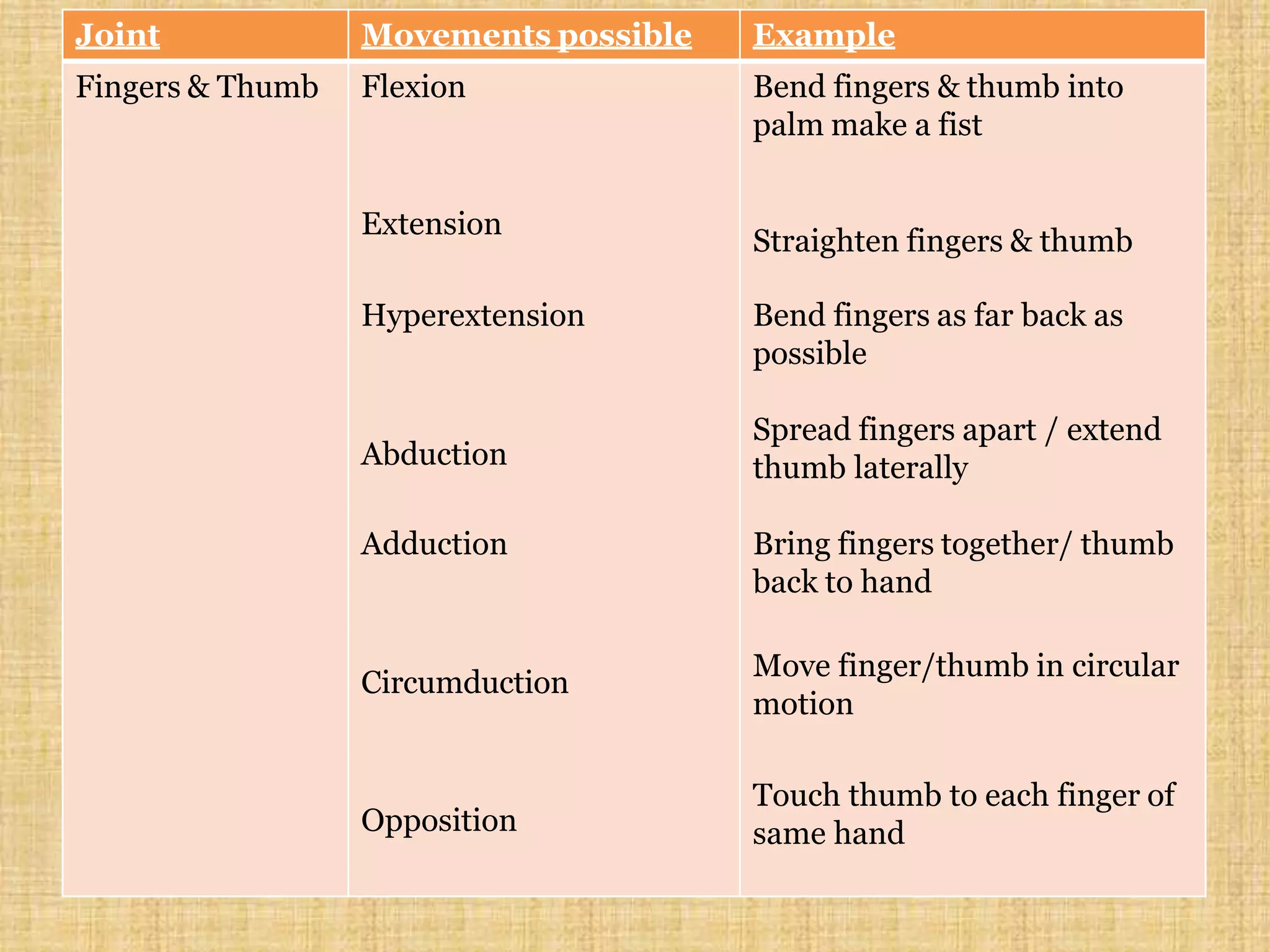
Joint Movements possible Example
Fingers & Thumb Flexion Bend fingers & thumb into
palm make a fist
Extension
Straighten fingers & thumb
Hyperextension Bend fingers as far back as
possible
Abduction
Spread fingers apart / extend
thumb laterally
Adduction Bring fingers together/ thumb
back to hand
Circumduction
Move finger/thumb in circular
motion
Opposition
Touch thumb to each finger of
same hand
Range Of Motion Of Various
Joints
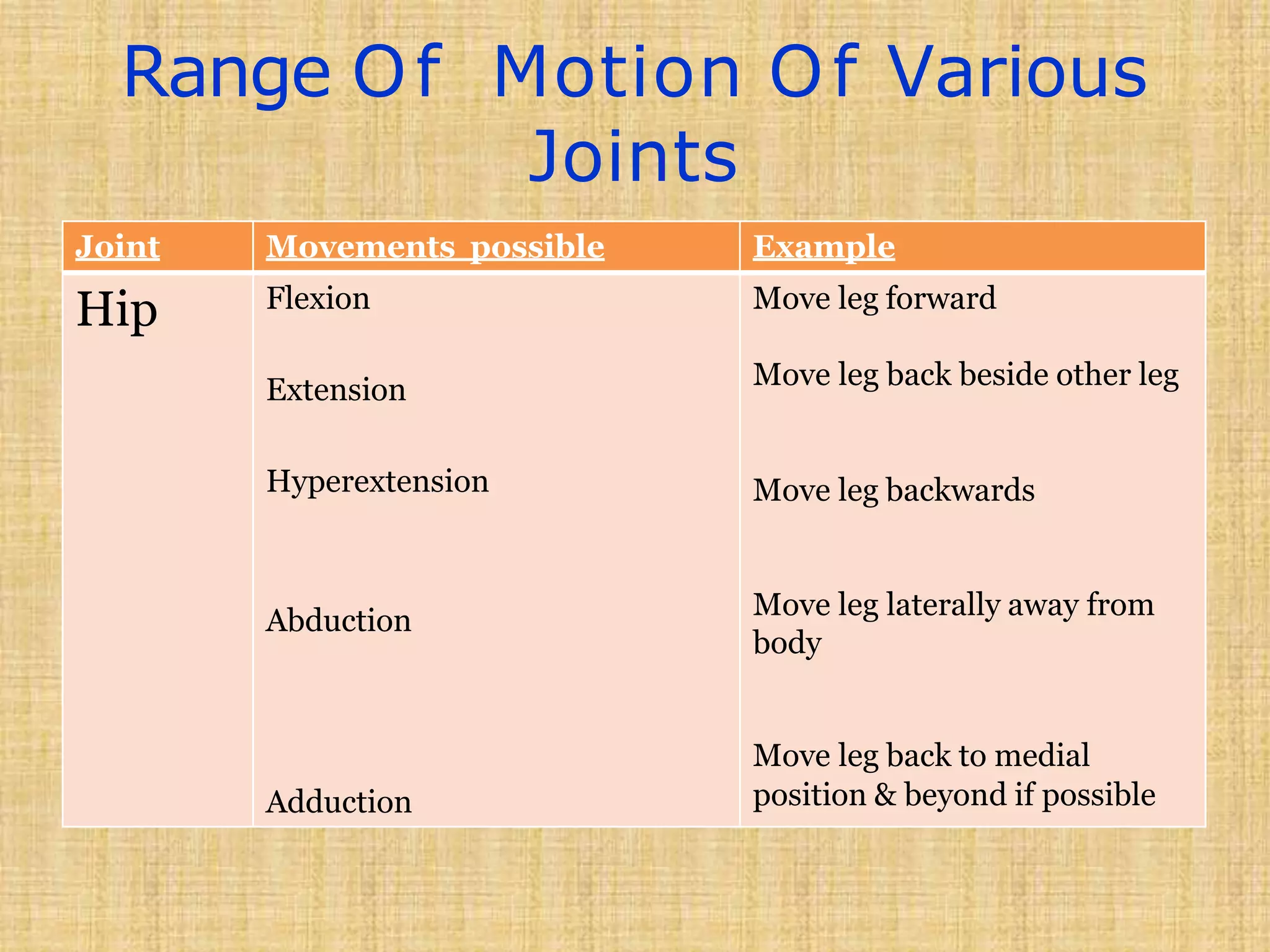
Joint Movements possible Example
Hip Flexion Move leg forward
Extension Move leg back beside other leg
Hyperextension Move leg backwards
Abduction
Move leg laterally away from
body
Move leg back to medial
Adduction position & beyond if possible
Range Of Motion Of Various
Joints
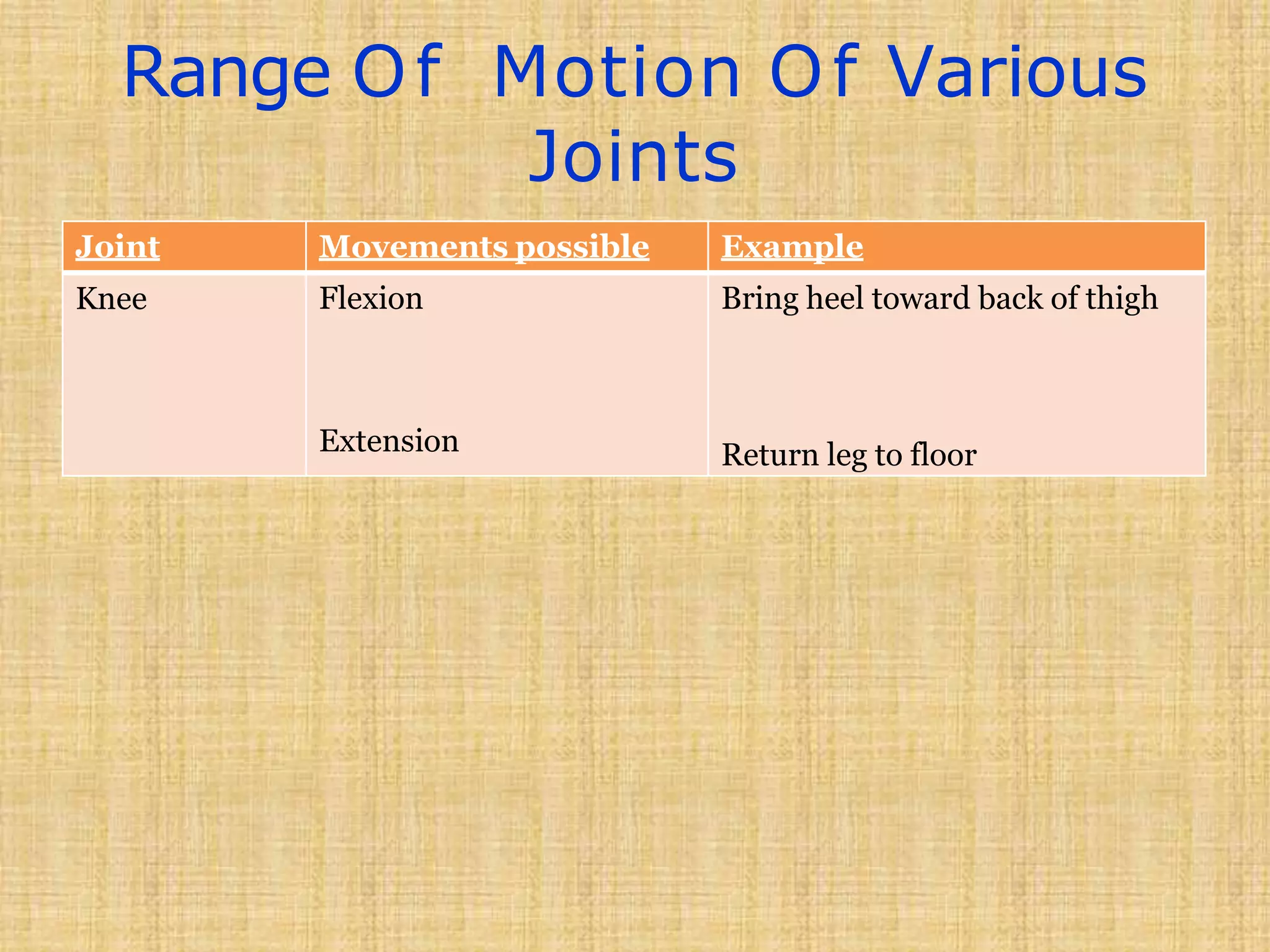
Joint Movements possible Example
Knee Flexion
Extension
Bring heel toward back of thigh
Return leg to floor
Range Of Motion Of Various
Joints
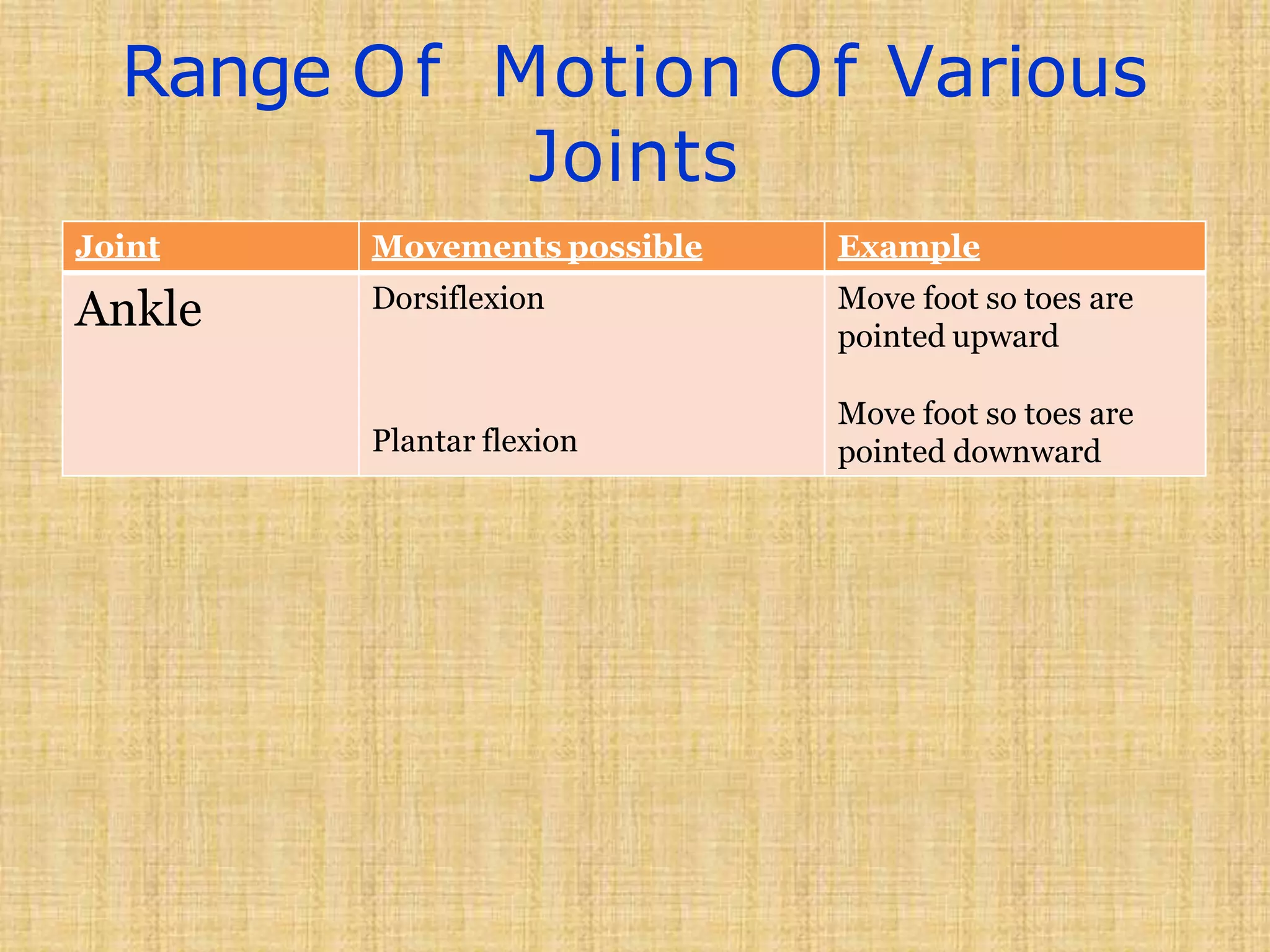
Joint Movements possible Example
Ankle Dorsiflexion
Plantar flexion
Move foot so toes are
pointed upward
Move foot so toes are
pointed downward
Range Of Motion Of Various
Joints
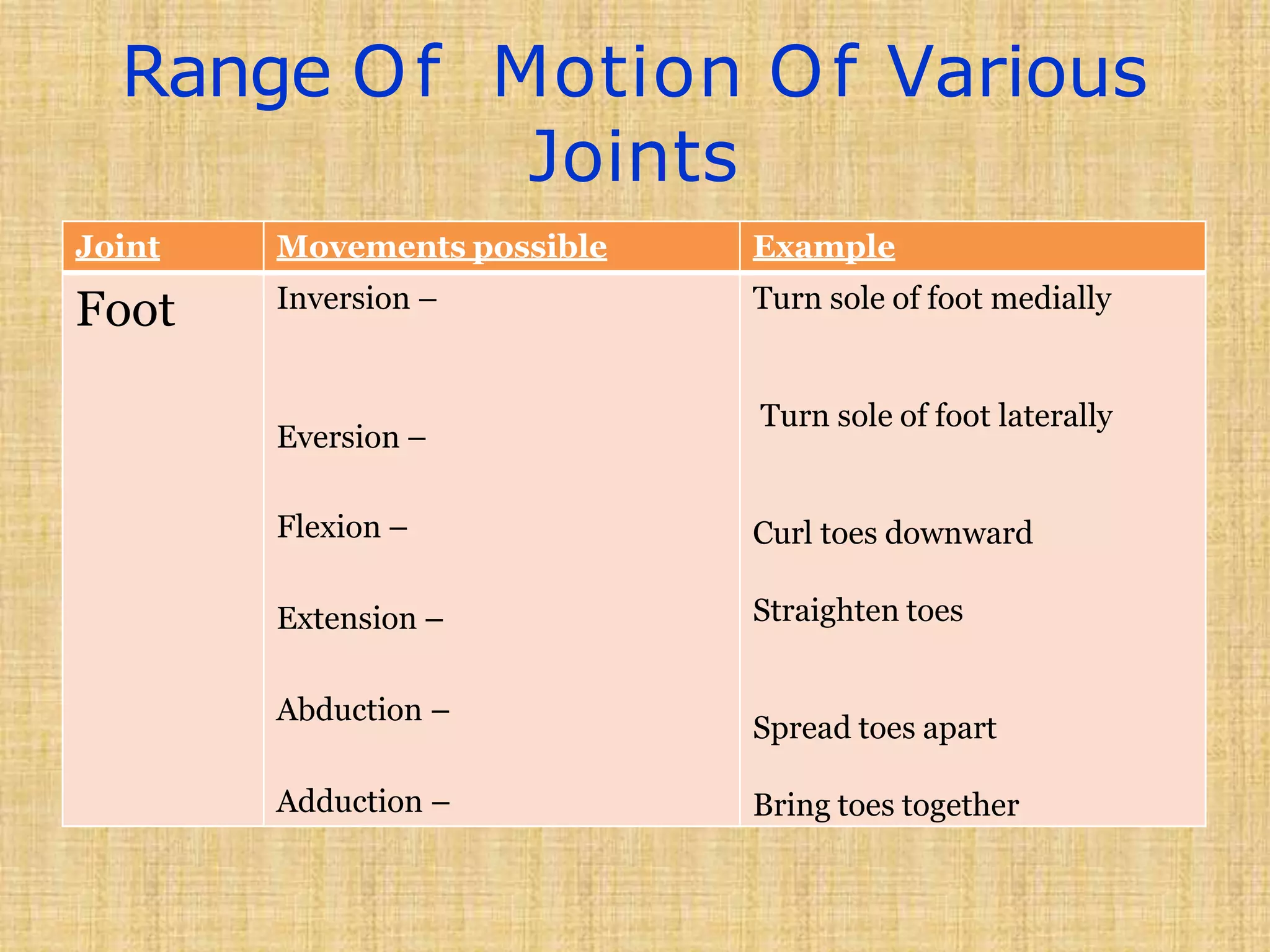
Joint Movements possible Example
Foot Inversion – Turn sole of foot medially
Turn sole of foot laterally
Curl toes downward
Straighten toes
Spread toes apart
Bring toes together
Eversion –
Flexion –
Extension –
Abduction –
Adduction –
Range Of Motion Of Various
Joints
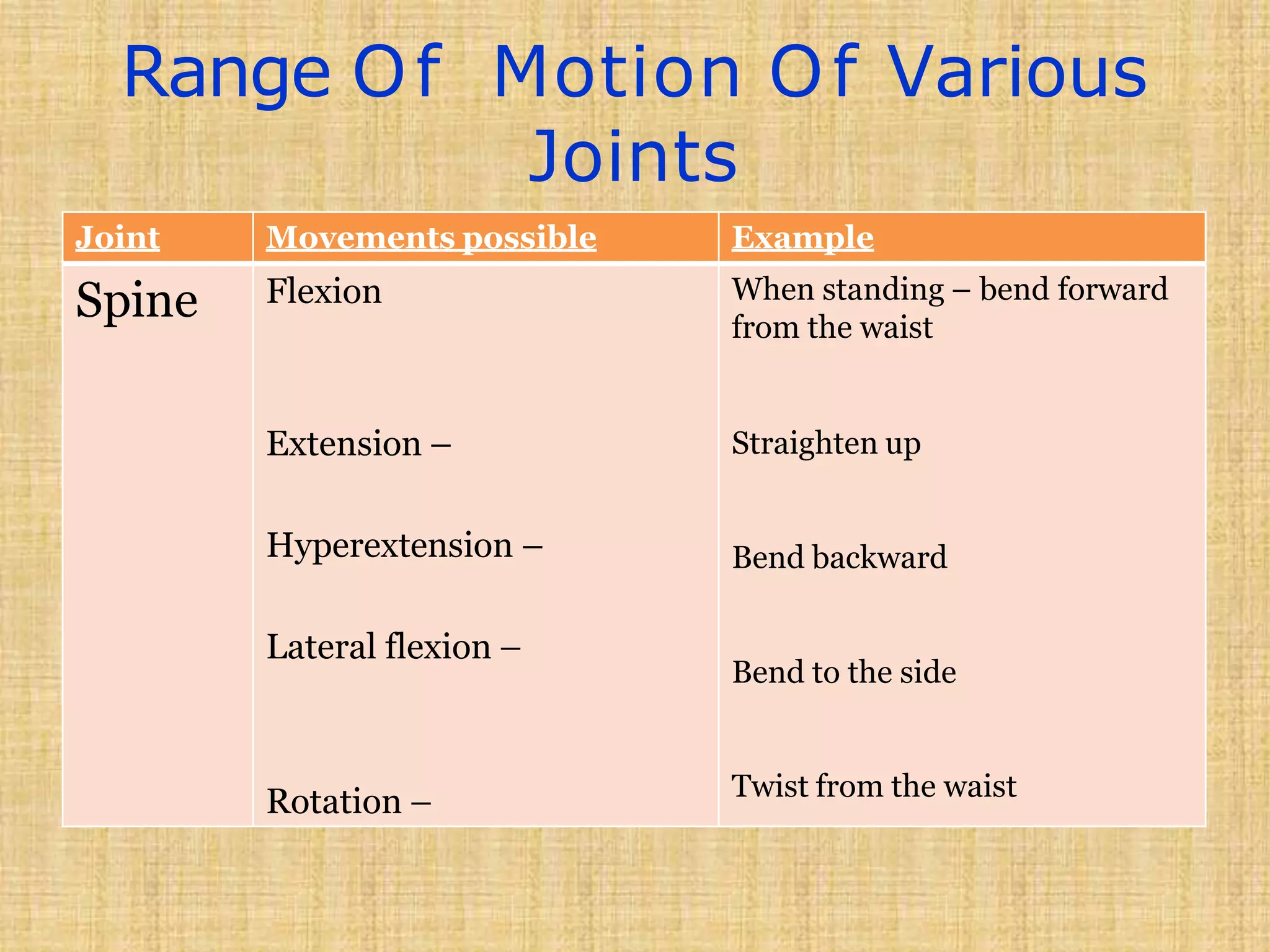
Joint Movements possible Example
Spine Flexion When standing – bend forward
from the waist
Extension – Straighten up
Hyperextension – Bend backward
Lateral flexion –
Bend to the side
Rotation – Twist from the waist
• Thank you

exercise.pptx

  • 2.
    EXERCISE - Definition Exerciseis physical activity for conditioning the body, improving health, and maintaining fitness.
  • 3.
    Purposes • Decrease riskfactors for chronic diseases and increase health and well-being • Improves functional strength. Functional Strength is defined as the ability of the body to perform work. • Develop activity tolerance. Activity tolerance is the type and amount of exercise/ADLs an individual perform without experiencing adverse effects
  • 4.
    Benefits of PhysicalExercise 1. Improves cardiopulmonary function 2. Reduces blood pressure 3. Increases muscle tone and strength 4. Greater physical endurance 5. Increases weight loss 6. Reduces blood glucose level
  • 5.
    Contd… 7. Decreases low-densityblood lipids 8. Improves physical appearance 9.Increases bone density 10.Regularizes bowel elimination 11. Promotes sleep 12.Reduces tension and depression
  • 6.
    Contd… Cardiovascular system: Effectsincludes lowering systolic and diastolic BP and resting HR, improves oxygenation & circulation to all body parts, and improved cardiac efficiency. American Heart Association (2013) recommends at least 150 minutes/ week of moderate exercise and 75 minutes/week of vigorous exercise or combination of moderate and vigorous exercise. Respiratory system: increased respiratory rate and depth, oxygen intake and carbon di oxide excretion increase during exercise, alveolar gas exchange is increased
  • 7.
    Contd… Gastrointestinal system: improvingthe appetite and increase GI tract tone, facilitating peristalsis. Metabolic/endocrine system: elevating the metabolic rate, increase the production of body heat and waste products and calorie use. Increasing the use of triglycerides and fatty acid thus reduce level of serum HbgA and cholesterol. Weight loss and exercise stabilize blood sugar and make cells more responsive to insulin
  • 8.
    Contd… Urinary system: promotesefficient renal blood flow, the body excretes wastes more effectively. Musculoskeletal system : increased muscle efficiency, balance and coordination. Psychoneurologic system: Exercise increases levels of metabolites for neurotransmitters such as norepinephrine and serotonin. It also improves quality of sleep, general behavior and self concept.
  • 9.
    Contd… Cognitive function: positiveeffect on decision- making, problem-solving process, planning, and paying attention. Helping individual with attention deficit/hyperactivity disorder, learning disorders, and mood disorders Immune system: improve circulation. Adequate rest is important after vigorous training to allow the body to recover. Integumentary system: improves tone color and turgor of skin by improving circulation
  • 10.
    Contd… Spiritual health: Yogaimproves the mind-body- spirit connection and establish balance in the internal and external environment. Relaxation response (RR) is a helpful physiological relaxation that can be elicited through recitation of word or phrase while sitting quietly and relaxing your muscle.
  • 11.
    CLASSIFICATION OF EXERCISE EXERCISE BASEDON MUSCLE CONTRACTION ISOTONIC ISOMETRIC ISOKINETIC BASED ON SOURCE OF ENERGY ACTIVE PASSIVE
  • 12.
    Isotonic exercise : Involvemuscle contraction (shortening) and active movement. Example: carrying out ADLs, independently performing range-of-motion exercises, and swimming, walking, jogging, bicycling, moving arms & Legs. Potential benefits include increased muscle mass, tone, strength, improved joint mobility, increased cardiac & respiratory function, and increased osteoblastic (bone-building) activity. These benefits do not occur when someone else performs passive ROM exercises for a patient.
  • 13.
    Isometric exercise: Tightening orcontraction of muscles without shortening (there is no movement). Example: contraction of gluteal & quadriceps muscles, such as what occurs when holding a Yoga pose. Potential benefits are increased muscle mass, tone, and strength, increased circulation to the exercised body part, and increased osteoblastic activity. Nurses should encourage both isotonic and isometric exercises for hospitalized patients with limited mobility.
  • 14.
    Isokinetic Exercise: Involves musclecontraction with resistance. Resistance is provided by an external source. Example: movement of leg / hand & lifting weights against resistance for knee and elbow injuries. Using the device, the person takes the muscles and joint through a complete range of motion without stopping, meeting resistance. A continuous passive motion (CPM) device used postoperatively after joint surgery (knee replacement, anterior cruciate ligament (ACL] repair)
  • 15.
    CPM Machine A continuouspassive motion (CPM) machine is a motorized device that passively moves a joint through a pre-set range of motion.
  • 16.
    BASED ON SOURCEOF ENERGY • Active exercise is therapeutic activity that the client performs independently. • Passive exercise is therapeutic activity that the client performs with assistance and is provided when a client cannot move one or more parts of the body.
  • 17.
    Based on typeof body movement Aerobic exercises- refers to sustained (often rhythmic) muscle movements that increase blood flow, heart rate, and metabolic demand for oxygen over time, promoting cardiovascular conditioning. Examples of aerobic activities include swimming, walking, jogging, cross-country skiing, aerobic dancing, bicycling, jumping rope, and racquetball. Aerobic exercise may be further distinguished as having high or low impact. Low-impact aerobic exercises include those activities in which at least one foot is on the ground at all times, such as walking, rowing, or riding a stationary bicycle. High-impact exercises include activities that are more apt to jar the spine, such as running, jumping, or kickboxing.
  • 18.
    Stretching exercises involvemovements that allow muscles and joints to be stretched gently through their full range of motion, increasing flexibility. Specific warm-up and cool down exercises, Hatha Yoga, and some forms of dance are examples. Benefits include increased range-of-joint movements, improved circulation, and posture and relaxation.
  • 19.
    Strength and enduranceexercises are components of a variety of muscle-building programs. Weight training, calisthenics, and specific isometric exercises can build both strength and endurance, increasing the power of the musculoskeletal system, and generally improving the whole body. They may or may not have aerobic benefit. Movement and ADLs include housecleaning, running after playful toddlers, climbing stairs instead of riding in eleva tors, and so on. Household activities can also contribute to an active lifestyle.
  • 20.
    Range Of MotionExercises Definition: The movement of a joint to the extent possible without causing pain Purposes: • Promote and maintain joint mobility • Prevent contractures and shortening of muscles and tendons • Increase circulation to extremities. • Facilitate comfort for the patient
  • 21.
    Contraindications To ROM •Any illness/disorder where increased use of energy or increased circulation is hazardous. • Example: Myocardial infarction. swollen, inflamed joints
  • 22.
    Types Of ROMExercises • Active ROM exercises – Exercises the client is able to perform independently. • Passive ROM exercises – Exercises performed for the client by someone else. • Active assisted ROM exercises – Performed by a client with some assistance. Client can move a limb partially through its ROM, but needs help completing the ROM.
  • 23.
    Guidelines For PerformingROM Exercises Start with the head and move down, always do bilaterally Do not grasp the joint directly Do not grasp fingernail or toenail. Be sure to support the distal and proximal end of the limbs Important joints – thumb, hip, knee, ankle Move joint through movement 5 times/session
  • 24.
    Guidelines For PerformingROM Exercises Return body part to normal anatomical position Move each joint through full range of motion Move to point of resistance not pain Allow for rest periods whenever required Avoid friction LIFT body part don’t drag Note drastic change in vital signs, extreme fatigue.
  • 25.
    Guidelines For PerformingROM Exercises  Should not disrupt the healing process  Warm water relaxes the muscles and joints, bathing is an ideal time to perform ROM
  • 26.
    Patient Preparation Explain andsteps and advantages of ROM exercises. Remove all restrictive clothing, linen, splint, and dressings. Drape appropriately Raise the bed to comfortable height. Position the patient comfortably- preferably supine position.
  • 27.
    • ABDUCTION -MOVING A BODY PART AWAY FROM THE MIDLINE OF THE BODY • ADDUCTION - MOVING A BODY PART TOWARD THE MIDLINE OF THE BODY • EXTENSION - STRAIGHTENING A BODY PART • FLEXION - BENDING A BODY PART • ROTATION - TURNING THE JOINT • INTERNAL ROTATION - TURNING THE JOINT INWARD
  • 28.
    • EXTERNAL ROTATION- TURNING THE JOINT OUTWARD • PLANTAR FLEXION - BENDING THE FOOT DOWN AT THE ANKLE • PRONATION - TURNING THE JOINT DOWNWARD • SUPINATION - TURNING THE JOINT UPWARD • INVERSION- TURNING THE SOLE OF THE FOOT TOWARDS THE MIDLINE • EVERSION- TURNING THE SOLE OF THE FOOT AWAY FROM THE MID LINE
  • 30.
    Range Of MotionOf Various Joints JOINT MOVEMENTS POSSIBLE EXAMPLE Temporo mandibular Open Opening mouth Close Closing mouth Protrusion Bringing lower jaw forward Retraction Taking lower jaw inside Lateral deviation Moving jaw to a side
  • 31.
    Range Of MotionOf Various Joints JOINT MOVEMENTS POSSIBLE EXAMPLE Neck Flexion Extension Hyperextension Lateral flexion Look @ the toes Look straight ahead Look up @ ceiling look straight ahead, tilt head to shoulder
  • 32.
    Joint Movements possible Example Shoulder FlexionRaise arm forward & overhead Extension Return arm to side of body Abduction Raise arm to side to position above head with palm away from head Adduction Return arm & bring across chest Internal rotation Elbow flexed, rotate the shoulder by moving arm til thumb is turned inward & toward the back (fingers to the floor) External rotation Elbow flexed, move arm until thumb is lateral to head. (Fingers point up) Circumduction Move arm in full circle
  • 33.
    Range Of MotionOf Various Joints Joint Movements possible Example Elbow Flexion Extension Hyperextension Bend elbow Straighten elbow Bend lower arm back as far as possible
  • 34.
    Range Of MotionOf Various Joints Joint Movements possible Example Forearm Supination Pronation Turn lower hand so palm is up Turn lower hand so palm is down
  • 35.
    Joint Movements possible Example Wrist FlexionBend wrist forward Extension Straighten wrist (fingers, wrist & arm in same plane) Hyperextension Bring dorsal surface of hand as far back as possible Abduction Bring wrist medially towards the thumb Adduction Bend wrist laterally towards 5th finger
  • 36.
    Joint Movements possibleExample Fingers & Thumb Flexion Bend fingers & thumb into palm make a fist Extension Straighten fingers & thumb Hyperextension Bend fingers as far back as possible Abduction Spread fingers apart / extend thumb laterally Adduction Bring fingers together/ thumb back to hand Circumduction Move finger/thumb in circular motion Opposition Touch thumb to each finger of same hand
  • 37.
    Range Of MotionOf Various Joints Joint Movements possible Example Hip Flexion Move leg forward Extension Move leg back beside other leg Hyperextension Move leg backwards Abduction Move leg laterally away from body Move leg back to medial Adduction position & beyond if possible
  • 38.
    Range Of MotionOf Various Joints Joint Movements possible Example Knee Flexion Extension Bring heel toward back of thigh Return leg to floor
  • 39.
    Range Of MotionOf Various Joints Joint Movements possible Example Ankle Dorsiflexion Plantar flexion Move foot so toes are pointed upward Move foot so toes are pointed downward
  • 40.
    Range Of MotionOf Various Joints Joint Movements possible Example Foot Inversion – Turn sole of foot medially Turn sole of foot laterally Curl toes downward Straighten toes Spread toes apart Bring toes together Eversion – Flexion – Extension – Abduction – Adduction –
  • 41.
    Range Of MotionOf Various Joints Joint Movements possible Example Spine Flexion When standing – bend forward from the waist Extension – Straighten up Hyperextension – Bend backward Lateral flexion – Bend to the side Rotation – Twist from the waist
  • 42.

Editor's Notes

  • #9 Mental or affective disorder such as depression, chronic stress may affect a persons’ desire to move (lack enthusiasm/ energy for taking any activity or even for usual hygiene).