Neuromuscular Adaptations to
         Training
   Baechle Chapter 4, pp. 143-151,
    Powers & Howley pp. 253-255
Lecture Overview

Neural Adaptations
Skeletal Muscle Adaptations
Connective Tissue Anatomy
Connective Tissue Adaptations
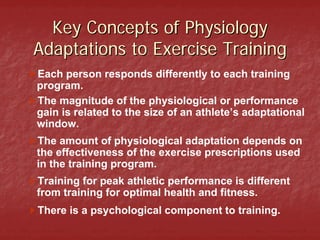
Key Concepts of Physiology
Adaptations to Exercise Training
Each person responds differently to each training
program.
The magnitude of the physiological or performance
gain is related to the size of an athlete’s adaptational
window.
The amount of physiological adaptation depends on
the effectiveness of the exercise prescriptions used
in the training program.
Training for peak athletic performance is different
from training for optimal health and fitness.
There is a psychological component to training.
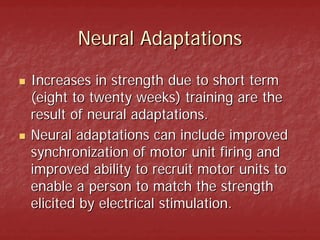
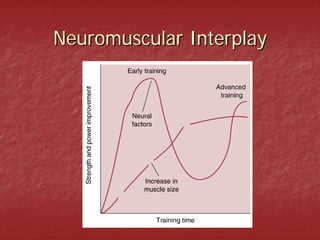
Neural Adaptations

Increases in strength due to short term
(eight to twenty weeks) training are the
result of neural adaptations.
Neural adaptations can include improved
synchronization of motor unit firing and
improved ability to recruit motor units to
enable a person to match the strength
elicited by electrical stimulation.
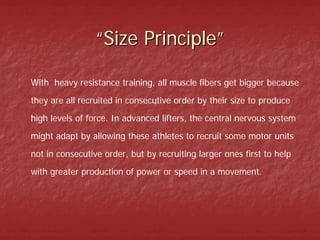
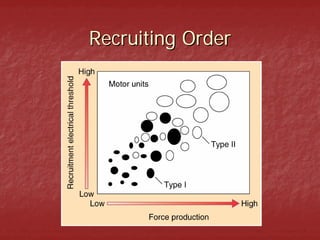
“Size Principle”

With heavy resistance training, all muscle fibers get bigger because

they are all recruited in consecutive order by their size to produce
high levels of force. In advanced lifters, the central nervous system

might adapt by allowing these athletes to recruit some motor units

not in consecutive order, but by recruiting larger ones first to help
with greater production of power or speed in a movement.
Recruiting Order
Type of Training

• Adaptations to resistance training are specific to the type
  of exercise performed. Moreover, resistance training has
  no meaningful impact on aerobic power.

• Although aerobic endurance training increases aerobic
  power, it does not enhance muscle strength or size. In
  fact, intense aerobic endurance training can actually
  compromise the benefits of resistance training.
Stimulating Muscular Adaptations
   through Resistance Training
For Strength
  High loads, few repetitions, full recovery
  periods.
For Muscle Size
  Moderate loads, high volume, short to
  moderate rest periods.
For Muscular Endurance
  Low intensity, high volume, little recovery
  allowed.
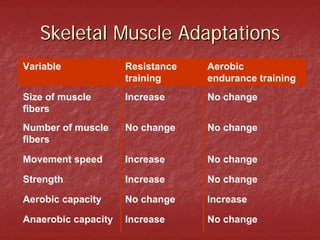
Skeletal Muscle Adaptations
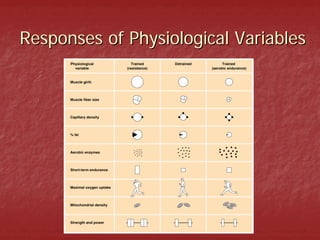
Variable             Resistance   Aerobic
                     training     endurance training
Size of muscle       Increase     No change
fibers
Number of muscle     No change    No change
fibers

Movement speed       Increase     No change

Strength             Increase     No change

Aerobic capacity     No change    Increase

Anaerobic capacity   Increase     No change
Skeletal Muscle Adaptations
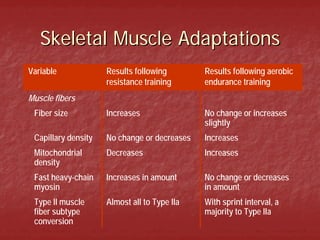
Variable             Results following        Results following aerobic
                     resistance training      endurance training
Muscle fibers
 Fiber size          Increases                No change or increases
                                              slightly
 Capillary density   No change or decreases   Increases
 Mitochondrial       Decreases                Increases
 density
 Fast heavy-chain    Increases in amount      No change or decreases
 myosin                                       in amount
 Type II muscle      Almost all to Type IIa   With sprint interval, a
 fiber subtype                                majority to Type IIa
 conversion
Muscle Fiber Size
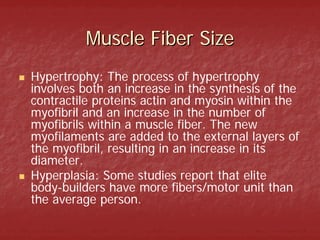
Hypertrophy: The process of hypertrophy
involves both an increase in the synthesis of the
contractile proteins actin and myosin within the
myofibril and an increase in the number of
myofibrils within a muscle fiber. The new
myofilaments are added to the external layers of
the myofibril, resulting in an increase in its
diameter.
Hyperplasia: Some studies report that elite
body-builders have more fibers/motor unit than
the average person.
Alteration of Muscle Fiber Types

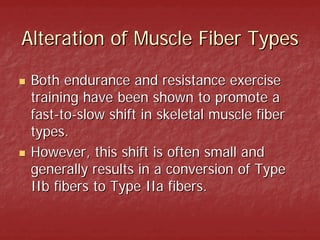
 Both endurance and resistance exercise
 training have been shown to promote a
 fast-to-slow shift in skeletal muscle fiber
 types.
 However, this shift is often small and
 generally results in a conversion of Type
 IIb fibers to Type IIa fibers.
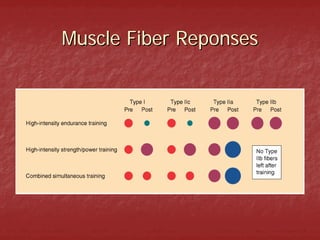
Muscle Fiber Reponses
Neuromuscular Interplay
Responses of Physiological Variables
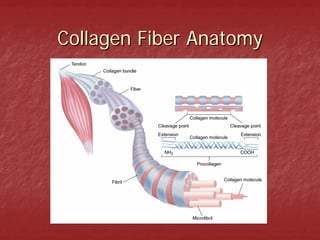
Collagen Fiber Anatomy
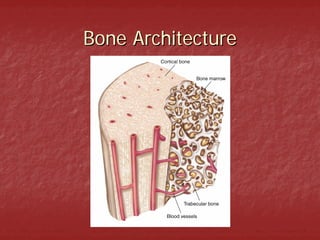
Bone Architecture
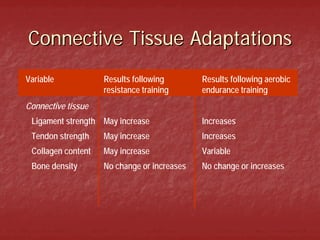
Connective Tissue Adaptations
Variable            Results following        Results following aerobic
                    resistance training      endurance training
Connective tissue
 Ligament strength May increase              Increases
 Tendon strength    May increase             Increases
 Collagen content   May increase             Variable
 Bone density       No change or increases   No change or increases
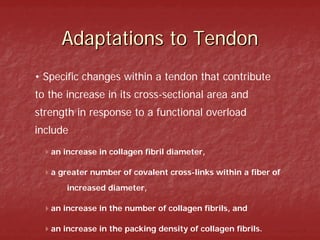
Adaptations to Tendon
• Specific changes within a tendon that contribute
to the increase in its cross-sectional area and
strength in response to a functional overload
include
   an increase in collagen fibril diameter,

   a greater number of covalent cross-links within a fiber of
       increased diameter,

   an increase in the number of collagen fibrils, and

   an increase in the packing density of collagen fibrils.
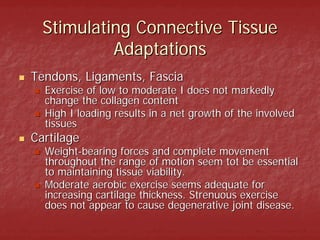
Stimulating Connective Tissue
           Adaptations
Tendons, Ligaments, Fascia
  Exercise of low to moderate I does not markedly
  change the collagen content
  High I loading results in a net growth of the involved
  tissues
Cartilage
  Weight-bearing forces and complete movement
  throughout the range of motion seem tot be essential
  to maintaining tissue viability.
  Moderate aerobic exercise seems adequate for
  increasing cartilage thickness. Strenuous exercise
  does not appear to cause degenerative joint disease.
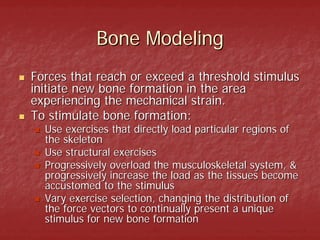
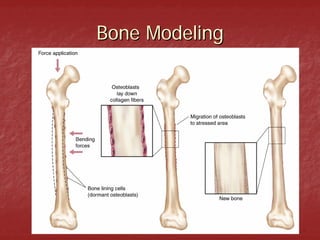
Bone Modeling
Forces that reach or exceed a threshold stimulus
initiate new bone formation in the area
experiencing the mechanical strain.
To stimulate bone formation:
  Use exercises that directly load particular regions of
  the skeleton
  Use structural exercises
  Progressively overload the musculoskeletal system, &
  progressively increase the load as the tissues become
  accustomed to the stimulus
  Vary exercise selection, changing the distribution of
  the force vectors to continually present a unique
  stimulus for new bone formation
Bone Modeling

Neuromuscular adaptations to training

  • 1.
    Neuromuscular Adaptations to Training Baechle Chapter 4, pp. 143-151, Powers & Howley pp. 253-255
  • 2.
    Lecture Overview Neural Adaptations SkeletalMuscle Adaptations Connective Tissue Anatomy Connective Tissue Adaptations
  • 3.
    Key Concepts ofPhysiology Adaptations to Exercise Training Each person responds differently to each training program. The magnitude of the physiological or performance gain is related to the size of an athlete’s adaptational window. The amount of physiological adaptation depends on the effectiveness of the exercise prescriptions used in the training program. Training for peak athletic performance is different from training for optimal health and fitness. There is a psychological component to training.
  • 4.
    Neural Adaptations Increases instrength due to short term (eight to twenty weeks) training are the result of neural adaptations. Neural adaptations can include improved synchronization of motor unit firing and improved ability to recruit motor units to enable a person to match the strength elicited by electrical stimulation.
  • 5.
    “Size Principle” With heavyresistance training, all muscle fibers get bigger because they are all recruited in consecutive order by their size to produce high levels of force. In advanced lifters, the central nervous system might adapt by allowing these athletes to recruit some motor units not in consecutive order, but by recruiting larger ones first to help with greater production of power or speed in a movement.
  • 6.
  • 7.
    Type of Training •Adaptations to resistance training are specific to the type of exercise performed. Moreover, resistance training has no meaningful impact on aerobic power. • Although aerobic endurance training increases aerobic power, it does not enhance muscle strength or size. In fact, intense aerobic endurance training can actually compromise the benefits of resistance training.
  • 8.
    Stimulating Muscular Adaptations through Resistance Training For Strength High loads, few repetitions, full recovery periods. For Muscle Size Moderate loads, high volume, short to moderate rest periods. For Muscular Endurance Low intensity, high volume, little recovery allowed.
  • 9.
    Skeletal Muscle Adaptations Variable Resistance Aerobic training endurance training Size of muscle Increase No change fibers Number of muscle No change No change fibers Movement speed Increase No change Strength Increase No change Aerobic capacity No change Increase Anaerobic capacity Increase No change
  • 10.
    Skeletal Muscle Adaptations Variable Results following Results following aerobic resistance training endurance training Muscle fibers Fiber size Increases No change or increases slightly Capillary density No change or decreases Increases Mitochondrial Decreases Increases density Fast heavy-chain Increases in amount No change or decreases myosin in amount Type II muscle Almost all to Type IIa With sprint interval, a fiber subtype majority to Type IIa conversion
  • 11.
    Muscle Fiber Size Hypertrophy:The process of hypertrophy involves both an increase in the synthesis of the contractile proteins actin and myosin within the myofibril and an increase in the number of myofibrils within a muscle fiber. The new myofilaments are added to the external layers of the myofibril, resulting in an increase in its diameter. Hyperplasia: Some studies report that elite body-builders have more fibers/motor unit than the average person.
  • 12.
    Alteration of MuscleFiber Types Both endurance and resistance exercise training have been shown to promote a fast-to-slow shift in skeletal muscle fiber types. However, this shift is often small and generally results in a conversion of Type IIb fibers to Type IIa fibers.
  • 13.
  • 14.
  • 15.
  • 16.
  • 17.
  • 18.
    Connective Tissue Adaptations Variable Results following Results following aerobic resistance training endurance training Connective tissue Ligament strength May increase Increases Tendon strength May increase Increases Collagen content May increase Variable Bone density No change or increases No change or increases
  • 19.
    Adaptations to Tendon •Specific changes within a tendon that contribute to the increase in its cross-sectional area and strength in response to a functional overload include an increase in collagen fibril diameter, a greater number of covalent cross-links within a fiber of increased diameter, an increase in the number of collagen fibrils, and an increase in the packing density of collagen fibrils.
  • 20.
    Stimulating Connective Tissue Adaptations Tendons, Ligaments, Fascia Exercise of low to moderate I does not markedly change the collagen content High I loading results in a net growth of the involved tissues Cartilage Weight-bearing forces and complete movement throughout the range of motion seem tot be essential to maintaining tissue viability. Moderate aerobic exercise seems adequate for increasing cartilage thickness. Strenuous exercise does not appear to cause degenerative joint disease.
  • 21.
    Bone Modeling Forces thatreach or exceed a threshold stimulus initiate new bone formation in the area experiencing the mechanical strain. To stimulate bone formation: Use exercises that directly load particular regions of the skeleton Use structural exercises Progressively overload the musculoskeletal system, & progressively increase the load as the tissues become accustomed to the stimulus Vary exercise selection, changing the distribution of the force vectors to continually present a unique stimulus for new bone formation
  • 22.