   Define diffusion and describe the role of diffusion in
    nutrients uptake and gaseous exchange in plants
    and humans.
   Define osmosis and describe the effects of osmosis
    on plant and animal tissues.
   Define active transport and discuss its
    importance as an energy-consuming process
    (Pure)
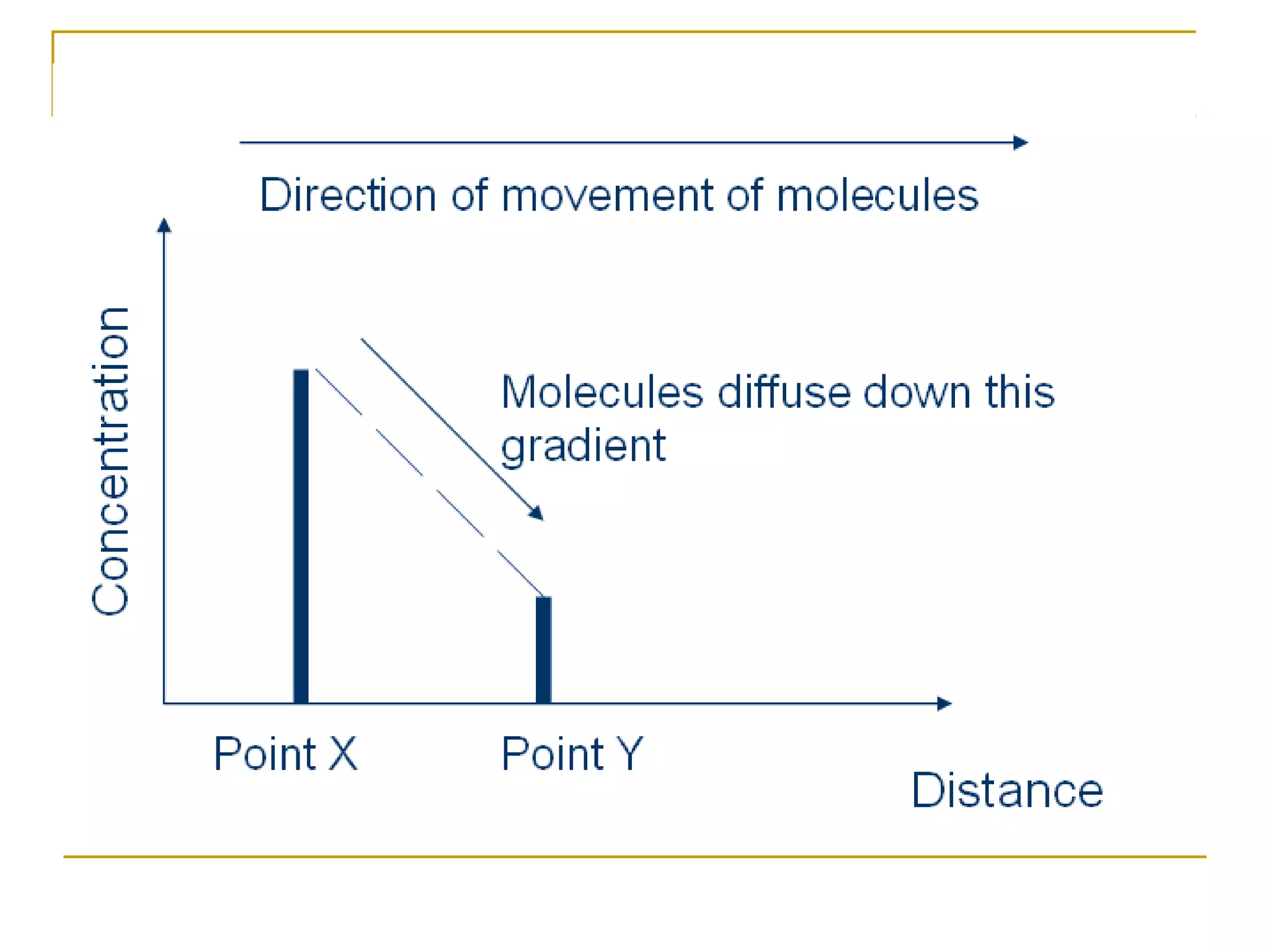
•Diffusion is the net movement of molecules
from a region of higher concentration to a
region of lower concentration, down a
concentration gradient.
•The difference in concentrations of the
substance between the two regions is
known as concentration gradient or
diffusion gradient.
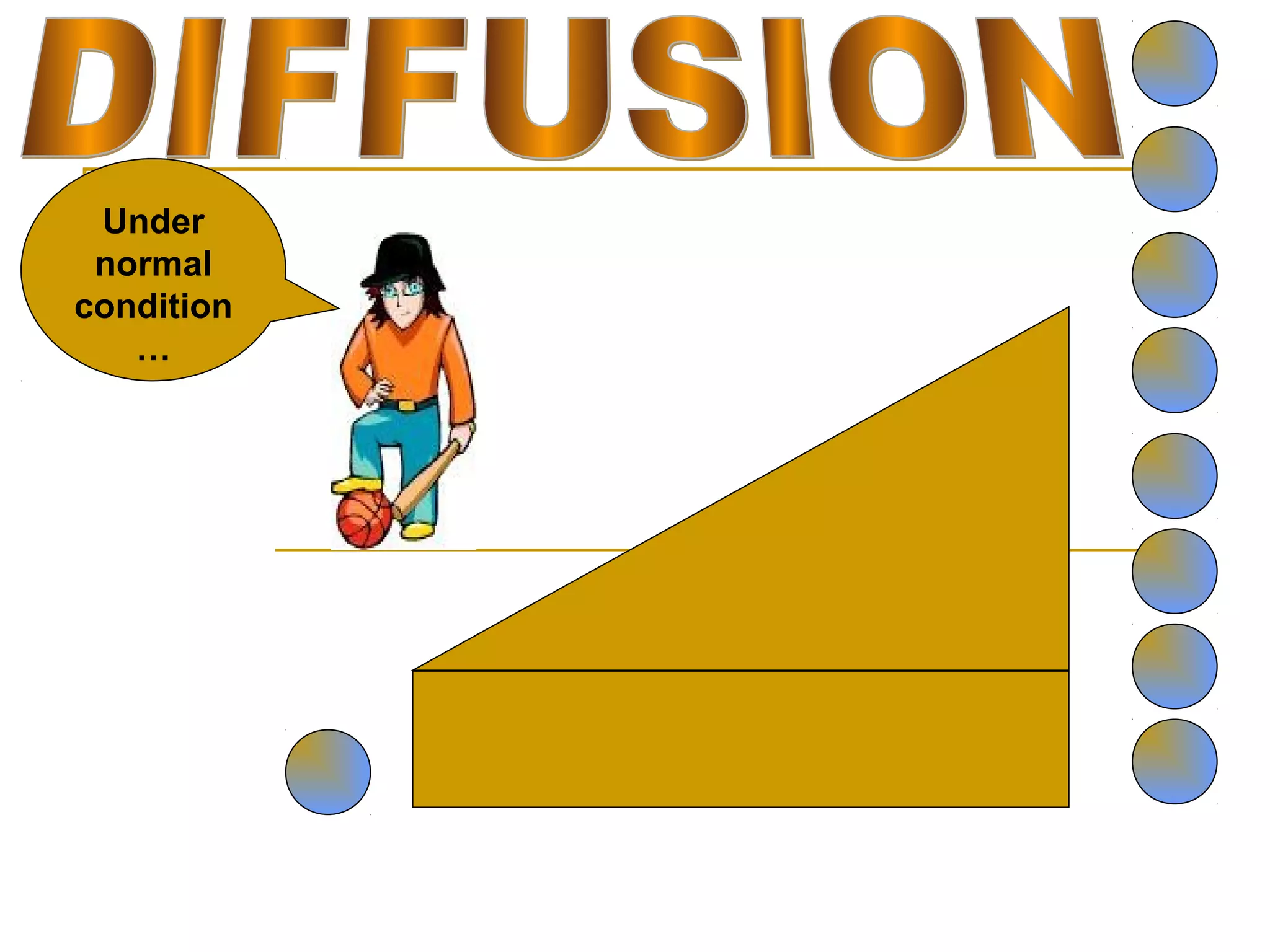
Under
 normal
condition
   …
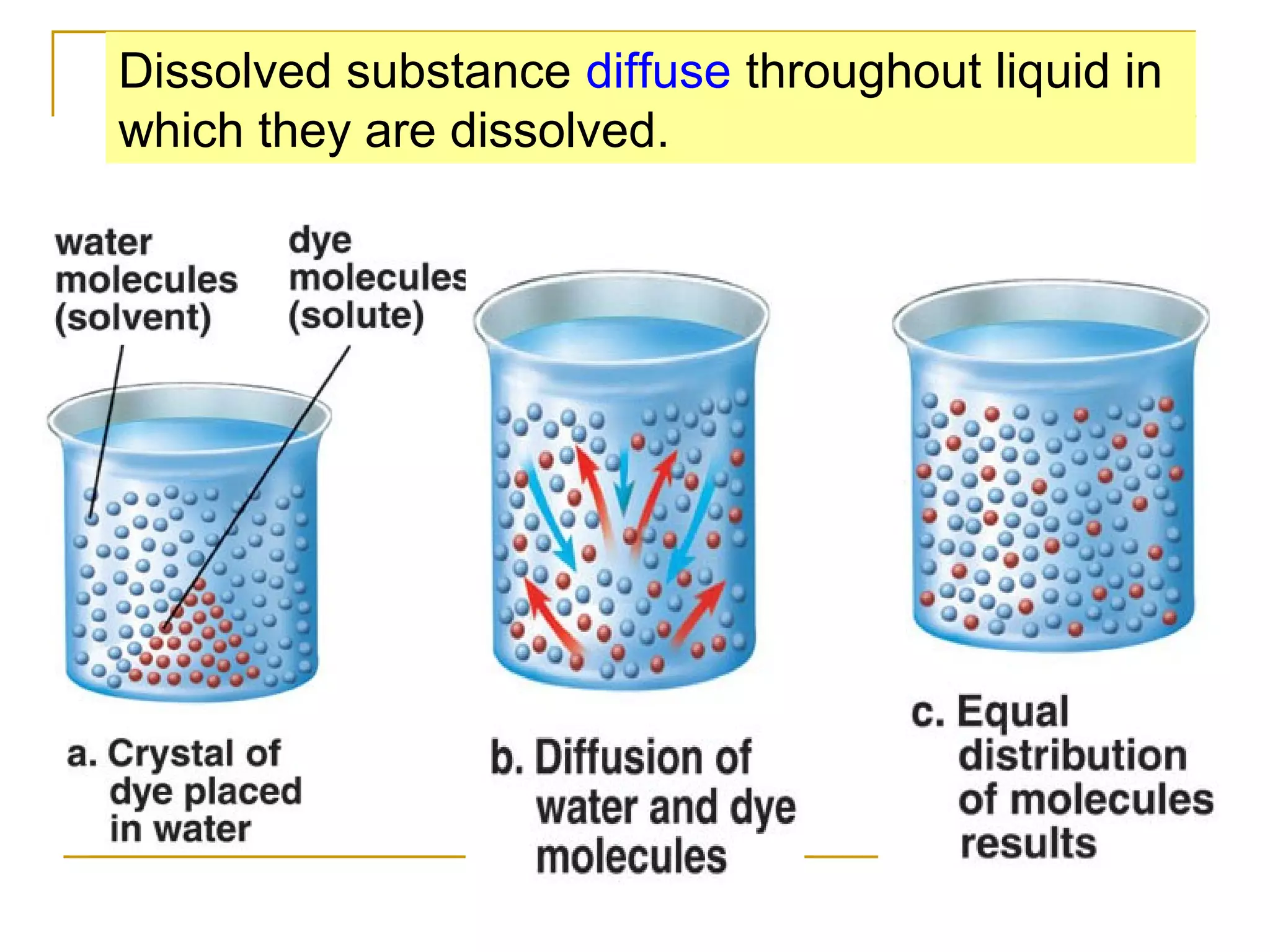
Dissolved substance diffuse throughout liquid in
which they are dissolved.
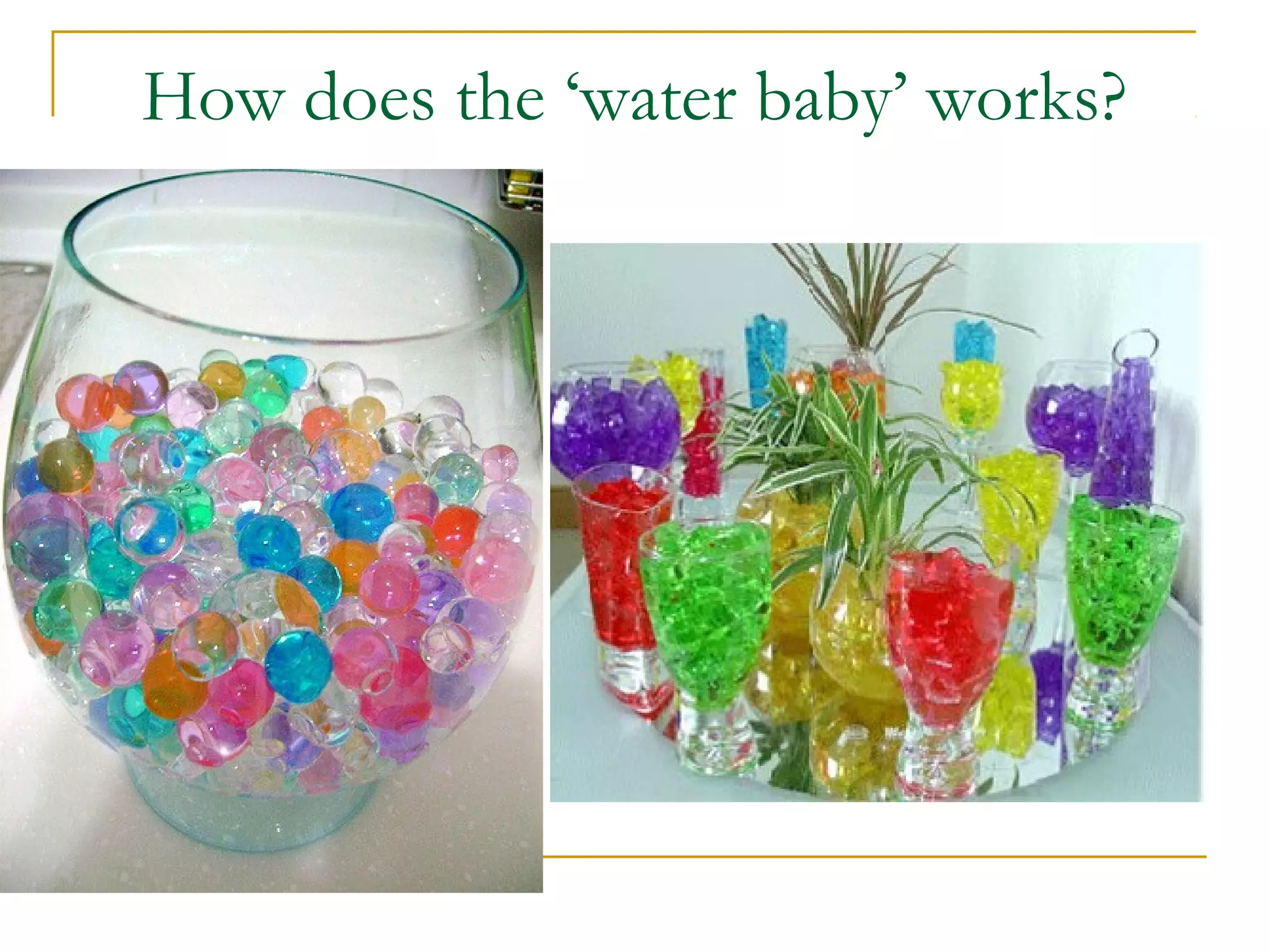
How does the ‘water baby’ works?
Examples of diffusion:

   Carbon dioxide diffuses from blood capillary
    into alveoli and oxygen diffuses from alveoli
    into surrounding blood capillaries.
   The diffusion of carbon dioxide through the
    stomata into the mesophyll cells.
   The diffusion of water vapour from the
    leaves during transpiration.
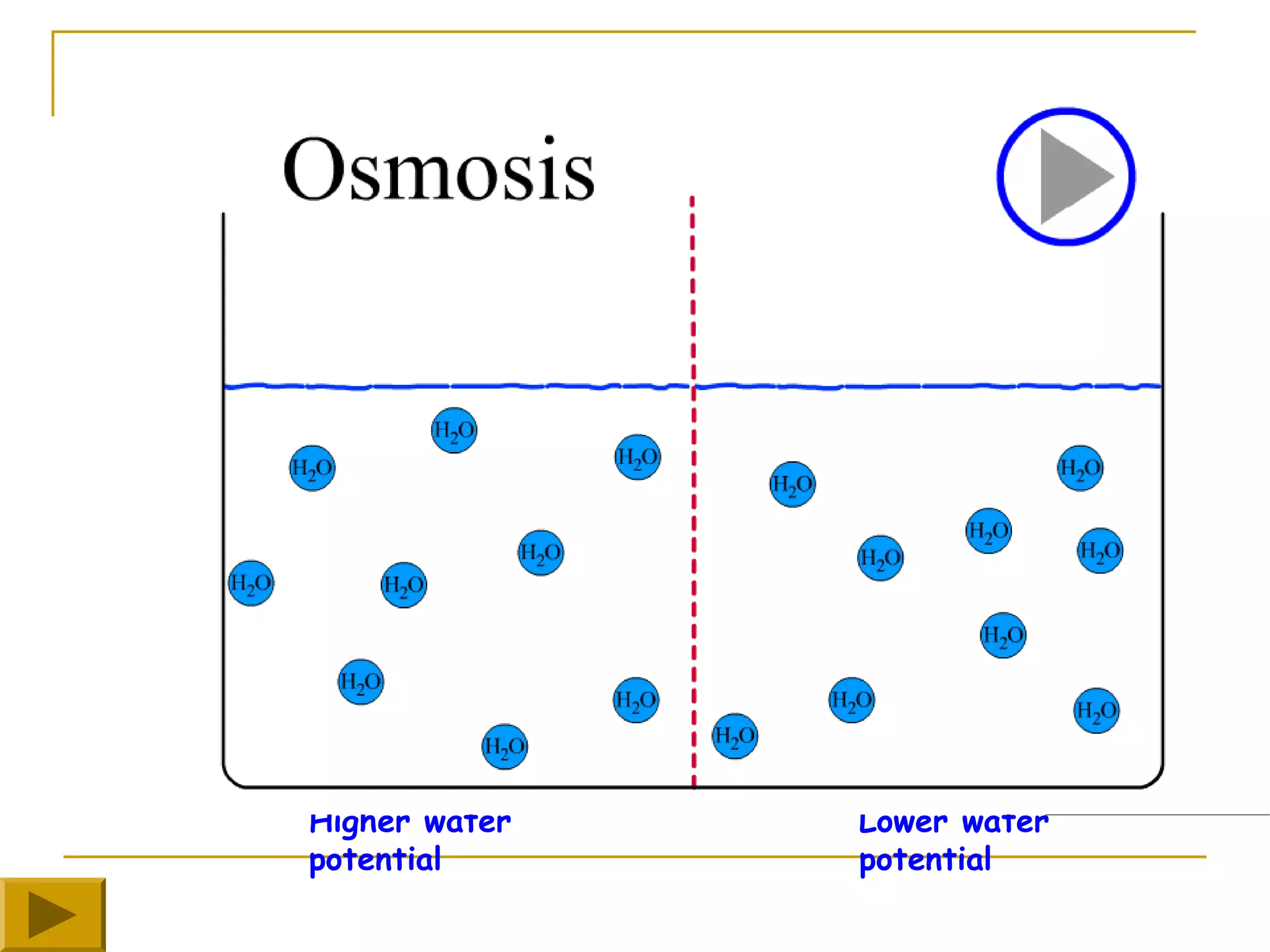
Osmosis is …
• the net movement of water molecules
• from a region of higher water potential to
  a region of a lower water potential
• through a partially permeable membrane
• Involves only water molecules
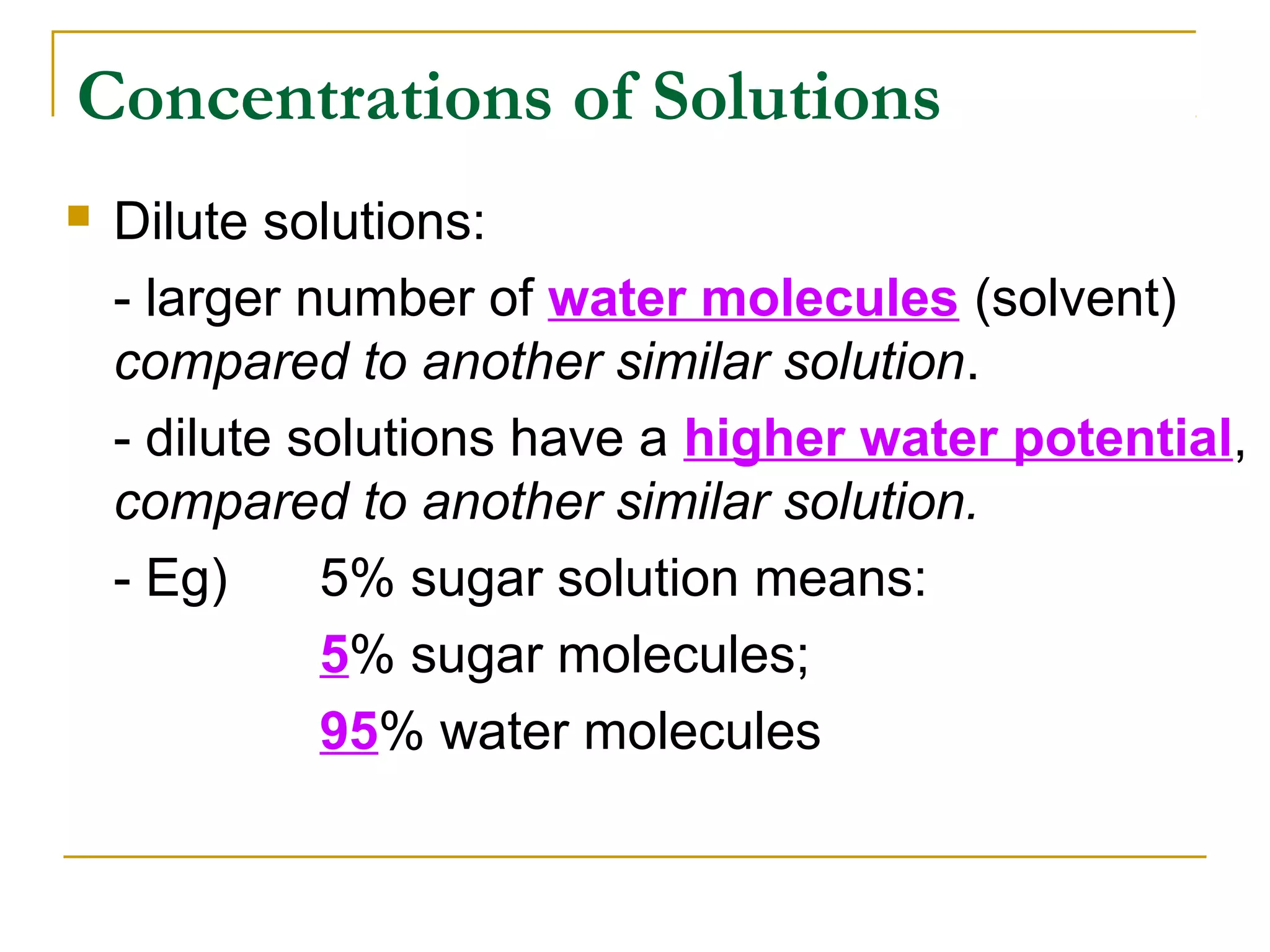
Concentrations of Solutions
   Dilute solutions:
    - larger number of water molecules (solvent)
    compared to another similar solution.
    - dilute solutions have a higher water potential,
    compared to another similar solution.
    - Eg)     5% sugar solution means:
              5% sugar molecules;
              95% water molecules
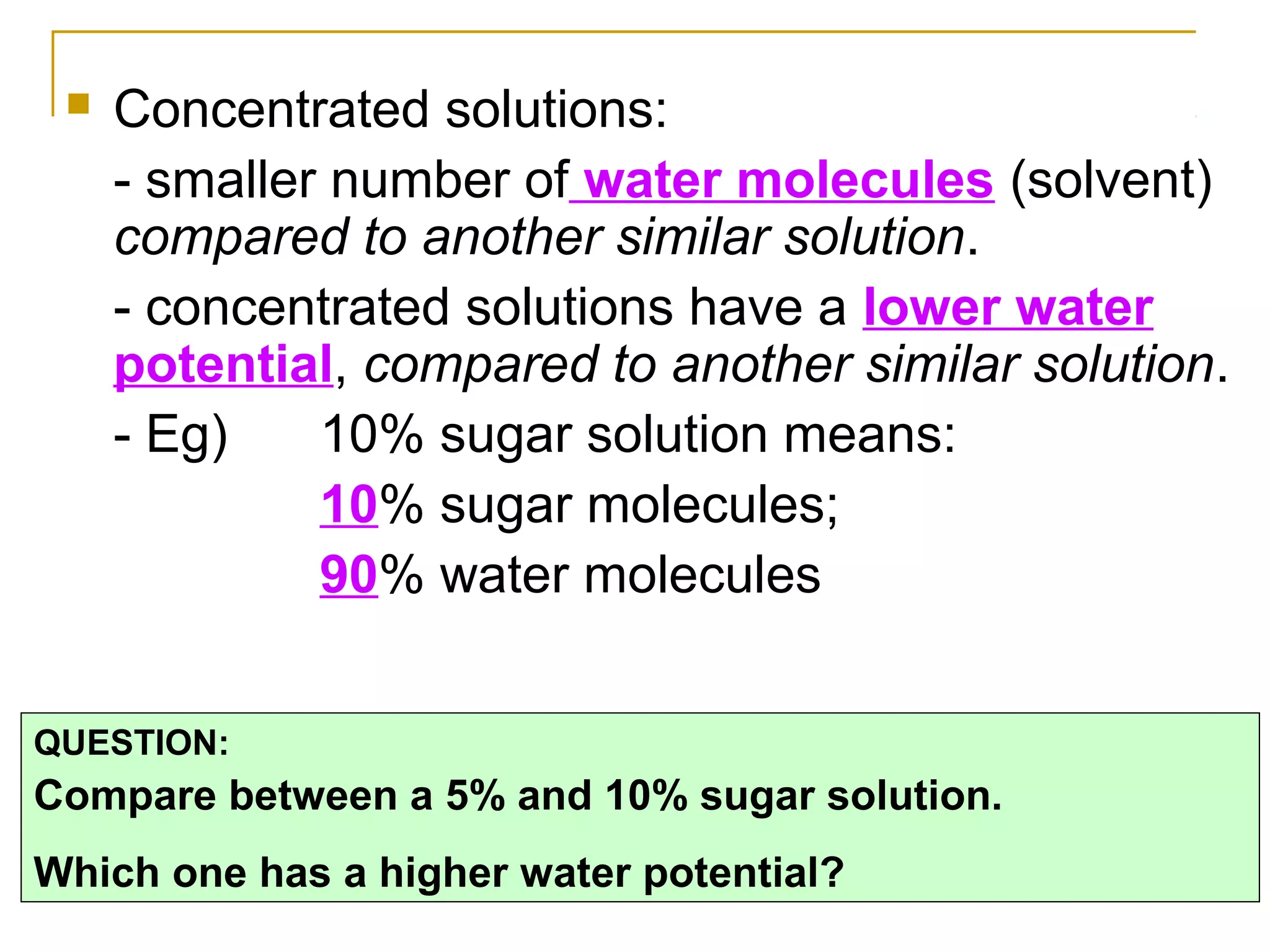
   Concentrated solutions:
     - smaller number of water molecules (solvent)
     compared to another similar solution.
     - concentrated solutions have a lower water
     potential, compared to another similar solution.
     - Eg)    10% sugar solution means:
              10% sugar molecules;
              90% water molecules


QUESTION:
Compare between a 5% and 10% sugar solution.
Which one has a higher water potential?
Osmosis
   Sugars such as starch molecules CANNOT
    pass through the partially permeable
    membrane (Too big)

   However, sugar such as glucose CAN pass
    through the partially permeable membrane
    (Small enough)
Partially
          permeable
          membrane


Higher water           Lower water
potential              potential
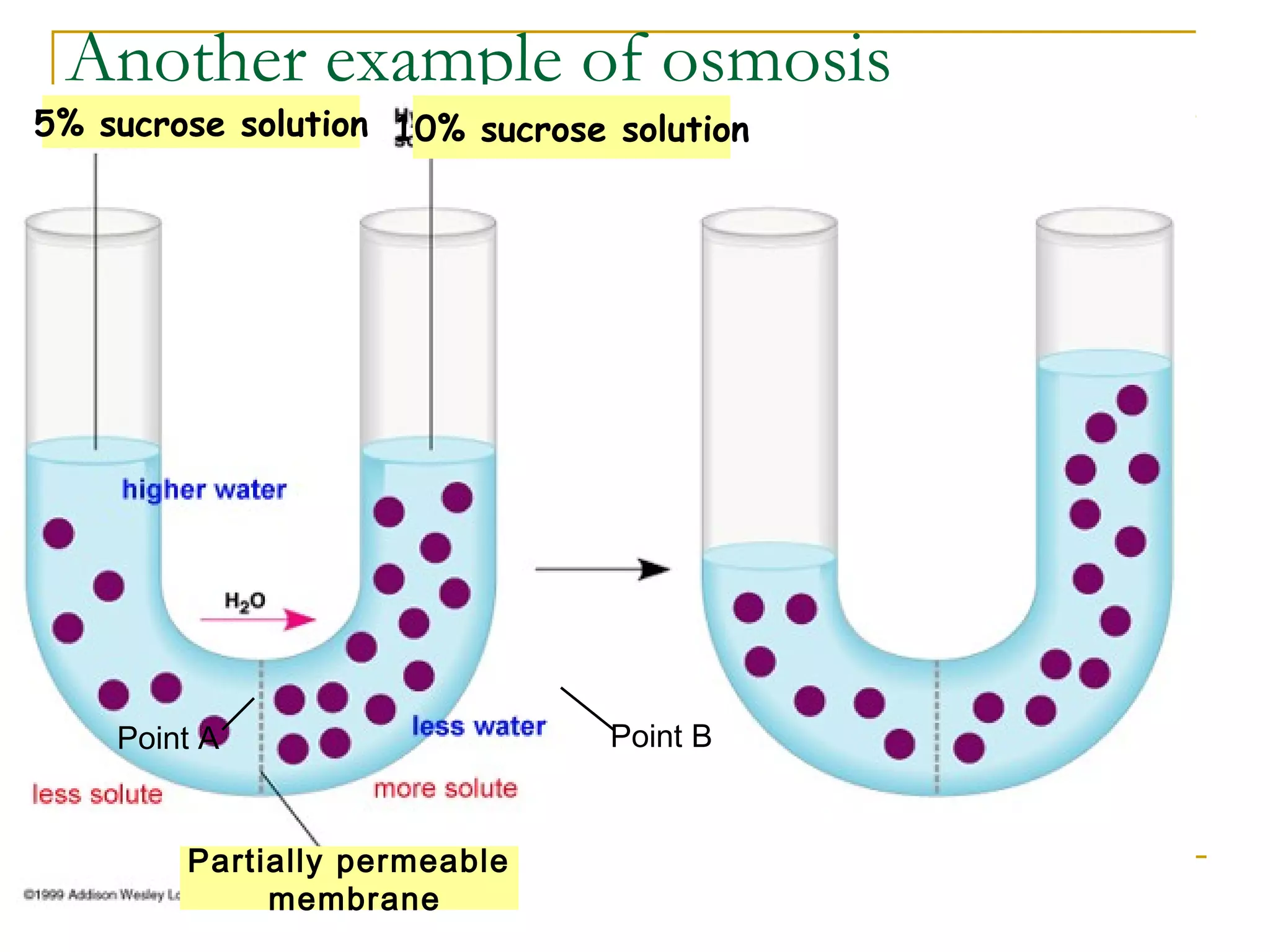
Another example of osmosis
5% sucrose solution 10% sucrose solution


    Point A                     Point B


        Partially permeable
             membrane
Demonstrations of Osmosis

Question:
What will happen to the water level in glass
tube?
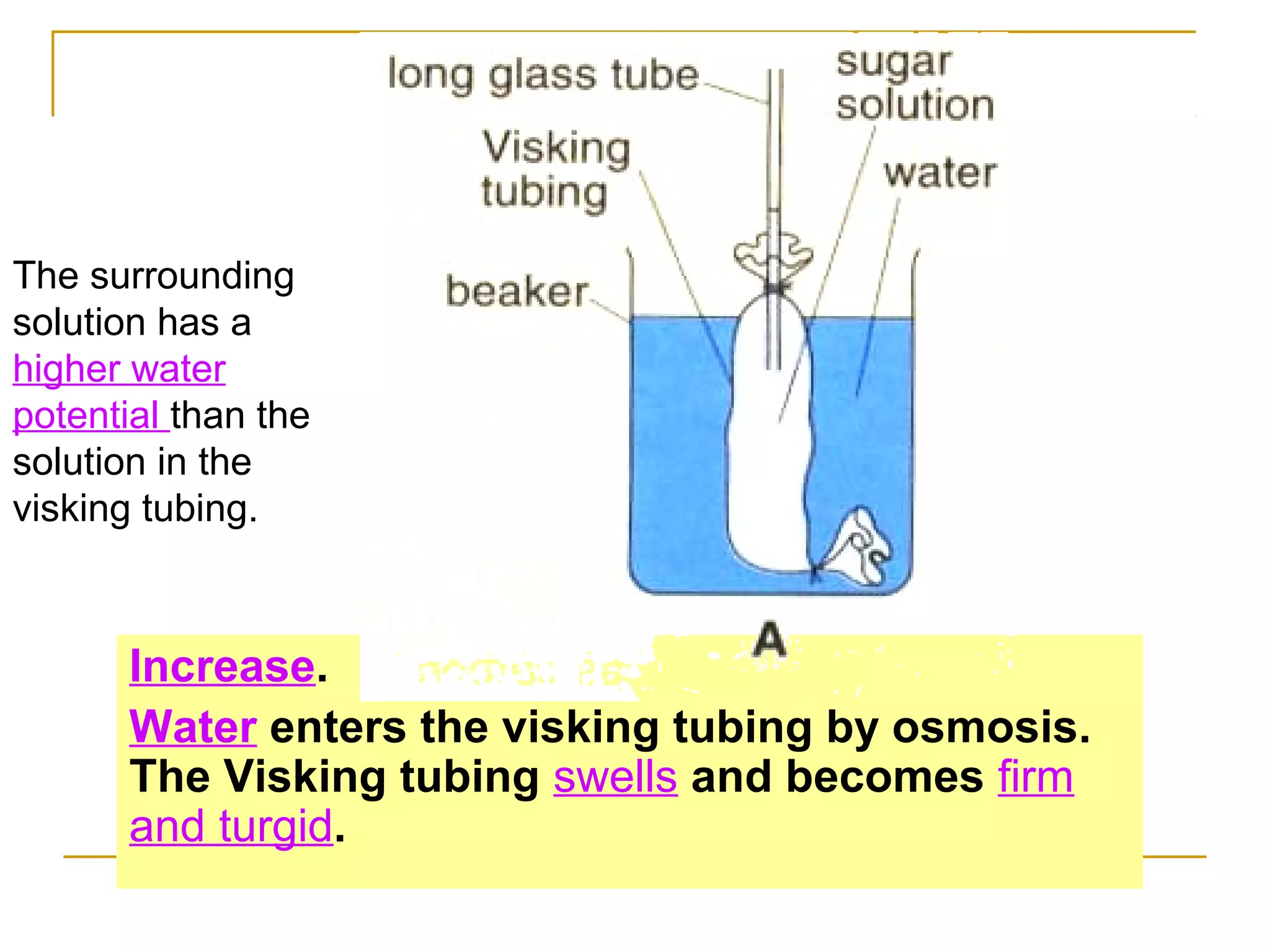
The surrounding
solution has a
higher water
potential than the
solution in the
visking tubing.


       Increase.
       Water enters the visking tubing by osmosis.
       The Visking tubing swells and becomes firm
       and turgid.
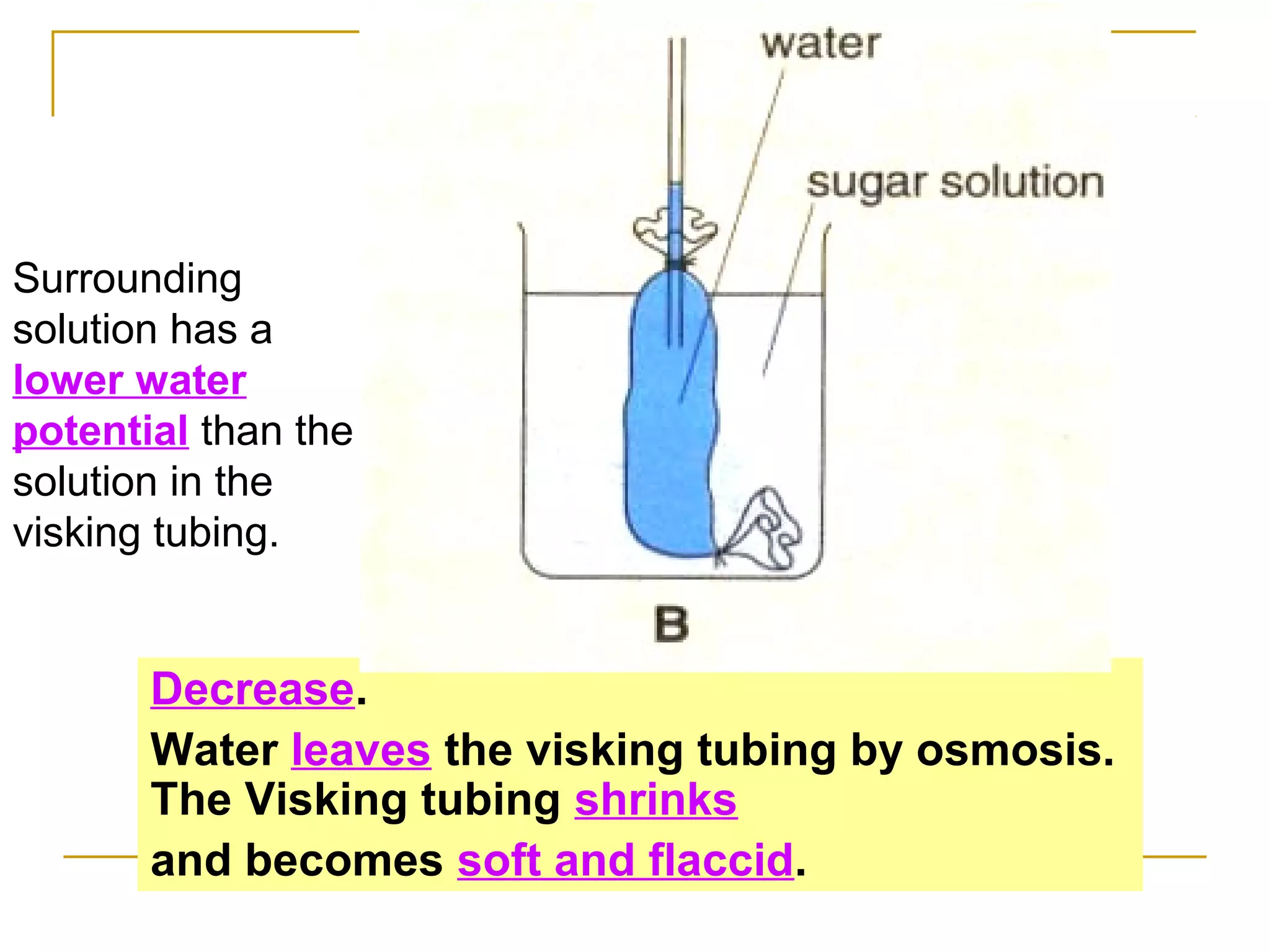
Surrounding
solution has a
lower water
potential than the
solution in the
visking tubing.


       Decrease.
       Water leaves the visking tubing by osmosis.
       The Visking tubing shrinks
       and becomes soft and flaccid.
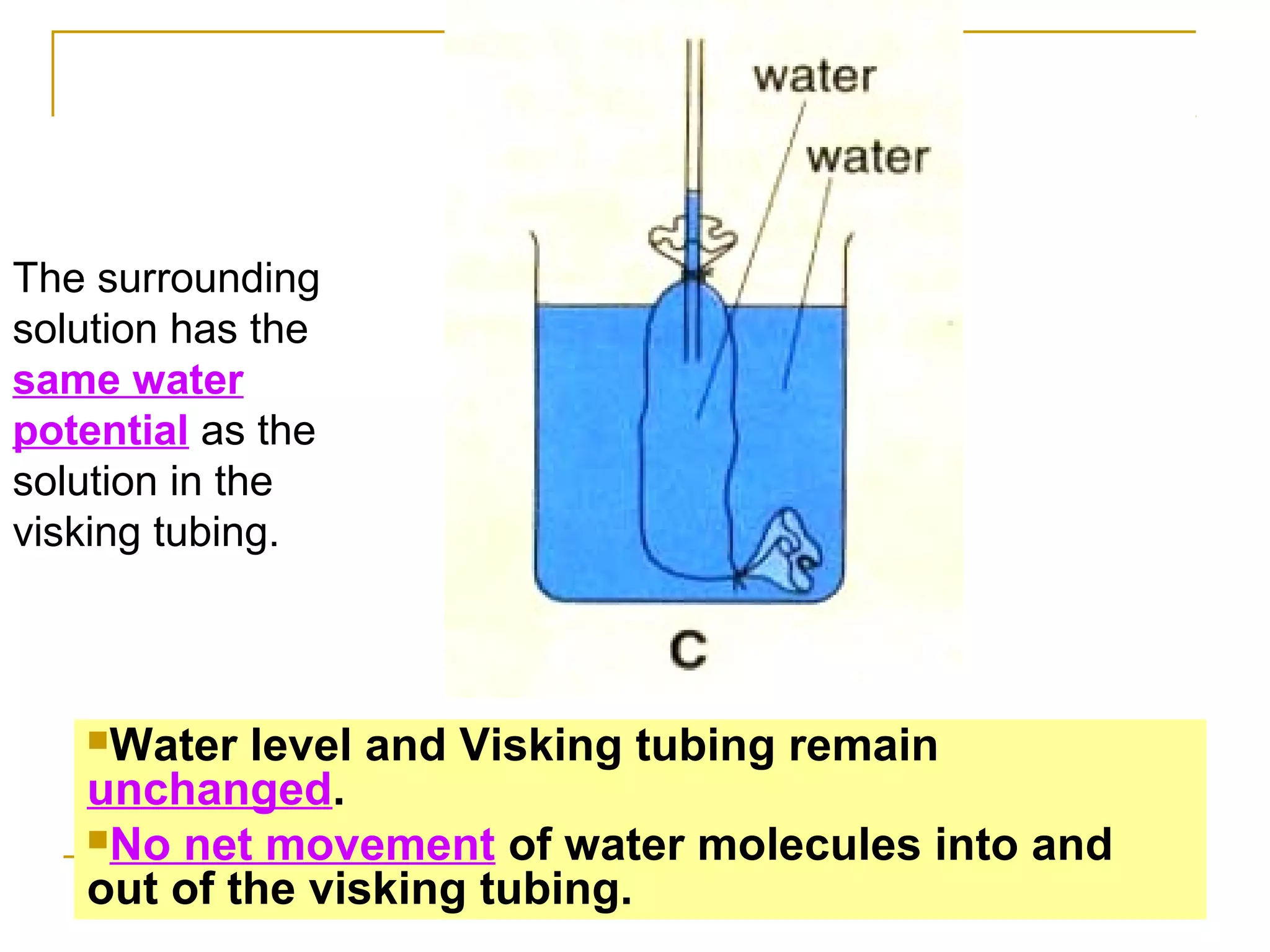
The surrounding
solution has the
same water
potential as the
solution in the
visking tubing.


   Water  level and Visking tubing remain
   unchanged.
   No net movement of water molecules into and
   out of the visking tubing.
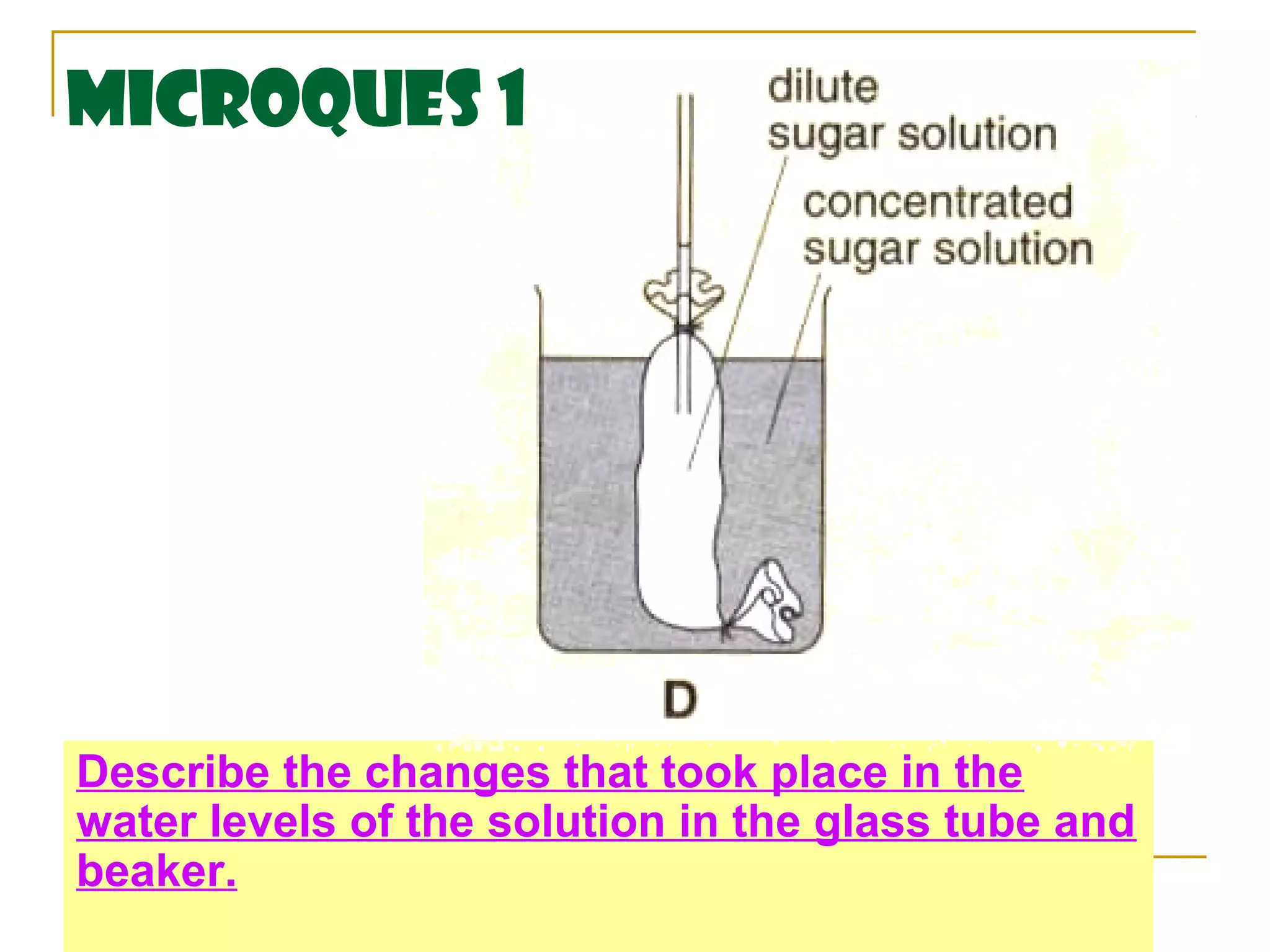
MicroQues 1


Describe the changes that took place in the
water levels of the solution in the glass tube and
beaker.
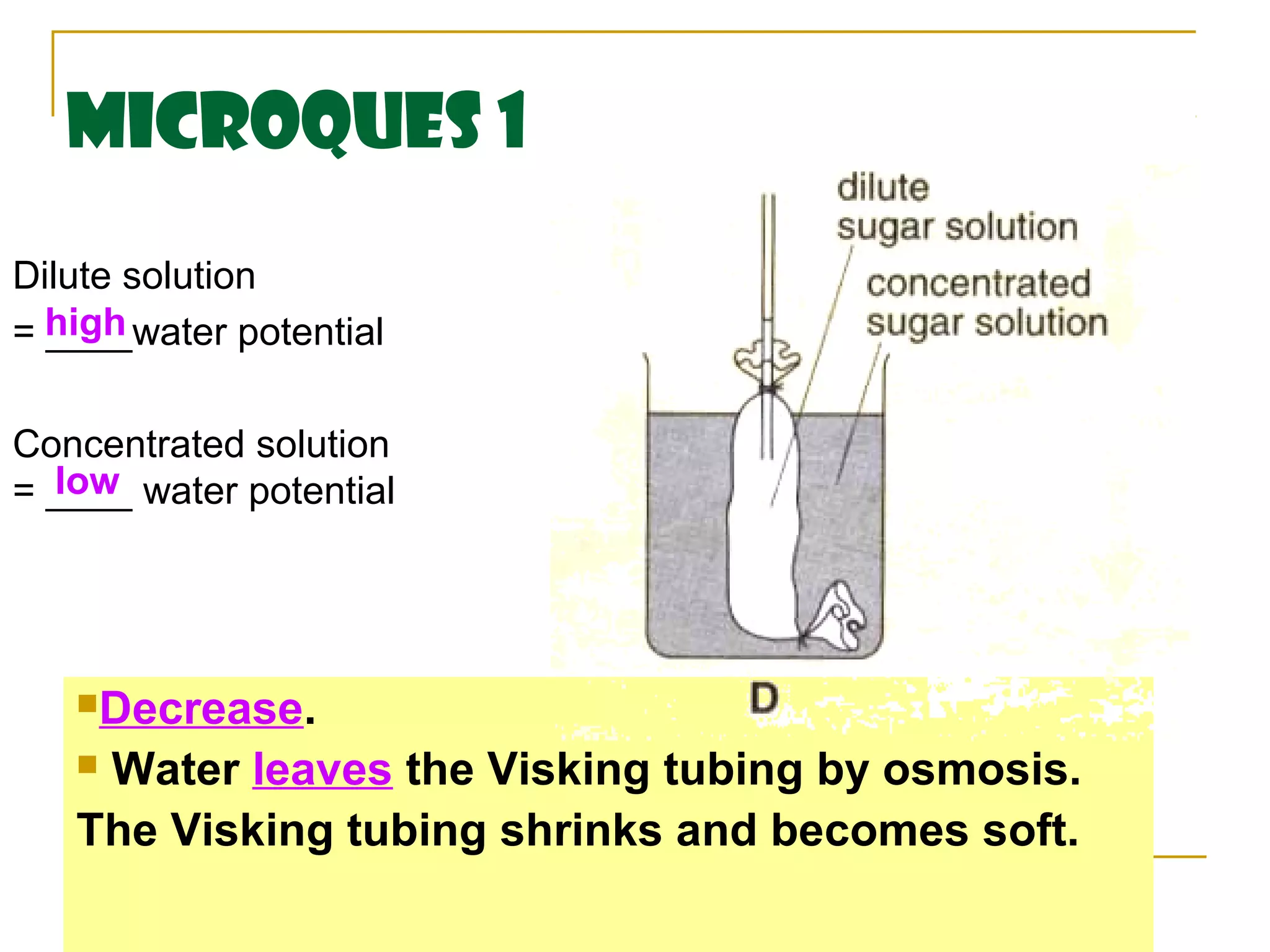
MicroQues 1
Dilute solution
= high
  ____water potential

Concentrated solution
  low
= ____ water potential


   Decrease.

   Water leaves the Visking tubing by osmosis.
   The Visking tubing shrinks and becomes soft.
MicroQues 2(a)
State the similarities between osmosis and diffusion.

Both   involves movement of substances.

Both involves movement of substances from a
region of its higher concentration to a region of
lower concentration.

Bothinvolves movement of substances down a
concentration gradient.
MicroQues 2(B)
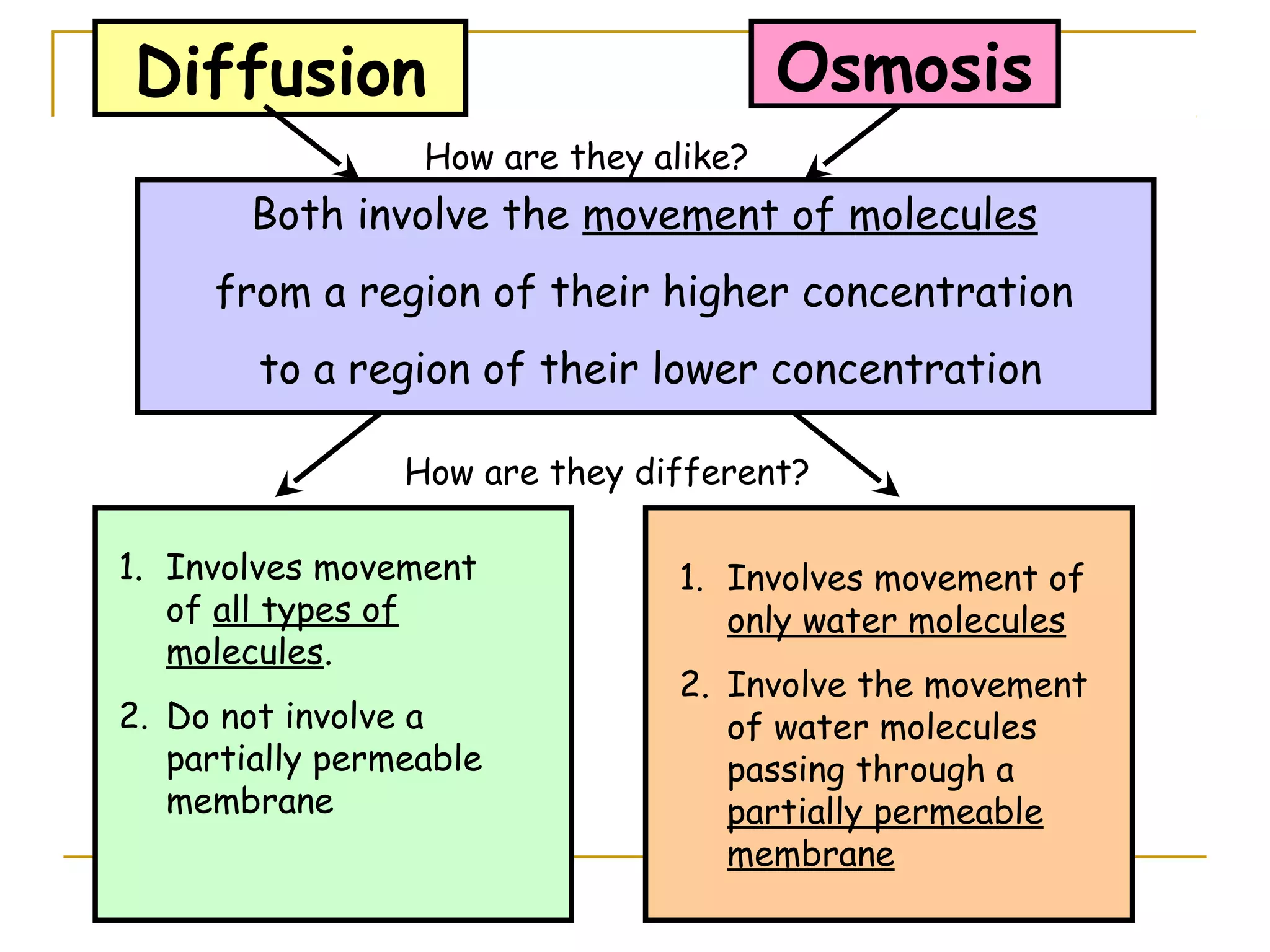
State two differences between osmosis and diffusion.
Diffusion                               Osmosis
                  How are they alike?
        Both involve the movement of molecules
     from a region of their higher concentration
        to a region of their lower concentration

                 How are they different?

1. Involves movement            1. Involves movement of
   of all types of                 only water molecules
   molecules.
                                2. Involve the movement
2. Do not involve a                of water molecules
   partially permeable             passing through a
   membrane                        partially permeable
                                   membrane
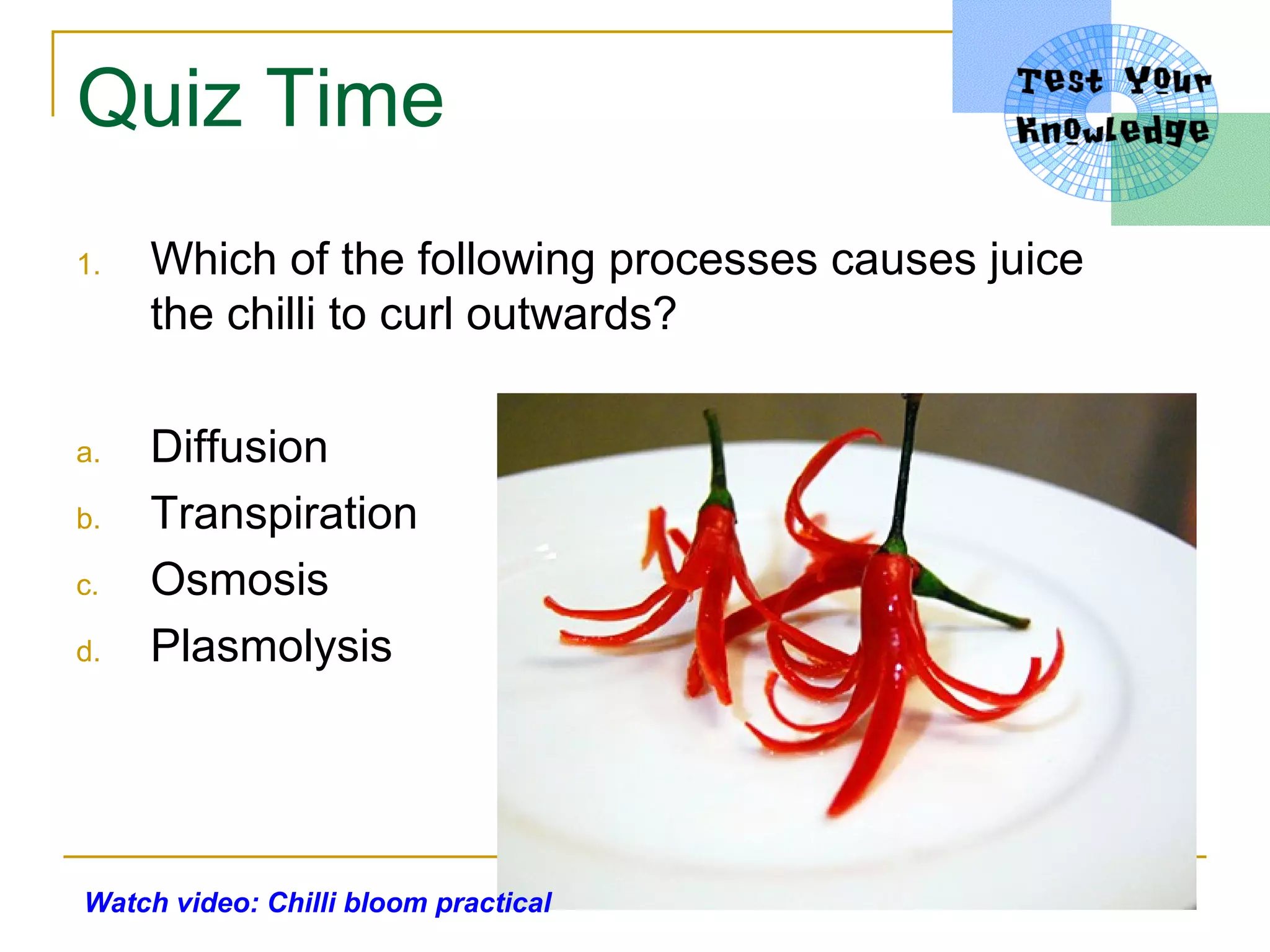
Quiz Time
1.   Which of the following processes causes juice
     the chilli to curl outwards?

a.   Diffusion
b.   Transpiration
c.   Osmosis
d.   Plasmolysis


Watch video: Chilli bloom practical
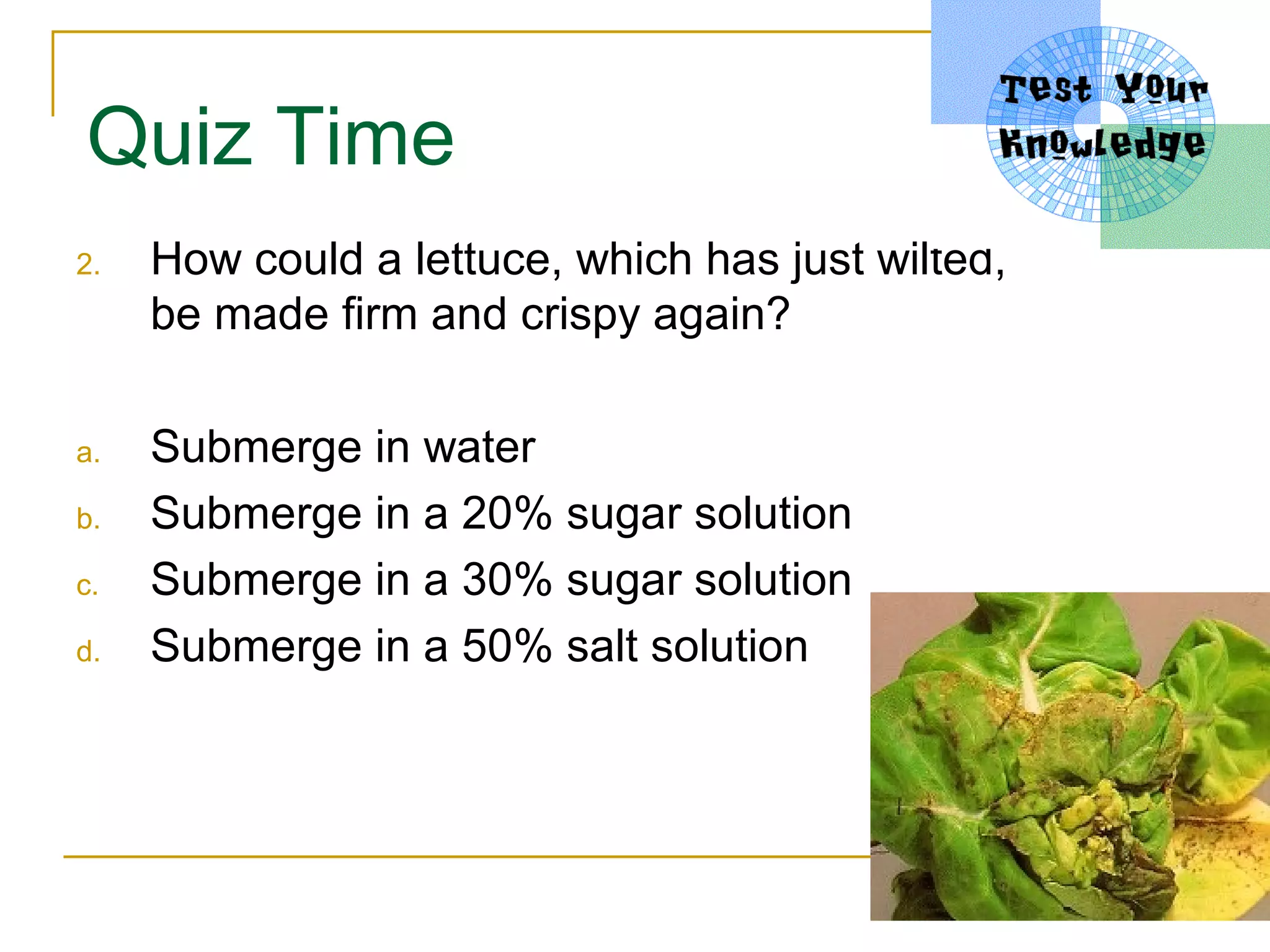
Quiz Time
2.   How could a lettuce, which has just wilted,
     be made firm and crispy again?

a.   Submerge in water
b.   Submerge in a 20% sugar solution
c.   Submerge in a 30% sugar solution
d.   Submerge in a 50% salt solution
   The cell membrane of living cells are
    partially permeable.
   The cell wall, however, is non-living, tough
    and fully permeable.
   In a plant cell, the vacuole membrane
    (tonoplast) is also partially permeable.
   The cell sap in the large central vacuole of a
    plant cell is highly concentrated (low water
    potential) as it contains a complex mixture of
    substances.
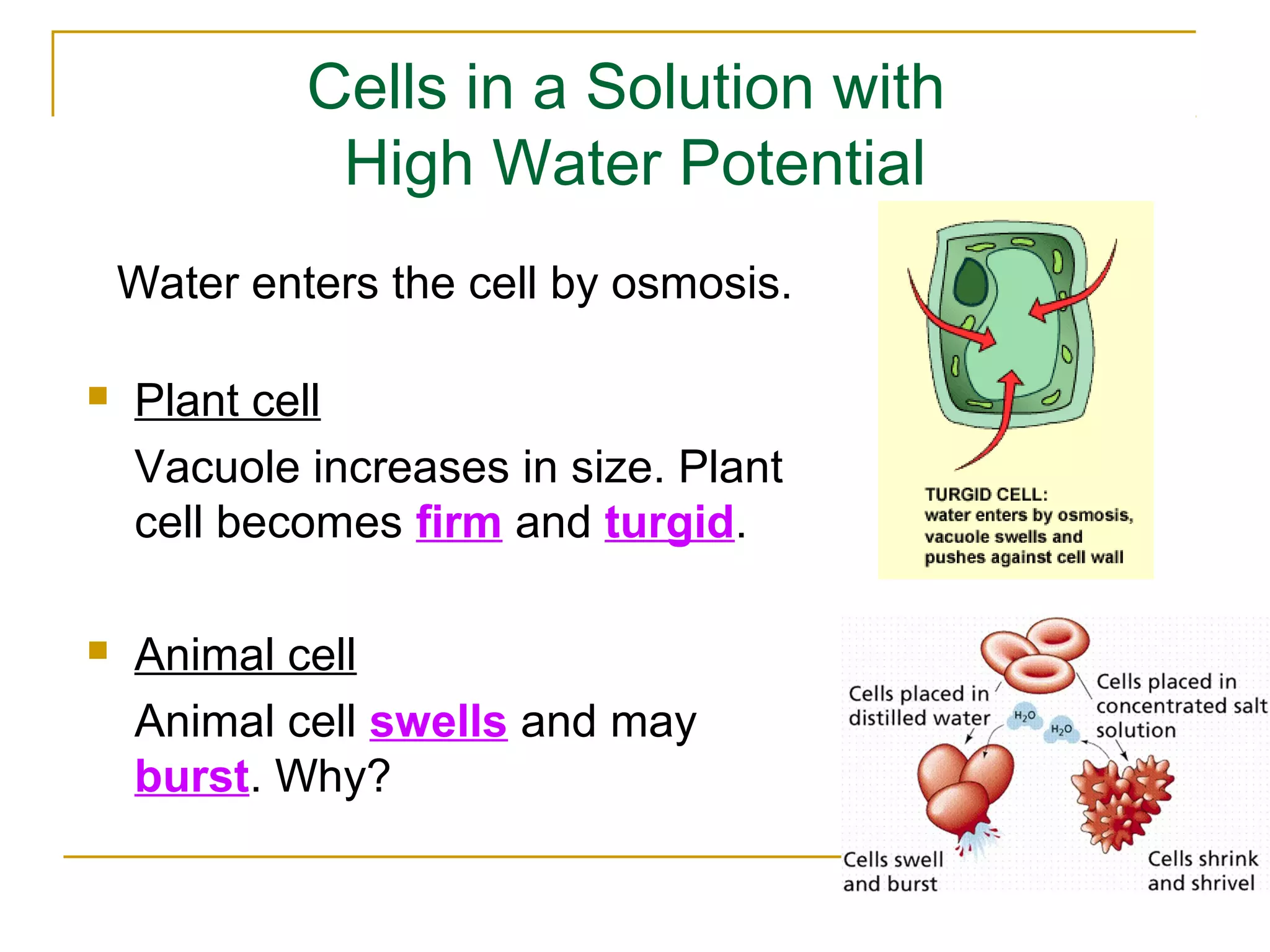
Cells in a Solution with
              High Water Potential
    Water enters the cell by osmosis.

   Plant cell
    Vacuole increases in size. Plant
    cell becomes firm and turgid.

   Animal cell
    Animal cell swells and may
    burst. Why?
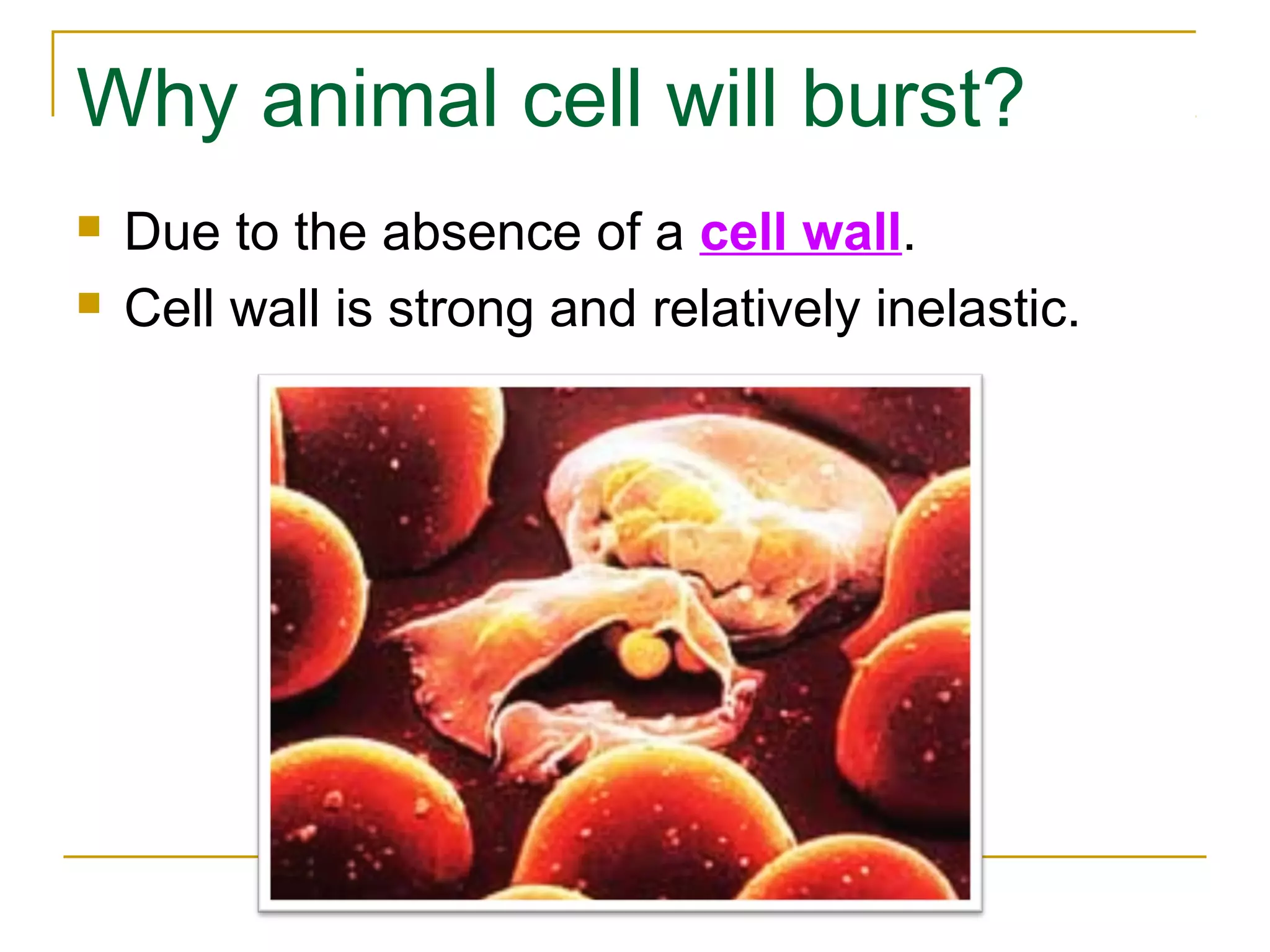
Why animal cell will burst?
   Due to the absence of a cell wall.
   Cell wall is strong and relatively inelastic.
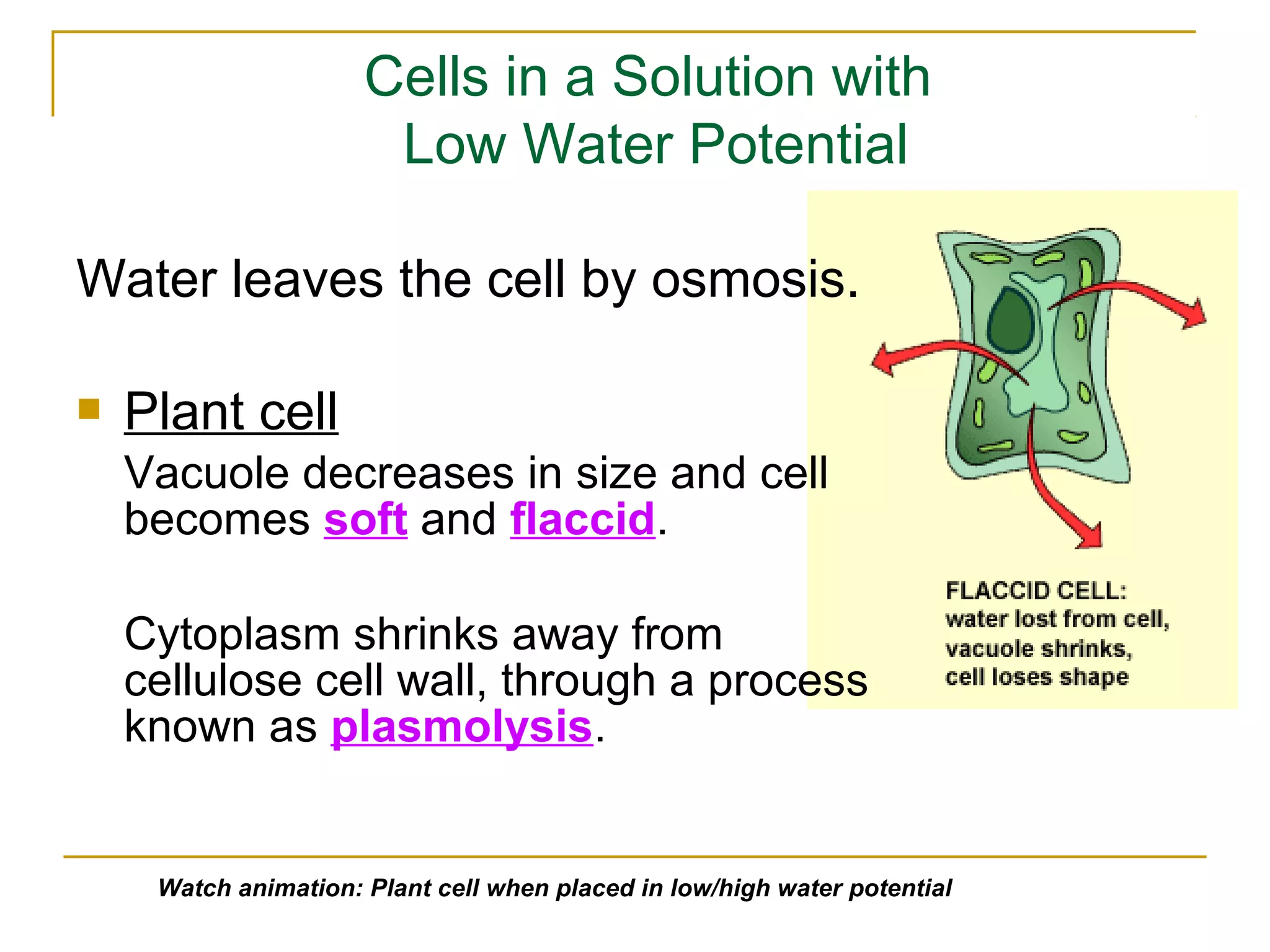
Cells in a Solution with
                       Low Water Potential

Water leaves the cell by osmosis.

   Plant cell
    Vacuole decreases in size and cell
    becomes soft and flaccid.

    Cytoplasm shrinks away from
    cellulose cell wall, through a process
    known as plasmolysis.


     Watch animation: Plant cell when placed in low/high water potential
Cells in a Solution with
                     Low Water Potential

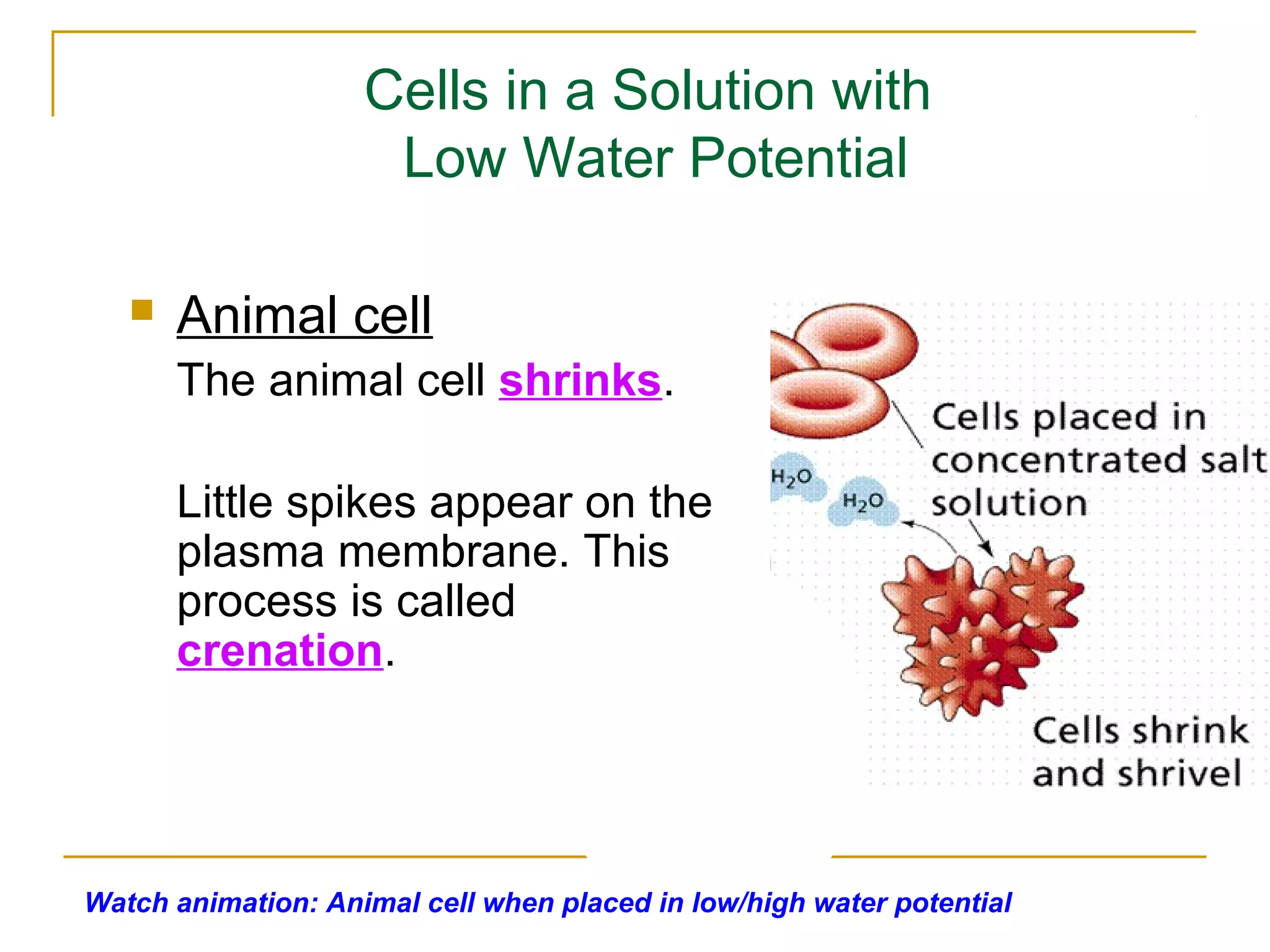
      Animal cell
       The animal cell shrinks.

       Little spikes appear on the
       plasma membrane. This
       process is called
       crenation.


Watch animation: Animal cell when placed in low/high water potential
Importance of turgor pressure
in plants
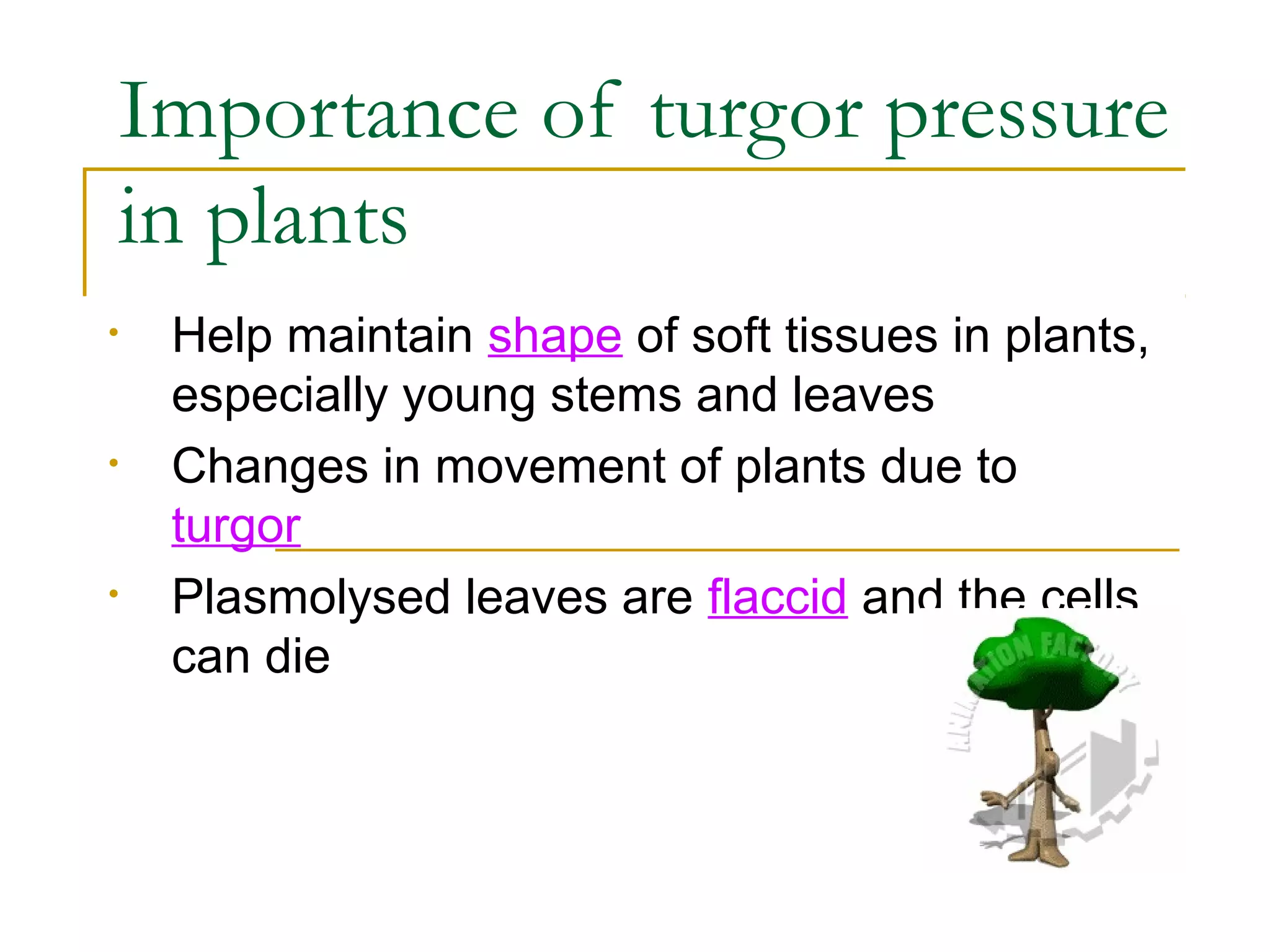
•   Help maintain shape of soft tissues in plants,
    especially young stems and leaves
•   Changes in movement of plants due to
    turgor
•   Plasmolysed leaves are flaccid and the cells
    can die
MicroQues 3
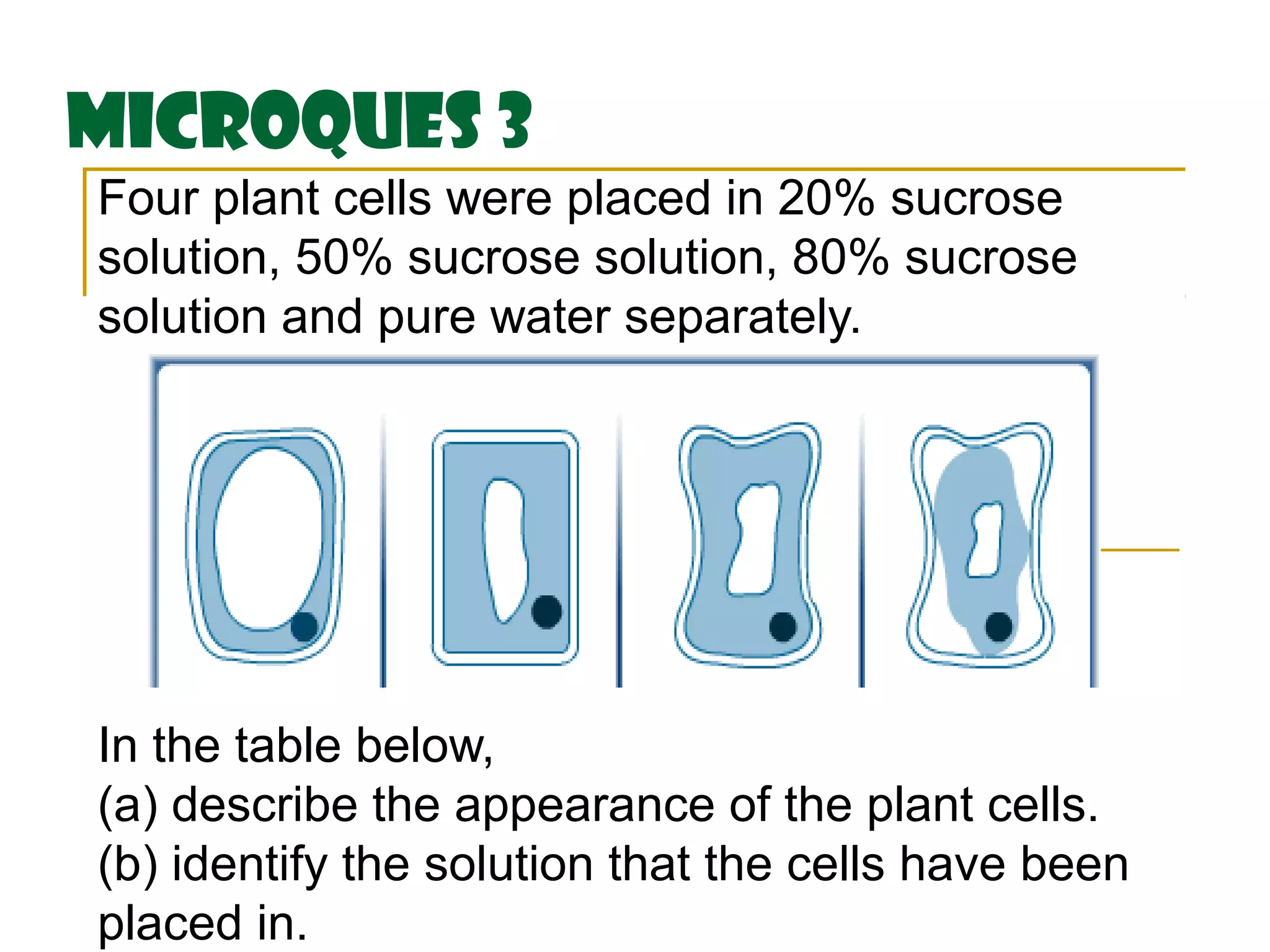
Four plant cells were placed in 20% sucrose
solution, 50% sucrose solution, 80% sucrose
solution and pure water separately.


In the table below,
(a) describe the appearance of the plant cells.
(b) identify the solution that the cells have been
placed in.
MicroQues 3


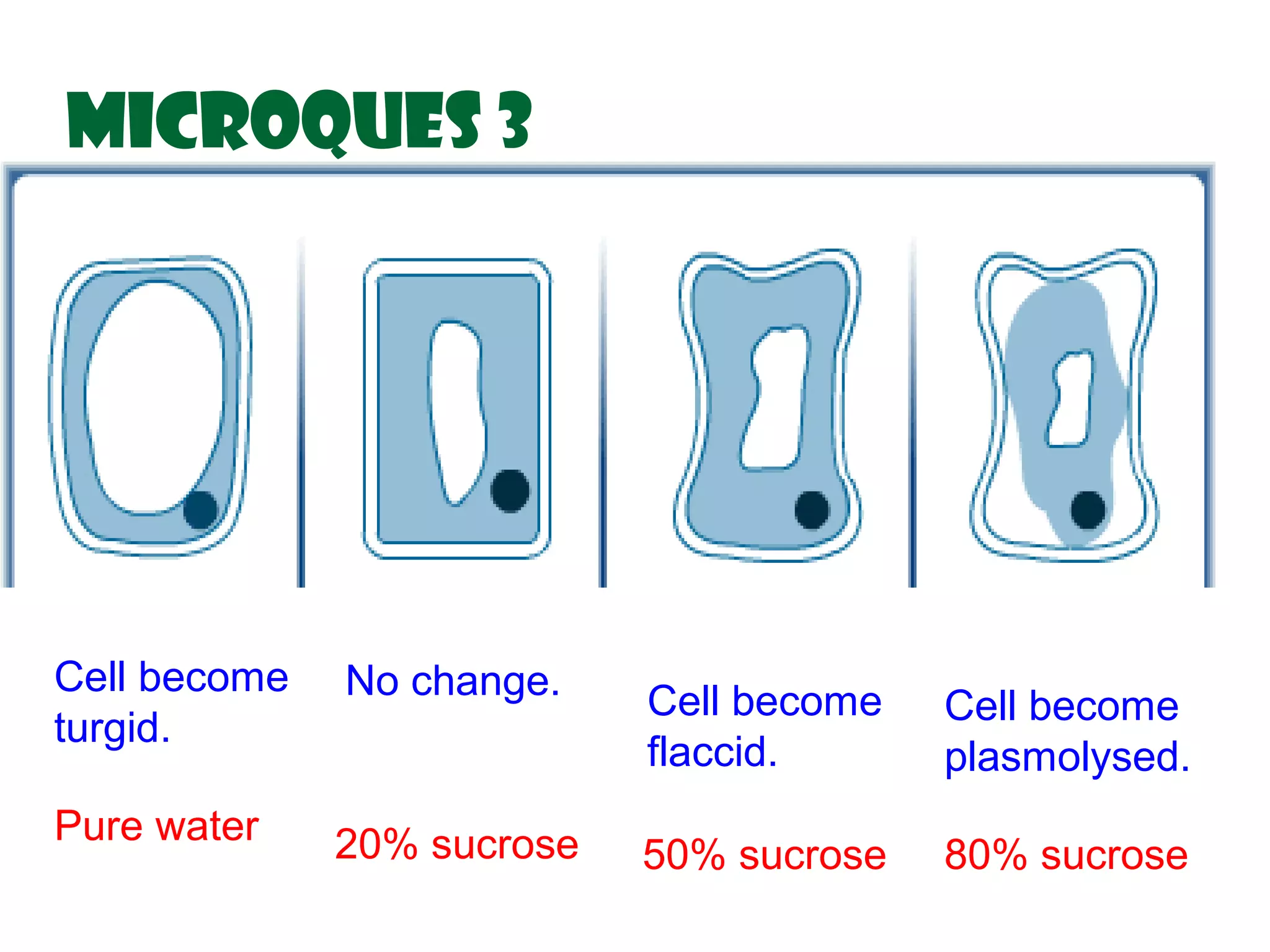
Cell become   No change.    Cell become   Cell become
turgid.
                            flaccid.      plasmolysed.
Pure water    20% sucrose   50% sucrose   80% sucrose
Question


        What happens to animal
       and plant cells when placed
        in solutions with differing
            water potentials?
Active Transport (PURE)
   Requires energy
   When substances move from a region of
    lower concentration to a region of higher
    concentration against a concentration
    gradient
   Occurs only in living cells as only living cells
    respire
   Respiration will release energy where part of
    it will be used in active transport
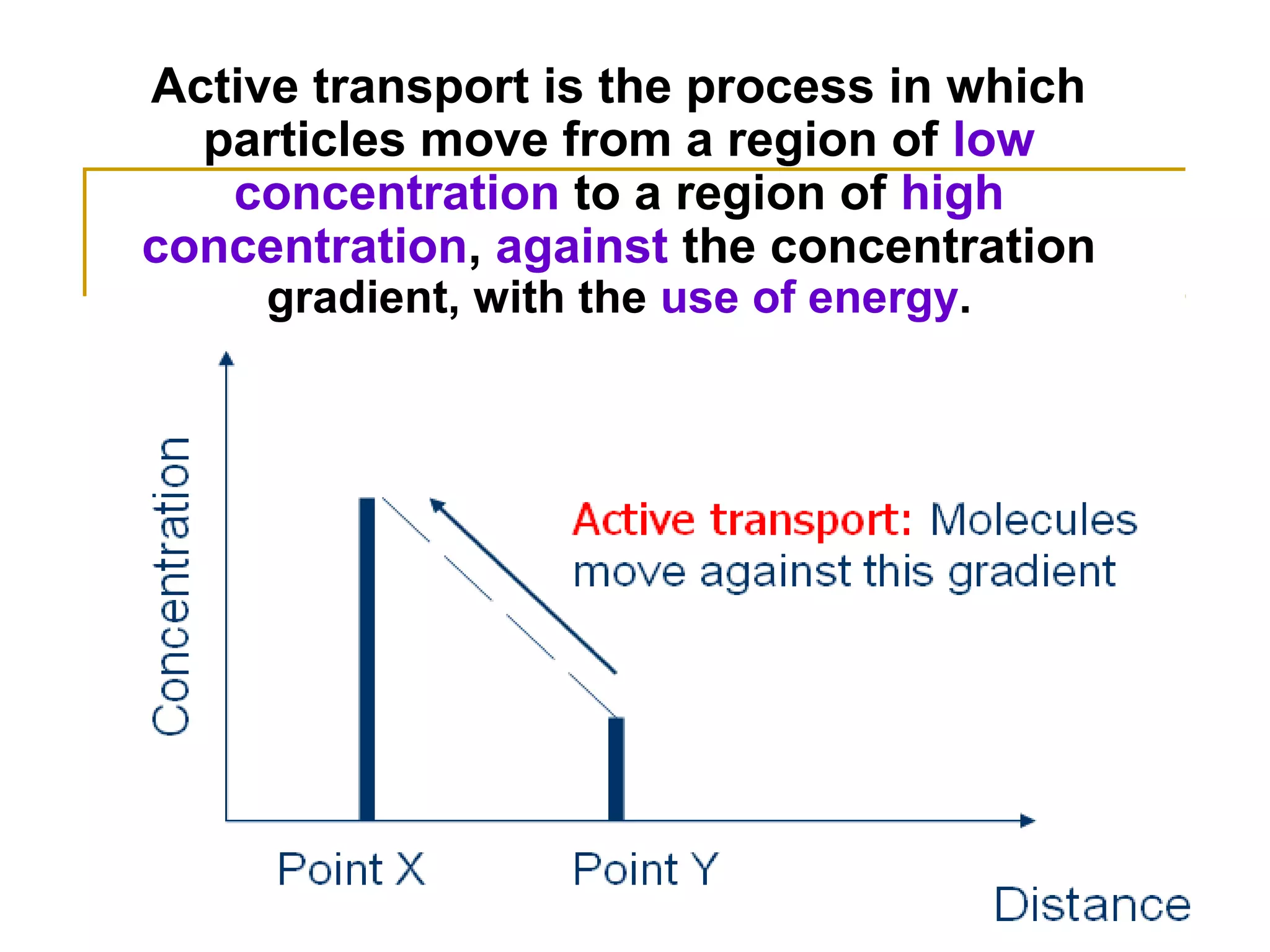
Active transport is the process in which
  particles move from a region of low
   concentration to a region of high
concentration, against the concentration
     gradient, with the use of energy.
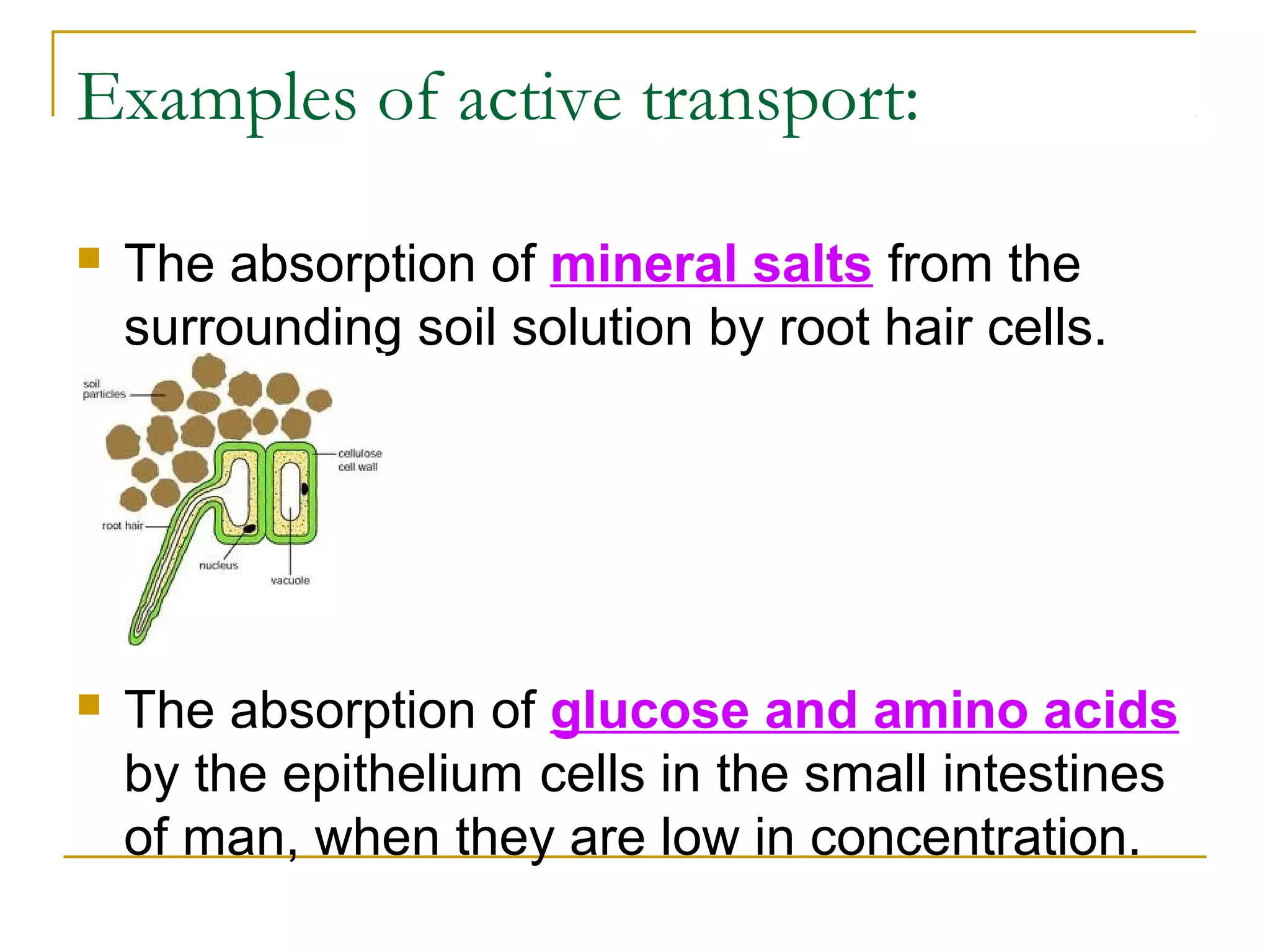
Examples of active transport:

   The absorption of mineral salts from the
    surrounding soil solution by root hair cells.


   The absorption of glucose and amino acids
    by the epithelium cells in the small intestines
    of man, when they are low in concentration.
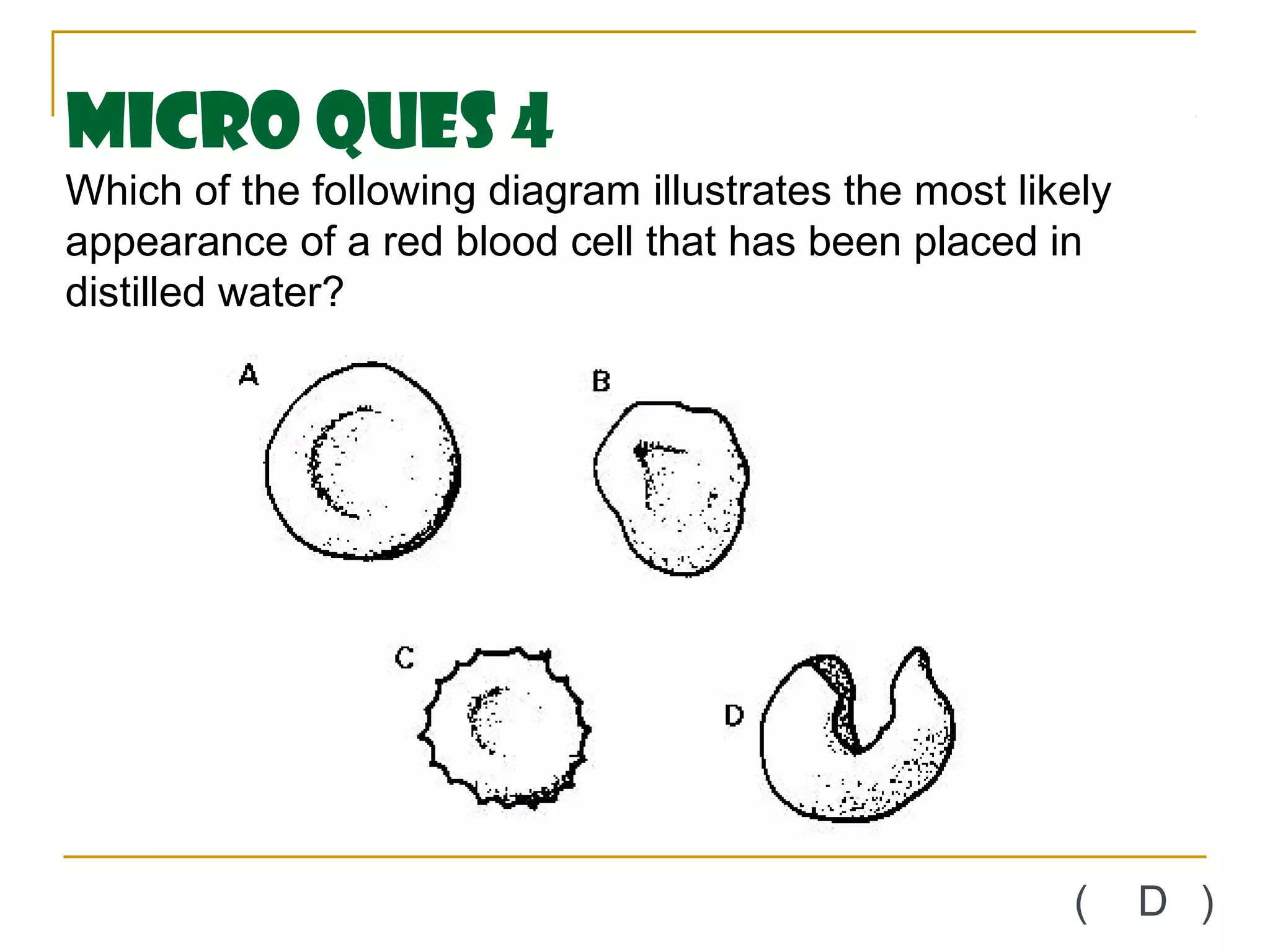
Micro Ques 4
Which of the following diagram illustrates the most likely
appearance of a red blood cell that has been placed in
distilled water?


                                                       (     D )
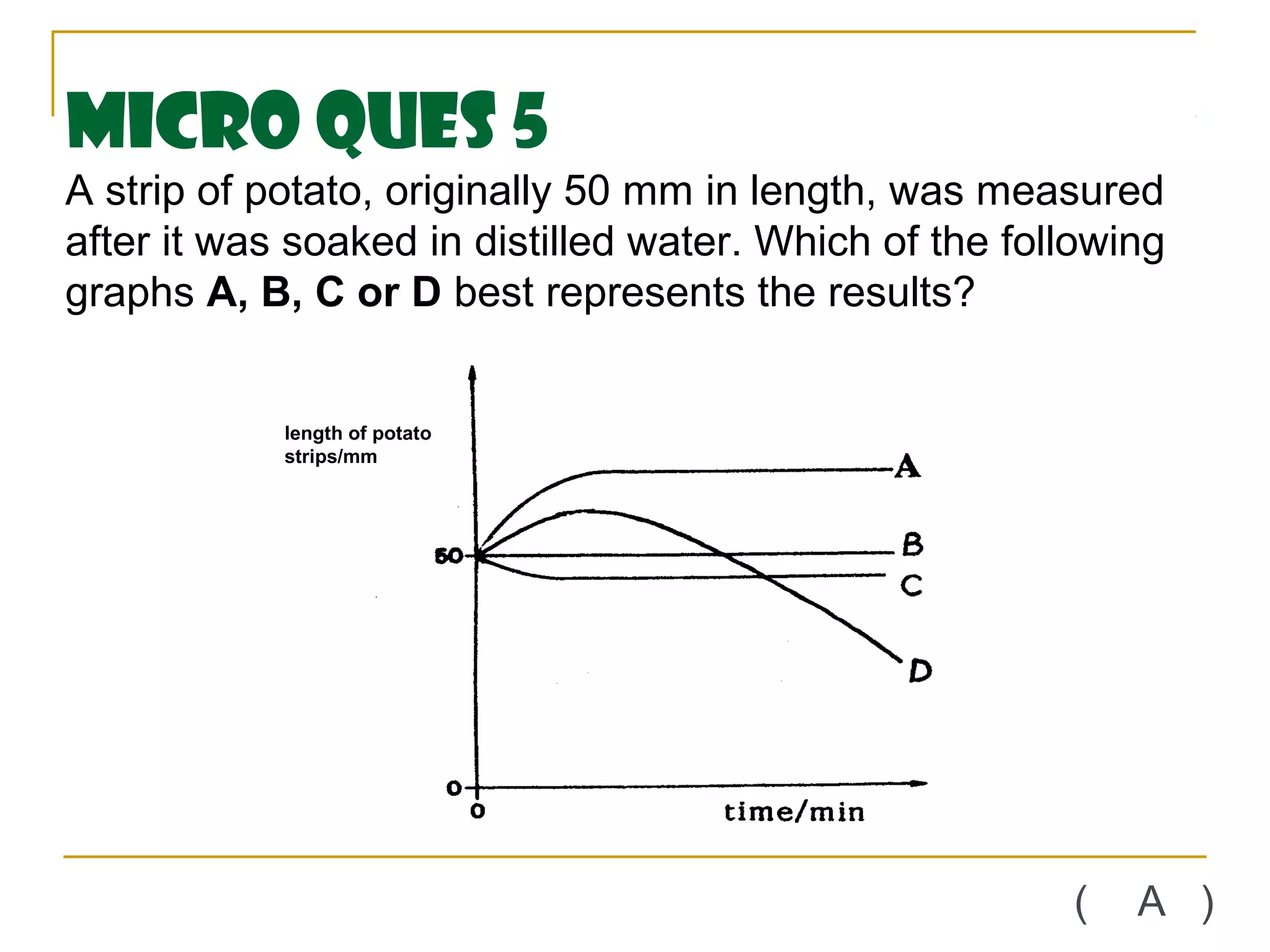
Micro Ques 5
A strip of potato, originally 50 mm in length, was measured
after it was soaked in distilled water. Which of the following
graphs A, B, C or D best represents the results?


            length of potato
            strips/mm


                                                        (   A )
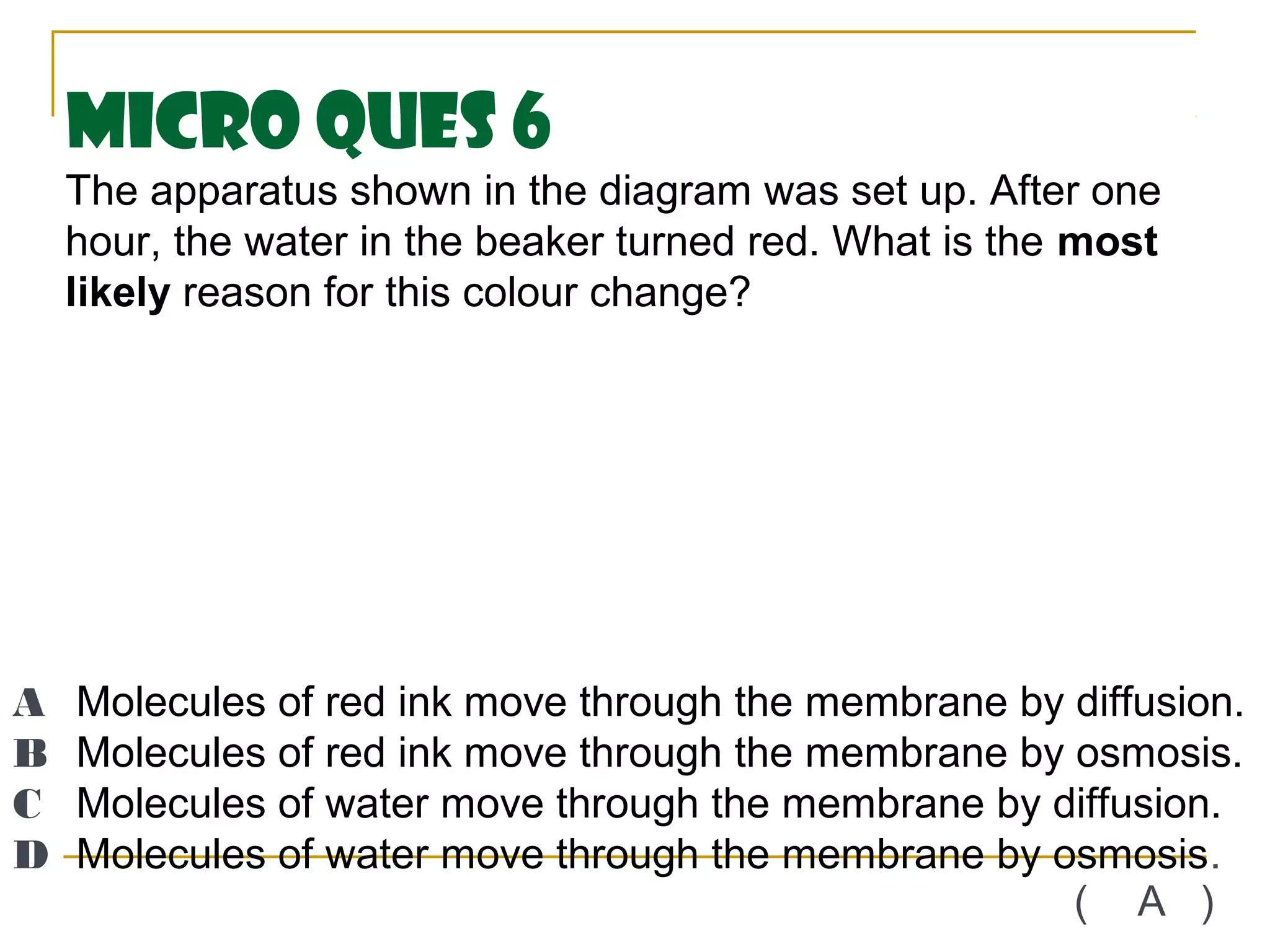
Micro Ques 6
    The apparatus shown in the diagram was set up. After one
    hour, the water in the beaker turned red. What is the most
    likely reason for this colour change?


A   Molecules of red ink move through the membrane by diffusion.
B   Molecules of red ink move through the membrane by osmosis.
C   Molecules of water move through the membrane by diffusion.
D   Molecules of water move through the membrane by osmosis.
                                                      ( A )

Movement of substances 2013

  • 1.
    Define diffusion and describe the role of diffusion in nutrients uptake and gaseous exchange in plants and humans.  Define osmosis and describe the effects of osmosis on plant and animal tissues.  Define active transport and discuss its importance as an energy-consuming process (Pure)
  • 2.
    •Diffusion is thenet movement of molecules from a region of higher concentration to a region of lower concentration, down a concentration gradient. •The difference in concentrations of the substance between the two regions is known as concentration gradient or diffusion gradient.
  • 3.
  • 5.
    Dissolved substance diffusethroughout liquid in which they are dissolved.
  • 6.
    How does the‘water baby’ works?
  • 7.
    Examples of diffusion:  Carbon dioxide diffuses from blood capillary into alveoli and oxygen diffuses from alveoli into surrounding blood capillaries.  The diffusion of carbon dioxide through the stomata into the mesophyll cells.  The diffusion of water vapour from the leaves during transpiration.
  • 8.
    Osmosis is … •the net movement of water molecules • from a region of higher water potential to a region of a lower water potential • through a partially permeable membrane • Involves only water molecules
  • 9.
    Concentrations of Solutions  Dilute solutions: - larger number of water molecules (solvent) compared to another similar solution. - dilute solutions have a higher water potential, compared to another similar solution. - Eg) 5% sugar solution means: 5% sugar molecules; 95% water molecules
  • 10.
    Concentrated solutions: - smaller number of water molecules (solvent) compared to another similar solution. - concentrated solutions have a lower water potential, compared to another similar solution. - Eg) 10% sugar solution means: 10% sugar molecules; 90% water molecules QUESTION: Compare between a 5% and 10% sugar solution. Which one has a higher water potential?
  • 11.
    Osmosis  Sugars such as starch molecules CANNOT pass through the partially permeable membrane (Too big)  However, sugar such as glucose CAN pass through the partially permeable membrane (Small enough)
  • 12.
    Partially permeable membrane Higher water Lower water potential potential
  • 13.
    Another example ofosmosis 5% sucrose solution 10% sucrose solution Point A Point B Partially permeable membrane
  • 14.
    Demonstrations of Osmosis Question: Whatwill happen to the water level in glass tube?
  • 15.
    The surrounding solution hasa higher water potential than the solution in the visking tubing. Increase. Water enters the visking tubing by osmosis. The Visking tubing swells and becomes firm and turgid.
  • 16.
    Surrounding solution has a lowerwater potential than the solution in the visking tubing. Decrease. Water leaves the visking tubing by osmosis. The Visking tubing shrinks and becomes soft and flaccid.
  • 17.
    The surrounding solution hasthe same water potential as the solution in the visking tubing. Water level and Visking tubing remain unchanged. No net movement of water molecules into and out of the visking tubing.
  • 18.
    MicroQues 1 Describe thechanges that took place in the water levels of the solution in the glass tube and beaker.
  • 19.
    MicroQues 1 Dilute solution =high ____water potential Concentrated solution low = ____ water potential Decrease. Water leaves the Visking tubing by osmosis. The Visking tubing shrinks and becomes soft.
  • 20.
    MicroQues 2(a) State thesimilarities between osmosis and diffusion. Both involves movement of substances. Both involves movement of substances from a region of its higher concentration to a region of lower concentration. Bothinvolves movement of substances down a concentration gradient.
  • 21.
    MicroQues 2(B) State twodifferences between osmosis and diffusion.
  • 22.
    Diffusion Osmosis How are they alike? Both involve the movement of molecules from a region of their higher concentration to a region of their lower concentration How are they different? 1. Involves movement 1. Involves movement of of all types of only water molecules molecules. 2. Involve the movement 2. Do not involve a of water molecules partially permeable passing through a membrane partially permeable membrane
  • 23.
    Quiz Time 1. Which of the following processes causes juice the chilli to curl outwards? a. Diffusion b. Transpiration c. Osmosis d. Plasmolysis Watch video: Chilli bloom practical
  • 24.
    Quiz Time 2. How could a lettuce, which has just wilted, be made firm and crispy again? a. Submerge in water b. Submerge in a 20% sugar solution c. Submerge in a 30% sugar solution d. Submerge in a 50% salt solution
  • 25.
    The cell membrane of living cells are partially permeable.  The cell wall, however, is non-living, tough and fully permeable.  In a plant cell, the vacuole membrane (tonoplast) is also partially permeable.  The cell sap in the large central vacuole of a plant cell is highly concentrated (low water potential) as it contains a complex mixture of substances.
  • 26.
    Cells in aSolution with High Water Potential Water enters the cell by osmosis.  Plant cell Vacuole increases in size. Plant cell becomes firm and turgid.  Animal cell Animal cell swells and may burst. Why?
  • 27.
    Why animal cellwill burst?  Due to the absence of a cell wall.  Cell wall is strong and relatively inelastic.
  • 28.
    Cells in aSolution with Low Water Potential Water leaves the cell by osmosis.  Plant cell Vacuole decreases in size and cell becomes soft and flaccid. Cytoplasm shrinks away from cellulose cell wall, through a process known as plasmolysis. Watch animation: Plant cell when placed in low/high water potential
  • 29.
    Cells in aSolution with Low Water Potential  Animal cell The animal cell shrinks. Little spikes appear on the plasma membrane. This process is called crenation. Watch animation: Animal cell when placed in low/high water potential
  • 30.
    Importance of turgorpressure in plants • Help maintain shape of soft tissues in plants, especially young stems and leaves • Changes in movement of plants due to turgor • Plasmolysed leaves are flaccid and the cells can die
  • 31.
    MicroQues 3 Four plantcells were placed in 20% sucrose solution, 50% sucrose solution, 80% sucrose solution and pure water separately. In the table below, (a) describe the appearance of the plant cells. (b) identify the solution that the cells have been placed in.
  • 32.
    MicroQues 3 Cell become No change. Cell become Cell become turgid. flaccid. plasmolysed. Pure water 20% sucrose 50% sucrose 80% sucrose
  • 33.
    Question What happens to animal and plant cells when placed in solutions with differing water potentials?
  • 34.
    Active Transport (PURE)  Requires energy  When substances move from a region of lower concentration to a region of higher concentration against a concentration gradient  Occurs only in living cells as only living cells respire  Respiration will release energy where part of it will be used in active transport
  • 35.
    Active transport isthe process in which particles move from a region of low concentration to a region of high concentration, against the concentration gradient, with the use of energy.
  • 36.
    Examples of activetransport:  The absorption of mineral salts from the surrounding soil solution by root hair cells.  The absorption of glucose and amino acids by the epithelium cells in the small intestines of man, when they are low in concentration.
  • 37.
    Micro Ques 4 Whichof the following diagram illustrates the most likely appearance of a red blood cell that has been placed in distilled water? ( D )
  • 38.
    Micro Ques 5 Astrip of potato, originally 50 mm in length, was measured after it was soaked in distilled water. Which of the following graphs A, B, C or D best represents the results? length of potato strips/mm ( A )
  • 39.
    Micro Ques 6 The apparatus shown in the diagram was set up. After one hour, the water in the beaker turned red. What is the most likely reason for this colour change? A Molecules of red ink move through the membrane by diffusion. B Molecules of red ink move through the membrane by osmosis. C Molecules of water move through the membrane by diffusion. D Molecules of water move through the membrane by osmosis. ( A )

Editor's Notes

  • #6 When crystals of dye are placed in water, they are concentrated in one area.