Chapter 3
HEREDITY AND VARIATION
3.1 Cell division
 All living organisms grow and reproduce & are made up
of cells
 Cells reproduce by dividing and passing on their genes to
daughter cells
 Each cell has its own nucleus which controls the cell’s
activities through the genetic material, DNA which acts as
a set of instruction or code for life
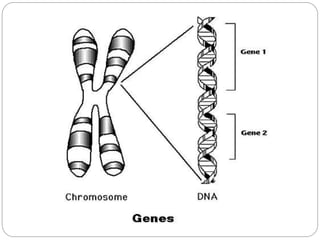
What is genes?
 Genes are sections of DNA that code for the production
of protein and are arranged along the chromosomes
 Carry the inherited characteristics of a person
 Genes occurs in pairs, therefore each inherited
characteristics is carried by two genes
 One gene from each pair comes from the father and the
mother
 Example of inherited characteristics carried by genes are:
- Colour of the eyes
- Pattern of finger prints
- Type of hair
- Blood group
- Intelligence
Deoxyribonucleic acids (DNA)
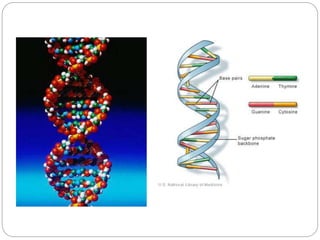
 Is a double helix, made up of a series of genes to encode
genetic information
 This determine the individual characteristics of an
organism
 All the information in DNA is transmitted in the form of a
genetic code
 Should any information not be followed, the baby will be
born with physical or mental defects
 DNA molecule is very complicated and resembles a
twisted ladder or staircase
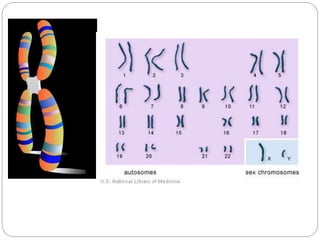
Chromosomes
 Is a thread-like structure found in the nucleus of a cell
 Chromosome and the genes on them are composed of
DNA
 It exist in pair and are identicalhomologous
 A pair of chromosomes has genes arranged in the same
way. As a result the genes also exist in pairs
 Human has two sets of chromosomes in the body(one
set from the father and another set from the mother)
Mitosis
 Occur in somatic cells all cells body except
reproductive cells
 Is the type of cell division that produces genetically
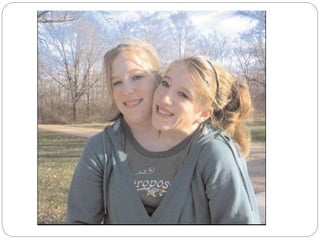
identical cells
 During mitosis, DNA replicates in the parent cell, which
divides to produce two new cells, each containing an
exact copy of the DNA as in the parent cell
 This allows growth of multicellular organism from
unicellular zygotes
 Replacements of cells and repair of tissues is possible
through mitosis followed by cell division
 Cells are constantly dying and being replaced by identical
cells
 Is the basis of asexual reproductionthe production of
new individuals of a species by one parent organism
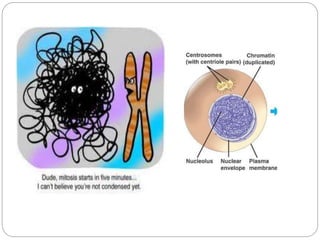
Mitosis
 Mitosis is the type of cell division that produces
genetically identical cells
 During mitosis, DNA replicates in the parent cell,
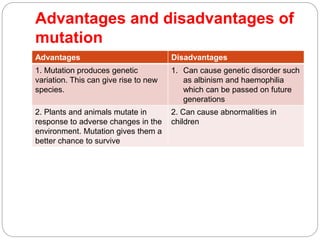
which divides to produce two new cells, each
containing an exact copy of the DNA as in the parent
cell
 Cells produced are diploid (2n)
 Replacement of cells and repair of tissues is
possible through mitosis (Ex: cell replacement is
rapid in the skin & in the lining of the gut
 Is actively carried out at the ends of plant shoots
and roots
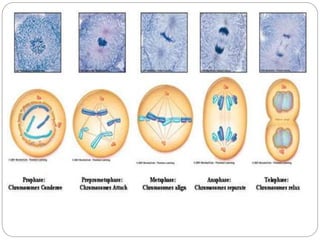
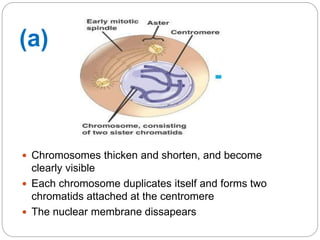
 Chromosomes thicken and shorten, and become
clearly visible
 Each chromosome duplicates itself and forms two
chromatids attached at the centromere
 The nuclear membrane dissapears
(a)
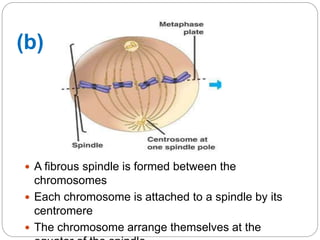
 A fibrous spindle is formed between the
chromosomes
 Each chromosome is attached to a spindle by its
centromere
 The chromosome arrange themselves at the
(b)
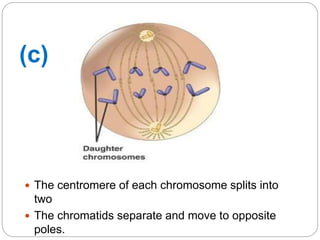
 The centromere of each chromosome splits into
two
 The chromatids separate and move to opposite
poles.
(c)
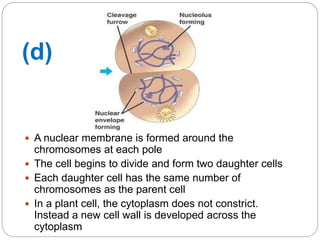
 A nuclear membrane is formed around the
chromosomes at each pole
 The cell begins to divide and form two daughter cells
 Each daughter cell has the same number of
chromosomes as the parent cell
 In a plant cell, the cytoplasm does not constrict.
Instead a new cell wall is developed across the
cytoplasm
(d)
Importance of mitosis
 Important for the following reasons:
(a) Growth
(b) Replacing old or damaged cells
 Enables organisms to reproduce themselves
(Ex: by asexual reproduction; binary fission in
amoeba)
 Ensures that the new cells produced have the
same number of chromosomes as the parent
cells
Meiosis
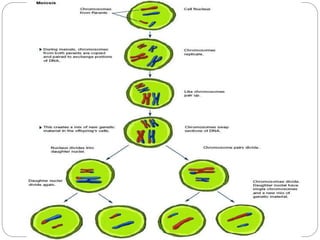
 Meiosis is the process by which a nucleus divides by
two divisions into four nuclei, each containing half the
number of chromosome of the mother cell
 Resulting nuclei are haploid (n)
 The cells produced are genetically different to the
parent cell and to each other
 Occurs in 2 stages that is meiosis 1 and meiosis 2
 Produces genetic variation (caused by crossing over
between homologous chromosome)
 In animals, meiosis occurs in testes and ovaries,
whereas in plants, it occurs in the anthers and ovaries
Importance of meiosis
1. Production of gamete – the only process that
produces gametes
2. Reduction in chromosome number – ensures that
each gamete has only half the number of
chromosomes of the parent cell
3. Maintenance of chromosome number in somatic cells
– the somatic cells have their number of
chromosomes maintained
4. Production of variation – causes genetic variation in
the descendants(can produce individuals who do not
resemble their parents closely
* Variation occurs in TWO ways:
1. Different combination of chromosomes
2. Crossing over
Comparing and contrasting mitosis
with meiosis
 SIMILARITIES of MITOSIS and MEIOSIS:
- Both are processes of cell division
- In each process, duplication of chromosomes occurs
once
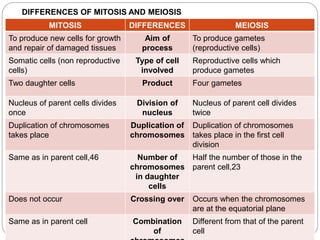
MITOSIS DIFFERENCES MEIOSIS
To produce new cells for growth
and repair of damaged tissues
Aim of
process
To produce gametes
(reproductive cells)
Somatic cells (non reproductive
cells)
Type of cell
involved
Reproductive cells which
produce gametes
Two daughter cells Product Four gametes
Nucleus of parent cells divides
once
Division of
nucleus
Nucleus of parent cell divides
twice
Duplication of chromosomes
takes place
Duplication of
chromosomes
Duplication of chromosomes
takes place in the first cell
division
Same as in parent cell,46 Number of
chromosomes
in daughter
cells
Half the number of those in the
parent cell,23
Does not occur Crossing over Occurs when the chromosomes
are at the equatorial plane
Same as in parent cell Combination
of
Different from that of the parent
cell
DIFFERENCES OF MITOSIS AND MEIOSIS
Exercises : CELL DIVISION
1. Which of the following is the simplest unit of
inheritance?
A. Nucleus
B. Chromatid
C. Chromosome
D. Gene
2. How many chromosomes are present in the nucleus
of a human cheek cell?
A. 23
B. 24
C. 46
D. 48
3. How many chromosomes can be found in the nucleus of a
human ovum?
A. 23
B. 24
C. 46
D. 48
4. What is the importance of mitosis in somatic cells?
A. It maintains the number of chromosomes in all new cells
which are produced
B. It occurs in all organs of the body so long as the cells are
actively growing
C. It prevents the body from being reduced in size due to
the death of old cells
D. It produces new cells which will support the cellular
activities of the old cells.
5. What is the importance of meiosis in living organisms?
A. It maintains the number of chromosomes of zygotes
produced from fusion of sex cells
B. It occurs only in parts of the living organism which are
actively growing
C. It replaces old cells which are no longer able to carry
out their cellular functions
D. It repairs damaged tissue in the body due to injury or
disease
6. Where is DNA found in a living organism?
A. Cell membrane
B. Cytoplasm
C. Nucleus
D. Cell wall
7. What is mitosis and meiosis?
8. Describe the process of mitosis.
9. Describe the process of meiosis
10. What is the importance of mitosis and meiosis?
3.2 The principles and mechanism of
inheritance
 The study of inherited characteristic is called heredity
 Genes carry the inherited characteristics of a person
 Each characteristic of a person is controlled by a pair of
genes
 A gene for a certain characteristic may be a dominant
gene or a recessive gene
Dominant genes and recessive
genes
 A dominant gene is powerful and can mask the effect
of a less powerful or recessive gene in a pair
 A recessive gene is weak and cannot show its effect if
it is paired with a dominant gene
 Each pair of genes is represented by two letters, a
capital letter used for a dominant gene and a small
letter for a recessive gene
Monohybrid inheritance
 Mendel chose true-breeding varieties of the garden
pea as the parents
 Mendel crossed a tall plant with a dwarf plant.
 Progeny from this cross, called the F1 generation (first
filial generation) were all tall
 All the F1 plants were then self-pollinated to obtain the
F2 generation (second filial generation)
 The F2 generation included both tall and dwarf plants
in the ratio of 3 tall to 1 dwarf(phenotype ratio)
 It is shown that only the dominant(strong) trait
appeared in the F1 generation.
 The recessive (weak) trait is blocked by the strong
trait from expressing itself and is therefore hidden in
the F1 generation
The mechanism of trait inheritance
 The character of height is determined by two
contrasting traits, tall and dwarf.
 The gene for tall is dominant while the gene for dwarf is
recessive
 If the gene for tall is represented by “T” and the gene
for dwarf is represented by “t”, there will be three
genetic combinations(genotype) for plant height
 Genotype is the term used to describe the genetic
make-up or constitution of a person. It includes the
genes inherited from both parents,whether they are
dominant or recessive
 Phenotype is the physical traits such as colour of the
eyes, height and ect..
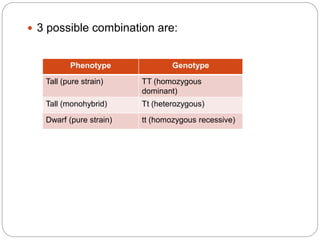
 3 possible combination are:
Phenotype Genotype
Tall (pure strain) TT (homozygous
dominant)
Tall (monohybrid) Tt (heterozygous)
Dwarf (pure strain) tt (homozygous recessive)
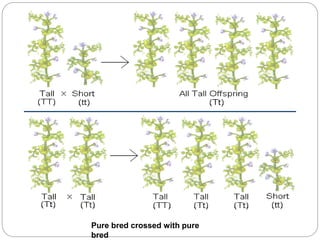
Pure bred crossed with pure
bred
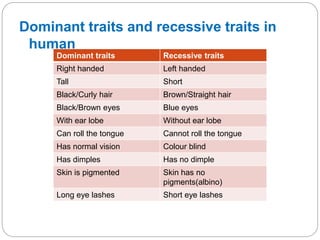
Dominant traits and recessive traits in
human
Dominant traits Recessive traits
Right handed Left handed
Tall Short
Black/Curly hair Brown/Straight hair
Black/Brown eyes Blue eyes
With ear lobe Without ear lobe
Can roll the tongue Cannot roll the tongue
Has normal vision Colour blind
Has dimples Has no dimple
Skin is pigmented Skin has no
pigments(albino)
Long eye lashes Short eye lashes
The principles and mechanism of inheritance
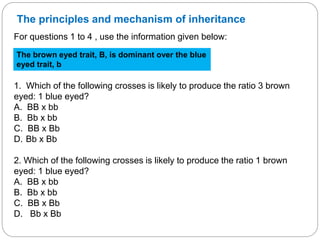
For questions 1 to 4 , use the information given below:
1. Which of the following crosses is likely to produce the ratio 3 brown
eyed: 1 blue eyed?
A. BB x bb
B. Bb x bb
C. BB x Bb
D. Bb x Bb
2. Which of the following crosses is likely to produce the ratio 1 brown
eyed: 1 blue eyed?
A. BB x bb
B. Bb x bb
C. BB x Bb
D. Bb x Bb
The brown eyed trait, B, is dominant over the blue
eyed trait, b
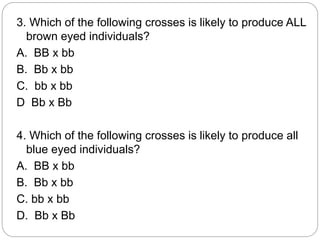
3. Which of the following crosses is likely to produce ALL
brown eyed individuals?
A. BB x bb
B. Bb x bb
C. bb x bb
D Bb x Bb
4. Which of the following crosses is likely to produce all
blue eyed individuals?
A. BB x bb
B. Bb x bb
C. bb x bb
D. Bb x Bb
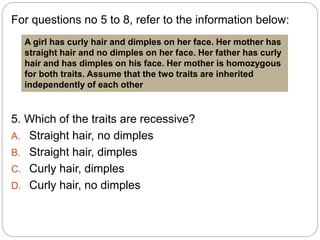
For questions no 5 to 8, refer to the information below:
5. Which of the traits are recessive?
A. Straight hair, no dimples
B. Straight hair, dimples
C. Curly hair, dimples
D. Curly hair, no dimples
A girl has curly hair and dimples on her face. Her mother has
straight hair and no dimples on her face. Her father has curly
hair and has dimples on his face. Her mother is homozygous
for both traits. Assume that the two traits are inherited
independently of each other
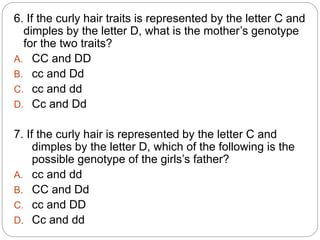
6. If the curly hair traits is represented by the letter C and
dimples by the letter D, what is the mother’s genotype
for the two traits?
A. CC and DD
B. cc and Dd
C. cc and dd
D. Cc and Dd
7. If the curly hair is represented by the letter C and
dimples by the letter D, which of the following is the
possible genotype of the girls’s father?
A. cc and dd
B. CC and Dd
C. cc and DD
D. Cc and dd
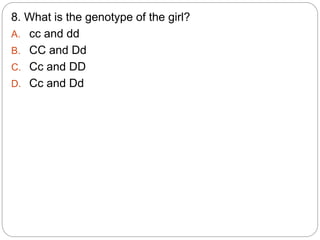
8. What is the genotype of the girl?
A. cc and dd
B. CC and Dd
C. Cc and DD
D. Cc and Dd
3.3 Sex Determination and the
occurrence of twins in human
beings
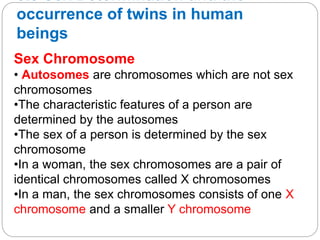
Sex Chromosome
• Autosomes are chromosomes which are not sex
chromosomes
•The characteristic features of a person are
determined by the autosomes
•The sex of a person is determined by the sex
chromosome
•In a woman, the sex chromosomes are a pair of
identical chromosomes called X chromosomes
•In a man, the sex chromosomes consists of one X
chromosome and a smaller Y chromosome
 Therefore, chromosomes in female can be written
as 44+XX while male as 44+XY
Mechanism of Sex
Determination
 Father’s sperm determine the sex of the baby
 If the baby inherits Y chromosome from its father boy
 If the baby inherits X chromosome from its fathergirl
 THUS, the sex of the baby depends on which sperm
fertilizes the egg cell(ovum).
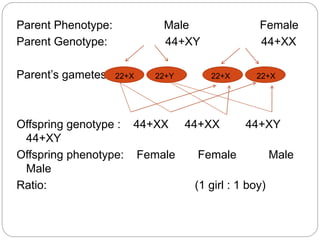
Parent Phenotype: Male Female
Parent Genotype: 44+XY 44+XX
Parent’s gametes:
Offspring genotype : 44+XX 44+XX 44+XY
44+XY
Offspring phenotype: Female Female Male
Male
Ratio: (1 girl : 1 boy)
22+X 22+Y 22+X 22+X
Identical and non-identical
twins
(1) Identical twins
 When an ovum is fertilized by a sperm, a zygote is
formed
 The zygote then divides into 2 separate cells in the
womb producing 2 embryos identical twins
 Identical twins are two normal, genetically identical
individuals of the same sex and share a common
placenta during developmental stage
(2) Non-Identical twins
 Some women may produce two ova at the same time.
 When the two different ova are fertilized at the same
time by two different sperms, two zygotes are
formed non-identical twins(fraternal twins)
 Non-identical twins are genetically different individuals,
can may be of the same sex or different sex and each
have their own placenta during developmental stage
Comparing and contrasting identical
twins with non-identical twins
1. SIMILARITIES:
 Two foetuses develop in the uterus at the same time
 Two babies are born at the same time
2. Differences
Identical twins Differences Non-Identical twins
One ovum and one sperm No of gametes
involved
Two ova and two sperms
One ovum is fertilized and one
zygote is formed
Fertilization Two ova are fertilized and two
zygotes are formed
The single zygote divides into two
zygotes
Division of
zygote formed
The two zygotes formed do not
divide
The two foetuses share one
placenta
Number of
placentas
The two foetuses have two
separate placentas
Have identical chromosomes and
genes
Chromosomes
and genes
Have different chromosomes
and genes
Have the same sex-both boys or
both girls
Sex of twins The twins may have the same
sex or opposite sexes
The twins have similar
characteristic feature
Characteristic
features
The twins have different
characteristic features
Siamese twins
 Sometimes a zygote can not divides into two
completely, so the two zygotes are still linked to each
other
 The linked zygote develop into foetuses and are born as
twins joined together in some parts.
 Siamese twins are identical twins that are formed when
the two embryos do not separate completely during the
developmental stage and are attached to one another
Exercises :Sex determination and
the occurrence of twins in human
beings
1. What are autosomes?
2. Name the chromosome which determines that
zygote will develop into a male
3. Why is the Y-chromosome smaller than the X-
chromosome?
4. Why do identical twins have identical features?
5. State the possible sex of non-identical twins.
3.4 Mutation
 Is a change in the amount or the chemical structure of
DNA
 Can occur spontaneously or induced by substances
called mutagens
 The new genetic material produced are called mutants
 Mutation occur in gamete cell  can be inherited
 Mutation occur in somatic cell  can only be inherited by
daughter cells produced by mitosis
Types of mutation
1. Chromosomal mutation
2. Gene mutation
Chromosomal mutation
 Is the result of changes in the number or structure of
chromosomes
 Can cause changes in the characteristics of the
organism
 Changes in the no of chromosomes are usually the
result of errors occurring during meiosis or mitosis
 These changes may involve the loss of a pair or a
single chromosome, or the increase in an entire haploid
set of chromosomespolyploidy
Consequences of chromosomal
mutation
1. Down’s syndrome
 Individuals suffering from Down’s syndrome have 47
chromosomes
 Additional chromosome is autosome no 21
 Symptoms: mental retardation, reduced resistance to
disease, congenital heart abnormalities, a short
stocky body, a thick neck and the characteristics folds
of skin over the inner corner of the eye
 Termed as mongolism
2. Klinefelter’s syndrome
 Have an extra X chromosome, so that the usual
karyotype of XY is replaced by one of XXY
 Male with underdeveloped testis, infertility and some
female characteristic such as breast enlargement
3. Turner’s syndrome
 Lack one X chromosome
 Such women are XO, rather than the normal XX.
 Have ovaries and breast that do not develop, do not
experience the menstrual cycle and do not ovulate
** Down’s syndrome and other related chromosomal
abnormalities occur more frequently in children born
to older women  related to the age of the mother’s
egg cells
2. Gene Mutation/point
mutation
 Is a change in the structure of the DNA at a single
locus
 Difficult to detect because physical changes on
specific genes are not visible and cannot be
observed under a microscope
 Often have undesirable effects but are sometimes
beneficial to the mutant organism
 If gene mutation produces a beneficial phenotype,
the frequency of the mutation in the population will
increase from generation to generation as a result of
natural selection
Consequences of gene
mutation
1. Colour Blindness
 Is a sex-linked recessive trait
 Recessive gene for colour blindness is found on the
human X chromosome
 Most common form is red-green colour
blindness(cannot distinguishes red & green)
 Females have pair of genes that control color
blindness but male have only one
 If a male inherits one gene for CB,he has this disorder
 Female can only has this disorder if she inherits two
recessive genes,one from each parent
2. Albinism
 Occurs when the gene which is responsible for
normal pigmentation undergoes mutation
 The gene responsible for albinism is recessive
 Albino human beings are unable to produce the black
pigment (melanin)
 So, they have no distinct colour in their skin, hair or
eyes
Causes of mutation
1. Radioactive substances
- Radioactive radiation such as alpha, beta and
gamma radiation
- X-ray also can cause mutation
- Can leads to cancer
- Can change the structure of functions of gene and
chromosome
2. High Intensity Ultraviolet Light
- Ultraviolet from the sun can destroy the cells in the skin
and cause mutation
- Can leads to skin cancer
3. Chemical substances
- Exposure of certain chemical substances like
formaldehyde, pesticides, benzene,nicotine
- Can cause cancer and foetal deformity
4. Changes in environment
- After a long period of time, changes in the
environment can cause organisms to adapt
themselves and mutate into new species
- These new species with their adapted or mutated
features are most suitable for living in the
changing environment
Advantages and disadvantages of
mutation
Advantages Disadvantages
1. Mutation produces genetic
variation. This can give rise to new
species.
1. Can cause genetic disorder such
as albinism and haemophilia
which can be passed on future
generations
2. Plants and animals mutate in
response to adverse changes in the
environment. Mutation gives them a
better chance to survive
2. Can cause abnormalities in
children
Exercise: Mutation
1. What is mutation
2. What pigment gives our skin colour?
3. Why is haemophilia known as a sex-linked
disease?
4. State one disorder in a woman with Turner’s
syndrome.
5. Illustrate what will happen if a normal female
(carrier) haemophilia married to a normal male.
Variation
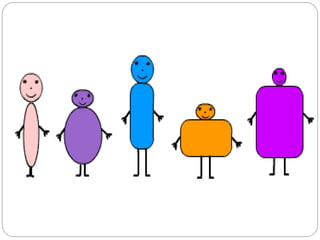
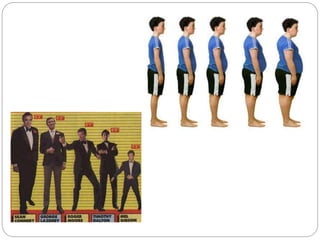
 Each person has unique features which enable
you to differentiate him or her from other friends
 No two people are exactly the same
 These differences among individuals in a
population or a species are called variation
 The differences may be the result of genetic
differences, the influences of the environment, or
a combination of genetic and environmental
influences.
 In human usually the character referred to are the
physical characters such as height, weight, skin
colour, etc..
 The differences in physiological processes such
as our blood glucose level and immunity level are
also considered
 There are two types of variation:
(1) Continuous variation
(2) Discontinuous variation
Continuous Variation
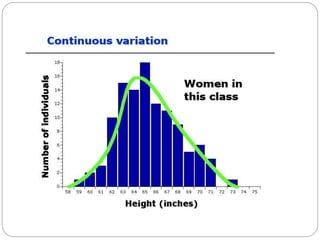
 The characteristics can be measured or graded on a
scale such as human heights, weight,skin colour, etc..
 Cannot be grouped into distinct and discrete
phenotypes
 Usually quantitative (they can be measured) and are
determined by genes and influenced by
environmental factors.
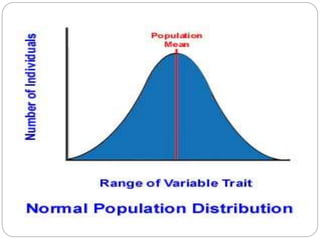
 In *CV, a normal distribution curve is obtained
 From the distribution curve, it can be seen that
individuals show gradual difference from one extreme
to another extreme
 There are very few individuals who are very short or
very tall
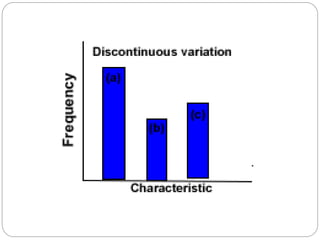
Discontinuous variation
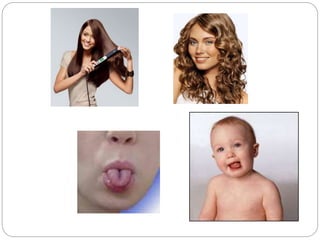
 The characters are discrete and cannot be
measured or graded on a scale such as ABO
blood group, color blindness, presence or
absence of earlobe,etc..
 Are qualitative(they cannot be measured or
graded)
 usually determined by a single gene with distinct
effect.
 Discrete distribution is obtained
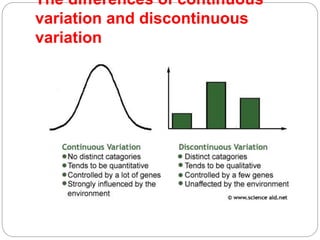
The differences of continuous
variation and discontinuous
variation
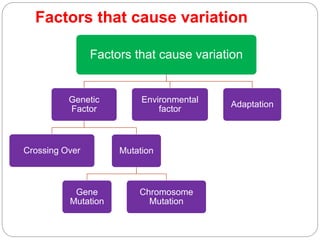
Factors that cause variation
Genetic
Factor
Crossing Over Mutation
Gene
Mutation
Chromosome
Mutation
Environmental
factor
Adaptation
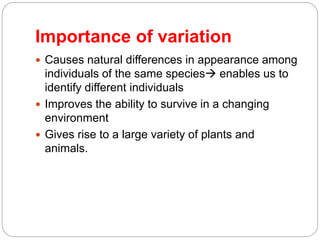
Importance of variation
 Causes natural differences in appearance among
individuals of the same species enables us to
identify different individuals
 Improves the ability to survive in a changing
environment
 Gives rise to a large variety of plants and
animals.
Exercises: Variation
1. What is variation
2. What is continuous variation. Give an example.
3. State two important factors which cause
variation
4. Why is the ability to roll one’s tongue considered
as a discontinuous variation?
5. State one important use of variation in daily life.

Chapter 3 heredity and variation

  • 1.
  • 2.
    3.1 Cell division All living organisms grow and reproduce & are made up of cells  Cells reproduce by dividing and passing on their genes to daughter cells  Each cell has its own nucleus which controls the cell’s activities through the genetic material, DNA which acts as a set of instruction or code for life
  • 3.
    What is genes? Genes are sections of DNA that code for the production of protein and are arranged along the chromosomes  Carry the inherited characteristics of a person  Genes occurs in pairs, therefore each inherited characteristics is carried by two genes  One gene from each pair comes from the father and the mother  Example of inherited characteristics carried by genes are: - Colour of the eyes - Pattern of finger prints - Type of hair - Blood group - Intelligence
  • 5.
    Deoxyribonucleic acids (DNA) Is a double helix, made up of a series of genes to encode genetic information  This determine the individual characteristics of an organism  All the information in DNA is transmitted in the form of a genetic code  Should any information not be followed, the baby will be born with physical or mental defects  DNA molecule is very complicated and resembles a twisted ladder or staircase
  • 7.
    Chromosomes  Is athread-like structure found in the nucleus of a cell  Chromosome and the genes on them are composed of DNA  It exist in pair and are identicalhomologous  A pair of chromosomes has genes arranged in the same way. As a result the genes also exist in pairs  Human has two sets of chromosomes in the body(one set from the father and another set from the mother)
  • 9.
    Mitosis  Occur insomatic cells all cells body except reproductive cells  Is the type of cell division that produces genetically identical cells  During mitosis, DNA replicates in the parent cell, which divides to produce two new cells, each containing an exact copy of the DNA as in the parent cell  This allows growth of multicellular organism from unicellular zygotes  Replacements of cells and repair of tissues is possible through mitosis followed by cell division  Cells are constantly dying and being replaced by identical cells  Is the basis of asexual reproductionthe production of new individuals of a species by one parent organism
  • 11.
    Mitosis  Mitosis isthe type of cell division that produces genetically identical cells  During mitosis, DNA replicates in the parent cell, which divides to produce two new cells, each containing an exact copy of the DNA as in the parent cell  Cells produced are diploid (2n)  Replacement of cells and repair of tissues is possible through mitosis (Ex: cell replacement is rapid in the skin & in the lining of the gut  Is actively carried out at the ends of plant shoots and roots
  • 13.
     Chromosomes thickenand shorten, and become clearly visible  Each chromosome duplicates itself and forms two chromatids attached at the centromere  The nuclear membrane dissapears (a)
  • 14.
     A fibrousspindle is formed between the chromosomes  Each chromosome is attached to a spindle by its centromere  The chromosome arrange themselves at the (b)
  • 15.
     The centromereof each chromosome splits into two  The chromatids separate and move to opposite poles. (c)
  • 16.
     A nuclearmembrane is formed around the chromosomes at each pole  The cell begins to divide and form two daughter cells  Each daughter cell has the same number of chromosomes as the parent cell  In a plant cell, the cytoplasm does not constrict. Instead a new cell wall is developed across the cytoplasm (d)
  • 17.
    Importance of mitosis Important for the following reasons: (a) Growth (b) Replacing old or damaged cells  Enables organisms to reproduce themselves (Ex: by asexual reproduction; binary fission in amoeba)  Ensures that the new cells produced have the same number of chromosomes as the parent cells
  • 18.
    Meiosis  Meiosis isthe process by which a nucleus divides by two divisions into four nuclei, each containing half the number of chromosome of the mother cell  Resulting nuclei are haploid (n)  The cells produced are genetically different to the parent cell and to each other  Occurs in 2 stages that is meiosis 1 and meiosis 2  Produces genetic variation (caused by crossing over between homologous chromosome)  In animals, meiosis occurs in testes and ovaries, whereas in plants, it occurs in the anthers and ovaries
  • 20.
    Importance of meiosis 1.Production of gamete – the only process that produces gametes 2. Reduction in chromosome number – ensures that each gamete has only half the number of chromosomes of the parent cell 3. Maintenance of chromosome number in somatic cells – the somatic cells have their number of chromosomes maintained 4. Production of variation – causes genetic variation in the descendants(can produce individuals who do not resemble their parents closely * Variation occurs in TWO ways: 1. Different combination of chromosomes 2. Crossing over
  • 21.
    Comparing and contrastingmitosis with meiosis  SIMILARITIES of MITOSIS and MEIOSIS: - Both are processes of cell division - In each process, duplication of chromosomes occurs once
  • 22.
    MITOSIS DIFFERENCES MEIOSIS Toproduce new cells for growth and repair of damaged tissues Aim of process To produce gametes (reproductive cells) Somatic cells (non reproductive cells) Type of cell involved Reproductive cells which produce gametes Two daughter cells Product Four gametes Nucleus of parent cells divides once Division of nucleus Nucleus of parent cell divides twice Duplication of chromosomes takes place Duplication of chromosomes Duplication of chromosomes takes place in the first cell division Same as in parent cell,46 Number of chromosomes in daughter cells Half the number of those in the parent cell,23 Does not occur Crossing over Occurs when the chromosomes are at the equatorial plane Same as in parent cell Combination of Different from that of the parent cell DIFFERENCES OF MITOSIS AND MEIOSIS
  • 23.
    Exercises : CELLDIVISION 1. Which of the following is the simplest unit of inheritance? A. Nucleus B. Chromatid C. Chromosome D. Gene 2. How many chromosomes are present in the nucleus of a human cheek cell? A. 23 B. 24 C. 46 D. 48
  • 24.
    3. How manychromosomes can be found in the nucleus of a human ovum? A. 23 B. 24 C. 46 D. 48 4. What is the importance of mitosis in somatic cells? A. It maintains the number of chromosomes in all new cells which are produced B. It occurs in all organs of the body so long as the cells are actively growing C. It prevents the body from being reduced in size due to the death of old cells D. It produces new cells which will support the cellular activities of the old cells.
  • 25.
    5. What isthe importance of meiosis in living organisms? A. It maintains the number of chromosomes of zygotes produced from fusion of sex cells B. It occurs only in parts of the living organism which are actively growing C. It replaces old cells which are no longer able to carry out their cellular functions D. It repairs damaged tissue in the body due to injury or disease 6. Where is DNA found in a living organism? A. Cell membrane B. Cytoplasm C. Nucleus D. Cell wall
  • 26.
    7. What ismitosis and meiosis? 8. Describe the process of mitosis. 9. Describe the process of meiosis 10. What is the importance of mitosis and meiosis?
  • 27.
    3.2 The principlesand mechanism of inheritance  The study of inherited characteristic is called heredity  Genes carry the inherited characteristics of a person  Each characteristic of a person is controlled by a pair of genes  A gene for a certain characteristic may be a dominant gene or a recessive gene
  • 28.
    Dominant genes andrecessive genes  A dominant gene is powerful and can mask the effect of a less powerful or recessive gene in a pair  A recessive gene is weak and cannot show its effect if it is paired with a dominant gene  Each pair of genes is represented by two letters, a capital letter used for a dominant gene and a small letter for a recessive gene
  • 29.
    Monohybrid inheritance  Mendelchose true-breeding varieties of the garden pea as the parents  Mendel crossed a tall plant with a dwarf plant.  Progeny from this cross, called the F1 generation (first filial generation) were all tall  All the F1 plants were then self-pollinated to obtain the F2 generation (second filial generation)  The F2 generation included both tall and dwarf plants in the ratio of 3 tall to 1 dwarf(phenotype ratio)
  • 30.
     It isshown that only the dominant(strong) trait appeared in the F1 generation.  The recessive (weak) trait is blocked by the strong trait from expressing itself and is therefore hidden in the F1 generation
  • 31.
    The mechanism oftrait inheritance  The character of height is determined by two contrasting traits, tall and dwarf.  The gene for tall is dominant while the gene for dwarf is recessive  If the gene for tall is represented by “T” and the gene for dwarf is represented by “t”, there will be three genetic combinations(genotype) for plant height  Genotype is the term used to describe the genetic make-up or constitution of a person. It includes the genes inherited from both parents,whether they are dominant or recessive  Phenotype is the physical traits such as colour of the eyes, height and ect..
  • 32.
     3 possiblecombination are: Phenotype Genotype Tall (pure strain) TT (homozygous dominant) Tall (monohybrid) Tt (heterozygous) Dwarf (pure strain) tt (homozygous recessive)
  • 33.
    Pure bred crossedwith pure bred
  • 34.
    Dominant traits andrecessive traits in human Dominant traits Recessive traits Right handed Left handed Tall Short Black/Curly hair Brown/Straight hair Black/Brown eyes Blue eyes With ear lobe Without ear lobe Can roll the tongue Cannot roll the tongue Has normal vision Colour blind Has dimples Has no dimple Skin is pigmented Skin has no pigments(albino) Long eye lashes Short eye lashes
  • 35.
    The principles andmechanism of inheritance For questions 1 to 4 , use the information given below: 1. Which of the following crosses is likely to produce the ratio 3 brown eyed: 1 blue eyed? A. BB x bb B. Bb x bb C. BB x Bb D. Bb x Bb 2. Which of the following crosses is likely to produce the ratio 1 brown eyed: 1 blue eyed? A. BB x bb B. Bb x bb C. BB x Bb D. Bb x Bb The brown eyed trait, B, is dominant over the blue eyed trait, b
  • 36.
    3. Which ofthe following crosses is likely to produce ALL brown eyed individuals? A. BB x bb B. Bb x bb C. bb x bb D Bb x Bb 4. Which of the following crosses is likely to produce all blue eyed individuals? A. BB x bb B. Bb x bb C. bb x bb D. Bb x Bb
  • 37.
    For questions no5 to 8, refer to the information below: 5. Which of the traits are recessive? A. Straight hair, no dimples B. Straight hair, dimples C. Curly hair, dimples D. Curly hair, no dimples A girl has curly hair and dimples on her face. Her mother has straight hair and no dimples on her face. Her father has curly hair and has dimples on his face. Her mother is homozygous for both traits. Assume that the two traits are inherited independently of each other
  • 38.
    6. If thecurly hair traits is represented by the letter C and dimples by the letter D, what is the mother’s genotype for the two traits? A. CC and DD B. cc and Dd C. cc and dd D. Cc and Dd 7. If the curly hair is represented by the letter C and dimples by the letter D, which of the following is the possible genotype of the girls’s father? A. cc and dd B. CC and Dd C. cc and DD D. Cc and dd
  • 39.
    8. What isthe genotype of the girl? A. cc and dd B. CC and Dd C. Cc and DD D. Cc and Dd
  • 40.
    3.3 Sex Determinationand the occurrence of twins in human beings Sex Chromosome • Autosomes are chromosomes which are not sex chromosomes •The characteristic features of a person are determined by the autosomes •The sex of a person is determined by the sex chromosome •In a woman, the sex chromosomes are a pair of identical chromosomes called X chromosomes •In a man, the sex chromosomes consists of one X chromosome and a smaller Y chromosome
  • 41.
     Therefore, chromosomesin female can be written as 44+XX while male as 44+XY
  • 42.
    Mechanism of Sex Determination Father’s sperm determine the sex of the baby  If the baby inherits Y chromosome from its father boy  If the baby inherits X chromosome from its fathergirl  THUS, the sex of the baby depends on which sperm fertilizes the egg cell(ovum).
  • 43.
    Parent Phenotype: MaleFemale Parent Genotype: 44+XY 44+XX Parent’s gametes: Offspring genotype : 44+XX 44+XX 44+XY 44+XY Offspring phenotype: Female Female Male Male Ratio: (1 girl : 1 boy) 22+X 22+Y 22+X 22+X
  • 44.
    Identical and non-identical twins (1)Identical twins  When an ovum is fertilized by a sperm, a zygote is formed  The zygote then divides into 2 separate cells in the womb producing 2 embryos identical twins  Identical twins are two normal, genetically identical individuals of the same sex and share a common placenta during developmental stage
  • 45.
    (2) Non-Identical twins Some women may produce two ova at the same time.  When the two different ova are fertilized at the same time by two different sperms, two zygotes are formed non-identical twins(fraternal twins)  Non-identical twins are genetically different individuals, can may be of the same sex or different sex and each have their own placenta during developmental stage
  • 46.
    Comparing and contrastingidentical twins with non-identical twins 1. SIMILARITIES:  Two foetuses develop in the uterus at the same time  Two babies are born at the same time
  • 47.
    2. Differences Identical twinsDifferences Non-Identical twins One ovum and one sperm No of gametes involved Two ova and two sperms One ovum is fertilized and one zygote is formed Fertilization Two ova are fertilized and two zygotes are formed The single zygote divides into two zygotes Division of zygote formed The two zygotes formed do not divide The two foetuses share one placenta Number of placentas The two foetuses have two separate placentas Have identical chromosomes and genes Chromosomes and genes Have different chromosomes and genes Have the same sex-both boys or both girls Sex of twins The twins may have the same sex or opposite sexes The twins have similar characteristic feature Characteristic features The twins have different characteristic features
  • 48.
    Siamese twins  Sometimesa zygote can not divides into two completely, so the two zygotes are still linked to each other  The linked zygote develop into foetuses and are born as twins joined together in some parts.  Siamese twins are identical twins that are formed when the two embryos do not separate completely during the developmental stage and are attached to one another
  • 50.
    Exercises :Sex determinationand the occurrence of twins in human beings 1. What are autosomes? 2. Name the chromosome which determines that zygote will develop into a male 3. Why is the Y-chromosome smaller than the X- chromosome? 4. Why do identical twins have identical features? 5. State the possible sex of non-identical twins.
  • 51.
    3.4 Mutation  Isa change in the amount or the chemical structure of DNA  Can occur spontaneously or induced by substances called mutagens  The new genetic material produced are called mutants  Mutation occur in gamete cell  can be inherited  Mutation occur in somatic cell  can only be inherited by daughter cells produced by mitosis
  • 52.
    Types of mutation 1.Chromosomal mutation 2. Gene mutation
  • 53.
    Chromosomal mutation  Isthe result of changes in the number or structure of chromosomes  Can cause changes in the characteristics of the organism  Changes in the no of chromosomes are usually the result of errors occurring during meiosis or mitosis  These changes may involve the loss of a pair or a single chromosome, or the increase in an entire haploid set of chromosomespolyploidy
  • 54.
    Consequences of chromosomal mutation 1.Down’s syndrome  Individuals suffering from Down’s syndrome have 47 chromosomes  Additional chromosome is autosome no 21  Symptoms: mental retardation, reduced resistance to disease, congenital heart abnormalities, a short stocky body, a thick neck and the characteristics folds of skin over the inner corner of the eye  Termed as mongolism
  • 55.
    2. Klinefelter’s syndrome Have an extra X chromosome, so that the usual karyotype of XY is replaced by one of XXY  Male with underdeveloped testis, infertility and some female characteristic such as breast enlargement
  • 56.
    3. Turner’s syndrome Lack one X chromosome  Such women are XO, rather than the normal XX.  Have ovaries and breast that do not develop, do not experience the menstrual cycle and do not ovulate
  • 57.
    ** Down’s syndromeand other related chromosomal abnormalities occur more frequently in children born to older women  related to the age of the mother’s egg cells
  • 58.
    2. Gene Mutation/point mutation Is a change in the structure of the DNA at a single locus  Difficult to detect because physical changes on specific genes are not visible and cannot be observed under a microscope  Often have undesirable effects but are sometimes beneficial to the mutant organism  If gene mutation produces a beneficial phenotype, the frequency of the mutation in the population will increase from generation to generation as a result of natural selection
  • 59.
    Consequences of gene mutation 1.Colour Blindness  Is a sex-linked recessive trait  Recessive gene for colour blindness is found on the human X chromosome  Most common form is red-green colour blindness(cannot distinguishes red & green)  Females have pair of genes that control color blindness but male have only one  If a male inherits one gene for CB,he has this disorder  Female can only has this disorder if she inherits two recessive genes,one from each parent
  • 60.
    2. Albinism  Occurswhen the gene which is responsible for normal pigmentation undergoes mutation  The gene responsible for albinism is recessive  Albino human beings are unable to produce the black pigment (melanin)  So, they have no distinct colour in their skin, hair or eyes
  • 61.
    Causes of mutation 1.Radioactive substances - Radioactive radiation such as alpha, beta and gamma radiation - X-ray also can cause mutation - Can leads to cancer - Can change the structure of functions of gene and chromosome
  • 62.
    2. High IntensityUltraviolet Light - Ultraviolet from the sun can destroy the cells in the skin and cause mutation - Can leads to skin cancer 3. Chemical substances - Exposure of certain chemical substances like formaldehyde, pesticides, benzene,nicotine - Can cause cancer and foetal deformity
  • 63.
    4. Changes inenvironment - After a long period of time, changes in the environment can cause organisms to adapt themselves and mutate into new species - These new species with their adapted or mutated features are most suitable for living in the changing environment
  • 64.
    Advantages and disadvantagesof mutation Advantages Disadvantages 1. Mutation produces genetic variation. This can give rise to new species. 1. Can cause genetic disorder such as albinism and haemophilia which can be passed on future generations 2. Plants and animals mutate in response to adverse changes in the environment. Mutation gives them a better chance to survive 2. Can cause abnormalities in children
  • 65.
    Exercise: Mutation 1. Whatis mutation 2. What pigment gives our skin colour? 3. Why is haemophilia known as a sex-linked disease? 4. State one disorder in a woman with Turner’s syndrome. 5. Illustrate what will happen if a normal female (carrier) haemophilia married to a normal male.
  • 66.
    Variation  Each personhas unique features which enable you to differentiate him or her from other friends  No two people are exactly the same  These differences among individuals in a population or a species are called variation  The differences may be the result of genetic differences, the influences of the environment, or a combination of genetic and environmental influences.
  • 67.
     In humanusually the character referred to are the physical characters such as height, weight, skin colour, etc..  The differences in physiological processes such as our blood glucose level and immunity level are also considered  There are two types of variation: (1) Continuous variation (2) Discontinuous variation
  • 68.
    Continuous Variation  Thecharacteristics can be measured or graded on a scale such as human heights, weight,skin colour, etc..  Cannot be grouped into distinct and discrete phenotypes  Usually quantitative (they can be measured) and are determined by genes and influenced by environmental factors.  In *CV, a normal distribution curve is obtained  From the distribution curve, it can be seen that individuals show gradual difference from one extreme to another extreme  There are very few individuals who are very short or very tall
  • 73.
    Discontinuous variation  Thecharacters are discrete and cannot be measured or graded on a scale such as ABO blood group, color blindness, presence or absence of earlobe,etc..  Are qualitative(they cannot be measured or graded)  usually determined by a single gene with distinct effect.  Discrete distribution is obtained
  • 76.
    The differences ofcontinuous variation and discontinuous variation
  • 77.
    Factors that causevariation Factors that cause variation Genetic Factor Crossing Over Mutation Gene Mutation Chromosome Mutation Environmental factor Adaptation
  • 78.
    Importance of variation Causes natural differences in appearance among individuals of the same species enables us to identify different individuals  Improves the ability to survive in a changing environment  Gives rise to a large variety of plants and animals.
  • 79.
    Exercises: Variation 1. Whatis variation 2. What is continuous variation. Give an example. 3. State two important factors which cause variation 4. Why is the ability to roll one’s tongue considered as a discontinuous variation? 5. State one important use of variation in daily life.