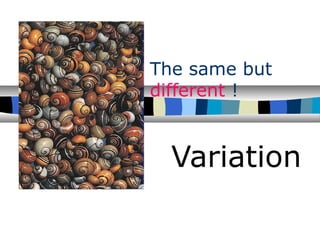
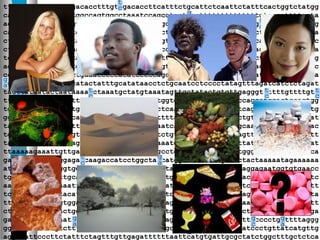
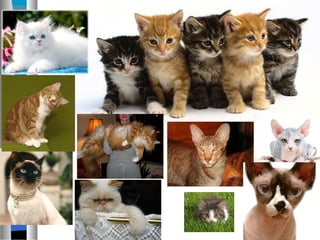
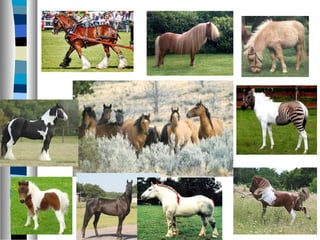
The same but
different !
Variation
AREN’T GOD’S CREATIONS AMAZING?
tttctccatttgtcgtgacacctttgttgacaccttcatttctgcattctcaattctatttcactggtctatgg
cagagaacacaaaatatggccagtggcctaaatccagcctactaccttttttttttttttgtaacattttacta
acatagccattcccatgtgtttccatgtgtctgggctgcttttgcactctaatggcagagttaagaaattgtag
cagagaccacaatgcctcaaatatttactctacagccctttataaaaacagtgtgccaactcctgatttatgaa
cttatcattatgtcaataccatactgtctttattactgtagttttataagtcatgacatcagataatgtaaatc
ctccaactttgtttttaatcaaaagtgttttggccatcctagatatactttgtattgccacataaatttgaaga
tcagcctgtcagtgtctacaaaatagcatgctaggattttgatagggattgtgtagaatctatagattaattag
aggagaatgactatcttgacaatactgctgcccctctgtattcgtgggggattggttccacaacaacacccacc
ccccactcggcaacccctgaaacccccacatcccccagcttttttcccctgctaccaaaatccatggatgctca
agtccatataaaatgccatactatttgcatataacctctgcaatcctcccctatagtttagatcatctctagat
tacttataatactaataaaatctaaatgctatgtaaatagttgctatactgtgttgagggttttttgttttgtt
ttgttttatttgtttgtttgtttgtattttaagagatggtgtcttgctttgttgcccaggctggagtgcagtgg
tgagatcatagcttactgcagcctcaaactcctggactcaaacagtcctcccacctcagcctcccaaagtgctg
ggatacaggtgtgacccactgtgcccagttattattttttatttgtattattttactgttgtattatttttaat
tattttttctgaatattttccatctatagttggttgaatcatggatgtggaacaggcaaatatggagggctaac
tgtattgcatcttccagttcatgagtatgcagtctctctgtttatttaaagttttagtttttctcaaccatgtt
tacttttcagtatacaagactttgacgttttttgttaaatgtatttgtaagtattttattatttgtgatgttat
ttaaaaagaaattgttgactgggcacagtggctcacgcctgtaatcccagcactttgggaggctgaggcgggca
gatcacgaggtcaggagatcaagaccatcctggctaacatggtaaaaccccgtctctactaaaaatagaaaaaa
attagccaggcgtggtggcgagtgcctgtagtcccagctactcgggaggctgaggcaggagaatggtgtgaacc
tgggaggcggagcttgcagtgagctgagatcgtgccactgcattccagcctgcgtgacagagcgagactctgtc
aaaaaaataaataaaatttaaaaaaagaagaagaaattattttcttaatttcattttcaggttttttatttatt
tctactatatggatacatgattgatttttgtatattgatcatgtatcctgcaaactagctaacatagtttatta
tttctctttttttgtggattttaaaggattttctacatagataaataaacacacataaacagttttacttcttt
cttttcaacctagactggatgcattttttgtttttgtttgtttgtttgctttttaacttgctgcagtgactaga
gaatgtattgaagaatatattgttgaacaaaagcagtgagagtggacatccctgctttccccctgattttaggg
ggaatgttttcagtctttcactatttaatatgattttagctataggtttatcctagatccctgttatcatgttg
aggaaattcccttctatttctagtttgttgagattttttaattcatgtgattgcgctatctggctttgctctca
t
c
g
a
g
a
g
a
g
a
g
a
g
c
g
c
g
c
t
c
g
a
g
a
g
a
g
a
g
a
t
c
t
c
t
c
t
c
g
a
g
a
g
a
t
c
g
c
t
c
t
c
t
c
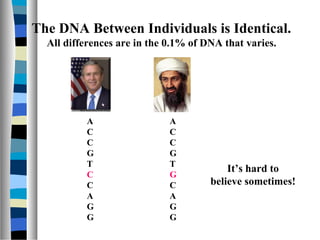
The DNA Between Individuals is Identical.
All differences are in the 0.1% of DNA that varies.
A
C
C
G
T
C
C
A
G
G
A
C
C
G
T
G
C
A
G
G
It’s hard to
believe sometimes!
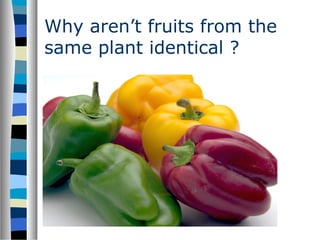
Why aren’t fruits from the
same plant identical ?
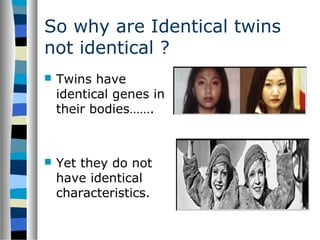
So why are Identical twins
not identical ?
 Twins have
identical genes in
their bodies…….
 Yet they do not
have identical
characteristics.
What is a species?
 A group of organisms which can
reproduce
 Examples?
 The differences within a species
are called variation
Variation is difference in traits in
organisms of the same species
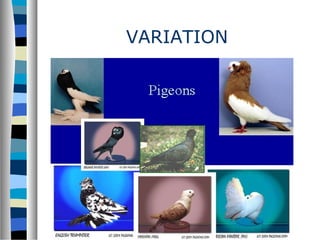
VARIATION
Variation In Humans
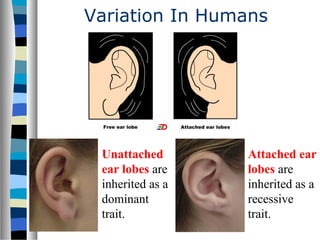
Unattached
ear lobes are
inherited as a
dominant
trait.
Attached ear
lobes are
inherited as a
recessive
trait.
Variation In Humans
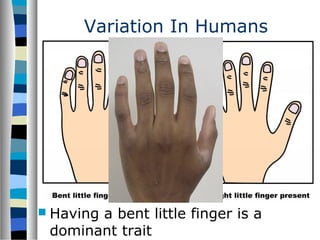
 Having a bent little finger is a
dominant trait
Variation In Humans
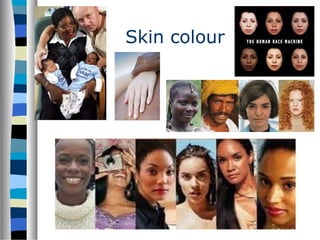
Skin colour
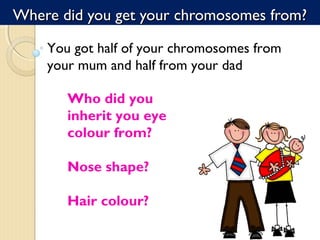
You got half of your chromosomes from
your mum and half from your dad
Who did you
inherit you eye
colour from?
Nose shape?
Hair colour?
Where did you get your chromosomes from?Where did you get your chromosomes from?
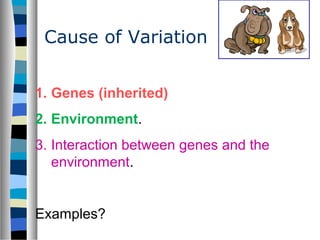
Cause of Variation
1. Genes (inherited)
2. Environment.
3. Interaction between genes and the
environment.
Examples?
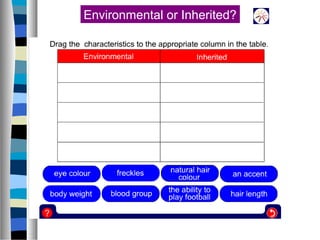
Environmental or Inherited?
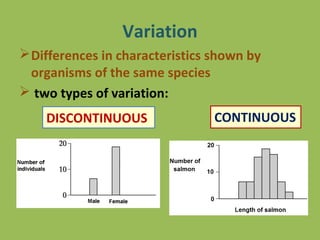
Variation
Differences in characteristics shown by
organisms of the same species
 two types of variation:
DISCONTINUOUS CONTINUOUS
Discontinuous Variation
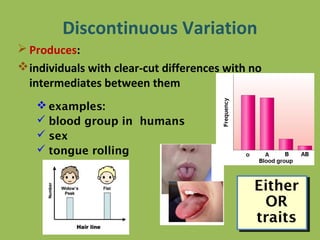
 Produces:
individuals with clear-cut differences with no
intermediates between them
 examples:
 blood group in humans
 sex
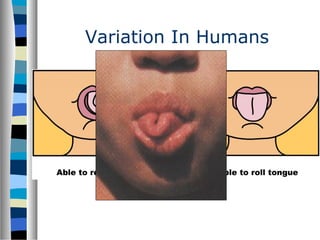
 tongue rolling
Either
OR
traits
Either
OR
traits
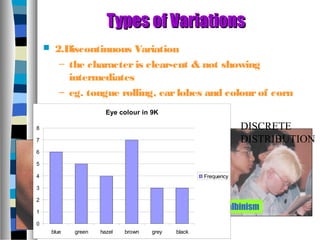
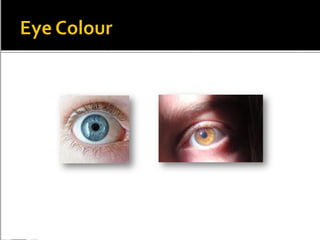
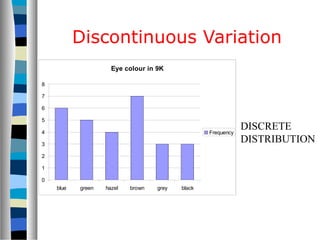
Eye colour in 9K
0
1
2
3
4
5
6
7
8
blue green hazel brown grey black
Frequency
DISCRETE
DISTRIBUTION
Discontinuous Variation
The environment cannot change discontinuous
type of variations
No matter how much you stay in the sun orNo matter how much you stay in the sun or
what you eat – will not change your bloodwhat you eat – will not change your blood
group!!group!!
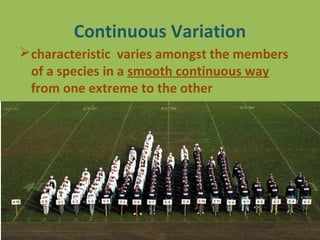
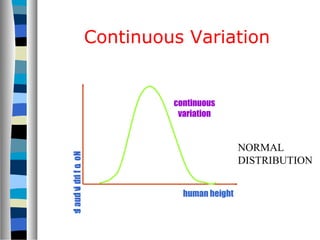
Continuous Variation
characteristic varies amongst the members
of a species in a smooth continuous way
from one extreme to the other
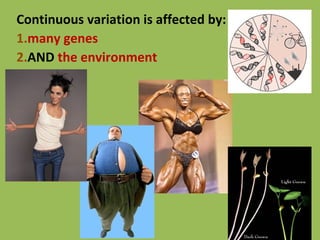
Continuous variation is affected by:
1.many genes
2.AND the environment
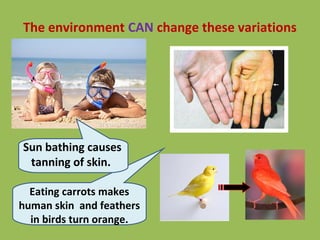
The environment CAN change these variations
Sun bathing causes
tanning of skin.
Eating carrots makes
human skin and feathers
in birds turn orange.
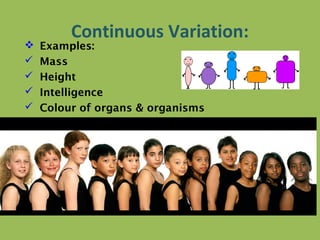
Continuous Variation:
 Examples:
 Mass
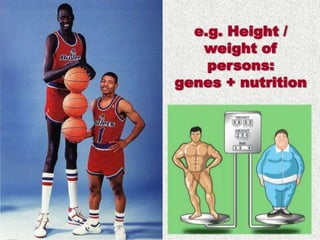
 Height
 Intelligence
 Colour of organs & organisms
human height
continuous
variation
No.ofindividuals
NORMAL
DISTRIBUTION
Continuous Variation
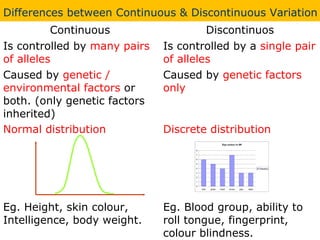
Differences between Continuous & Discontinuous Variation
Continuous Discontinuos
Is controlled by many pairs
of alleles
Is controlled by a single pair
of alleles
Caused by genetic /
environmental factors or
both. (only genetic factors
inherited)
Caused by genetic factors
only
Normal distribution Discrete distribution
Eg. Height, skin colour,
Intelligence, body weight.
Eg. Blood group, ability to
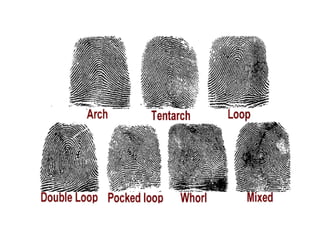
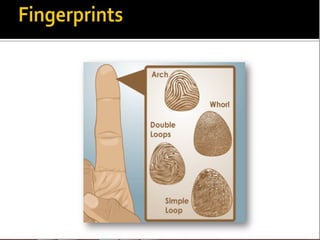
roll tongue, fingerprint,
colour blindness.
Eye colour in 9K
0
1
2
3
4
5
6
7
8
blue green hazel brown grey black
Frequency
How does variation come about?
#Environmental factor
#Genetic factor
 Sexual reproduction
 Mutations
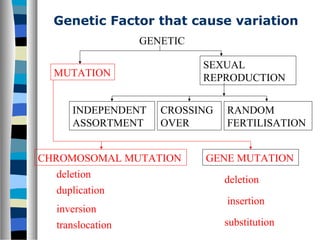
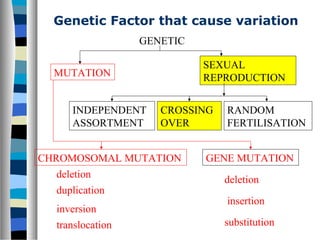
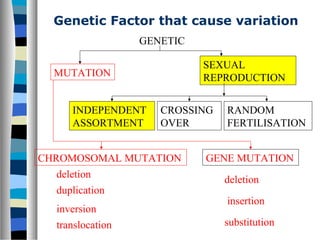
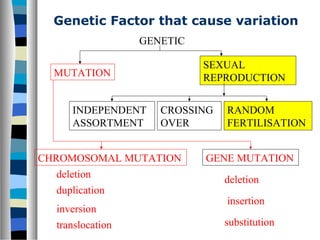
Genetic Factor that cause variation
GENETIC
MUTATION
SEXUAL
REPRODUCTION
CHROMOSOMAL MUTATION GENE MUTATION
INDEPENDENT
ASSORTMENT
CROSSING
OVER
RANDOM
FERTILISATION
duplication
inversion
translocation
deletion
deletion
insertion
substitution
 Offspring of sexual reproduction
are highly varied
The Origins of Genetic Variation
Sexual Reproduction
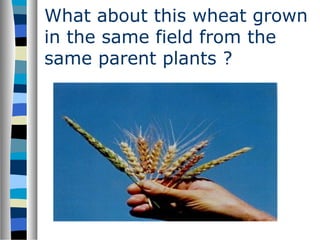
What about this wheat grown
in the same field from the
same parent plants ?
Genetic Factor that cause variation
GENETIC
MUTATION
SEXUAL
REPRODUCTION
CHROMOSOMAL MUTATION GENE MUTATION
INDEPENDENT
ASSORTMENT
CROSSING
OVER
RANDOM
FERTILISATION
duplication
inversion
translocation
deletion
deletion
insertion
substitution
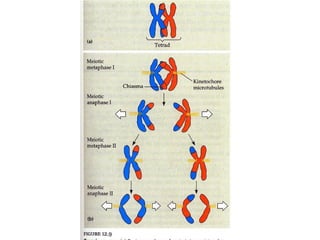
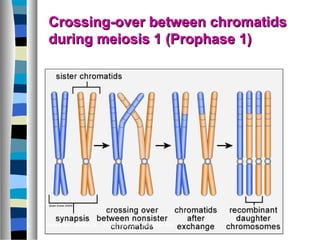
Crossing-over between chromatidsCrossing-over between chromatids
during meiosis 1 (Prophase 1)during meiosis 1 (Prophase 1)
Based on: Mader, S., Inquiry Into Life, McGraw-Hill
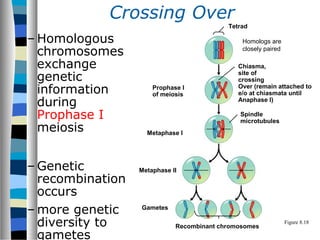
Crossing Over
– Homologous
chromosomes
exchange
genetic
information
during
Prophase I
meiosis
– Genetic
recombination
occurs
– more genetic
diversity to
gametes
Figure 8.18
Prophase I
of meiosis
Metaphase I
Metaphase II
Gametes
Recombinant chromosomes
Spindle
microtubules
Tetrad
Chiasma,
site of
crossing
Over (remain attached to
e/o at chiasmata until
Anaphase I)
Homologs are
closely paired
Genetic Factor that cause variation
GENETIC
MUTATION
SEXUAL
REPRODUCTION
CHROMOSOMAL MUTATION GENE MUTATION
INDEPENDENT
ASSORTMENT
CROSSING
OVER
RANDOM
FERTILISATION
duplication
inversion
translocation
deletion
deletion
insertion
substitution
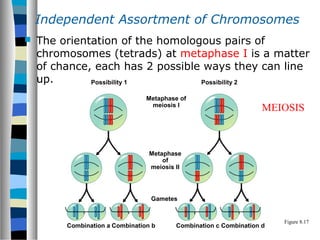
 The orientation of the homologous pairs of
chromosomes (tetrads) at metaphase I is a matter
of chance, each has 2 possible ways they can line
up.
Independent Assortment of Chromosomes
Figure 8.17
Possibility 1
Metaphase
of
meiosis II
Combination a Combination b Combination c Combination d
Gametes
Possibility 2
Metaphase of
meiosis I
MEIOSIS
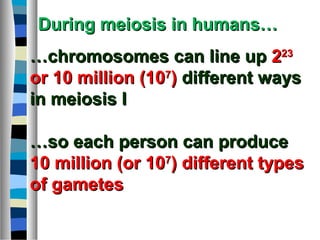
……chromosomes can line upchromosomes can line up 222323
or 10 million (10or 10 million (1077
)) different waysdifferent ways
in meiosis Iin meiosis I
……so each person can produceso each person can produce
10 million (or 1010 million (or 1077
) different types) different types
of gametesof gametes
During meiosis in humans…During meiosis in humans…
 Meiosis
– homologous chromosomes separate
independently from each other and pass
into a different gamete ( INDEPENDENT
ASSORTMENT).
– a great variety of gametes are produced
Causes of VariationsCauses of Variations
Genetic Factor that cause variation
GENETIC
MUTATION
SEXUAL
REPRODUCTION
CHROMOSOMAL MUTATION GENE MUTATION
INDEPENDENT
ASSORTMENT
CROSSING
OVER
RANDOM
FERTILISATION
duplication
inversion
translocation
deletion
deletion
insertion
substitution
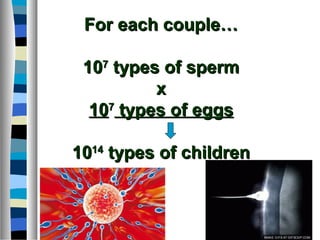
For each couple…For each couple…
101077
types of spermtypes of sperm
xx
101077
types of eggstypes of eggs
10101414
types of childrentypes of children
~~ENDEND~~
END OF PART 1
GO TO 6.2
EXTRA
Question: SEP, 2005 [pg. 83]
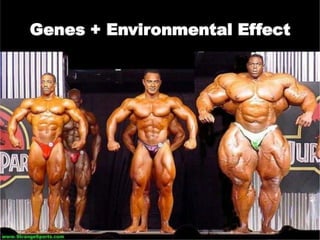
Look at the drawings of the two men.
List two features shown in the diagram, that are
inherited and three features that are not inherited. (5)
Types of VariationsTypes of Variations
 2.Discontinuous Variation
– the characteris clear-cut & not showing
intermediates
– eg. tongue rolling, earlobes and colourof corn
albinism
Eye colour in 9K
0
1
2
3
4
5
6
7
8
blue green hazel brown grey black
Frequency
DISCRETE
DISTRIBUTION
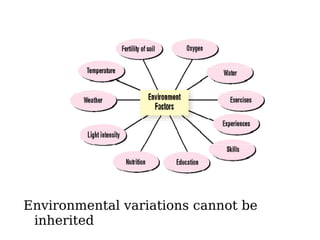
Environmental variations cannot be
inherited
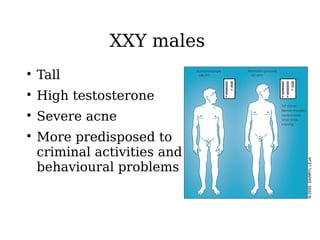
XXY males

Tall

High testosterone

Severe acne

More predisposed to
criminal activities and
behavioural problems
Poliploidy

Chromosomal Mutation

Polyploid organisms:
− Triploids (3n) – three sets of chromosomes
of one type
− Tetraploid (4n) – have four sets of
chromosomes

Polyploidy is common in flowering
plants

Not occuring in animals

Produce bigger fruit with more
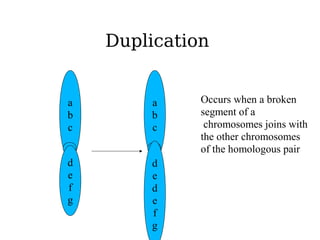
Duplication
a
b
c
d
e
f
g
a
b
c
d
e
d
e
f
g
Occurs when a broken
segment of a
chromosomes joins with
the other chromosomes
of the homologous pair
a
b
c
d
e
f
g
a
b
c
d
e
f
g
a
b
c
d
e
f
g
a
b
c
d
e
q
r
a
b
c
d
e
f
g
a
b
c
d
e
f
g
l
m
n
o
p
q
r
a
b
c
d
e
f
g
a
b
c
d
e
f
g
l
m
n
o
p
f
g
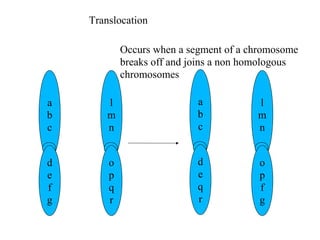
Translocation
Occurs when a segment of a chromosome
breaks off and joins a non homologous
chromosomes
a
b
c
d
e
f
g
a
b
c
d
f
g
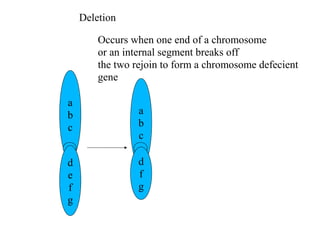
Deletion
Occurs when one end of a chromosome
or an internal segment breaks off
the two rejoin to form a chromosome defecient
gene
a
b
c
d
e
f
g
a
b
c
d
f
e
g
Break
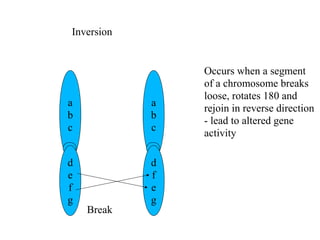
Inversion
Occurs when a segment
of a chromosome breaks
loose, rotates 180 and
rejoin in reverse direction
- lead to altered gene
activity

Biology Form 5 Chapter 6 Variation 6.1

Editor's Notes

  • #23 Note that this activity may raise some discussion, as some of the features are of course affected by both genetics and environment. The answers for this activity have been worked out on the most simple scenario. See the following two slides for a discussion of the more real but a bit more complicated situation.
  • #41 Main Idea(s) of This Slide - During the process of meiosis some homologous chromosomes “trade” portions of their DNA with each other resulting in new configurations of alleles.
  • #46 Main Idea(s) of This Slide - The 23 pairs of chromosomes found in human cells can line up in 10 million different ways during the first phase of meiosis. Because of this, each person is capable of producing 10 million genetically unique gametes.
  • #50 Main Idea(s) of This Slide - In one couple, the man can produce 10 million (107) genetically different sperm cells and the woman can produce 10 million (107) genetically different egg cells. By randomly combining one of each, we end up with a possible 1014 genetically different offspring that can be produced.