PRESENTED BY –
PRAJNYA ELINAR DIGAL
M .SC (N) Tutor
SNC
Introduction:
 A motive etymologically means that ‘which moves’.
 A motive may be considered as an energetic force or
tendency (learned or innate) working within the individual
to inspire him to act for the satisfaction of his basic need or
attainment of some specific purpose
Definition of motive:
 A need gives rise to one or more motives. A motives is a
rather specific process, which has been learned. It is
directed towards a goal. -
CAROL-1969
Meaning:
 A motive is something that causes us to act or behave in
order to reach a goal or desired endpoint. It comes from
the Latin word that means 'moving'. A motive is the reason
WHY you do something.
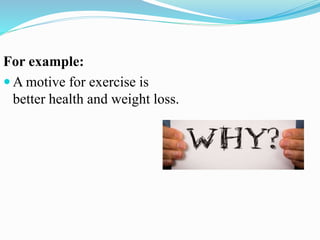
For example:
 A motive for exercise is
better health and weight loss.
 For example, In criminology a
motive is the reason an
individual committed a crime or
offense. For instance, the motive
for someone who robbed a store
is most likely that they needed
money.
Behavior:
 Anything a person or animal does that can be
observed in some way.
 Behavior consists of all our physical responses,
habits, skills, all our organic responses, feelings,
emotions and tensions, & all our intellectual
responses, perceiving, thinking, and reasoning.
Motivation:
 The factors that direct and energize the
behavior of humans and other organisms.
Classification of Motives
Biological Motives and
Homeostasis:
 Biological motives are called as physiological motives.
 These motives are essential for the survival of the organism.
 Such motives are triggered when there is imbalancement in
the body.
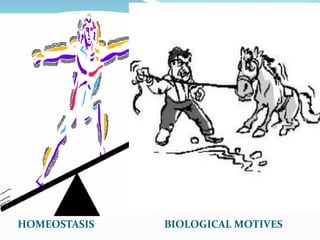
 The body always tends to maintain a state of equilibrium
called “Homeostasis”- in many of its internal physiological
processes.
Cont….
 This balance is very essential for the normal life.
 Homeostasis helps to maintain internal physiological
processes at optimal levels.
 The nutritional level, fluid level, temperature level, etc., are
maintained at certain optimal level or homeostasis levels.
 When there is some variation in these levels the individual is
motivated for restoring the state of equilibrium.
Example:
HOMEOSTASIS BIOLOGICAL MOTIVES
PHYSIOLOGICAL MOTIVES
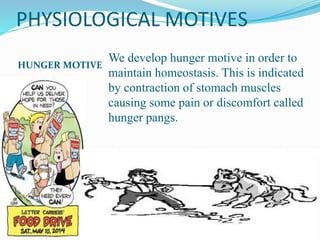
HUNGER MOTIVE
We develop hunger motive in order to
maintain homeostasis. This is indicated
by contraction of stomach muscles
causing some pain or discomfort called
hunger pangs.
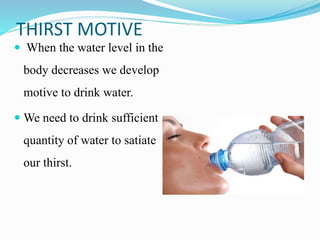
THIRST MOTIVE
 When the water level in the
body decreases we develop
motive to drink water.
 We need to drink sufficient
quantity of water to satiate
our thirst.
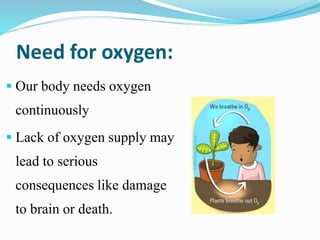
Need for oxygen:
 Our body needs oxygen
continuously
 Lack of oxygen supply may
lead to serious
consequences like damage
to brain or death.
Motive for regulation of body
temperature
 Maintenance of normal body
temperature (98.6°F or 37.0°C) is
necessary
 For example, opening of
windows, put on fans, take cool
drinks, remove clothes, etc., when
the temperature increases to
above normal level; and closing
doors and windows, wear
sweaters, take hot beverages
when temperature falls down. In
this way we try to regulate the
body temperature.
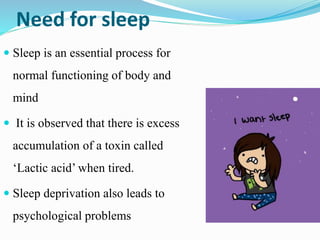
Need for sleep
 Sleep is an essential process for
normal functioning of body and
mind
 It is observed that there is excess
accumulation of a toxin called
‘Lactic acid’ when tired.
 Sleep deprivation also leads to
psychological problems
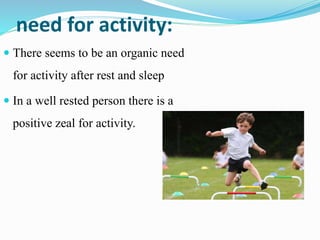
need for activity:
 There seems to be an organic need
for activity after rest and sleep
 In a well rested person there is a
positive zeal for activity.
Need for avoidance of pain:
 No organism can continue to
bear pain
 For example, when we are under
hot sun we go to shade. When
something is pinching we avoid
it.
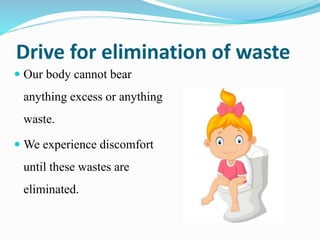
Drive for elimination of waste
 Our body cannot bear
anything excess or anything
waste.
 We experience discomfort
until these wastes are
eliminated.
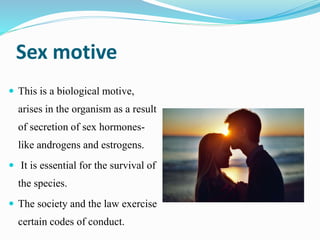
Sex motive
 This is a biological motive,
arises in the organism as a result
of secretion of sex hormones-
like androgens and estrogens.
 It is essential for the survival of
the species.
 The society and the law exercise
certain codes of conduct.
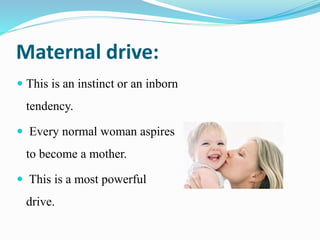
Maternal drive:
 This is an instinct or an inborn
tendency.
 Every normal woman aspires
to become a mother.
 This is a most powerful
drive.
Social Motives
 social motives are specific only to human beings.
These are called social motives, because they are learnt
in social groups as a result of interaction with the
family and society.
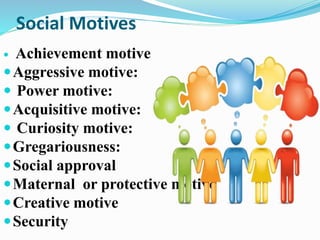
Social Motives
 Achievement motive
Aggressive motive:
 Power motive:
Acquisitive motive:
 Curiosity motive:
Gregariousness:
Social approval
Maternal or protective motive
Creative motive
Security
Achievement motive
 Achievement motivation refers
to a desire to achieve some
goal.
 This motive is developed in the
individual who has seen some
people in the society attaining
high success, reaching high
positions and standards.
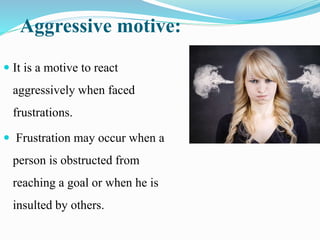
Aggressive motive:
 It is a motive to react
aggressively when faced
frustrations.
 Frustration may occur when a
person is obstructed from
reaching a goal or when he is
insulted by others.

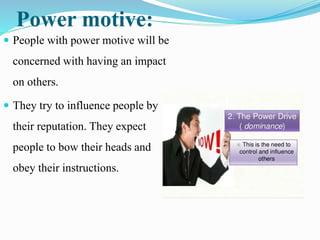
Power motive:
 People with power motive will be
concerned with having an impact
on others.
 They try to influence people by
their reputation. They expect
people to bow their heads and
obey their instructions.
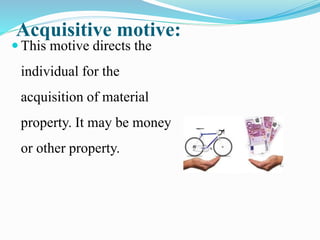
Acquisitive motive:
 This motive directs the
individual for the
acquisition of material
property. It may be money
or other property.
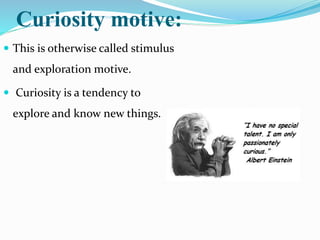
Curiosity motive:
 This is otherwise called stimulus
and exploration motive.
 Curiosity is a tendency to
explore and know new things.
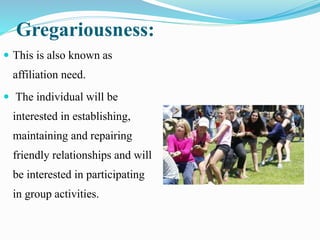
Gregariousness:
 This is also known as
affiliation need.
 The individual will be
interested in establishing,
maintaining and repairing
friendly relationships and will
be interested in participating
in group activities.
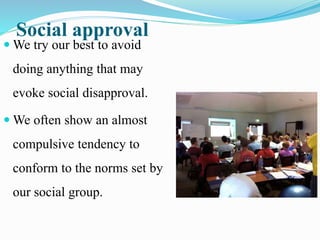
Social approval
 We try our best to avoid
doing anything that may
evoke social disapproval.
 We often show an almost
compulsive tendency to
conform to the norms set by
our social group.
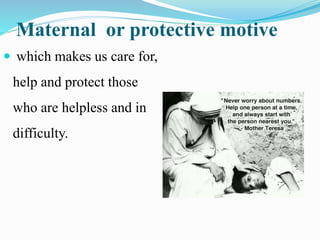
Maternal or protective motive
 which makes us care for,
help and protect those
who are helpless and in
difficulty.
Security
 It is very important .we want to feel
secure economically and
emotionally.
 An individual needs to feel secure in
the affection of another or believe
that he is in favor with his parents,
relatives, neighbors, teachers and
class-fellows or associates.
Personal Motives
Unconscious motivation
 These motives or desires which are repressed by our
conscious remain in our unconscious and will be
influencing our behavior.
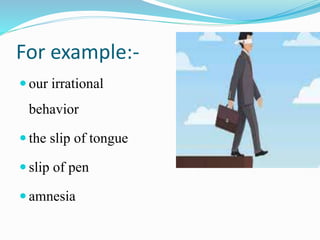
For example:-
 our irrational
behavior
 the slip of tongue
 slip of pen
 amnesia
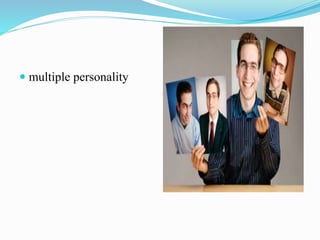
 multiple personality
 somnambulism
Motives and behavior
 Motives act as the immediate force to energize, direct, sustain
and stop a behavior.
 Motives are the powerful tool for explaining behavior.
 Motives help us to make predictions about behavior in many
different situations.
 Motives are inner forces that control an individual’s behavior in
a subtle manner.
Nurses responsibility
 A nurse has to remember that all these motives are at work in the
life of her patients, colleagues and in her own daily relationships.
 She has to note the manifestation of these motives in her patient
carefully, because some of them adopt peculiar means to satisfy
them.
SUMMARY
 Introduction of motives
 Definition of motive
 Meaning of motives
 Meaning Behavior
 Meaning of Motivation
 Biological Motives and Homeostasis
 Classification of Motives
 Motives and behavior
 Nurses responsibility
CONCLUSION
 Motives, in the broad sense of the word, includes needs,
basic drives, interests, likes and dislikes, desires and
attitudes because all these move us to some action or the
other.
ASSIGNMENT
 Definition of motives, list of the type of motives?
 Why nurses should have to learn about motives ?
Motives

Motives

  • 1.
    PRESENTED BY – PRAJNYAELINAR DIGAL M .SC (N) Tutor SNC
  • 3.
    Introduction:  A motiveetymologically means that ‘which moves’.  A motive may be considered as an energetic force or tendency (learned or innate) working within the individual to inspire him to act for the satisfaction of his basic need or attainment of some specific purpose
  • 4.
    Definition of motive: A need gives rise to one or more motives. A motives is a rather specific process, which has been learned. It is directed towards a goal. - CAROL-1969
  • 5.
    Meaning:  A motiveis something that causes us to act or behave in order to reach a goal or desired endpoint. It comes from the Latin word that means 'moving'. A motive is the reason WHY you do something.
  • 6.
    For example:  Amotive for exercise is better health and weight loss.
  • 7.
     For example,In criminology a motive is the reason an individual committed a crime or offense. For instance, the motive for someone who robbed a store is most likely that they needed money.
  • 8.
    Behavior:  Anything aperson or animal does that can be observed in some way.  Behavior consists of all our physical responses, habits, skills, all our organic responses, feelings, emotions and tensions, & all our intellectual responses, perceiving, thinking, and reasoning.
  • 10.
    Motivation:  The factorsthat direct and energize the behavior of humans and other organisms.
  • 11.
  • 12.
    Biological Motives and Homeostasis: Biological motives are called as physiological motives.  These motives are essential for the survival of the organism.  Such motives are triggered when there is imbalancement in the body.  The body always tends to maintain a state of equilibrium called “Homeostasis”- in many of its internal physiological processes.
  • 13.
    Cont….  This balanceis very essential for the normal life.  Homeostasis helps to maintain internal physiological processes at optimal levels.  The nutritional level, fluid level, temperature level, etc., are maintained at certain optimal level or homeostasis levels.  When there is some variation in these levels the individual is motivated for restoring the state of equilibrium.
  • 14.
  • 16.
    PHYSIOLOGICAL MOTIVES HUNGER MOTIVE Wedevelop hunger motive in order to maintain homeostasis. This is indicated by contraction of stomach muscles causing some pain or discomfort called hunger pangs.
  • 17.
    THIRST MOTIVE  Whenthe water level in the body decreases we develop motive to drink water.  We need to drink sufficient quantity of water to satiate our thirst.
  • 18.
    Need for oxygen: Our body needs oxygen continuously  Lack of oxygen supply may lead to serious consequences like damage to brain or death.
  • 19.
    Motive for regulationof body temperature  Maintenance of normal body temperature (98.6°F or 37.0°C) is necessary  For example, opening of windows, put on fans, take cool drinks, remove clothes, etc., when the temperature increases to above normal level; and closing doors and windows, wear sweaters, take hot beverages when temperature falls down. In this way we try to regulate the body temperature.
  • 20.
    Need for sleep Sleep is an essential process for normal functioning of body and mind  It is observed that there is excess accumulation of a toxin called ‘Lactic acid’ when tired.  Sleep deprivation also leads to psychological problems
  • 21.
    need for activity: There seems to be an organic need for activity after rest and sleep  In a well rested person there is a positive zeal for activity.
  • 22.
    Need for avoidanceof pain:  No organism can continue to bear pain  For example, when we are under hot sun we go to shade. When something is pinching we avoid it.
  • 23.
    Drive for eliminationof waste  Our body cannot bear anything excess or anything waste.  We experience discomfort until these wastes are eliminated.
  • 24.
    Sex motive  Thisis a biological motive, arises in the organism as a result of secretion of sex hormones- like androgens and estrogens.  It is essential for the survival of the species.  The society and the law exercise certain codes of conduct.
  • 25.
    Maternal drive:  Thisis an instinct or an inborn tendency.  Every normal woman aspires to become a mother.  This is a most powerful drive.
  • 26.
    Social Motives  socialmotives are specific only to human beings. These are called social motives, because they are learnt in social groups as a result of interaction with the family and society.
  • 27.
    Social Motives  Achievementmotive Aggressive motive:  Power motive: Acquisitive motive:  Curiosity motive: Gregariousness: Social approval Maternal or protective motive Creative motive Security
  • 28.
    Achievement motive  Achievementmotivation refers to a desire to achieve some goal.  This motive is developed in the individual who has seen some people in the society attaining high success, reaching high positions and standards.
  • 29.
    Aggressive motive:  Itis a motive to react aggressively when faced frustrations.  Frustration may occur when a person is obstructed from reaching a goal or when he is insulted by others.
  • 30.
    Power motive:  Peoplewith power motive will be concerned with having an impact on others.  They try to influence people by their reputation. They expect people to bow their heads and obey their instructions.
  • 31.
    Acquisitive motive:  Thismotive directs the individual for the acquisition of material property. It may be money or other property.
  • 32.
    Curiosity motive:  Thisis otherwise called stimulus and exploration motive.  Curiosity is a tendency to explore and know new things.
  • 33.
    Gregariousness:  This isalso known as affiliation need.  The individual will be interested in establishing, maintaining and repairing friendly relationships and will be interested in participating in group activities.
  • 34.
    Social approval  Wetry our best to avoid doing anything that may evoke social disapproval.  We often show an almost compulsive tendency to conform to the norms set by our social group.
  • 35.
    Maternal or protectivemotive  which makes us care for, help and protect those who are helpless and in difficulty.
  • 36.
    Security  It isvery important .we want to feel secure economically and emotionally.  An individual needs to feel secure in the affection of another or believe that he is in favor with his parents, relatives, neighbors, teachers and class-fellows or associates.
  • 37.
  • 38.
    Unconscious motivation  Thesemotives or desires which are repressed by our conscious remain in our unconscious and will be influencing our behavior.
  • 39.
    For example:-  ourirrational behavior  the slip of tongue  slip of pen  amnesia
  • 40.
  • 41.
  • 42.
    Motives and behavior Motives act as the immediate force to energize, direct, sustain and stop a behavior.  Motives are the powerful tool for explaining behavior.  Motives help us to make predictions about behavior in many different situations.  Motives are inner forces that control an individual’s behavior in a subtle manner.
  • 43.
    Nurses responsibility  Anurse has to remember that all these motives are at work in the life of her patients, colleagues and in her own daily relationships.  She has to note the manifestation of these motives in her patient carefully, because some of them adopt peculiar means to satisfy them.
  • 44.
    SUMMARY  Introduction ofmotives  Definition of motive  Meaning of motives  Meaning Behavior  Meaning of Motivation  Biological Motives and Homeostasis  Classification of Motives  Motives and behavior  Nurses responsibility
  • 45.
    CONCLUSION  Motives, inthe broad sense of the word, includes needs, basic drives, interests, likes and dislikes, desires and attitudes because all these move us to some action or the other.
  • 46.
    ASSIGNMENT  Definition ofmotives, list of the type of motives?  Why nurses should have to learn about motives ?